How to Hire your first Employees after the Pre-Seed
This is a YouTube video titled "How to Hire your first Employees after the Pre-Seed" created in July 2025. It features Martin G. Tobias delivering a detailed talk and Q&A session about hiring strategies for early-stage B2B software startups after raising a pre-seed round. Martin shares his extensive experience investing in over 300 pre-seed companies, discussing priorities for early hires, common mistakes, and personal anecdotes. The content includes interaction with multiple participants asking questions about leveraging contractors, hiring senior versus junior staff, and balancing team building with fundraising.
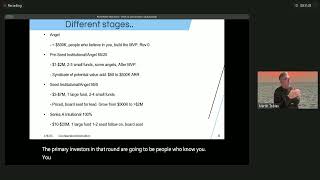
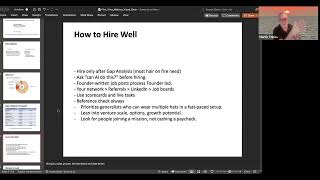
Here. Thanks for joining me. We have four or five people. We had about 50 that said they joined, but it's a Wednesday night. Good to see everybody again. And I'm gonna just spend a few minutes yammering on about my experience hiring your first couple of people in Pre Seed. I'm going to focus on B2B software, pre seed. I'll talk for 10 or 15 minutes and then I'm happy to take questions about either Pre Seed hiring or seed or series A or any kind of hiring. I was inspired to do this because basically, you know, usually I'm funding 1, 2, 3 guys or girls and a dog. And one of their first questions after they raised financing is who am I going to hire and how do I hire and who do I hire first? And so I've invested in over, you know, 300 pre seed B2B companies and I thought I'd share a little bit about what I learned and what's important. So. So let's get to it. Why does hiring matter? Well, hiring matters for two reasons. One, you know, for what hiring does to your company and then secondly, how it helps you achieve what you need to do during the pre seed. Those early hires are really force multipliers. The first five people that you hire are going to shape the next 50 people that come into the company. And those mistakes, if you make them early, can, can be very costly. And those early hires will really define the culture and the execution of the company. So let's look at what you need to do in Pre Seed. You need to do basically five things. You know, you need to build the product, you need to raise some money, you need to sell the product, you need to support customers and you have to operate the business. And I'll go through what I think the founders need to do versus what can be hired or where your greatest leverage is. I posted on Twitter just before this, if you go follow, there's five or six articles that I read in preparation for this and all those resources I put on my Twitter feed. But one of the really helpful ones was Lenny Chowski. I probably misstating his name and he actually surveyed about 40 startups that are all venture funded and asked him the question what was your first, second, third, fourth, fifth, sixth and you know, up to 10th employee. And he has a grid in his post that I linked there which shows this companies in the first 10 employees. And when you analyze those sort of 300 hires, what you find is that 70% of the first employees that people hire after they've received financing is an engineer, as you would expect. And then it goes into customer service and depending on what you're building, maybe some designers and data scientists and stuff like that. But when you see the fact that most people hire an engineer first, that's because the primary job in pre seed is to get your product built. And that typically takes engineers, especially when we're talking about B2B. So I took everything I read about this topic and I put them into a grid in terms of priority, of what groups I would hire and in what order and what you see here. This is a little bit longer list of things that you need to do in pre seed. You need to raise money, you need to hire engineers to build the product. You need to have salespeople, customer set, product managers, subject matter, expertise, things like that. The way that I see well started B2B software company is that when you're founding, when you pull the company together, you do an angel round. You pull together a little bit of funding to build your mvp. The founders are basically doing everything. Then once you receive a pre seed round, and I define pre seed as after you've gotten an MVP, you've gotten a one to two million dollars round. I don't see where precede as that first hundred $200,000 to build your MVP or to pull your team together. That is what I call the angel or the founding ground. What I'm talking about is what do you do with that one to two million dollars after the two or three person team has done everything, then is it safe to hire people to get leverage for the founding team and in what order should we do that? Some of the things you should not hire at the pre seed and some of the things the founders need to keep doing, for example raising money, founders need to do that. Pre seed seed Series A founders need to be the primary money raisers. I've actually seen people try to hire like business development people or CFOs in a pre seed or a seed round to try to get them to talk to investors for future rounds. That never ever works. You will not be able to get any leverage in money raising by hiring people. So then what can you get leverage and in what order should you do it? Following up on the analysis that Lenny did, the number one place you should look to hire people is engineering. The number two I think is customer success. And why is that? Because it'll be easy to get people to try your product. It'll be hard to get them to stick with it. But what I have found is in pre seed the founders tend to still be the salespeople and I would rather you get leverage in customer success and answering tickets before you hire another salesperson and keep the founder doing founder led sales. But the third area I would hire after and I think this is a little counterintuitive, Maybe not all VCs would agree, but I would prefer if in pre seed you hired customer success people before you hired another salesperson because the founder can get the first hundred customers, but getting those customers to be successful on your product takes a lot of detailed follow up and a lot of time that the CEO is probably not going to have. The highest leverage a CEO can do is continue to sell and get leverage in customer success and engineering. After you've filled those out, I think then you can go in and hire product managers and maybe some subject matter expertise. If you don't come from the industry and then get into recruiting and operations in pre seed, you're never going to hire a CFO or a VP of sales and business development's still going to be done by the founders. I've seen people try to hire those senior people and I'll get into why that's a mistake. In pre seed. If you look at the first eight hires after you receive your pre seed round can vary depending on what you're building. But I would expect you to hire about 40% tech people, about 30% sales and about 20% in ops. And we can discuss why I think those are the right breakdowns. And then how do you hire? Well, the first thing you should do is only hire after you've done some sort of gap analysis, basically where what part of the company is falling apart part. And typically it's going to be engineering because you're going to have to build more than you can and it's going to be customer success. You should only hire after realizing that part of your company is breaking and that the founders can't do. In the last year that I've had all my founders start asking before they hire someone is can AI do this? And you've seen other companies like Shopify and others saying that same thing many times. The answer is before you hire someone is that AI could do it if it's a specific thing like marketing outreach or something like that. Another trick I've seen a lot of founders do is that the recruiting process to hire those eight people. Just like the fundraising process process, it definitely has to be founder led. I think the founders should write the job posts. I think the founders should do all of the first interviews and no one in Pre seed wants to be talking to a head of HR when they're joining a company. They want to hear from the missionary and join the mission. Your network is going to be the number one source of referrals and customers. I also recommend when you're hiring to always use scorecards and have live tasks for any job that you're doing. Ask somebody to do the task and give them a sample task. That is a better hiring screening than looking at somebody's resume. And I do recommend, even in Pre Seed that you always do reference checks. You don't want to hire the person that already has three jobs and is over employed. Also early, I would recommend that you prioritize a generalist who can wear multiple hats. And when you're talking to people, lean into the fact that you're venture funded. You've got options and the growth potential is there. This is something that people don't have at bigger companies. So the summary of how to do it well, look for people that are on a mission, not just trying to cash a paycheck. Now let's get into a couple of mistakes to avoid and my personal favorite where I have in fact failed hiring people in Pre Seed. The number one mistake I've heard is hiring for resume over conviction. And what that means is you look at somebody's resume and you're like, oh, they were at Google and Microsoft and faang and you know, they went to MIT and Stanford. You don't have high conviction that they're going to fit into the culture that you have or that they're bought into the mission that you're going to deploy. Leaning too much on a resume early, it's much more important to get cultural fit from a generalist than it is to get the absolute best, most qualified person from a specific job. I think a second mistake people make is delayed in firing decisions. You should hire fast and you should fire fast. If you know we give in almost all my companies, I recommend you give a 90 day period and a cliff on your options. The reason you do those kind of things is because if in 90 days the person's not working out, you want to be able to fire them and not waste any equity on them. Trying to squeeze round pegs into square holes is a big problem and you don't have the time in Pre seed for people that are not working out. I also if you're going to fire fast, you also need to keep the documentation going. Well, I think it's also a problem early to hire people that are only like you. What you want to do is hire people that can do things better than you. People who complement you, people who are good at things that you do not excel at. A good example of this is customer success. You know, a CEO might be very big picture. Customer success is a very detail oriented job and you want to hire people who love detail orientation. Don't hire the big picture thing to be customer success because they will not do a good job there. The other mistake is beware of startup tourists. The idea of working in a startup is really appealing to a lot of people, especially at big companies. And I've seen a lot of people say we want to try the startup thing. I have a story about that and it never works out. And also the number one mistake I see people is hiring senior people too soon. People that have worked at a big company, gotten a big salary and they've never worked at a pre seed startup. That's going to be very challenging. I think your first eight employees should all be people who have worked at a startup before at some capacity so they know what they're getting into. Now let me get into a couple of personal fails. Let me tell you four or five stories where I've had horror stories. In the early days. One of the companies I started was called Imperium Renewables biodiesel company in Seattle. I hired this guy, very senior guy, out of Microsoft. His first day on the job, he wanted to do the startup thing. He'd worked at big tech and he's like, oh, startup sounds like fun. The first day when he came in, he said, where's my secretary? And I said, what are you talking about? We're a startup. You don't have a secretary. And it was downhill from there. His expectation was that he would have all the corporate infrastructure around him that he had at Microsoft. He left within three months. I hired another guy, a programmer once when I was at Anderson Consulting. During the interview he was absolutely amazing. Rhodes scholar, won all these computer competitions, number one in his class at mit. Like just super brainiac. We hired him and we put him on bug fixing in a production environment. He was completely tilted. He said, this code is shit, everybody sucks. I could have written it better myself. I don't like fixing anybody else's code. He was so confident in his own abilities that he could not work with anybody else and could not work on anybody else's code. And we didn't hire him as a chief architect. We hired him as a programmer. And that's where you start his bug fixing. He went back back to academia and started teaching because he wanted control over all of his work and did not want to have to deal with anybody else's code because he was such a perfectionist. So he lasted about three months. Then when I was in la, I was running this company called Upgrade Labs and I hired this guy as a manager of one of my facilities. He's a super personable guy, like a guy you want to have a beer with. Super nice, super, super engaging, like everybody's best friend. It turned out that he was working three jobs. He submitted phony expense reports, we did not call his references, and he had been fired from his last job. And he actually had an SEC complaint for selling unregistered securities against him. He was basically a confidence man grifter who lied about his entire background and, and got jobs in industries that he didn't know what he was doing. But it was because he was such a nice guy he could convince anybody to hire him. We didn't do our background checks and we hired him because he was a nice guy and he ended up stealing a bunch of money from the company and we got in a lawsuit with him. Do your reference checks at that same company. We love employees that want to hustle. Hustlers are great employees. Unfortunately, if they're not hustling for your company and they're hustling on the side and they're just cashing your check to go do their own side hustle, that can be a problem. We were running a fitness facility and we had personal trainers there and we had two personal trainers who were trying to set up their own personal training business on the side. We found that they were posting Instagram reels from our facility on our computer during work hours and trying to drum up business and selling our customers their own side hustle business to go revenue directly to them and cutting out us from while we were paying them on the clock. So I think you should encourage people to do side hustles. But if, if they, if you realize that they are side hustling them themselves out of your business, this is not a good thing. Another one in the area of big companies, people coming in and not being successful in startups. When I was at Imperium Renewables, the biodiesel company, I hired a guy who was the VP of Sal GE for wind turbines. Their number one salesperson had sold to all the big electrical utilities and we wanted to sell to electrical utilities. So I hired him. But the problem was just like the guy who said, where's my secretary? He was used to having a crapload of corporate infrastructure, having a plane, having this, having that. And when he had none of that, he was just not very successful. And what we found out was that what got him all of those meetings was the fact that he had a GE business card. And when he had an Imperium Renewables business card, the people wouldn't take his calls. So he didn't have a lot of authentic connections. He was riding on the back of his prior company's business card. And that was hard for us to find out before we hired him. But again, he lasted about three months. So I'm incredibly cautious of hiring people with Big code credentials. If you don't validate that, they can bring those credentials with them. The last, you know, hiring fail that I talk about, I could probably talk about them all day, is I one time hired a corporate counsel from a big law firm to be the corporate lawyer at the company. He had been our corporate lawyer for about three or four years. He'd been at the big company for big law company for 15 years. And he had seen all of his clients, you know, become billionaires and millionaires and so on. And he's like, I want to do the startup thing. But again, he comes there to be our corporate counsel. He doesn't have a secretary, he's got to get his own coffee. The culture shift was just too much. And he lasted six months and then went back to big law because it was too much work for him. So again, be very cautious about taking people who have no startup experience. As far as resources, I posted on Twitter all of these things. There's good reading from Lenny's newsletter and things on the first date, people, the 10 essentials for the top 10 hires is a really good article. Feel free to go read those if you want to talk more about that. In summary, I think in pre seed, every CEO should hire for the gaps they have in their actual business, what their hair on fire problems are, and for leverage, you cannot hire things that the core team has to do like business development and fundraising in the initial sales and prioritize product and sales for your first couple hires. In pre seed, focus on generalist over specialist. Leverage your network. That's where your best customers are going to come. Don't over hire, don't hire senior people too early and fire as quickly as you can. So those are pretty much all of the learnings I've had. I'm happy to take a few questions if anybody has on how to hire well or how not to screw up. So raise your Hand or just come off mute and I can take some questions now if anybody has any. Okay. Hey, Darren. I don't know how, if I can.
Thank you. Thanks for the presentation. I appreciate it. Great tips along the way and some of them sound familiar to me, so I appreciate that. I wondered what you think about. So I've been leveraging 1099 employees. So I am technically the only employee up to this point, but I've been leveraging like interns, 1099 employees to help me with sort of on the ground marketing. I actually did hire like a social media person just because I knew that that was an element that was going to be important and I just was not going to do it.
But that's a good thing to outsource. Yeah.
Yeah. So I think I'm in the stage where I am looking for probably the next. The, the next one or two real hires and I want them to be co founders and I am thinking about an engineer because I'm building on sort of a different platform that ultimately I want to get off of. But the marketing consultant, I guess you'd say is sort of the closest thing to a co founder that I have. And I wondered what your thoughts were about leveraging 1099 employees until. Till you get the real deals in the door.
I think 1099 employees are fine, especially things like marketing or social media specialist skills that are important but not strategic to your business. The question, when you're bootstrapping and building it yourself, you should just hire as many subcontractors as you can. But when you're building a company that has an asset that could potentially be sold to somebody else, they're going to want to know who the full time employees are. And the full time employees should be creating the highest value parts of the business. That is unlikely to be your social media feed. It is more likely to be your code, maybe your sales relationships. Right. That's why I said 40, 50% tech, 20, 30% sales. So one of the mistakes I see a lot of people in pre seed doing is they're like, well, I outsourced the development. I had a dev shop in India build everything. And then you're like, okay. I'm an investor and I say, okay, so you don't own the talent that built your product. That's not an asset of your company. So that's why you see 70% of people buying, you know, hiring engineers as their first people. It's a okay to build your MVP, you know, with an outsource. With a 1099 with whatever. But when you start talking about something that investors might want to invest in, they're going to want to know who are the core teams, who are the core people on the team and are those core people building the highest value, you know, IP in the company? And that tends to be technology and sales relationships.
All right, yes, it's very useful. I appreciate you doing this.
Two questions.
One, the question is you mentioned don't hire senior kind of people. When you say that, could you kind of quantify it in terms of like Microsoft examples? Because I assume you mean like principal and plus engineer.
I would not want, I would be hesitant to be the first stop for those people after big tech just because like a guy who's been at big tech, Microsoft as a principal engineer for 15 years, they've been reading about all their friends getting rich doing startups and they're like it's finally time. I've packed my 401k and I did everything I could at Microsoft so I'm going to frickin try it. I've seen that be unsuccessful, more than successful. But if you're the second or third startup that that 15 year Microsoft principal engineer tries and he knows what he's getting himself into and he knows what. Because the biggest problem is that is the culture shift between big company and startup. In big company you've got a lot of infrastructure around you, a lot of benefits and everything like that. You probably don't have to work that hard. Small company you've got to do a whole bunch of crazy things. You got to wear a lot of hats and you know, there may be people that come from big companies. You know, not all big companies are like that. The thing to watch for is for somebody that doesn't know what they're getting into in terms of the workload and the time commitment and you know, the amount of work that want to do. The other problem, you know that I found hiring senior people too early, like for example your co founder who might be a technical person. I prefer co founders that were maybe senior developers versus CTOs. Hiring a traditional CTO that has, that is basically just used to managing a hundred person developer team. It's been five years since they've written a line of code. This is not the right CTO for a pre seed company because whoever has that title CTO is most likely more like a senior developer. You probably want them in the code base. And a CTO from a big company has not been in the code base. He's been in management meetings for the last Five years. You see the difference?
Yes, yes. And then the reverse of it. How junior or how inexperienced would you consider for the early like if there's a really hungry new grad that should ace the interview and it's like, you know what, like we can make use of them. Is that like how would you.
I, I would. My second question, I think Hungary, you know, guys are great but I think you don't want that to be your first hire. Especially in engineering you want your first or second hire to be a 5 to 10 year mid level, fairly experienced person. That person can then manage a bunch of more junior, really hungry super young people. I think it's okay to have super young first time people in other non critical roles like social media or things like that. There's a lot less risk. But in engineering I would do the first 1, 2 or 3 to be at least 5 to 10 year experienced people. I wouldn't hire green people in engineering until five or ten down the road.
Thank you.
Okay, finish.
Hey, thanks for the talk Martin. I appreciate it. Just quick question, a little bit of context I guess. So I'm building this B2B SaaS company. I've been building it solo until now. It's been like six, seven months and the product's ready, I can take it to market. I've talked to customers, I'm confident I can get the customers. But now there's different ways I can go about the go to market and just taking the product to market that I'm considering. But the problem is I don't have a team and I'm pretty sure I can hire a team but then I need money to hire the team and I'm pre revenue right now. And if I talk about money, the first thing investors talk about is the team because they need to see a team. So I find myself in a unique loop where I'm kind of between hiring the team and raising money.
That is a unique problem. And frankly, you know, there's been research. I don't have a personal preference of whether the founder comes from a technical background or a business background to really understand the customer. The research shows that they're equally successful. You can start on technical and bring in people who understand the business or you can start with the business and bring in people understand technical. So the fact that you're a technical solo founder and you want to bring in some business people, that's fine. What you're talking about is there is a preference in venture to fund teams of two or three solo founders do raise at a much lower rate. And the reason is is because you go back to what you have to do in pre seed. You got to build the product, you got to raise money, you've got to sell the product, you got to support the product, you got to operate the company. Five different jobs. It's really hard for one person to do that job. So you definitely need VCs are going to want to see two or three people. So then the question if you are a solo founder and you've done the build product part, but you haven't done the raise money and sell it part yet, then those are the. I don't think you can outsource raise money. I think it's your product, your vision. So you're going to have to tell that story to investors. I think if I were you, I would focus on trying to find somebody to help as a co founder to sell the product. And I don't think that's just hiring a salesperson. That's finding somebody that you went to school with, somebody you know in your network who might want to run the business side of this. Go to market and see if you can get them as a co founder and you know, for sweat equity or something for three months to get your first customers. If you went out with a co founder who understood the business and had some go to market experience and you had started to generate five or ten thousand dollars of ARR for your product, your fundraising would be ten times easier.
That makes a ton of sense. Just want to clarify one thing. I am the business person. It's just that I can code and so I do want to do the sales myself. I also have some background product.
More from Martin






Product and User Experience, how to make a cure and not a vitamin with Greg Raiz