Where are We at in AI? Oct '26

Martin Tobias of Incisive Ventures argues AI will expand the $650B software market to $5-10T by automating services. Only 2% of knowledge workers use AI today, but reasoning models and agents are shifting from chat to task completion. His fund invests in vertical AI agents targeting specific workflows, with portfolio companies like Aura 300 and CivicIQ growing fast on minimal capital.
Questions this video answers
Tobias says moats will come from vertical‑specific data and specialized models that outperform general‑purpose models; early adopters will build their own models (e.g., Harvey) to create a data moat.
He explains a hybrid model: a fixed seat provides a baseline token allowance, with additional usage billed per token, mirroring traditional SaaS pricing while accommodating AI consumption.
Chapters
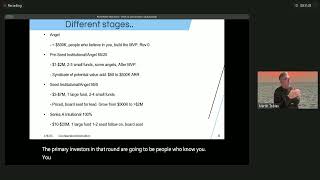
Hello, everybody. Happy Tuesday. Gonna admit a few more people here. Wow, a lot of people coming. Hope everybody's doing well. We got a ton of people coming, so I'm gonna wait for another, I don't know, 3 or 4 minutes to let people in, and then we'll get into it. I'm gonna talk for maybe 15 or 20 minutes, start with how, where I think we are at in AI, and then get to what we're doing about it at Incisive Ventures and how we're investing in this time. And at the end, we'll have maybe some time for questions as well. Well, it's been about 2 minutes. I'll let more people in as they get going. So why don't we get started? Hi, I'm Martin Tobias. I'm the managing partner of Incisive Ventures, and thanks for joining me today on Tuesday. I've had a ton of questions from founders and VCs and limited partners just saying, hey, you know, where are we in AI and what's your opinion of all of this? And so I thought I'd put together some slides about where I think we're at, how we're reacting, and see a lot of people here. Hey, Bill, nice to see you. And, you know, just go through where I think we're at, how we're reacting at Incisive Ventures, and at the end, maybe have time for some questions. I'll talk for maybe 20 minutes, and then we'll have some time for questions. So what's happening? Let me start with the headline first, and then I'll go into the details of why I believe this. I think as far as software, and I'm primarily a software investor, that I'm not gonna comment here any on robotics, space, biotech, anything I don't invest in. What I'm talking about is AI's implication on software and specifically B2B software. My contention is that this AI change is going to be the biggest change we've seen at software. It's going to be a tailwind. If you look today, currently application software is about a $650 billion a year business, about $300 billion in SaaS, about $350 billion of on-prem. And my contention is that I think that this is a opportunity to create a $5 to $10 trillion software market built by eating $10 to $20 trillion of services. And we'll get into all of that and why I believe that's the case in a minute. But one thing I wanted to do is to level set as to where we are and why this wave is happening faster than every than before. What's happening is that we are riding the AI wave on top of lots of things that came before it. For people that remember all the way back to the beginning of computers, you had semiconductors that made— making personal computers happen. And then you had personal systems, you had networks, and the internet connected everything. Then cloud came along and said, hey, you don't have to have onsite stuff, you can leverage cloud. And then mobile happened. And then in the 2020s, what happened was this beginning of AI, which is the NVIDIA, the chips that make AI data centers happen, and then the models that became truly useful about 3 years ago. My contention is that starting in another 3 or 4 years, we're gonna get into the place where AI applications can eat labor and replace services across all sorts of categories. And we're really, even though we're 3 years into this AI boom, thing. We're really just in the absolute beginning of AI being adopted by knowledge workers. And one of the things you need to realize in this wave of AI, every technology wave that comes through gets— one of the ways to measure it is how long does that technology wave take to get to 100 million users? And if you look in the past, things like the telephone took 75 years. But even more recently, things like the mobile phone took 16 years. But then things got faster— the web, Facebook, Instagram. But what has happened with AI— ChatGPT was the absolute fastest thing to 100 million users ever. It was 2 months. So what you're seeing over time is as you are building technology waves on top of each other, the adoption of these things happen faster, which is, I think, an interesting opportunity. It makes it harder to invest, but it's an interesting opportunity. The next thing I want to talk about is how to separate a computational innovation, which I believe AI is, from a communication innovation, which some of the prior ones were. So we talked about the telephone and networks and internet and cloud. Internet and cloud, those were changes in architecture of how people communicated with each other or how computers communicated with each other. It was, it was not fundamentally a computational innovation which changed the pace at which computers could do their work. But the calculator was silicon and the PC was, and that's what AI is. And I'll explain that a little bit better. Basically, AI is a computational revolution, not a communication revolution. It means that, that, that, that now computers can compute answers to things faster. It's not just about, you know, the social media wave, which is connecting us to people that we you know, hadn't talked to for a while or something like that. And now let's talk about 3 things that have happened. When I say the floor keeps moving faster and the fact that ChatGPT, you know, got to 100 million users in 2 months, we have already seen 3 major shifts in how AI's capability in only the 3 years that we've seen ChatGPT. And these are general Generally, what they have been as as I have seen them in the beginning when ChatGPT came out in 2022, it was kind of basically like a smart friend with an encyclopedia. It had it was the smartest person you ever knew, and you could ask it questions. So what did we invest in there? Well, we invested in AI companies that fundamentally changed unit economics in a business B2B software. We did not invest in any of these wrappers that and that was kind of. A lot of the applications looked like just wrappers around a chatbot in 2022 and 2023. And then what happened, the next sort of step function, which happened faster than most people thought, just 2 years later in December of 2024, was these reasoning models. So instead of just being a smart friend, that your smart friend could now do chained reasoning and could go through multiple steps to get to an answer with more complex datasets. And that really, opened up a lot of interesting applications rather than just talking to your smart friend. You could have your smart friend, you know, reason over larger datasets. And so we started investing in, you know, 2024 in companies that were doing a lot more with unique data. And then the next major step function that happened in just the last 3 years of AI is in November of 2025 when the agentic era really took off. And what was different about the agentic era is not just you had a smartphone with an encyclopedia, a person that could deal with lots of datasets, but you have now a coworker who could actually complete tasks, full things in certain domain areas. And what really kicked it off was Claude Code and Opus 4.5 that gave your smart friend now tools, hands, eyes, arms, things like that, that could complete full tasks. And we're only like literally like 6 months into this agentic era, but you can already see the trajectory where, you know, these things can get capable very quickly, especially if you— you know, plan out the speed at which the other parts of AI have come. So your smart friend now became a coworker. And I love this slide. You know, people talk about, you know, cars and horses. In 1900, you had like lots of horses and the car had just been invented and there was like one car. And 13 years later, you have one horse and all cars. So my contention is in AI that the cars are here for sure, but we're kind of more like 1900. We're at the beginning. People still made faster horses. While you have the ability for lots of people to drive cars, they are not yet driving cars. The cars have arrived, but the diffusion is really missing. And that's what this slide is all about. The difference between what the world actually uses and what AI can do is getting bigger. And that diffusion gap between what the capabilities of the models are and the agents and what people actually use is the opportunity for all of the AI companies that we're investing in. And let me explain a little bit more some of those. Let's also level set as to where we are in terms of AI's diffusion into knowledge work. There are, according to Sequoia and a couple other people, approximately 1.5 billion knowledge workers. In the world, AI today has truly reached less than 2% of them. And if you look at what the use case is for all all of the vast majority of AI today, I'll get in a little bit to where the revenue comes from from OpenAI and Anthropic. It's basically software development, cloud code, and you know Google code and. ChatGPT code and stuff like that. So the last about there's about 30 million software developers, and approximately 1 million of them are super developers that are spending approximately 80% of all the tokens in AI today. So we have found an incredibly killer use case for applications for AI. It's called coding, but realize it is less than 2% of the total knowledge workers. So the opportunity is to diffuse AI into all of the other knowledge, 1.47 billion knowledge workers. The second thing to level set of where we are at in terms of access to AI, we today have approximately 4 gigawatts of total compute dedicated to AI. Some people say we in 2025, we might have added like 6 or 8 gigawatts. So maybe we're at a total of 10. But the reality is, that we are in a completely supply-constrained mode on every aspect of AI, compute capacity, NVIDIA chips, you know, power, data centers, everything. Now, I don't think we get relief in the supply side of AI until something like 2028. You guys have probably read there's been about $730 billion of bid Big tech CapEx announced this year and last year to build approximately 80 gigawatts of AI data centers by 2028. But as you see in the press, there's lots of people against data centers now. There's all sorts of regulatory problems. I doubt we get all 80 gigawatts of data centers by 2028. But I hope we get at least 2 or 3 times. But every projection I've read is that even if we get from 4 gigawatts today to say 20 gigawatts or 25 gigawatts, you're still in a supply-constrained environment for core AI capacity. And remember, this crazy demand over demand under supply has only been driven by 2% of knowledge workers adopting AI. And, and Here's some more details on that. If you look at the AI application revenue today, it's approximately $120 billion. That's all the revenue to Anthropic, xAI, OpenAI, and stuff like that. I'm not counting any of the AI revenue going to NVIDIA data centers. I'm just talking about revenue for the software providers in AI. That's approximately adding up the big labs, $120 billion this year in 2020. 95% of that is going to the frontier labs, and 95% of that is going to coding. The amount of money being spent today for legal review, you know, voice AI, every other use case for AI other than coding is a rounding error relative to the large labs. And what that means in my opinion, is that there's a huge opportunity in that 98% of knowledge workers that are not being monetized despite us having created some of the most fastest growing, highest margin businesses ever on the back of one business use case. So if you look at the size of the AI software revenue today of $120 billion, I think we're looking at an expansion of about 40x to about $5 trillion of app revenue in, you know, going after services. A16Z puts it at $5 trillion, David George. You know, you can look at it as a percentage of the services market. If AI captures 25% to 30% of the current $20 trillion services market, However you look at it, you know, whether you say that we're only at 2% penetration of knowledge workers today and you can add, you know, say we're going to get to 10% next year and 15% the year after that. However you slice it, as AI gets diffused into more categories of knowledge work, this is a multi-trillion-dollar opportunity for the application layer in AI, which is much bigger than just the labs because there's a lot of verticals. So now let's look at what the labs are doing and how it affects application layers. So the labs are right now in a huge price war for tokens. You see the price of tokens have gone down like 800% in the last 3 years. That's all good for people that are building at the application layer because it means better margin for people that are building vertical applications. Right now, the labs are, you know, going to the top Fortune 500 companies and trying to do custom integrations, which is fine for the Fortune 500 and fine for them. They're buying teams like you saw xAI buy Cursor to try to get, you know, catch up from behind. The labs are building horizontal apps. Anthropic published a report said here's the 10 most at-risk jobs for AI, number 1 being a programmer, number 2 being a customer service agent, number 3 being a sales rep. You're seeing the labs shipping applications that do those horizontal things. What they're not doing is they're not attacking the verticals. They're not going after pizza parlors or hair salons. And it's going to be a very long time before the labs get out of the Fortune 500 and the large horizontal verticals. So now let's go into the second part of this presentation, which is what does this mean for Incisive Ventures and for investors who want to invest in the application layer at this time? What I think this means is AI is the best friction destroyer that we've ever seen. If you— if I look back at the companies that I had invested in before, The best software companies basically removed friction at scale. And here were a few like DocuSign. Hey, signing something on your phone is way better than signing it with a PDF file and a fax machine and all of that stuff. Deel was a way better employer of record than the incumbent. And what's interesting with AI is that you're— and I'll get into some of my portfolio. It is because of the intelligence layer and the hosted capabilities able to remove friction in areas that you could not given the SaaS architecture or traditional software architectures, and I'll get into it. In February this year, there was a huge freakout. They called it Softwaremageddon, and like 50% of Salesforce's market cap was just— was taken off because everybody said, hey, It's software maggedon. AI is going to eat all of SaaS software and software is over as a business model. I said at the time, I don't think that's the case. I think it's the next chapter. It's an evolution. Certainly some of the traditional incumbents are going to fail. But I said exactly at the time, I don't think you should count Salesforce out. And if anyone saw Salesforce's most recent quarter, they basically told everybody to pound sand. They had $1.8 billion of agent force revenue. They did a partnership with Anthropic. Turns out AI is a tailwind. You still need a system of record, which is a CRM with multiple ways to update and get information in and out of it, including AI and the traditional SaaS architecture. So it turns out, I actually think AI ends up being a tailwind for software. It certainly will disrupt some software categories, but the smart SaaS companies like Salesforce are going to turn it in to a tailwind. What is going to be different, like if you look at in the past, you know, this, the, you, you basically, you know, software vendors went in and sold to the IT budget. What's happening now is that software vendors are going in and selling against the labor budget. If the IT budget for SaaS software is $300 billion, but the labor budget is $4.5 trillion, selling outcomes instead of per seats, selling to the operator of a business unit. This is why I think the opportunity is fundamentally different, because software is selling to a different buyer at a different price point. It's still software, but this is what's different and why traditional per seat Software sold top-down to the CIO, I do think has risks, but the new software is different. Here is the part where we are investing. Again, we're investing at the application layer. We don't invest in dev tools, models, cloud hosting, chips, or data centers. We're investing $500,000 to $750,000 into pre-seed companies. If you look at where we've been investing relative to where some of the things you read in the press and so on, In Fund 1, which I'm finishing investing this year, the average pre-seed company that I invested in, I invested at an $8.4 million valuation. If you compare that to the average pre-seed on Carta, that was about 50%, $6 million, $7 million less than the average. And it's definitely about 1/3 of the average seed. And you look at the series, so I'm investing very early. I am going to have a higher failure rate, but it is definitely the highest multiple place to invest. The other thing that's interesting is in Fund 1, of those 35 companies that I invested in at an $8.4 million valuation, 6 of them got to profitability with raising less than $2 million. So we are going into a time now where you don't have to raise a Series B, C, and D and, you know, $100 or $200 million. You're going to have a lot of very valuable B2B software companies that get created raising only a few million dollars. People forget that Microsoft raised a total of $1 million in venture capital prior to the IPO. So what does it mean to reduce friction? Here are some of the things that we look for: removing steps in a particular process, very close to the money, fast time to value. Most of my companies, you get an ROI in the first month. You get a founder that's really lived it. And what's different today is the distribution wedge. Whereas maybe 5 years ago, I would want a team that has a very strong CTO. Now, since it's so much cheaper and easier to build software, I really want a distribution wedge. And let's talk about some of our companies that we've invested in. Aura 300, building vertical market agents for hair salons. They got to ramen profitability, raising less than $300,000 in total fundraising. They're growing 30% month over month. This is a vertical, 180,000 hair salons in the United States. You know, Claude and ChatGPT are never going to get there, but there's custom integrations that have to be made. This company is growing very well. It's going to be very profitable on raising very little money. Another company I wanted to point out is CivicIQ. This is in the category of businesses where creating new databases using AI that would never— were created before. So they have AI agents that listen to public markets Zoom calls, read PDF files, and create a structured database of the $1.2 trillion of local government spending and allow people to search and find contracting opportunities. This AI infrastructure allowed them to create this database, which never basically existed before, and created at a cost that you could afford. This company is growing 30% month over month, has only raised a seed, will likely get to Series B metrics before they have to raise again. Another company is doing very well is ImproveOnHealth. They raised only $6 million pre-seed and seed together. They are doing $13 million of revenue this year. This is a company that was able to skip the A and go straight to the B because they were so capital efficient. And we're seeing that in our portfolio a couple of times where companies can get so far with raising less money that they get to skip rounds. And the risk that we're watching You know, labs are going direct, but we're going into verticals that they don't do. Model providers are moving up the stack, but we're staying in verticals that are farther away from what they're doing. One of the things that happens a lot in these bubble scenarios is that valuation gets very frothy. We're staying focused on companies that are around $10 million valuation. It means we're going to miss some companies at a $40 million pre-product. But I think our discipline is going to end up being better for our LPs at the end of the day. So the summary of everything is what's happening in AI, costs are down, capabilities are up, change is accelerating. I think we are only about 2% diffused of AI into the knowledge work that needs to happen. And it's going to take us 5 to 10 years to really get that diffusion going. And it's going to take a lot of specialized companies in a lot of verticals to get that diffusion. And all of that diffusion is going to benefit from the competition at the model layer, making this intelligence even more available to everybody. So I think that's the end of my prepared comments, but if anybody has any questions or anything, want to raise your hand, I'd be happy to take a few questions before we wrap up. Okay, let's see, how do I unmute you, Andrei? Hi.
Hi, Martin. Thanks for doing these again. Like, quick question, 2 questions for you, if you don't mind. One, Where's the moat? Because, right, so if you look at what Anthropic and OpenAI has been doing, they've been waiting for companies to build up a massive ARR and then they just say, okay, fine, we'll release that product. Like legal, for example. Harvey went to $100 million. Anthropic and Claude said, okay, we'll offer legal services. Where's the moat? And the second question, how do the AI SaaS companies maintain margins? Because a lot of AI SaaS is kind of a bit upside down because of tokenomics. They're a little— So Those 2 questions.
Okay, sure. The first is, I wouldn't count Harvey out. Harvey did exactly what Cursor did, is start on the models and then build your own model. And then your own specialized model ends up being better than the generalized models. That's certainly what Cursor did. That was their bet. They ended up getting bought by somebody who really fucking needed it, which was Elon. I don't know that that's going to work in every scenario. But if you look at legal, I think that's exactly what's going to happen. The guy, the early person starts, they use the general models very quickly, they build their own specialized model. And then their moat is going to be that we understand this vertical better than the generalized models do. And I think that there is going to be some traction there. The question is then, how much better is it than the generalized model? And how much more expensive is Harvey's model than the generalized models. And then you start to get into all this, you know, arguing. But I think that, you know, there'll be different layers in the market. You know, the big— in legal, for example, the big high-service companies will probably stick with Harvey because they want the absolute best, most intelligent thing they can. SMBs, are they going to be okay with legal included in their monthly subscription to Claude?
Probably.
So I think there'll be a bifurcation. But what the companies that have already started and are close to the sun, like legal, need to do is what Harvey did as fast as possible, which is to try to get your own model, your own data moat, your own thing that is quantifiably better than a general-purpose model because at the end of the day, for specific industries, if you have more data, you're going to be able to do better than a general-purpose model if you have enough data and training. So that's what you need to do. Secondly, on the consumption versus standard economics, that is something that every software provider has to deal with. And the smart ones like I actually just backed up the truck and bought a crapload of Figma about 6 months ago because I think Figma got overwhacked. But they had the same problem. They're like, okay, Figma's a fixed price thing. How are they going to do with AR? Are they going to get replaced? Because Claude has Claude Design and that's going to get replaced in like 5 seconds. My bet was that Claude Design was going to be not as good and the workflow and the people used to using the UI for Figma was all going to be— it was going to be a moat for them. It turned out to be true. But then the question is, how do they convert their fixed-price people into marginal-price people? So what they did is they said, okay, with your fixed monthly seat, you get X number of tokens, and then they have consumption on top of that. So all of those software guys are gonna— that's the model they have to do, which is to say, as a part of your standard SaaS thing, you get X amount of intelligence. And then if you consume more, then you pay a per-use fee. And almost every SaaS vendor has started to do that. I think people are used to that. They're used to the idea that, hey, if I use more of this intelligence or these new features, that I owe more. And that's fine. And that's how the SaaS guys will evolve to this, to a hybrid model. What I'm seeing for AI-native people that start from the beginning, some of them are skipping the whole per-seat model price at all. Like, for example, I have a company called Desk.us, which is selling a transaction coordinator for residential real estate people. That residential real estate transaction coordinator is a fixed price today, about $500 per transaction that they pay to a human to do the work. What they did is they said, we're going to do that work for $100. We're going to do it with AI agents. So it's 80% cheaper. And they never ever went with the per seat, per month, per model. They just went straight to worker, you know, completed work.
Pricing.
Now, what they hope to do over time is to add more completed work pricing, but then move into a per-seat model for turning all that stuff into a system of record over time. So I actually think AI companies can go both ways on that. All right. If anybody else has any questions, just raise your hand and We'll take a few more. Oh, hey, Raul.
Yes. Are you investing in the electronics space, creating electronics?
Creating electronics hardware? No, I'm not. I'm a B2B software investor. If you use my softwareinvestormatch.pro and put your deck up there, you'll find some people that specialize in that. I'm just not a great hardware or electronics guy.
Okay, okay. Yeah, because our customers are actually software people that want to produce a complete system, yet they don't want to deal with the hardware. So I call our offering as software that makes hardware.
Yeah. The software is going to be really good at making hardware. It's not the kind of software I would invest in at this time.
Okay, perfect.
Thank you.
Yeah, thank you.
All right. Well, if we have any more questions, I'll take— I have time for maybe 1 or 2 more. Otherwise, I will Let everybody go. Thank you, everyone, and I will see you on Twitter, hopefully, and good luck with whatever you're building.
More from Martin





Product and User Experience, how to make a cure and not a vitamin with Greg Raiz