How to Pick your first Angel or Pre-Seed investors
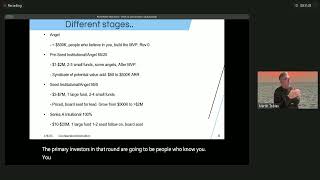
Martin G. Tobias, a pre-seed VC and ex-operator, explains how to pick your first investors in 2025. Angels write under $500k for ideas or MVPs; institutional pre-seed VCs typically invest $1–2M. Treat investors as strategic partners for business development and hiring, avoid those demanding advisor options or low-diligence momentum plays, and prioritize those who can introduce follow-on investors.
Chapters
Maybe we can just get to it. Let me see. Make sure everybody mutes here. Yeah. Admit a few more people. Let me get started. I have a few slides and Hi, I'm Martin and I'm a oop. Gotta keep admitting people. I'm a pre seed VC. I made about. I do B2B software. I define pre seed as you've got an MVP in the market, you're trying to get your initial product market fit. I've invested in about 80 such companies in the last five years. Six of them are unicorns. I've deployed about 30, 40 million dollars. Before that I was a three times venture backed CEO. I took two companies public and I raised about 500 million dollars for myself. I'm an ex Microsoft guy and so what I'd like to do is start with some observations on the venture capital community. I'll give a little detail in these. First of all, I think right now I've been investing for about 25 or 30 years. I think right now is the best time to invest in early stage B2B software. In my LifeT technology continues to be inflationary. AI is in its first wave. And then I'm going to go into some considerations for founders that I've seen of how to pick your first investor. Let me start with this slide on why I think it's the best time to Let me just mute a few more people here to invest. Whoops. And this is the last couple cycles that we've seen. The tooth bubble, the 2008 and the green line is what valuations have been. And what is that in 2025, despite people thinking there is a bubble in AI valuations on a relative basis, valuations for venture capital companies are not as inflated as they were in the last two bubbles. So what that means is that it's a good time for investors to invest. In my opinion. I still think we're at the beginning of the change is going to become brought by AI. Those first two waves. The first wave in 2000 was the first Internet creation of value and the second was social media. And this is the third major technology wave which is going to be driving a lot of innovation which is AI. And I think we're still at the very much beginning of it. This is an interesting slide. It only went to 2015, but when I started my first company in about 97, it cost about $5 million to create what was called an Internet company at the time. You had to buy your own servers, you had to pay people a lot of money. The cost of starting what's called an Internet tech startup has gone down every year for the last 20 years. It was $5,000 in 2015. Today it's maybe a couple hundred dollars. And what we're seeing, I think I've tweeted about this a few times, is that there are many companies that can be started with raising less than a million dollars. What a lot of people don't know, Microsoft received one round of venture capital financing prior to its IPO. It's $1 million. If you were that venture capital investor, you were a very lucky investor. But the reality is it's cheaper today to start a company than it ever has been. So it means you need to raise less money, and you can get further with whatever money you do raise. And the reason I say AI is in the first inning here is I think the adoption of AI is going to go very similar to what happened with the cloud. And this is a chart of what happened with the cloud. If you see, starting in 2010, people started to invest in data centers and hardware to build out the cloud. And it wasn't for another maybe seven or eight years that people started to build cloud infrastructure services and SaaS software companies on top of that hardware cloud infrastructure. And now this doesn't go into 2025, but SaaS software is three times bigger than data center software today. The SaaS software built on top of the cloud infrastructure is three times larger than the cloud infrastructure itself. And in AI, we are in that first two or three years of the hardware build out. If you looked at all of the AI spending today, Nvidia gets roughly 80% of all the money. And that's because we're spending money building out core AI infrastructure. If you roll forward five to seven years, I think you'll see the AI applications that are solving business problems being a much larger percent. And actually, at the end of the day, AI applications, I think, will be a 3 to 8 times larger opportunity than the AI core AI data center market, which is what 95% of the market is today. That's what makes me confident to say that I think we're in the very first innings of AI, which is why I'm very excited to invest in a lot of these AI application software companies. So now let's go into some considerations for founders. Yeah, sorry to interrupt. If you're sharing your screen, we don't see. I don't see it. I'm not sure if others can. Oh, I don't. Okay, I. I can see it fine. Yeah. Okay.
You have to swipe I think you can swipe to the next view and then it'll show you the.
The slides. I'm sharing the slides. Yeah. Maybe just mess around with your slack or your. All right, sounds good. Yeah. Some considerations for founders and I'll go through slides on each one of those. First of all, whatever money you raise, it's not just capital. And I'm going to talk a little bit about the difference between angel and pre seed versus Series A and what you want to get out of those different investors. I'm going to talk about how to get noticed by outbound. One statistic that I read is something like 85% of tier 1 VC firms at the A discover their companies via outbound. And so they have analysts that are tracking product hunt and stuff like that. And so it's not inbound or warm introductions. You have to do things that are going to get your startup noticed by people. So that's particularly interesting in the Series A. We do a lot of outbound here at Incisive Ventures for people that are in stealth, founders and stuff like that. So I'll talk about how to get noticed by VCs who have an outbound strategy. I'll talk about a few things to watch out for in early investors, things that you don't want to take in your money. I'll talk about the incisive process and then quickly two case studies of companies that I invested in, how the CEOs put together their pre seed round and what their considerations were. First of all, it's not just capital, all capital. While all capital spends the same. You can be strategic. I want to talk about creating. One of the things you can do is create a large syndicate of champions. I'm an investor in a consumer company called Element lmnt. It's a stick packs for electrolytes and they've raised from about 5,000 shareholders, about 4,000 of them being their customers, about a thousand of them being influencers. They've been a profitable company for the entire time they've been around after the first three months. They've never needed any of their investment capital, but they used their investors as champions. They did a crowdfunding campaign and people invested like a hundred dollars and they were their customers. Those people who invested $100 felt like owners and never sold their and never canceled their subscriptions. So that's one additional thing you might want to consider is how do you make your investors champions of your product or to help you get customers? So things to look for from investors is business development opportunities. Does this investor invest in other companies that are related to what you're doing. Did they used to work at a company where you might have where there might be business development opportunities for your company? Look at what the record is for that investor in follow on financing. One of the unfortunate things with a lot of angel investors is that they typically write a 25 or $50,000 check but they don't have reserves and they don't know a lot of series A investors. To help you get follow on financing. Professional pre seed managers like me have regular relationships with larger VC funds and can really help with follow on financing introductions. That's a consideration that you might want to ask your investors for is who else do you know who can give me financing later? Another thing a lot of investors can help with is hiring. They might help you find a CTO or something like that. Product design and development, strategic sales and distribution tricks. There's a lot of VCs out there now that are former operators like myself and they may have done some distribution deals or help you figure out channel partnerships. There's another thing that some investors could bring to you which is vendors. For example, when I invest in a company I've got a whole list of software discounts you can get on Notion and Salesforce. I have the email addresses of the people that run the cloud credits at AWS and Google. They actually give venture capitalists more cloud credits than they do on their standard website. If you are part invested in from a company like me that has access to those premium cloud credit programs, you can actually get more credits than you can get just by applying on their website. And another thing to look for is is help with governance. For example, one company that I looked at last in December, they had a three person board and it was all the founders and I recommended to them that they change it to one independent director, one investor and the CEO. That's the standard governance structure. They decided not to do it and what happened was their venture round fell apart and they did not receive any investors because they had a non standard governance structure that did not work for venture capitalists. Investors who have done a lot of investing might be able to help you set up your board and things like that in good governance ways. So those are some of the things that you should look for in addition to capital. I also put on the side there questions. As a founder you should ask your investors. You should ask investors for references. I actually love it when CEOs ask me to talk to other CEOs. Did I have found that I have Funded, you should do your diligence. It's not just the money, it's who's this person that's going to be with you for the next 10 years of your startup. You should review the portfolio of the company, of the investor and if they have it online or something and see if there are, you know, related companies that you might want to meet. And you should ask about the decision process. One of the big errors I see a lot of first time founders doing is talking to junior people at big firms who can't make a decision and thinking that they're going to get a term sheet. Always ask investors what the decision process is, who has to be involved and ask them for references. And let's talk about capital at different stages. I define three stages before series A. Some investors will conflate angel and pre seed, but in my mind you are raising an angel round. If you're raising less than $500,000 and you're going to build the MVP and you've basically got zero revenue, the primary investors in that round are going to be people who know you, people who you have met somehow, your parents or uncles, those kind of things. The next round is a pre seed institutional round. And that's where companies with VCs like me come in. People with 10, 20, $30 million funds that are right writing two, three, $400,000 checks. That's usually a one to two million dollars round. It includes funds, maybe some angels. And it's typically after you've written the MVP. Professional VCs like me tend to not want to invest in an idea. Only the kind of when you see somebody raise a $10 million first round, that's from big investors, that's typically a third or fourth time founder who those investors already know. If you're a first time founder, it's typically angel to build the MVP to get the ARR from 50 to $500,000. Then a 2 to 3 million dollars seed round, usually led by one large investor, maybe two or three small funds, and grow revenue from 500,000 to 2 million. And then series A is typically an all institutional round, very few angels, and it's a 10 to 20 million dollars round. And this is all in B2B software. So those are how I see the different rounds. I'm going to talk specifically about how to find angel and pre seed investors. And I already mentioned a few things of what people should look for. One thing I think founders should do if they're trying to get noticed by angels or pre seed investors is to do Things that might get noticed by you Went on mute Martin. Better unmute myself then. Thank you. So the majority of Tier 1 Series A rounds are discovered by Outbound. So that means when you're in pre seed and seed stage you have to start doing things that are going to get you noticed by Outbound. And a lot of pre seed funds like me are doing Outbound as well. So we're following influencers on on on Twitter and stuff like that. But we're also looking at trending things on product Hunt or GitHub. If you're doing a particularly technical thing. I I think every B2B software company should launch on Product Hunt, should do a campaign. If you're doing an open source thing, you should be on GitHub, winning a pitch competition on Accelerator. If you're in YC or Alchemist or any of those or participating in pitch competitions, a lot of pre seed funds I participate in Alchemist, I could participate in yc. I look at those things. Those things do matter, do matter. And if you beat one pre seed VC that you happen to ask them for other pre seed VCs that they can introduce you to because typically if you're raising a pre seed round of a million dollars and somebody wants to write $250,000 check, they're going to want to introduce you to their friends to fill out the round when big oh I misspelled that gig. Customers win big customers in the press. I have all sorts of notifications set up in Google alerts and stuff like that where I'm looking for press announcements of B2B software companies getting contracts with big names and things like that. Another thing to do is to try to get on a market map. If you're in a particular category and there's an analyst like at Gartner or somebody talking about your category, try to get on those market maps because that will get you noticed by investors as well. Another great thing to do is to build in public. If you are building a B2B software company type thing, just try to go on Twitter, go on Instagram, talk about your releases on a weekly basis. If you're in a particular vertical talk have an influence in that vertical post about you. I follow a lot of people that specialize in vertical market software and I look at the tools that they're using and if I see interesting ones that I look up to see if they are looking for investors. So those are some things you can do as a CEO to get noticed by Outbound. Let's talk about some things to Watch out for and I've been doing this for 30 years. I've invested in 250 companies and I've seen all sorts of bad behavior in early investors. So if you are talking to an early investor and they ask for some of these things, I think you should get your yellow flags out. The first thing is advisor options. I can't tell you how many companies I've seen that are like, yeah, I got this angel investor and he invested $25,000 and then he asked for $100,000 in options to be an advisor. As a professional investor, when I see those advisor options, that's basically a discount. And that tells me that the CEO was either really hard up for the money or wasn't a very experienced CEO. I tend to not want to see a lot of advisor options. So if you have investors asking for advisor options in addition to their capital, what they're asking for really is a discount and that's a bad signal for the next investors. The same with warrants. A lot of. I forget the accelerator that was in Tennessee that went bankrupt, but there have been a couple of accelerators that had pretty onerous warrant terms on them. Let's say they invest $500,000, but they get a warrant to buy $1 million of shares at a $10 million valuation. And that is a long term warrant. Sometimes it'll say it's a one year warrant, but then if you don't send monthly updates, it turns into an infinite warrant. I've seen a couple times where companies had infinite warrants at a fixed price. And if you're going to raise money in the future, that turns out to be a significant liability for future investors to wanting to invest in you. So I'd be very careful about issuing warrants, especially in an angel or pre seed round. Another thing I'd be concerned about is side letters other than a side letter which offers information rights. In a lot of times when you're doing a safe, the investor doesn't get information rights. But if you're writing a significant safe like I do a 250 or $500,000, I might want information rights, just basically monthly updates. But a side letter that says anything else like a right of first refusal or anything else like that. I would be concerned about side letters that had special terms, warrants, right of first refus, things like that. I would be very cautious of investors that ask for side letters that are anything other than information rights. Another thing that I would watch out for is investors that do very little diligence a Lot of founders maybe don't like all of the diligence that some investors ask for. But when investors ask for a lot of diligence, they want to talk to customers, they want to see your sales list, they want to see your pipeline, they want to, you know, dig into the details. They want to match your bank statements against your balance sheet. What that means is that they're really interested and they're really drilling in to try to understand your business. If somebody says they'll write you a check, you know, in two days with doing no diligence, frankly I think that's a problem. You may say I want the money, but I found that I found those kind of investors to create more problems later. So that's. Oh, I misspelled fair again there. So that's what I mean by fair weather investors. The trick in early investors is to get people who are going to be with you for the long term and help you build customer relationships and hire people and build your business. If they think they're jumping on a steaming train or a fast running train and anything goes wrong in your business, they're going to be the first ones to leave your support. And I don't think that I've seen more investors getting skittish than because they're there. They were fundamentally momentum investors and early. You don't want momentum investors. They're going to down the road create more problems for you. What you want is people that are aligned with your mission, that want to build what you want to build, that want to see what you're building in the world. That's why I recommend references on investors. So let me describe the incisive process and just a few more slides and then happy to take people's questions. At incisive, we invest in B2B pre seed where our network can provide a lot of leverage. So we don't invest in crypto hardware, we don't invest in consumer ideas. We do include potential customers and diligence. So we will ask you for customer references because we want to see that there are customers. We do not invest prior to having customers we identify in our own network. At least three follow on investors that are identified before we will write you a check. And the reason I do that is if I'm putting a $250,000 check in a million dollar round and we're agreeing that in 12 months you'll get this amount of traction, what we're doing is funding you to get to the next level so then you can raise a seed or a series A and what I want to do is I want to know who those seed or series A people are going to be that I'm going to call when you're successful. So as part of my process I identify who I'm going to call when you're successful and I'll tell you who that is. We do have some software tools that we've written that CEOs can help do. Warm introductions for those follow ons. In my portfolio of my pre seed investments, approximately 74% of my pre seed investments have received follow on financing. If you look at PitchBook, only about 30% of pre seed financing companies have received follow on financing. Which means 70% of pre seed funded companies fail. But in my portfolio 74% succeed at least to the next round. And that's because we have some of these tools that help with fall on financing. Because I know three investors who I'll call if you're successful before that. And I offer regular one on ones with the CEO. So that's it. Let me talk about two companies that I funded in the last year and how they chose their first couple customers. First company is a company called Kurt Chisholm and he's at Lease Up. It's a vertical market software for commercial real estate brokers. And the number one investor there was Second Century Venture. So he had, he was raising $2 million, he had an oversubscribed round, he had a whole bunch of investors that were wanting to invest. And what he decided was that he wanted to take the lead from Second Century Venture because Second Century Ventures is the venture capital arm of the national association of Realtors. And what he was looking for from them was introductions to the national real estate companies because there were his customers. So he was optimizing for business development introductions from his lead investor. And he took us because we had experience doing vertical market software. And then he took Red Swan, which was another small VC like me, because they had invested in a similar commercial real estate company. So he optimized getting investors who had specific knowledge of the space that he was in. I didn't put on here also, but he had probably seven or eight angel investors who were all commercial real estate brokers themselves. So he really optimized for people who under who could make introductions to build his business. His business grew 300% last year and it's in large part because a lot of his investors were helping him sell his software. There's another company I invested in called Tembo Plus. This guy reached out to me cold on Twitter actually. And I Met him Victor Joseph, he was building a. Is building a API first digital banking middleware company in Africa. It's like plaid for Africa. And when he told me what he was building, I love API first companies and then he told me what he wanted he said I want a US investor like you who can help me raise money from follow on financing people in the US in the next round and I want fintech investors. So I introduced him to Rally Capital who is a fintech investor in Africa and Southeast Asia who I knew and I introduced him to Hustle Fund and I introduced him to Micro Traction which is a local Nigerian one. So he had a local VC Micro Traction he had a fintech VC Rally capital and he had two large US based pre seed investors Hustle Fund and me who could help him introduce him to series A US investors because he wanted to raise his series A from US investors. So from the precede he was thinking about what investors could introduce him to large US funds after when he successfully finished his product. So those are just a couple examples I will stop sharing now and those are my thoughts on how to pick your investors Precede and Angel. I am happy to take questions. Now if anybody has any questions you can raise your hand or just go off mute and maybe we can take a couple questions.
Hey Martin, nice to meet you. Been been following your stuff on Twitter for a while. I have a cool question. I'd love to know what your thoughts are on the consumer space. I know you're more B2B but what would be some funds or people that you think would be good to look into in the consumer space? If we're working on something that's like a TikTok YouTube competitor.
Okay.
Advice there.
So there is one fund and I'm trying to think of the name I'm not going to remember the Goodwater Capital. Goodwater Capital I think is the best consumer VC and what they do, they actually have a whole. They have a eight person data team and they track app Downloads, they track DAUs on every consumer app that's out there. And so they. I don't know if you've ever seen that website called Exploding Topics. No I haven't.
I'll check it out right now.
Exploding Topics, basically they track like search traffic for different terms and they do something like that but for consumer apps. So what they do is they identify consumer apps that are starting to get traction in terms of consumer downloads and stuff like that and they reach out to them, they do seed as consumer investing and they have invested in some of the biggest consumer companies later, Facebook and Twitter. But I would say find somebody at Goodwater Capital and look what they're doing. I don't. I have invested with them before. I don't do a lot. It. It takes a special amount of data analysis to understand consumer trends and searches. And they correlate things like Google searches and all that stuff to try to figure out what companies are building, something that are interesting. But the best consumer investor in my mind is Goodwater Capital.
All right, I really appreciate you looking out. Thank you.
Okay. All right, why don't we. One Frequency United. Why don't you go off mute and let's hear what you what your question is.
Awesome. Cool. I appreciate it. Hi, how's it going, Martin? My name is Will Sokolowski. Will Cybertron on X follow you very actively. I looked up for you for a long time here, man. So my question is I've got a music tech startup.
Music tech. Okay. Yes.
So when I'm looking at like last year, the top 25 startups, it's all in music creation. It's all. Almost all of it is like tickets or that type of platform. Right. As I'm starting to do outreach to folks and I've been at it here for a little while and even looking at the top investment companies, there's no one talking about it. It's a $30 billion industry that grows 10% year over year for the ninth straight year.
Which industry is that?
Like the music industry. The music tech industry. So the top 25 startups last year were all very driven towards music creation, music licensing, music.
This.
The platform building is radically different. But I'm having a hard time connecting with anybody that has anything to do with music in general. You had shared with me that you used to own the largest venue in Seattle there.
I did.
So what? For someone like me that wants to get investors in music, I've looked all over, Right. And maybe I'm just looking in the wrong places and in my circles, but.
Well, it's.
Anything that I can look at in.
That regard would be awesome. What are you doing in music? Is it a community or. Oh, it's a. By yourself? Yeah.
So it's an AI driven platform that empowers bands, record labels and venues with the tools and resources that they need to succeed. Right. AI, if you're talking about a band that doesn't know how to do marketing, they don't know how to do sales, they can't manage their finances.
They.
They want to launch crypto token or NFTs. AI powered, actual true, ML powered helps them do that.
And so first of all, I don't know any VCs that invest in music because music is shitty business. Yeah. Secondly, so I did own the largest music. The the only person making money in, in music is like Ticketmaster and Live Nation. But the reason they make money is because they control the venues and they control the margin on the venue. So you gotta have scale. The music is a concentrated business. There's what, six labels and I used to run a company called Loudi Technologies and we were the largest digital media service provider in the beginning. We created. We actually ran the servers for the Apple Music Store in the beginning before they had their own servers. We did the clip service, it did the 30 second sound sample for Amazon. Whenever you bought music and stuff like that, we ran that music library. But it was a terrible business because there's all these rights and things and you get sued by the big record labels and it's a trademark like disaster. And that's why investors don't like it because it's very concentrated. There's only a few people that make any money and you get sued by them if you go off the rails somehow. And the record labels are basically like venture capitalists to the, to the bands. They give them money advance on things and then they control all of the marketing and it. There's not really a big opportunity to sell software independently to bands because the record labels take, want to take control of their mailing list, they want to have control of their booking, they want to have control of everything. It's so concentrated and you're going to get sued by so many people. That's why people don't like to invest in it. I've never seen a large business startup business created in music other than like Spotify. But Spotify was 15 years ago and I don't think you could create a Spotify competitor today. You've got Apple Music and all of that stuff. I unfortunately don't know anybody who invests there. What I would recommend. I've seen a couple music startups for bands like you're talking about and they just started selling direct to bands and artists themselves. And it's a SaaS subscription. Yeah, for sure. And make it a side project and make it a lifestyle business. I don't know any investors who invest just because it's such a hard business to not get sued. And investors hate when their companies get sued because the companies waste all their money on legal fees instead of building a business.
I appreciate it. Thank you Very much.
All right, thanks, George. Let's hear your question.
Hi, Martin, can you hear me?
Yes.
Can you guys hear me?
Hi. Yeah. So thank you for.
I apologize for the video being terrible. And George, founder of Albatross AI we're focused on an AI for real estate. Specifically, we build AI sales agents for real estate. And my question to you is about understanding and prioritizing, as you mentioned, the right fit in terms of an investor. And here's the key issue is, let's say if you're looking at real estate investors, I quickly realized that there is potentially a lot of overlap between their current portfolio companies and what we're doing. And so like I said, real estate multifamily, there's very few things that people are going to build at some point or another. It's going to be either some solution to improve leasing or some solution to improve maintenance. And so what is your thought on going after these vertically focused VCs or investors and the potential to. Yes. Help you spread out in the industry versus Actually, there might be a lot of conflict there and maybe you're better off focusing on generalists or maybe won't help be able to help you sell in this space. But there's very little chances that their portfolio companies might start overlapping.
What stage are you at? Have you raised any money yet before?
So, no. So we've done a family and friends round. We have our repl. We have one customer. And yeah, and we're still trying to figure out who are the right reason people approach.
And yeah, real estate is one of those verticals that not a lot of generalist VCs are going to touch because it is such a small industry and it has some very specialized investors like 2nd Century, like 5th Wall and companies like that. So the, and the reason is because it's very much a concentrated industry. I think in commercial real estate brokerage, like the top 10 firms control something like 45% of the market or something like that. Having investors who know those people is very important. And in generalists know that and know that it's an industry that kind of like music that is controlled by a small number of people. And so if you're not in with those small number of people, you can't really win. So I don't know a lot of generalist VCs that try to invest in real estate. I think you should talk to the specialist and you, you shouldn't worry about whether they have competitors. They might have already seen what you're building. But then your job is to convince Them that what you're building is better and okay, you might talk to some. I just think you're better off with some angels that are brokers or real estate agents themselves and one or two VC funds that they know the industry in real estate. It's just a very hard. There's another guy named Jonathan Wasserstrom who he created a company called Bigfoot. He is an investor in real estate deals. I would focus on the vertical ones.
The focus on verticals.
Thank you. Appreciate it. Thank you. Pete, you have a question? Oh, I can't hear you yet. Sorry about that.
Thanks for doing this. Super informative. I have two quick questions on the outbound signals that you're tracking. Do you pay attention to academic papers about the technology that's a signal at all?
I probably should have put that on there. I do not. But a lot of deep tech guys do. What are you building?
It's a multi agent framework, API driven system.
If you have them, definitely put them on your website, talk about them on Twitter, stuff like that. I know I'm not a deep tech investor but I do know other deep tech investors who have AI things that are scouring academic papers and they're trying to spin technology out of labs and you know, research universities and stuff like that. I haven't found that approach to work that well in a lot of regular sort of B2B software. Because B2B software is all about execution and distribution. I think I posted something the other day about one of my companies said they can do in two days what they used to do in six months now with these AI coding agents and in B2B software, in my experience, it's more about execution and getting a distribution hook than it is about the core technology. Because the core technology that you're building can probably be replicated by almost anybody. I don't know, you might have some unique proprietary approach that you think. But in. In my experience in B2B software there's very little that is research worthy. No, it's more the execution. Can you get customers? Can you get people to pay for it? How many people have the problem that you have? How big is the problem? And all of that stuff.
That actually leads me to my second question which is around the angel versus pre seed. If I have an MVP built and I have a customer, I guess my question is, does the angel give you, does the angel round give you like credibility about the company?
I can, you know, because I'm also.
Thinking about your slide about $5,000 to get things going. So if I can get those things out there and I come and say, hey, I'm interested in a pre seed round. Would you be like, no, you gotta start at angel.
Like I said, different VCs are gonna have different opinions of what precedes some. A lot of VCs will not make a differentiation between angel and pre seed. I make a differentiation in that if you have an idea and no MVP and no customers, you're an angel round, in my opinion. Because you've got an idea, you've got something you want to build, you haven't built it yet, and you want some money to build it. That's an angel round, that's fine. But those are rounds I don't participate in. I participate after you have built something and gotten two or three customers and the customers have been on your platform for at least three months. Because then I can call the customers and talk to them. As a pre seed investor, I need to have customers. Not every VC is like me. Some of them will say, fine, show me your idea. Right? But personally, however you built your mvp, whether you did it bootstrapped on the weekends with your own money, whether you raised a little bit of money from friends and family, that's fine, I don't care. But I don't think you Most precede professional VCs, which are who are going to write bigger checks, like me, 250 or $500,000. I'm not talking a 10 or $20,000 check from your friends. I'm talking a two, three, $400,000 check. Somebody who's going to write that kind of check, they're going to want to see an MVP with at least two or three customers for at least three months. They're going to want customers they can call and they're going to want to see financials, which is a little bit further along than a lot of people are. Sometimes you can get there by bootstrapping. Sometimes after you raise a little bit of money. Got it. Cool.
Thanks so much.
All right, thank you. Looks like there's one other question. The iPhone, I went to go change.
The name on there. I'm not sure how to do it.
After just says iPhone.
One thing I wanted to check with you on and get your thoughts on would be this. I understand there's like big differences between B2B and what in the process would there be any differences that you would approach? If I have a product that's on market in about a week, took us like three weeks to build. I'm on my fifth company. Never needed to raise Money before and I'm looking to work with other people. I'm in the New York City area and I have a lot of relationships for the consumer side to get people onto it. Let's say I get the product going, I get people on within about a month. Would you also say that for consumer you look at the three month span or if you just get really high numbers in the engagement, if it's sticky, is it different? What would be like your process for approaching and working with angels or VCs that way? If you have a product on market, a solid team with good experience, good relationships, so forth, what would you say would be the best approach the diff.
The main difference between angel and pre seed in my mind is that it seems like you're in the angel ish range. In the angel you're talking to investors who hear whatever it is you want to build and they just love it. They know you, they want to see whatever you're building built and they are not really very sensitive about valuation or traction or they just like they fall in love with the idea. They that's all they're buying is the idea because there's nothing else yet. Right. And even in consumer, you know, when you want to get real money, you have to show people that what you're doing is getting some traction. In B2B I like to see, you know, three months of customers, at least two or three customers and I want to be able to talk to the customers. Why? Because I want to see is that customer really have a problem? How big is our problem, how many people are like them and does the product really work? Even if it's only solving 10% of a problem that they have and they believe in all this other stuff. I want to be able to talk to customers. And on the consumer side, while I don't do that, I think people want to see the same thing, let's say because it's a different pitch to an investor to say I think the world needs a new TikTok and people are like oh yeah, worlds. These new TikTok here is $25,000. Then the question is after you build the MVP and you launch it, then the question that the next investor is going to have is do people want it? Can you get people on? What's their dau, what's your churn? They're going to want to start to see some numbers. So any professional consumer, like I mentioned Goodwater Capital, they track for example every app in the Apple Istore, in the Google Play store. They know what Apps are getting downloads. They know what percent downloads are increasing month over month. They know the target customers, all that stuff. And what they identify from their data analysis is they say, oh, look, that app is growing 300% month over month and has a DAU in the top 10% of every customer in that segment, or something like that. They have an analytical way of figuring that out. And even somebody like that's smart enough to find you before you find them. But any professional consumer investor is going to have the same question, okay, you built this thing, but how do you get the first 10,000 people on it? What's their average usage? They're going to want. Anyone who's going to write more than a $25,000 check is going to want to look at some basic consumer retention numbers. They're going to want to look at your viral coefficient. They're going to want to look at your dau, your MAU, and your monthly growth rate. And you're going to have at least three months of experience to prove that.
To add on to that, if we. I have a really tight network. I used to work in music management previously. I, I know a lot of influencers that have really big followings. We've had, for example, major rappers and their teams reach out to us through personal relationships and they're like, we really want to get on this thing. We want to work with you. So if that part is covered and I can get a lot of people on and we can have that traction, would you say that it makes sense in any way to add a monetization feature into it right off the bat? Or you think it's still like the old days where you want to just grow the platform first and then raise money from there. We have a method similar to like super chats on YouTube or Rumble, where we have built out that you can interact with your audience and they can send you money when they send you a message. Do you think little things like that should be worried about in the beginning, or it should be more about getting traction to get VC money instead of focusing on maximizing.
I'm not a consumer investor, so you might want to talk to some other consumer investors. But frankly, the most successful consumer thing was Facebook. And Facebook didn't even have ads until after they went public. They were all about users, they were all about engagement. And most consumer platforms started out that way and went for the network effects prior to pressing the monetization. Same as Twitter, everybody. It seems like the better consumer plan is to get traction. One of the things that you Said it's nice that you have rappers that want to do it. The problem is that I found with that kind of influencer is that everybody says they want to get on it, but then if you don't have enough users or engagement or whatever, they'll all try it and then they churn very quickly.
Yes, yes, I'm very familiar with something like this. Would you say though, this would be the real question. Do you think that it's possible for consumer products to go more towards a B2B route where they're monetizing themselves earlier, regardless of the prehistoric data? Or do you like, for example, this is like an inappropriate type of thing. Like only fans, they have a lot of free cash flows, they make a lot of money. There's things like damn.store that are coming, so things like that. Those are more oriented towards monetizing right away. Do you think those work because they're extensions to existing platforms like Instagram where they offload their base to these things to make money or if the platform.
The reason only fans worked is because they did something that nobody else wanted to do. It was illegal. And they were willing to provide services in a category that all the other major networks were not willing to do. And so they did monetization from the get go. And there was no advertiser. It was illegal to advertise in that category. So that's definitely been a successful strategy. If you take an illegal category and you're the only one who's willing to do it, like back pages or something like that, then you can make all the money in that category. But I don't think that's what you're talking about. I don't know. I invested in one of the consumer investments that I did. I invested in this company that's trying to compete with Facebook, create a new social network. But it's a paid social network and their basic pitch is, you pay me a hundred dollars a year and you get no ads. So they were going to go 100% paid from the beginning and where you have real trusted people and their thesis was that people would rather pay to not be the product themselves of the data.
Like a wire model.
Exactly. And I was like, that sounds great. I joined, I paid. The problem they had is that not enough people wanted to pay. Not all your friends are on there. And you have a network size problem, you have a cold start problem. The reason people go free upfront is to solve the cold start problem of the network.
Okay, that three up front, that's very good feedback. I Have one last question with the things in Delaware going on with for example, I don't know all the details but I saw Paul Graham and a bunch of other people posted about this. They're saying that you might not want to incorporate in Delaware because of the the ruling on Tesla with the shareholders.
Yes.
Is it still Dell, Is Delaware still the best place to incorporate or would you say Nevada or Wyoming are feasible options? Is it feasible to incorporate in Wyoming and to raise money at the same rates and to just point at that or is that not possible yet?
I'm hopeful that we get a change in that. If you. I still think that Delaware is the best place. I just tweeted about this today. Delaware is still the best. It's the simple no questions asked, brain dead thing to do it every VC is going to want. It's going to be used to seeing a Delaware C corporation. Tesla moved to Texas. I think you're going to see a competition between states for better laws. I think what Delaware did was absolutely a travesty. It's terrible for shareholders. But as precede and see you're never going to have any disputes where you're going to have to worry about Delaware courts. It's not going to ever be a problem unless get into crazy things like Tesla got into. I don't think there's any downside to sticking with Delaware. I think there is a downside to going with Nevada or Wyoming because it just causes the VCs to do additional work. I would not change from Delaware as a a startup today. Not yet, but. Okay, thank you. I think in the next two or three years you might get some other states that are better but not yet.
All right, I really appreciate you Mark. Thank you.
Thank you George. You have one more question and then I think we'll be done.
Yeah, actually speaking of Texas, so I'm in Austin, Texas. My question is actually about angels and raising money from angels and I'll admit it could be a skill issue but it feels like there's just not that many investors angels that exist in Austin. A lot of people were investing in startups somewhere at the later stage around.
So do you have any Capital Factory?
I am, I have a. Actually I'm literally typing an email to Capital Factory right now as we speak. But as I mentioned there they are actually seed and they do help you out the pre seed but they don't really invest at pre seed or earlier and so I guess maybe is that my suggestion would be what do you suggest people do to find angel investors if they're not in the Bay Area. You already mentioned cattle factory, so I'm honing in on that.
Is it just in Austin? I have two friends that are real estate developers there. This guy named Bobby. I, I would say you, you have to go through your industry. If it's commercial real estate brokers or real estate developers, go go to their meetings and, and try to meet them that way. There are people in Austin. Austin is the sixth largest venture market in the United States. So it's not trivial. Michael Dell's there, Joe Rogan's there. Peter T is there. Jason Calacanis moved there. Jason lives there now. Capital Factory seems to do a decent job of having events and stuff like that. I would just go out to events run by Capital Factory or go to some of these angel events trade shows. I'm actually going to be speaking in Austin in April at a health and wellness conference. I would just go talk to people. I, you just have to get out and, and meet people in your industry and, and there's plenty in Austin. Austin has the, I, I, I, I was there like three weeks ago. It has the highest percent of construction cranes per square acre of any city in the United States right now. So there's a shitload of people doing real estate there. Find people like they're there.
I guess my customers wise, I do believe Austin is great. It just felt like people who invest.
But so talk to your customers and say, hey, do you, do any of your friends in the business invest in startups like this? Okay. Okay. That's how you find industry related investors. Talk to your customers.
So turn them into investors.
Okay.
Then I'm, I wouldn't say do you want to invest? I would say do you have any friends in the industry? And they might know somebody else that you put some on the spot if you ask them direct, but I would just ask them for their friends. And also I'm sure there's a, an angel network in Austin. I don't know who runs it, but.
Okay, yeah, no, there is. It's essential Texas Angel Network. It just feels, compared to what I hear people talk about the Bay Area, it feels like there's a lot less.
The Bay Area has something, collects something like 60% of the venture capital in the United States and Austin is 6 or 8. So it's quite a bit less. But it's still plenty, it should be plenty to raise a couple hundred thousand dollars especially given the real estate concentration there. Okay. Okay. Good luck with what you're building and thank you everybody.
More from Martin




Product and User Experience, how to make a cure and not a vitamin with Greg Raiz