The importance of Inflection points is how to tell a compelling "why now?" story.
Martin G. Tobias explains why pre-seed investors need to see an inflection-point thesis: the intersection of founder insight, meta-trends, and enabling technology. He uses Shopify, OpenSea, Airbnb, and Uber as examples of companies that nailed the timing, then answers questions on marketplaces, AR, and founder fit.
Chapters
Hello everybody, I'm Martin. I'm going to get going here in about two or three minutes. Today it's just whoop, where's my slides? Today it's just going to be me talking about some VC stuff and why now and hopefully we'll, I'll talk for maybe 10 or 15 minutes and then we'll have time for questions. This is one of my favorite topics which is the importance of why now on a pre seed deck for a startup founder. And let me just start where I'll give you a little bit of background about me and go into some of the insights I've had over the years. I've been so I'm Martin tobias. I'm the GP of Incisive Ventures. I've been investing for about 20, 25 years on. For the last five years I've been investing exclusively in B2B. So software and precede. So I like to say three guys and a dog. I've done 80 investments over the last five years. Six of them turned out to be unicorns. I've deployed about $15 million in a syndicate and about $20 million through funds. I'm also an LP in 17 venture funds. So I get to see what a lot of other venture capitalists talk about in terms of what they look for. I go to their annual meetings. Before I was a VC I was an entrepreneur. I was three times a venture backed CEO. I took two companies public and raised about $500 million. I've been in and around this whole startup thing for quite a long time and have invested, operated all that stuff. We're still getting a lot more people here. I'm adding some of the investments that I've done and I'll talk about the why now parts of some of the investments that I've done. I've done 80 investments over the five years, six unicorns. I was pre seed in companies like Jeeves Deal, OpenSea and Yassir. I'll be talking about Jeeves Deal and OpenSea, their why now and what compelled me to invest in them when they were three guys and a dog. A little bit later let's talk about why you need a why now slide. It's interesting when I see a lot of precede decks that a lot of them are missing a why now slide. And and let me tell you why. I think it's important to have a why now slide. That is because ideas, trends, technology and infrastructure are all commodities these days. If you say I've got this market size and there's the market's this big. Everybody sees the same thing. Everybody sees the same market. You say I'm building on aws, everybody's building on aws, the infrastructure, the meta trends that are true for everybody. So the question is, a lot of CEOs in their pre seed decks will spend a lot of time talking about the market size, the problem area, things like that. But those are things which are true for everybody who's competing in the market space. And that doesn't help me as an investor understand why you and why now. And that's the part that's missing a lot. And so what I like to say is the why now slide explains the intersection of people, meta trends, enabling technology and why the time is right right now. Hold on, let me just make sure that I mute everybody. So what I want to see on a why now slide is Slide the why Now. What's that?
Oh, sorry, I didn't know I wasn't mute. I'm sorry, I'm sorry, sorry.
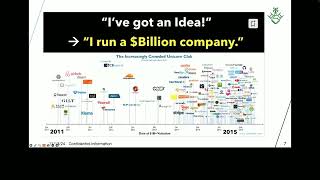
I. I do, I do want everyone to mute just for now. Hold on. Mute that. So the what I'm looking for in the why now slide is. Let me go back, I'm still learning how to use this. What is your insight into inflection point that is counterintuitive but turns out to be correct? That's what the why now slide should do? You need to answer what previously intractable, very valuable problem is now solvable by my my ends? The intersection that of me, the the some meta trends and technology and my insight into an inflection point as to why now is the time to build this thing versus any other time. Let me go in and explain a little bit more about what I think this is. These are some of the meta trends that everybody's following. This is the historical cost of computer memory and storage. One of the reasons I love investing in B2B software is that we are in a fundamentally deflationary environment. The cost of our raw materials that we use to build and invent our things is going down every year. This is Moore's Law. This is all the power of technology. But again, those things are happening with or without you doing anything. But what is important is along that path, say in 1970, what kinds of business problems could you unlock given the price performance metrics in 1970 and then in 1980, like today, what things are unlockable today that were unlockable say 10 years ago because of the advance in that curve? Right? This is what we're talking about. Why now? It's why is what inflection Point has the trend line that you're following met that allows you to unlock some previously unlockable problem. And if you look at over time historical technology adoption thing, this ability to unlock problems is going faster and faster with every sort of five year cycle. And this is how many months does it take for a technology to reach 100 million users? It took the telephone a very long time. It took TikTok nine months to get to 100 million users. It took Chat GPT two months to get to 100 million users. So the point of this is that when the timing is correct, before ChatGPT people were talking about AI and ML for 15 years, but they hit the timing of the cost to deliver that thing. The virality of things riding on the back of things like TikTok. The timing was exactly perfect and that's how they were able to get to 100 million users in two months. Another thing which has happened over time is the cost of starting a company has continued to go down every year. When I started investing, say in the late 90s, it cost you roughly $5 million to build any kind of Internet tech startups. You had to buy your own server, you had to hire people, you had to rent office space and all of that stuff. These numbers only stopped in 2015. It was roughly $5,000 to start the company in 2015 that you would have cost $5 million in 2000. Today, in 2020 that's probably a couple hundred dollars because you can buy everything you need to start a company in the cloud. So the. But that's true also again for any entrepreneur. So that goes to my point of that the cost of technology is not a differentiating factor in the wide out. It's that intersection of the cheapness to start a company and your insight as a CEO or experience in the market and some other inflection point. And what over the last bunch of years is that the number of people starting companies has really accelerated. This chart just shows the fact that unicorns were created at an ever denser, ever faster ratio. And that's because all of these things about how easy it is to start a company have been true. And many inflection points of why now have been tripped over the last couple of years. And this is just something showing you that you can start a company in any kind of cycle. So let me go and just talk specifically about a couple of why now Examples and why it was counterintuitive at the time and it turned out to be correct. So this I saw Toby post on Shopify about the friction that he was doing. So he was talking about he had met up with a venture capitalist that had passed on his deal and the venture capitalist was saying hey Toby, what did I miss? And what he missed. The why now that the VC missed was when Toby pitched him there were approximately 20,000 E commerce sites on the web at the time when he started Shopify. And what he's talking about here in the friction is that he thought that the existence of of a push button to start your e commerce store infrastructure would open up the opportunity for e commerce to millions of people. What the VC said is well I think I see that the market today is only 20,000 e commerce websites. If you get 50% share, you don't have a very big business. This is a small business. What the VC missed was the fact that and was the why now? Which was the of a push button e commerce infrastructure would make the market larger than it had ever been before. Today there are over 1 million E commerce stores just on Shopify. So the VC missed the fact the the counter idea was that easy to deploy e commerce infrastructure would 1x the demand for e commerce infrastructure. And the why now was because you could do it as a shared infrastructure and that's what the VC missed and that was what was counterintuitive. But prior to Shopify everybody had tried to build their own e commerce website by themselves and nobody had tried to share infrastructure with anybody else. And that was the why now that caused Shopify to be so successful. Let me give you another couple of examples of why now companies that I have invested in, some big ones you may know of and others that I've done recently. So I invest in a company called Deal is an employer of record. They compete with Trinet. I invested in 2019 and the pitch was hey, we're better than Trinet. Trinet sucks and we're going to focus on international hiring international people, which is something that they don't do. Terms I agreed with the core thesis that Trinet sucked the but what they said is they said we think the demand for international employees is going to significantly increase. This is in 2019. What they didn't know was that the pandemic was coming in March of 2020 and it put rocket fuel on the demand for international employees. That's why deal went from zero revenue in 2019 to $550 million last year. So they actually got rocket fuel on their why now? But their why now original pitch was we're going to go make it easy for us employee companies to hire international employees through a single user interface in any country. Something that the current vendors are not doing. And we think that market's going to grow quite fast. They turned out to be correct on both accounts. The second one that I and I was a pre seed investor in, Deal, the second company that I invested in, it had a pretty compelling why now was OpenSea. OpenSea is a marketplace for NFT creators. And the why now was these crypto native products called NFTs are coming out. Everybody's interested in crypto products, and we need a specialized marketplace to sell these products because Amazon and eBay cannot sell them. It turns out that the selling dynamics was slightly different and the existing marketplaces could not sell them. And there was a technical requirement because OpenSea had ran the registry for NFTs and NFTs had to be registered, and OpenSea had the monopoly on creating on the registry. So there was something technically different about it. And they were at a time where this was a crypto native product and there was lots of general interest in crypto. The why now was we have to have a specialized marketplace. Amazon, eBay can't do this. I agreed with that. It turned out to be correct. That got to be a very big business. It's now a much smaller business. But that doesn't change the fact that when they started, it was exactly the right time to start that, because it was, there was a requirement for a different marketplace versus Amazon or eBay. Let's look at another one. Airbnb. When Airbnb started, it was a crazy idea for people to think you would sleep on somebody's couch. But the two reasons why they said why now is that they said, we think that reviews, honest reviews, can reduce people's fear of staying in other people's houses. And the confidence of people putting in their credit cards into an Internet app is reaching a tipping point. And they were right about both of those things. Consumer confidence in reviews and credit cards and general trust in the Internet was at a tipping point when they started Airbnb. And if they had started it five years before, there wouldn't have been enough general confidence in E commerce, I think, on the Internet to have started Airbnb. What's another one that I invested in was Uber. The why now for Uber was, first of all, everybody hated taxis. But the real unlock for Uber of why now is the launch of the iPhone and the existence of GPS chips in mobile phones. They had become about six months before Uber started, GPS chips had become standard in port portable phones. If you had not had a GPS chip in a portable phone so that you could dispatch some a card directly to where somebody was holding their phone. You would not have been able to to launch a service like Uber if you had started it, you know, a couple of years before. It would not have been the right time. But they explained in their pitch deck the reason the timing is correct is because of the existence of these GPS chips. And that was the main why now that drove investors to be interested in Uber. Another one, which I was a series A investor in Google. The why now was basically PageRank as a search algorithm was better than AltaVista or Yahoo @ the time. And that was pretty obvious to everybody who used Google versus AltaVista or Yahoo. You got better search results. So that was in fact a product driven why Now? Let me give you some recent examples of good why now statements and then I'll summarize things and take a few questions. Here's four companies that I've invested in the last sort of year. One company is called with Civik and they're building a database of local government purchasing contracts, cities, counties, things like that. They are scraping and creating the database from public records requests as well as from using AI to scrape video recordings of county council meetings and city council meetings. They're basically building the database using a bunch of AI scraping tools that have just become available really in the last year. And they are able to build a database which is very valuable to vendors who want to sell to local people, but was basically technically impossible to build prior to the existence of these scraping tools and these LLMs that have come available only in the last year. The why now is there is an enabling technology that allows you to build this database that everybody's wanted that was too expensive to build with people in India before that was the why now with Civik. There's another company I invested in called Mid Funnel. They're doing personalized follow up messages for everybody in your CRM using AI. They basically will take 20,000 people in your CRM, stalk those people on Instagram and Twitter and everything with AI and tell you as a salesperson what when the buying signals might have changed for some of your leads and when you should reach out to them and do personalized nurturing of the people that are in your funnel. This is something which very large sales organizations do. If you have 20 name sales accounts with a big quota, you would be stalking all of your people yourself. But you cannot do that with a larger number of people. It's basically taking an enterprise sales practice and making it available to SMB people with AI scrapers. Again, these are AI intelligence scrapers that were not available until last year. This is a product you could not have built until this year. A third company I've invested in is a company called Leaseup Co. They provide vertical market software that is better workflow for commercial real estate brokers to close deals from loi to lease faster. Basically, it's a little counterintuitive in that the commercial real estate sector has really slowed down with the raise in interest rates. But what was counterintuitive is that when the deal volume slowed down and the expenses went up in these commercial real estate brokers, they said we need to pull forward investments in technology that allow us to do our business more efficiently. And the why now for them has been that the slowdown in transaction volume actually increases demand for IT investment. That was the pitch. It turns out to be true. This company is growing like 3 or 400% year over year. But it was, it was very counterintuitive to think that commercial real estate brokers would increase technology investment during a downturn. But that was the explanation from the CEO and it turned out to be correct. Another company that I invested in is a company called Tembo plus, which is basically building a plaid type API first infrastructure layer for Africa. Basically Africa FinTech is growing fast, but many of the companies are having to write, you know, to 52 different banks. Writing to one bank API is going to save them a lot of development effort. The why now was basically that Africa FinTech is 15 years behind America. People are starting to invest. This infrastructure layer is needed so that the apps can be developed faster. That was the why now they explained. I agreed with it and made the investment great. Why now slide is going to answer a couple of questions. Why you as a CEO, why are you the best person, the only person who can solve this problem? What is the insight that you have into the market or product that others don't see? What do you see happening and what is the inflection point that enables this thing? So why? What is what has changed that others don't see that is going to enable you to deliver your particular solution which results in the timing being perfect for you. The reason I am so passionate about a why now slide is that when the CEOs just talk about the problem and their solution, it doesn't explain the intersection of why them and why their insight is going to solve this problem or solution. Because everybody in the category is trying to solve the same problem or solution. But those are all the slides I have about why now. Why? I think it's an important part of a pitch and hopefully that's been helpful. I would love to take some questions if anybody has any, I can raise hands. Oh, here, let me. What's your maximus? Okay. Hey Maximus, go.
Ahead. I had several things going through my brain whilst you were talking, but I decided to narrow it down to AR technology since you like software and I like hardware. Okay, so there's a company in China called Xiaomi X I O M.
I.
Okay. They demonstrated how smart glasses can allow you to read anything as if you're on Kindle. Okay, I didn't know that. So I was thinking about why Apple is struggling to deploy smart technology in glasses to read stuff and I, and then I saw the article this afternoon about how Chi has already demonstrated the use of AR technology to read newspaper or anything in dark mode or in transparent mode and yet the market hasn't responded to them. As you, you explained the why now why you? I begin to think if Xiaomi's technology was exactly transferred to Apple right now, almost every Apple user would buy it as opposed to Xiaomi. So it's becoming sense, it's making sense to me. Why the why you? Except when I build something, I don't agree with the why you statement because I feel very passionate about what I'm building to the point where I don't want anybody else to be the one building.
It. Okay, so what's your.
Question? My question is what's your opinion on why the AR technology, even though there's been so much investment from Meta and Apple and Google and Xiaomi has demonstrated that you could wear glasses and your Gmail. Why hasn't it caught on when everybody has used Kindle for all these years? We have smartphones, we have every other ways of reading technology with hardware and software. Why hasn't the AR technology caught on in your.
Opinion? In my opinion, AR hasn't caught on for the same reason that VR never caught on. There is no the, there's no compelling why now. There's no compelling use case for it. It is a technology in search of a problem. And ar, you've got big companies like Meta and Apple that have a lot of money that are going to try to launch products and they should and can and will continue to launch products and maybe eventually they hit some intersection. How many times did Apple try the tablet before they got it with the iPad? I'm not saying that they won't ever get it and maybe this Chinese company might get it. The reason AR hasn't taken off in the mass market yet is because there really aren't that many compelling applications for it like video.
Games. Maybe airline pilots can usual can use smart glasses.
Maybe. But how many airline pilots are there? That's not a big market. There are many niche markets and there are no mass markets. And those niche markets don't add up to a big enough market. So that's my explanation why AR has not hit the why now thing yet. Let me take another question. Dimitri, why don't you go ahead. Hey.
Dimitri. Hi. Sorry, I think we did muting.
Twice.
Whatever. Okay, I have a two parter question. I just got back from annual NIR conference National association of Realtors for those who don't know. And I was just talking to somebody who I understand was a member of the executive team team at DocuSign. How DocuSign was one of the best NIR investments. Questions, what do you see was the why now at DocuSign and I guess why now at founding and why now at the time of going into real estate. And another question, what do you see as why now in.
Proptech? I. I was an early investor in DocuSign and I was actually just in Sun Valley with the founder Tom of DocuSign two weeks ago. Basically the why now of Docusign was. It fits into my thesis. The reason I made the investment is it I'm like here is software that automates a business process. Signing a contract, which is today a pain in the ass. You used to have to print out a PDF file, sign it, scan it, fax it. Like the business process itself was 10 times easier to do on in software than the old way to do it. So you had a fund fundamentally inefficient business process that with software was fundamentally 10 times better, number one. Number two, you had millions of those business processes a day. And number three, why did the national association of Realtors do it? National association of Realtors said their job is to make it easier for people to buy houses. They thought this technology, if it were, if it reduced 5% of the work or made it two seconds easier, they were just simply looking for any technology that would make it a little bit easier to buy a home. And they saw that DocuSign could potentially do that. They signed a contract, they did it. Now what turned out to be to happen in, as happens in many companies, when they launched it, they got basically very low usage by Realtors. So the national association of Realtors signed the deal, included it in their document processing thing. Everybody could use DocuSign nobody used it for the first three months. And the reason they didn't is because there was training that had to happen. People were technophobic. They said, I don't know if this is legally binding. I thought you used. I thought you had to have a notary signature. So they had to do a whole bunch of education and webinars and all of this stuff to train, retrain people so many times. It's not the existence of the technology that gets the adoption, it's the training that gets the adoption. They had a compelling why now? They wanted to close deals faster, but they had to do a little more work on the training than they thought to actually deliver on the why now. It's not always enough or very. In fact, it's very rarely enough for the technology to just work, to have the wine out kick in. Makes sense. All right, thank you. John, you have a question? Offer.
House. Yeah, Fitting. Dimitri was just mentioning the nar. Our solution is a DIY platform or tool for real estate investors to buy their real estate without.
Paying. A phone, I think connected to. Well, I turned off my Bluetooth. Oh, cool. That explains why my headphones stopped working on you.
Guys. And so I. You were just talking about that again, the whole NAR lawsuit thing. From our perspective, our why now is due to those lawsuits. It's really opened up people's eyes that they don't have to actually pay for a realtor, especially considering people are now getting forced to pay for their buyer's agent. Do you think that, in your opinion, is a good enough reason to really push that as our.
Primary. Potentially, what you're talking about is you. You have a product that is trying to capitalize on an inflection point in residential real estate. That inflection point is this new ruling that makes it. You able to negotiate your commissions. Now, technically, in the past you could, but nobody did. And there was all sorts of these other things. It is a. That is a reasonable inflection point to try to monetize. The trick on that one is going to be in the details of how it actually rolls out. I have. I know a lot of real estate agents and I think their behavior is going to be harder to change than many people think. I also think it's going to be. I think if you're focusing on. In real estate investors, which it sounds like you are, you can probably build a product for them because they're very cost conscious and. But it's going to take. That particular inflection point is one of those ones that's good that it's going to take longer to work its way through the system than people.
Think. I.
Agree. It's a good time to start talking about it because people are like they're aware. And to build a product that really drives value in a new way for people that you could not before. That's that all is the right why now? The tricky part's going to be can you get enough.
Adoption? That's what we're finding as well. And I got heckled last night at a presentation by a.
Realtor. The realtors are not happy about this at all, as you can imagine. And they are going to do everything they can to slow walk this slow, roll it, not participate. Even though their lobby and trade association has been sued, the individuals are not going to change their behavior very quickly. Yeah, good luck with that. John Paul, you have a.
Question? Yeah, thank you. Brevity is important in a pitch deck. And I'm building essentially a marketplace business. And so we've got a few different why nows? There's a consumer why now? Our marketplace serves a couple different industries. So on the B2B side, there's a couple different winos and then there's also a technology why now? Okay, I guess my question comes down to. In 90 seconds on one slide, how would you focus this or is a slide about a why now consumer why now Technology why now B2B something.
That could also work if you have multiple trends that are intersecting with the why now? I would just have your why now slide be that like a three circle button with the intersection or something like that and say there are three trends that are all intersecting which equal the why.
Now? Got it. And just on the marketplace topic, what why now to you matters most? Is it the consumer or is it the technology or the business? If as from an investor standpoint, when looking at a marketplace that, well, it's a marketplace that requires the B2B.
Interaction. It depends. When I invested in OpenSea, which is basically a marketplace, it was tech. It was the combination of technology and consumer interest in a. In buying a new good that never existed before. You had both of those. You had to have a marketplace that operated in a different way than Amazon and ebay technically, because you were technically buying a different thing. Right. And you had. But you had that intersecting with a giant wave of consumer interest in that category of things. So I think for a new marketplace, you have to show both, like why? What is the technical reason why you need a new marketplace? Is it what is different about the thing? The buyers and sellers in your marketplace that require a different marketplace. And then you have to show people why. There are a lot of buyers and sellers that potentially want to do that and what is going to cause them to move. I don't know. One of the trends I'm seeing in marketplaces is, and I don't know if this is you, but a disaggregation from the general marketplaces to specific marketplaces. So you see people moving collectible tennis shoes from Amazon to StockX. Right. People taking categories off of the general marketplaces and doing them better in a specialized marketplace. That is a general trend which is happening. But there are reasons for that. There is something specific about that category of buyers and sellers or that merchandise that is being better served in a new marketplace versus the generic ones. There are many categories that's not going to work that where the general marketplace is going to be better. Usually it's something high end or something specific about the merchandise that requires a new marketplace. You got to have the intersection of customer interest and that.
Merchandise. Great, that was very helpful. Thank.
You. All right, thank you. There's another question from Georges. You have a question. You had your hands up and then. Andre, you're.
Next. Can you hear me.
Martin? I can.
Yeah. Hi. Yeah. So thank you for hosting this. My question was actually very much exactly what Paul was going to ask. So I appreciate you answering that. I guess I wanted to pivot it a little bit and see if you're okay with this. I've seen you post recently about startups who only raise once and then reach profitability and then just go from there. Right now maybe I'm misunderstanding this, but it maybe runs a little counterintuitive to how ventures or VCs want companies to run, which is consistently running through cash, trying to grow as quickly as possible versus reaching early profitability. Are you seeing a change in how investors, and you maybe in particular think about companies where you're fine with them seeking to reach profitability earlier and be sustainable versus go all out and try to reach 100 million? Or is that still like how most investors want, which is companies that are not exactly profitable at a million ARR, but run really.
Fast. The idea of companies raising a billion dollars before they go public is frankly a relatively new thing. In the last five to seven years, if you take the total amount of venture capital that was raised by the big seven by Facebook, Google, Microsoft, Amazon, it was like $300 million. Okay, total. How much money did Microsoft raise in venture capital? Total $1 million. One check, one round. They raised one on 20, they never raised again. And they're worth $3 trillion. Now, you can do that with software companies. You could not do that with hardware companies. You couldn't do that with drug discovery companies. There are certain companies where that doesn't make sense and you just require more capital. But this idea that you. And in B2C companies, many times you're going to need more capital because you got to acquire customers and spend money on customer acquisition. And so that's why you have had a lot of companies raising a billion dollars, especially in the B2C area. I looked at one company, Lime Scooters. They've raised a billion five and the company's worth a billion five. So basically their investors are underwater. But they had to raise a lot of money because they had to buy a bunch of hardware, they had to launch a bunch of cities, they had to do a bunch of marketing. Right. I only invest in B2B software companies. And I think people who invest in B2B software are not expecting their companies to have to raise so much money. The company Tembo plus that I invested in Africa and Tanzania, they've raised less than $500,000 and they're profitable now. I don't. They may still raise money to grow a little bit or do some investments, but they don't have to. And the last two companies that I invested in raised twice as much money as they expect to get to profitability, and that was both times less than $2 million. What? I don't have a preference, personally. Personally, as an early investor, I would rather that if you were that one investor who wrote Microsoft that one check and no other VC was able to write Microsoft that check, you're pretty fucking happy with yourself. Yeah. Because you're the only guy. Right. And so me, as a 250 or $500,000 investor, if I invest in a million and a half dollar round, that company gets to profitability, grows very quickly and doesn't take any more money, and in the end is worth a lot of money. And I'm one of the few investors in that company. I'm really happy. I don't want them to raise more money. Yeah, really. But do I think most companies will be able to do that for a couple million dollars? Probably not. But what I'm happy about and excited to see is again, some of those trends that I showed there is that the cost of starting anything today is so low. And with These copilots, with GitHub, Copilot and other things like that, being able to write Code faster. You should be able to build almost any software company you want for very little money and get to profitability on a very small raise. And I think that's good for everybody. It's good for founders, it's good for VCs, it's good for.
Everybody. So one follow up to that is sure you find there might be a conflict between a company chasing high margin profitability versus chasing what they call venture scale. Or do you think it's very doable that they should be able to achieve.
Both? I think you could. You should be able to achieve.
Both.
Okay. The whole point of venture scale. Venture scale, I wrote something about this is basically you got to be able from about a million dollars ARR. To trip double, double your revenue. And if you can do that from cash flow, you're a fucking decacorn unit. You're like off the charts good. Most companies can't do that with cash flow and that's why they take venture capital, is because you can grow faster with venture capital. But at the same time you want to make sure that you're growing in a positive net revenue retention positive way or in a low burn multiple way. The problem we had in the recent past is that companies were running at burn multiples of like 10 or 20. What a burn multiple is how much money did you burn versus how much new revenue did you get? And there were companies burning $10 million to add $1 million of revenue. That's a road to fucking.
Nowhere.
Yeah. If you burn $1 million to add $3 million of revenue, that's a reasonable thing to raise money to continue to do more of.
Right. All right, thank you. Thank.
You. All right, thank you. I think I have time for maybe two more questions. Andre, you have a.
Question. Hey Martin. Yeah, super quick. I wanted to get your take and then just two quick questions. You mentioned Shopify and how VCs missed.
It. I think Shopify, some VCs missed it, but one guy did an in fact invest. Yeah. Oh.
Yeah. What I was saying is that I don't think necessarily was the ease of use of the website deployment because a lot of had it. I think it's there was the Alibaba, the ease of use of getting drop shipping inventory that allowed you to very quickly create end to end. I think if Alibaba was in their Shopify wouldn't be the same. But that's a.
Yes. I agree. They added a whole lot to their platform that made it easy and it was all shared infrastructure, plug and play type of a stuff. What most VCs missed was the fact that that infrastructure could be shared on a $20 a month basis and that that as you added more features to that, that got more valuable over time. The network effects. What's the value of the Federal Express network? The value of an additional node on the FedEx network is more than one. And that's what happened at Shopify is they got it going and then they added, yeah, the drop shipping, they added the finance shop pay and all of that other stuff. And it just got to be so valuable that there was that nobody thought about installing their own E commerce server ever.
Again. Yeah, exactly. And then I had two questions or whichever. Could you give your perspective on why now for two companies, Venmo, when there's PayPal and Tesla, when they're releasing the.
Roadster. Sure. Venmo. I was an LP in a fund that invested in them. And basically the why now and Venmo, it was a bit of a copycat thing to PayPal, but it was started by a guy who left American Express. And so the why now was here. See, PayPal was San Francisco and American Express was New York Finance. And so basically this was the why now was New York VCs. And it was funded by a venture firm that I know called RRE Ventures. It was a guy who spun out of American Express. And the pitch was, New York, where the bankers actually live, are going to do this fucking right? And fuck those west coast assholes. That was the why now of Venmo, okay? And it turned out that they got it going and then American Express bought it. So it was a spin in to American Express why Now on the Tesla Roadster. I actually remember, I don't know how many you know this, but Elon did not start Tesla. A guy named Martin Eberhard did. And I was actually in Silicon Valley and rode around in his Franken car that he had this Lotus Esprit with Martin before Elon invested in Tesla. But the why now was basically at the time, oil was starting to go up in price. Oil has had gone up from $40 to $70. People were in the macro environment, everybody was talking about peak oil and everybody was saying, we're running out of oil. This is before they invented fracking, which brought the price of oil back down. But in the macro environment, people were worried about the end of oil, right? So then people were interested in alternatives. And the why now was, hey, electric. The energy density of an electric car, the efficiency of an electric vehicle converting stored energy to forward power is something like 90% internal combustion engines are something like 15% just on a first principles basic energy conversion metric. Electricity looked like the best alternative. Better than hydrogen, better than renewable fuels in internal combustion engines and things like that. So the why now was we think we're running out of oil. What's the best alternative? Electricity. Oh, this guy's got something that works. That works. We think we can build one pretty cheaply. And then the third thing was that they thought they had enough demand. They had a wait list for the Tesla roadster of about 5,000 cars before they even built one. So the VCs were like oh we can at least sell these to all the rich idiots in San Francisco and prove out the high end version of this all with the eye of we got to build enough scale to build the mass car. And that was what Elon ended up publishing a couple years later after he invested was the master plan. The the whole purpose of the Tesla Roadster was to prove or basically a proof of concept and then figure out on those cost curves of the cost of an electric lithium ion battery and all that stuff where the right time was to raise the money to build the super factory to launch the mass market car. Right. They knew the whole time the why now was we're going to start this process knowing that we're too early, but we're going to sell this expensive thing to the rich people in San Francisco and then we're going to build up capacity and hopefully time our investment correctly to launch the mass market car which I think it turned out pretty.
Good. Thank you very.
Much. Yeah, thank you. Okay, one more question from. Hold on Maxi, I got one more question guy that hasn't asked a question.
Yet. Hello.
Martin. Hey.
Fernando. Consider the millions of marketplaces that just only succeed in Shopify, but most there are many more outside of it. Buyer one is like a reverse version of Amazon where the buyers post the items, the products that they want to buy and they the sellers approach them with the compelling offers is compelling enough for this time for wine now to launch this type of reverse E.
Commerce. What is the value for each party of reverse E.
Commerce? Yeah, for buyers they can save a lot of time searching for the best deal and at the maybe at the budget that they can buy that they can pay for. And for sellers they can save customer acquisition expenses and approach motivated buyers that already paused their buyer.
Intentions. I would be skeptical and the reason is I have seen attempts at this. There was Groupon that did group buying, there were attempts at group buying and reverse buying sites in the first dot com boom in two thousand and twenty. The problem with all of them was getting enough buyers and sellers and getting people to change their buying behavior. This is not a normal way that people go to acquire things. And the problem has never been the technology. The problem has always been there's not enough of a compelling reason for people to change their behavior. It's not bad enough just by the way they always have. Because the problem is, let's say that you want to buy something, you put a thing out there, you have to get all of the potential suppliers of that to bid on your thing or it's not valuable. Right? And if you have a subset of them bidding and getting enough buyers, it's one of these marketplaces cold start problem things that the reason they never get going is that you can't get enough. You can't get everyone to participate from the beginning. Not valuable to, to anyone. So what I would ask you though is I might think to turn it around and say what is potentially different that could make this kind of change why now useful right at this time. And if you think about AI, I've seen a couple of business plans that are basically AI shopping agents that where buyers say I want to buy this. And rather than putting a bid out and letting people come along and try to bid for your buying, they have an agent that's going out. It's shopping. Amazon, it's shopping. Walmart, it's shopping like it's calling, it's looking up in service directories, supplier directories, it's sending emails with rf like it, like these kind of proactive supply chain buyer bots. I think that when you, if you build those and those are automated and they're just running for people, I think that could potentially be something that you could build. Now that there is a good why now Reason. It's because you could not build those kind of proactive buyer bots before you had chat, GPT and Claude and an agentic architecture like.
LangChain.
Right. This is something that people wanted to do to have a robot shopping for them, but it was not, it was too difficult to build one of those before you had these agentic architectures. So I could see people building basically proactive shopping buyer bots with AI and having those be successful as long as they, you know, shopped enough places like it and did things like even looking up vendor lists for potential things you want to buy and sending RFPs in email or calling vendors on the phone with generative phone calls or something type of thing. It has to Be a pretty robust buyer bot.
Sure. Maybe B2C is a more complex way, but maybe easy to see, like marketplaces of Facebook or Offerup or Playlist. It could be so useful. Sometimes you see any product at a certain price and you said, I would like to pay a little less for that. So it's a friction between the sellers and buyers. So you post the item and maybe the seller, that particular business is in a hurry to sell and they avoid, at a certain point, they avoid the friction of negotiation. And maybe is open card, I'm willing to pay this amount, you're willing to sell me at that amount. It's like an open card for both.
Parties. Maybe. But people have been able to bid and ask like that on eBay for 25 years. And it has fundamentally changed the way businesses buy things. That much. I think there's something around AI bots that would change people's buying behavior in a material way. Thank you for that question. All right, I think I have about two more minutes. If we had even one more question. Yeah. Hey, Max, I have a question. I've been trying to raise my hand, but I don't see the button. That's okay. One more question and then we can wrap it up. Thank you everybody for your time. All right, so the question is, when it comes to the why you versus why now, how do you qualify the why you to someone like you as an investor? What I want to hear is what is unique about your experience in the world that makes you uniquely able to solve this problem you've chosen to solve? And so what I'm typically impressed with is, for example, I invested in this company called Zella Me, which is a vertical market software for private security operators in Latin America. The founder guy went to Harvard, his family lives in Mexico, goes back to Mexico City, is living in his condo building, gets robbed in his condo building three times. Why did he get robbed? He got robbed because his security guard didn't show up for his shift. And so he's like, why did my security guard not show up with the ship for my shift? For his shift? So then he goes down the rabbit hole and sees all the operational problems running security guard firms. These are low wage people. So anyway, he had a very personal experience, a personal problem. And he, and he called the owner of the security firm and said, why can't you get your people here on time? Here's all these problems. He says, I'm a software, maybe I can solve it. So anyway, he had a very personal problem, a very personal insight. He went and looked for somebody else to solve the problem for him. He wanted to switch his security firm. He wanted to buy software for his security firm. Nobody else could solve this problem and therefore he was solving it because he had tried to get to buy a solution and nobody would do it. That is a really good why you because you have a personal stake in the problem. You've researched the market. You, you have some insight into how to solve this problem that other people haven't had, and you earned it the hard way. That's a good answer to the why.
You.
Excellent. Thank you. Last thing, can we make you do B2C again since you did Airbnb or not really? No, that was back in the day. I'm not doing B2C anymore. But thank you, everybody. Have a great week and enjoy and keep building. It's the best time to.
More from Martin





Product and User Experience, how to make a cure and not a vitamin with Greg Raiz