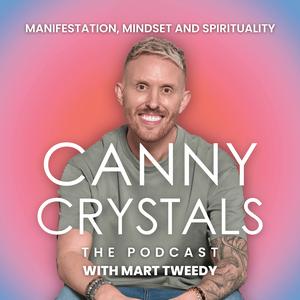
251: The hidden power of colour, ft. Kate Harrison
30 Jul 2026 · 55 min
In this episode of the Canny Crystals podcast, host Mart Tweedy interviews colour‑therapy expert Kate Harrison. The conversation moves from personal anecdotes—Kate’s 20‑year styling career, post‑natal depression, and the creation of a rainbow‑bracelet—to the science and psychology of colour (chromotherapy). They discuss how wavelengths of light affect the nervous system, cite studies such as the "prison pink" experiment and green‑view recovery rates, and explain how brands use colour to influence behaviour. Kate introduces her proprietary "Soul Shades" system, which matches a person’s energetic profile to a specific colour and its complementary "magnetic pair" to balance traits like nurturing versus people‑pleasing. Practical applications are explored: wardrobe decluttering, home‑design colour choices, colour‑meditations, and daily habit‑stacking. The episode also includes promotional reads for Grow Therapy, Aura, and Acast, and ends with a call‑to‑action for listeners to notice and intentionally incorporate the seven visible‑spectrum colours into their environment, using a free colour‑selector tool and sharing their experience on social media.
Chapters
Everyone treats summer like it owes you happiness. Long days, pool parties, your best life on a loop. So what does it mean when you feel worse? The summer blues are real. It's why summer is one of the busiest stretches of the year for people starting therapy. Grow Therapy is here for all the moments when you decide you want more. More support, more clarity, more tools. Grow connects you with thousands of high-quality licensed therapists across the US, offering both virtual and in-person sessions, nights and weekends. The therapist you want takes your insurance on Grow. Grow accepts over 125 insurance plans. Sessions average $21 with insurance, and some pay as little as $0 depending on their plan. Visit growtherapy.com/startnow today to get started. That's growtherapy.com/startnow. growtherapy.com/startnow. Availability and coverage vary by state and insurance plan.
Most people don't realize how much of their personal information is being bought and sold every day. Data brokers are making billions pulling details about you from public records and the internet, then packaging and selling it, usually without your consent. That's how your information lands in the hands of scammers, spammers, even stalkers. It's why you get endless robocalls and why ads seem to follow you everywhere. That's where Aura comes in. Aura actively removes your data from broker sites and keeps it off. They also instantly alert you if your information shows up in a breach or on the dark web. But Aura goes beyond data protection. With one app, you get a VPN, antivirus, password manager, spam call protection, dark web monitoring, and even up to $5 million in identity theft insurance, all backed by 24/7 US-based fraud support. Other companies might sell just credit monitoring or just a VPN. Aura gives you all of it together at the same price competitors charge for just one service. Start your free trial today at aura.com/safety. Protect yourself now at aura.com/safety.
Acast powers the world's best podcasts. Here's a show that we recommend.
10 years after Troy, Odysseus is still lost.
I'm Tristan Hughes, And all of this month on The Ancients, I'm going to be sailing through Homer's treacherous world of monsters, witchcraft, and tempestuous gods, exploring the real archaeology and history beneath the myths.
Join us on The Ancients from History Hit. Listen now and subscribe on your favorite podcast player.
Acast helps creators launch, grow, and monetize their podcasts.
Everywhere. Acast.com.
Hello everyone, welcome back to the Canny Crystals podcast. I hope that you're all well. My name is Mart Tweedy, I'm your host, and this week I've got a guest on the show. Now, I want to start today's episode with a little question. Have you ever walked into a room and instantly felt calmer without really knowing why? Or have you found yourself constantly drawn to one particular color at a certain point in your life? Or maybe you've painted a room, changed your wardrobe, bought a crystal, or even chosen a journal simply because something about that color just felt right. Most of us assume color is just about personal taste. We like blue because we like blue. We avoid orange because it just isn't our thing. But what if there was so much more happening beneath the surface? What if the colors that we surround ourselves with are constantly influencing our nervous system, our emotions, our confidence, our motivation, and even the way that we show up in the world? And if that's true, could color become another tool for manifestation? Could the energy that we create through color support the intentions that we're setting? And it's a fascinating subject because it's something that every single one of us interacts with every single day, yet very few of us ever stop to think about it. So today's guest has spent years exploring exactly that. So she specializes in chromotherapy, otherwise known as color therapy, helping people to understand the incredible impact that color can have on well-being, emotions, and everyday life. So today we're going to be diving into the science, the spirituality, the psychology, and the practical side of color. So please give a huge Canny Crystals welcome to today's guest. It's the gorgeous Kate Harrison. Hello, how are you?
Hello, I'm good, thank you. It's so nice to see you.
I know, it's lovely to see you. We haven't seen each other since Manifest last month.
No, and we were both on our knees by the end of that, weren't we, Mart?
Do you know, I've already talked about this on the podcast a few weeks ago, but yeah, that girl that passed out in the toilet, and I thought you were joking asking me to ring 999 while you've got your phone in your hand running down the corridor.
I know.
So I walk into the toilet and I kick her in the fanny.
I've learned that I'm probably not the best first responder. You know, this is what I've learned from that experience, that having your phone in your hand when you could quite happily phone yourself an ambulance, but didn't do that, that I decided to go for you instead. So sorry about that. So partially my fault that she got kicked, um, and probably I'd say 80% yours, but never mind. We got there in the end. It was absolutely fine. Nobody was harmed. That's what happens after 7 glasses of Prosecco and not a lot to eat.
Yeah, yeah. I just assumed that you were like pulling my leg. Everyone had been playing pranks on us all day and that's what my friends do. So I just thought, oh, here she goes, she's playing a little prank. Who is on the floor? And then boom, straight in the fanny. And then I just thought, she's actually unconscious.
No, I'm not pranking you. Yeah, there was actually a medical emergency at your Manifest But do you know what? We dealt with it, didn't we? That's what we do.
We handled it well. We did.
We sorted it.
So, Kate, let's start at the very beginning. Before chromotherapy entered your life, who was Kate Harrison? What was happening that eventually led you down this path?
Oh gosh, there've been so many iterations of me, I think. I think. But for 20 years, I was a stylist, right? So I was— I trained in the early noughties. What a time to be alive. Chunky belts, chunky beads, the lot. Very straight hair. One of my producers from a TV series that I had a couple of in the early noughties sent me a showreel from our show the other day, and my PA said to me, my God, how did you get your hair that straight? But it was very straight, very blonde, very straight, kind of very straight fringe, quite severe. And that was the vibe. Um, yeah, so I was a stylist. So I trained down in London because Manchester's not fashionable enough apparently back in those days. You had to go to London to become become a stylist and did that and trained in like traditional colour analysis. So that whole draping in 750,000 fabrics and then telling you you can't wear black, that was kind of what I did. And from the get-go, I was like, oh, this is just jarring with me. I thought I wanted to be a stylist because I loved fashion. I'd worked for Armani, I'd worked for Selfridges, I'd worked for Flannels, and I had studied a retail marketing degree. So I thought I'm in this, I'm a fashion girl, I just can't wait to do it. And actually what I learned through that process was that I really love people, not the clothes. The clothes were just something that I could use, a tool to make people feel really good about themselves. Um, so me telling people they can't wear black was kind of like jarring a little bit. And also when I turned up there, um, head to toe in Sunshimmer, because you know that was a thing back then.
Oh my God, I forgot about Sunshimmer! I used to wear that.
My dad's bathroom hasn't forgot about Sunshimmer. My God, that is completely— but I was very bronzed, put it that way. And the woman literally sent me home and said, right, I can't even analyse your skin tone because you are caked in, in orange. It was, it was thick. It was like, you know, whatever you, you, you creosote your fence with. It was like, not good. So I came back the second day and colour and doing the colour analysis process, it kind of like stripped me back to who I was. I had not had my own skin tone or my own hair tone for some time by that point. I think I started bleaching my hair at like 15, and the sunshimmer was on big time from probably '95 to, I would say, at least 2005. So it was a look. Um, and what she did was she kind of took me back to my natural colourings, which was terrifying at the time because I think I'd put on this kind of mask. It was like a form of masking and what she showed me then was how to correlate colours that were natural extensions of me. And I thought, you know what, I can get on board with this. But she did tell me I should never wear orange again because it had a warm skin tone base and mine was cool. And I was like, well, that doesn't feel right. I topped up in a, in an orange knitted cardigan from Miss Selfridge as well, so I was a bit upset about that. But anyway, I packed it away and did this styling for, um, until about 2008, and that was when I had my first son. And in that time I had a great time, and colour was one of the biggest ranges. And I kept kind of seeing in women that I could put them in a red dress when they've been living in black leggings, and they would transform, especially on camera, like the, the reveal. They'd look incredible, they'd be glowing, and their friends and family would say they were, and they would say, 'I look amazing.' But then 2 weeks later, they go straight back to the black leggings again, and I'm like, 'What's going on here?' And they never said it looked too much, they never said it looked rubbish, because it always looked dead good. But what they said was, it felt too much and it didn't feel like them and it felt wrong. And I'd started to kind of unravel this. Are they feeling colour? Like, because I could put them in a colour that would look incredible, but if they weren't feeling it or it didn't feel right for them, then they'd never wear it. But anyway, I got sidetracked then by having 3 babies, as you do. So 2008, had my first son and, um, got really bad postnatal depression and just gave my business away to my business partner. Um, and that was really the first time that I felt like I had no colour in my life. I was the woman wearing the black leggings and not being able to get my knickers on the right way. I'd put on 6 stone, didn't recognise myself in the mirror, and I was in a really dark place, like, mentally and physically as well. I noticed that My food was beige, you know, my home, I just didn't even open the curtains in the day. And I was just trekking around in this size 26 grey tracksuit and I lost the zest for life. It just felt really, really dark. And it was then this little kind of spark that actually, I think I've lost my colour because my life used to be really bright and really colourful and I remembered being this woman but I couldn't see it. So I think that's probably where the first sort of embers of what I'm doing now kind of came into fruition.
So was there kind of one defining moment where you thought, oh my God, there's something in this? Or did you like build your belief slowly over time? Because it's funny, like what you were saying even about like beige food there, because I've done it myself. I know fine well when I'm eating crap because I'll put loads of stuff in the air fryer and I'm like, oh, I'm having a beige tea. I say that all the time. And it's like no vegetables, and it's like I've put in like potato waffles or something, and I've put in some like turkey dinosaurs or chicken drummers or do you know what I mean?
Oh yeah.
So was there one defining moment where you thought, oh my God, there is actually something in this?
Yeah, for sure. Um, and, and, and that the seed really was that people kept telling me it didn't feel like them. And when I looked in the mirror, I thought, this doesn't feel like me, and what is it? And actually, the thing that started turning the dial again— and I always say it's like turning the TV up, or the turning the, um, the, the the colour up on a telly, on an old-fashioned telly when I was a kid. We could really zoom that colour up, and if I was watching Noel's House Party, Mr. Blobby would go like psychedelic, and it was ace. I'd be like, look at him, he's glowing. Um, that was— and it's funny you said food— that was the first way I started introducing colour back into my life when I had had this postnatal depression. I actually went to Slimming World, or the slimming groups that are available, but what they taught me was to— they did red and green days there, do you remember that? They used to do red and green days, and They taught me to eat the rainbow. That's what it was about, you know, you got to try and get as many bright colored fruits, vegetables in your food as possible. And I felt like it reset something in me, and it made me think, this bringing this color back in is just like what I saw with these women, that actually when you start bringing it back in, the bad stuff kind of comes away again. And, and it, and it, and it seemed to soften the darkness a little bit. And actually, as I lost weight— I had 6 stone to lose, it took me a year— and as I lost weight, I felt like I was ready to be visible again. And I felt like the depression did start to lift, and that I would buy a new smock top or something, you know, something that was still nice and big and baggy, but maybe it was in green or maybe it was in purple. And I saw in myself what I'd seen in women as well, and I thought, yeah, there's really something into this. There really, really is. Um, and that was just the first baby. I then had two other babies, um, I didn't get postnatal depression those times, but I was still kind of within this sort of cycle of thinking about colour, understanding colour, wondering if there was something linked to it. And I was still kind of doing the styling events and stuff, and I was very aware of my home and how I could use colour in my home, and how when we bought our first home it was very beige, and I started being quite bold with my colour choices. I put like a lime green wall in one of them, and I put like a bright pink splashback in my kitchen, and I just started to start playing around with that, and I could see a change. And I could also see how all of my children, everything I bought for them was colourful. And I think when you have a kid, you start seeing this, don't you? The toys are colourful, the clothing's colourful. You know, I had a mural done on the wall, it was colourful. And I started then looking back at my wardrobe and realising there was less colour in there, and it was almost like I had giving all my colour to my kids. And then I've started thinking, is this a thing? So I start reading around it. And so all these experiences then kind of came to fruition within COVID when all of my kids— I was homeschooling 3 kids, no fun whatsoever, please never take me back there, I've got PTSD, um, and they were all learning something new. They had worksheets and all this sort of stuff. And I thought, you know what, I want to learn something new. And I enrolled on an advanced diploma in chromotherapy. I didn't really know what it was, but I knew that if I wanted to take this colour thing to the next level. I wanted to understand how people are using colour within therapy, because I myself had had talking therapy before, but I know that I felt the biggest difference when I surrounded myself by colour. And I studied this thing, and at the time there were rainbows everywhere, right? It was all about the NHS and, um, you know, drawing rainbows for the NHS, and it symbolised hope. And I was like, there was just this light bulb moment. I remember reading this really long course, and it was all obviously home-based to It took me a couple of years to get through it, but pretty much that's how long lockdown was, so it was all right. And I remember reading and reading and reading and then going, "It's the rainbows. There is power in that." And it just clicked. And I was like, "That's it. I'm moving this forward. I don't know how I'm gonna move it forward." But you know when you just get a feeling?
Yeah.
And you're like, "This is what I've known all along. I've known this all along, but I need to be able to verbalize it in a way." that people don't think I'm mental, because that can be a problem sometimes, and also that people can use every day. So it's taken me a while to get this distilled into— so it's probably 25 years worth of work you're looking at right now. Um, but I feel like we're finally getting there. And actually, is colour a wellbeing tool you can use every day? Absolutely.
It's funny I'm speaking to you today because just yesterday I thought, I'm gonna do a little Sunday declutter. I do them maybe once a quarter. And I just opened my wardrobe, opened my drawers, and I just thought, I've lost 4 stone in the last year. And I thought, I can feel the weight slightly coming back on. And I thought, no, I'm going to release it before it has chance to. So I'm gonna get rid of anything that reminds me of the size that I was. So I went through my entire wardrobe, I chucked out 2 and a half bin bags full of like clothes, basically took them up to the charity shop. And as I was showing the charity shop them, because it's like a charity shop that helps people that have been in domestic abuse and stuff like that, and they, they go through all the items just to make sure that everything is suitable. And as they were going through them, they were like, oh, there's a lot of black and white in here. It's very like monochrome. They were like, oh, this is a very monochrome wardrobe. And I was like, do you think? And I was like, oh my God. And it just suddenly hit us when you were talking there. My wardrobe was monochrome because I didn't want to be seen because I knew I was bigger than I am right now. Whereas now I'm introducing color back into my wardrobe because I've lost the weight and I'm happy to be visible again. It's all kind of making sense.
It does make sense. And colour is linked to visibility. So I think what I've spoken about, and I spoke about on Manifest, it was so exciting, is that colour has energy and colour is energy. So every colour is wavelengths of light, essentially. That's the science of it, is that to see a colour, it's different wavelengths of light refracted through. And so therefore, each colour has its own frequency and has its own wavelength. So each colour feels differently and it gives you different things. So when I was told I should never wear orange, and then I duly did that for like 10 years, um, just because it didn't look great next to my skin tone, I kind of eliminated orange completely from my life. But what's so important is that we need every single one of these colours to balance our energy. There's no point in having one of them without having another one. You know, it's like only having vitamin D when actually you need all the vitamins. So it's really—
it—
when you start looking into it, you just think, why has no one told me this before? And, um, but here I am to tell you we need to colour in our lives because living in grayscale, it's not good for you.
So why do we think that colour has such a profound effect on us when it's something that we often don't even consciously choose or notice?
Yeah, and that is exactly right, is that actually colour affects us subconsciously. So it bypasses our conscious brain and goes straight into our subconscious. And obviously how we are subconsciously affected by things changes throughout our lives, you know, all to do with hardwiring from when we were younger. There might have been some sort of an experience that was— that happened around that colour, which we don't even— we haven't even noticed, we've not even recognised. Or it could be something that's been societally kind of embedded in us within those rules that society put on. Pink for girls, blue for boys, all that kind of thing. It could be cultural. So different cultures celebrate different colours differently. You know, Indian weddings have red wedding dresses. You know, we have white wedding dresses. So there's so many different things that affect how we subconsciously process colour. But one of the biggest ones of those is the feeling of it. And the thing is, when we have all our senses, so our sight, our sound, you know, our smell— I'm trying to think of the senses. We've got loads. 6. When we have them all, we kind of use them all and different things take over. And because colour visually, it takes over, so it's what looks good and what we can see. But actually, if we lose that sense with colour, we can still feel it. And this was proven in a scientific study where they put different coloured cards. And I did it myself the other week, the other year at Car Fest. I actually put these big coloured boards in front of this bloke who was completely blind, who'd actually come and found me because he wanted to prove this point, that he could put them in order from red, which is the lowest frequency frequency up to violet without being able to see them at all, just through the touch. And actually what he was feeling for was heat. So he said he could feel it, some felt warmer than others, and he could put them in order, and he put them in exactly the right order of the visible spectrum of light.
Wow.
So if he's, you know, and that's because he can't see them. Just because he can't see them doesn't mean he can't feel them. I get asked a lot about what if I'm colourblind, you know, or my husband can't see colour, and then that's all right. Because you could consciously choose for him how he wants to feel, and you can do the same for you. So it's about being able to, um, consciously choose how you want to feel on a day. And so when you wake up and it's pouring down and it's grey and you feel knackered and the kids have played up, you've had no sleep, then what colour do we need for that day? And you can set your vibration, which is magic when it comes to manifesting as well.
So do you think that we're drawn towards certain colours because they reflect who we are right now, or because they're showing us what we actually need in our lives.
Oh, sometimes. And sometimes— so I have a process called Soul Shades where we work out the color of your energy. I don't think we've done yours yet, Mart, have we?
No, we really need to. I have a feeling I know exactly what it's going to be, but I'm not going to tell you because I want to— yeah, I'll write it down and then we'll do it and then we'll try and match up.
Yeah, obsessed. But yeah, so, so Soul Shades is essentially the color of your energy, and we've all got a soul shade. Some of us, it might be our favorite color. Some of us it might not. And sometimes when it's a colour that people will go, "Oh God, I don't think that's my colour. I don't really like it," it's because actually they've become disconnected with who they are in their own, in their own values, in their own energy. So it's about reconnecting with who you are. And lots of therapies are about that, aren't they? It's about getting above the masking, getting past the masking, getting past who you're expected to be, the societal expectations, what everybody else thinks of you. And getting back to basics. And that's exactly what Soul Shades does, but it gives you a visual color to hook onto that as well. So mine's green, and when I found that out, um, it unlocked so many different things for me. It kind of unlocked looking back. You can look back in your life and see how this color has come up in your life. And for me, it meant I remembered when I was a kid and I just used to love running around the fields with the horses. I really did used to love that, and at that time that wasn't in my life anymore, and it made me realise how important that was to me and how important it was to be— have that colour in. And it actually then set me forward motion into getting a horse, being back outside. Even now, I'm even looking down there, I've chosen a green suitcase so that when I'm travelling— I go to London quite a lot for work— I'm bringing something of me into it. It's like my little mental hook to bring me back to myself. And it works brilliantly. It's also really cool that when you get your Soul Shade, you get a magnetic pair. And when you were talking then about what you need or what you want, sometimes those two things are totally different things. So we know for me, I'm a green Soul Shade, which means that I'm kind of like a heart-led, I'm a nurturer. Um, I love nurturing people. I'm a bit of a fixer, one of those dead annoying people that wants to fix people. So knowing that, I know that I kind of need to calm that little bit down. It's a massive strength, But it can go into people pleasing, it can go into having no boundaries, it can go into me just giving everything I've got and actually not getting anything in return. So my magnetic pair that I need the most is red. And that was the color that all these women struggled with so much when I put them in this red dress and they were like, it doesn't feel like it's for me, it's too much. And can you see that's the opposite? That's the people pleaser in them and that's that nurturer in them, happy to nurture everyone else. But when you wanna go send center stage, you're like, oh no, it feels too much. So actually, that red energy is so important for me to embody every single day and to bring into my life every single day. So often when there's a colour that's creating a bit of friction, so it's often orange, actually. Orange is one that I get a lot with adults. When I do these for children, these sessions for children, orange is one that kids are gravitating towards all the time as their favourite colour. Orange, we celebrate. Orange is all about your sacral chakra. So it's all about where those wavelengths hit, which is creativity, which is your gut instinct, which are things that kids are applauded for using every single day of the week. Let's make a mess, let's create. And then we become adults and kind of, that's not cool anymore. Like, what, you've got time to go painting? I don't think so. God, you mustn't be very busy or professional. It's not applauded as adults. We tend to detach from those kind of energies. And in fact, when people reattach back in with them, it literally can transform things. You know, I've known people change careers. I've known people start to trust their gut instinct because in the past, maybe they haven't, maybe they've abandoned that completely in the past. And then once someone just tells you to do it again, it, it, it can transform mindset. And I know you're all about mindset and, and how we are how we're showing up. It's, it's so interesting.
It's so funny that you mentioned that about orange because I wore orange for Manifest, and the reason that I chose that as I, I just wanted to wear some white trousers and then I found that orange t-shirt and I thought, oh, this looks quite playful and happy and energizing. So that's the reason I wore it. It's funny that you said all that, but what you were saying there about the green as well and how green helps people and they fix people Now whenever you say green to me, my first thing is obviously trees. They help people because they're helping us to breathe. But also like medic boxes and stuff, you know, like first aid kits, they're green. Or like if you think of a medic sign, it's a green backdrop with a white cross across the top.
Yeah.
So it's like almost like colors are like totally corresponding to different things all around us all the time. But like you say, it's not conscious, is it? It's subconscious.
It's a new way of looking at the world, and the book that I'm writing at the moment really is that, you know, every time I write it, I'm like, God, this seems— I think because I've been doing it for so long and because I think I've felt it for so long. Like, when I did my TED Talk, they said, we want you to go right back to your childhood. And I remember my dad was an artist, so I think this came from my dad because the house was always dead colorful, and he had loads of brightly colored ties. It was the '80s, big look that for an art teacher in the '80s. Um, and I used to kind of get in his tie rack and press the ties up against my face like I feel the colours and the coolness of the silk. So I think it's so second nature to me that when I write it down, I'm like, "No, this is actually a different way of experiencing the world." And once you see it, you start to feel it, and then you can use it. And it's something we can use every day. We've got to get dressed every day, you know. We can make choices of what we eat, we can make choices of how we decorate our environment, we can make choices of what we listen to. So I found it really difficult to meditate. So I started bringing in these 5-minute color meditations. So I just choose a color every morning and just pop that 5-minute meditation on, depending on what energy I'm after for that day. So it is a new way of experiencing the world and a new way of unlocking kind of wellness as well. But it feeds into literally everything, because if we're talking about its wavelengths of light, we've got our infrared saunas below red. So everything that we can see within the visible spectrum, red's the lowest frequency of light as human beings. Humans we can see. That's the lowest wavelength. And violet and white is the highest. White actually contains every color in the visible spectrum, so it's really, really high vibrating, high frequency. But anything below red, infrared— but we're seeing it in saunas and we're spending fortunes on it, you know. People are charging us for the shit that we can't see. And then, um, anything above violet is ultraviolet. And again, we're getting charged for that stuff, you know. We can't access that for free, apparently. We have to get charged. So what I'm trying to show people is can we access the stuff that is free, the stuff that you can understand because you can see it? If you can understand that you can feel it, that's where the game changer comes in.
It's so funny when you mentioned there about red being the lowest and white being the highest, because straight away I think red, low, hell, the devil, and then white, angels up in the sky.
There you go. And even the connotation, even the connotations of it, right? And just below white, we've got that violet. And again, if you have got, you know, we saw so many of your gorgeous contributors in in the, in the shopping halls and stuff. And a lot of them went with that purple because it is high frequency, whether they know it or not. It's high frequency, so it's actually vibrating in the head. So it's much more kind of crown chakra, kind of, um, spirituality, connection, purpose. And it does make you feel different, even in nature. Like, nature is so— it knows, okay? So those very, very high frequency calming, um, lavenders you know, you've got your violets in there, they are the high frequency. And then if you think about chilli or, uh, yeah, red chilli or pepper, turmeric, bang down there in the reds and the oranges, that's energy building, that's heat creating. So it literally goes across the whole of life. It's mind-blowing when you start looking into it.
It doesn't— it even like incorporates crystals because crystals are exactly the same. You've got your reds like your carnelian where it's like like fire, passion, drive. And then you've got your amethyst, which is purple up there, and that's all calming energy and soothing.
I'm obsessed with this, Mart. We have to do a collab on this because this is gonna be wild.
Well, you know, you got me that little bracelet. Oh, you got it?
Yeah, I love it.
If you can see it, yeah, the little thin one. Um, but yeah, I was looking at that the other day and I was like, I wonder if that is like literally the spectrum because it goes from Red to purple.
Yeah, it is the pet spectrum. So those bracelets, that came from a really tough time about 4 years ago when my husband was really poorly. Um, he had a breakdown, and I wanted to— I wanted something for him, and I wanted something for me that we could wear every day just to remind you to look for the colour every day. Because when you're going through a shit time, it's not colourful, let's face it. It is dark, and you want to stay in that dark pit. So I couldn't find anything that I really liked that was pretty enough for me to wear, for him to wear, so I just made one. And, um, and now that's become kind of my first physical product that isn't a digital download, that sort of rainbow energy bracelet. And it comes with a 10-minute color therapy meditation. So it's a little bit like a daily ritual that you can do just to— even if you are wearing head to toe in black in a beige room, eating beige food, you've got to start somewhere. And even if you just start by wearing the bracelet, doing the meditation, you'll be surprised how quickly then things fall into place. And it opens up that subconscious. Yes. Just to a more colorful life.
Everyone treats summer like it owes you happiness. Long days, pool parties, your best life on a loop. So what does it mean when you feel worse? The summer blues are real. It's why summer is one of the busiest stretches of the year for people starting therapy. Grow Therapy is here for all the moments when you decide you want more, more support, more clarity, more tools. GROW connects you with thousands of high-quality licensed therapists across the US, offering both virtual and in-person sessions, nights and weekends. The therapist you want takes your insurance on GROW. GROW accepts over 125 insurance plans. Sessions average $21 with insurance, and some pay as little as $0 depending on their plan. Visit growtherapy.com/startnow today to get started. That's growtherapy.com/startnow. growtherapy.com/startnow. Availability and coverage vary by state and insurance plan. Most people don't realize how much of their personal information is being bought and sold every day. Data brokers are making billions pulling details about you from public records and the internet, then packaging and selling it, usually without your consent. That's how your information lands in the hands of scammers, spammers, even stalkers. It's why you get endless robocalls and why ads seem to follow you everywhere. That's where Aura comes in. Aura actively removes your data from broker sites and keeps it off. They also instantly alert you if your information shows up in a breach or on the dark web. But Aura goes beyond data protection. With one app, you get a VPN, antivirus, password manager, spam call protection, dark web monitoring, and even up to $5 million in identity theft insurance, all backed by 24/7 US-based fraud support. Other companies might sell just credit monitoring or even just a VPN. Aura gives you all of it together at the same price competitors charge for just one service. Start your free trial today at aura.com/safety. Protect yourself now at aura.com/safety.
One thing I always find fascinating is how people can walk into a room and just instantly feel either relaxed or uncomfortable. Like, what's actually happening there from a colour perspective? How does that affect our mindset?
Yeah, and it really does affect our mindset. And, and you see this in different brands use this all the time to force you to do different things, like buyer behaviour. So you will see that when something's got a red sign, that red sale sign, people like, oh, alert, alert, alert, quick, quick, quick. They want you to move quickly. McDonald's is yellow and red. These are low frequency wavelengths. They don't really want you hanging around in there. This is fast food. It's fast. It's gotta get your energy, get your eye and go. So what they have done recently, and I know this 'cause my son, my eldest son has got a little part-time job in McDonald's. They've started putting in calm corners in McDonald's, right? Which is something new to them. And they're painted purple. Purple. So they're painted a really soft lavender corner. So it's about, um, A, if anyone gets overstimulated in there, kind of, um, if they've got SEN children or they can get overwhelmed in those environments, they can go and sit there. But also they're for people to dwell in. That's what they want them to do is to spend more time there. And they are specifically colour-coded for that. And it's so interesting. So now they do want you to dwell, but they only want you to take your time in a certain area and they're colour-coding it for you because they know that difference. Difference. Um, my home. So when we moved into this house, it was just before COVID We didn't really have time to do anything with it, so it was a white box. And in the end, I ended up painting my lounge dining room area green. Um, and the difference that that made to everyone's nervous system. People walk into the house now and are just like, oh God, this feels so calm. And it does straight away, straight off the bat. You know, the NHS use blue a lot, and that's all linked to, um, trust.
Trust, isn't it?
Yeah, and calmness. But they are more increasingly bringing that green in as well. You know, I've seen— my dad had cancer last year, and we spent a lot of time in hospital, um, using that green, even if it's in a canvas print of the hills and nature, because they're starting to understand that actually there was a study done that, um, took surgery patients and they found that the surgery patients that overlooked a green view recovered 65% faster.
Oh, wow. That's crazy.
Just because of how it made them feel. It felt relaxing. It felt balanced. So, there's some serious study going into this now. There hasn't been in the past because there's not much money in it.
Yeah.
Because that's the problem is that if there's something that people can treat people with and they can invest the cash in to do it, there hasn't been. But now more and more there is. There was this Prison Pink study that was, I think it was 1963, that was done in a correctional facility in the States where they painted one prison cell pink and they left one white. And the pink, so when we talk about adding whites to a colour, it softens the intensity of the vibration. Prisoners calmed down 68% faster in the pink cell. Well, because the white one, people, everything was kind of bouncing off them, but in the pink one it was grounding and stabilising and they calmed down quicker. So there's massive insights now coming from how much your environment, and we know this, like you, you're decluttering.
Yeah.
Your environment really does shift your mindset and you're a product of it. So understanding the colours within your environment are so important, and with feng shui as well, you know, you had Kimberley at Manifest, and I loved every minute of it because this really does play into feng shui as well and that house design.
I know, I really need to look at my house design because my whole house is monochrome. You can probably see behind us, everything is white, black furnishings, or gray, and then plants everywhere. White, black, and gray and green. That's literally my entire house. I need some color.
Plants are amazing. But yeah, so I will send you— I've got a little guide to coloring your home. I've sent it to Fran because she just got her new house, hasn't she? And I'm like, do this. She won't do this. It'll mean that I've got to go down there and do it with her.
It'll be me. I'll be the one ended up bloody doing it for her.
Yeah, maybe I need to come to you, do it for you, and then you can go to her and do it for her. But, um, it doesn't have to be, you know, this whole, like, don't have to look like Mr Tumble. It doesn't have to look like Sneebiebies land in your house. It doesn't. Um, you've got to decide how you want a space to feel and then choose the colours for it and choose, you know, the green that I've got downstairs, quite an olivey green. It's called Spanish Olive, you know, It's not some bright out-there colour. In my Colour Loft, yeah, it's really, really colourful because that's where I want people to feel it. And they walk in there and they go, whoa, this feels like nothing I've ever experienced before. But what I help people do, especially in the homes, is create corners, colourful corners. So let's have one where you want to chill, let's have one maybe where you need to power up, where you need to regenerate, where you need to energise. You know, you can have different areas for different things. And that's really important. We've just done, and one of my clients, we've just done a whole de— she did a declutter in her office and we went in there with the yellow and purple in her office, just in artwork, in a chair, uh, even in a notebook, and it has completely transformed things. Like, her life's on a different trajectory now and it's, it's so exciting.
Love it. I know the, um, the energy in my office totally changed when I renovated that at the start of this I just wanted a little like content area, and I barely use it, to be totally honest. I use it more for my online courses and things, but I just added splashes of color, and I kept it like, you know, beiges, whites, and like light colors and really airy colors. But then I would put in like a splash of gold and black on the wall, and then there was like some green at the side and stuff. So it has added like loads of energy. And obviously on this podcast, I talk a lot about manifestation and becoming the version of yourself who already has what you desire. So how does color play into that, and how does it actually help us to embody that future version of ourselves?
Yeah, hugely. And I've got— so when it all went a bit Pete Tong 4 years ago and we were in this really dark time, my husband wasn't here, and I thought, right, I need to step into this. And that's where really Chromie started growing legs, and I started thinking, I'm going to show people how I'm going to get out of a gray space so that I can help them do it in the future. And that's where I really started planning all my courses and the book and all the rest of it. Um, but on that particular morning, I'd woken up in a really rubbish mood. I managed to get all the kids to school. I felt awful, but I knew that there was a female networking brunch not far from me, and I could have shown up that day how I was feeling, which would have meant I'd have put the black tracksuit on. Now, black as well, I do want to kind of talk about it because it has massive power in that it doesn't have a frequency or a vibration. It's an absence of light. So it is incredibly powerful because we can cocoon in it and it's very comfortable and we feel safe and it blocks things. Um, you know, like with the moldavite, that is a powerful crystal, right? That is— that's the one that can change things. And within black, we have got that power to to evolve and to kind of— it's like the chrysalis. It's like, what are we doing in it? But let's use our time in it really, really wisely. The thing is that people tend to then link onto it and, and hold on to it and then never come out of this chrysalis because it is so safe and it is so— it steps back. I'm working with a guy at the moment who's a roadie for a big rock band, and he's so used to wearing black all the time because he's the background. Okay, so I could have gone out in black tracksuit or in that black suit because that's how I was feeling. I didn't really want people to see me. I didn't really— I just wanted to go. But I thought, you know what, if I'm going, I want to go as me in 3 years' time where I've been using this colour for a long time now and I am showing people how it's going to connect. I said, I just want to go and connect with people. So I chose a bright pink dress and bright yellow jacket. I kind of went all out and I walked into that room and I hadn't said anything. I didn't have a business card. I didn't even really really have a business at the time. And every single woman in that room wanted to talk to me.
Good.
Before I'd even spoken, before I'd done anything, they were like, oh my God, who are you?
Yeah.
And I was no one, literally. Like, I was in a very dark place with no business. But from that day, I had a business. I had 10 women going, oh my God, you— would you help me color in my life? Literally everyone was in gray, everyone was in black. And just being in there and showing up as this full spectrum version of me. Game changer. So from then on, I made a pact that I'm never going to wear black for anything to do with business again. The only time I wear black really now is when I'm around my kids, if we're going to like football or something, and I very much need to step back. So it's a brilliant way for me never to be spoken to. If I'm wearing black, people are like, leave her alone, clearly she's in some sort of dark area. Um, but that's my support act colour now. That's my support act. If I want to blend in, I will use that. If I want, you know, if I don't want people to see me, I'll wear grey and people will walk straight past me. But in my business, that's the opposite of what I want people to do. So I chose to stand out, I chose to be visible, and now I help other people do the same.
This is fascinating as well because, as I was saying just before we started recording this podcast episode, I spend the majority of my time working from home, and because I just want to be comfortable, I wear gym clothes. All of my gym clothes are black. Like, I've got multiple gym outfits, but they are all black, and it's because I don't want people looking at me while I'm working out in the gym. That's exactly why I wear black, not to stand out. So when I'm in the house, I'm wearing black, but then I'll be thinking, oh, I need to put some social media content out tonight, so I'll record myself and I'm wearing black. So really I'm recording my business content wearing black, and really I should be wearing colour, shouldn't I, to stand out?
It's a bit like, um, going, when you go out for a meal, I'll order something really healthy, and then I go home and have chicken nuggets. So you're still going to feel a bit rubbish. You're going to feel a bit rubbish if you are not supposed— what I want you to start seeing colour is as a supporting, um, not as the supporting act to you really. You're the main character, right? And you can bring in all these different colours colours to help you. These are— I want you to start thinking how they can help you rather than thinking, oh God, I've got to choose something for today. And even if you just have a look at the little colour guide cards, I think I gave loads of them out at Manifest, um, there are probably— there are some on my website, there are some on social media, and just understand what the different colours do for you. Then you can go, God, today what have I got to do? And you can plan your outfit for that day. So today I'm in with the client, I want to be nurturing, but I want to have some boundaries. Maybe I'm going to go for a pink, you know. Or today I'm making content, I want to be friendly, I want to be creative, I'm going for an orange. There's so many different ways that you can bring it in. And what I don't want it to be is just thinking, another thing to think about in the morning. Because once you've got these things either in your wardrobe or in your fridge, on your, you know, Tesco order every single week, then they're in there and you're just using them. And just know that Even just using, using them, going outside for a walk in nature, 5 minutes a day, 20 minutes a day, whatever you've got, will make a massive difference. It's like habit stacking. It's a little bit, little bit like Atomic Habits with your habit stacking. You know, how can we bring as much colour as possible into our lives? And if you can do it through various things you have to do anyway, getting dressed, eating, breathing, sleeping, you know, you can do it even through having different bed colours. Colors. Yeah, so interesting how you can do it. You can do it in infinite numbers of ways. But, um, when I do color prescriptions for people, it's about understanding where their energy is at now and what they need to bring in to balance it a little bit. And believe me, when you start getting surrounded by those energies, it just becomes second nature.
I think for me it's more to do with the fact that I was using up so much energy wearing different clothes in my wardrobe, thinking doesn't really suit us anymore. I don't really fit into that anymore. So straight away I open my wardrobe when I'm on, I just think black shorts, black t-shirt, done, jobs are good. And then I'm not dispensing or wasting any more energy than I need to. It's like Simon Cowell said he's worn the same outfit for 40 years or something. And Steve Jobs, I think, is another one that just wears the same outfit day in, day out, because why would you want to spend more energy choosing something? But I can totally get where you're coming from by like looking at your calendar or your diary for the day ahead and thinking, right, how do I want to show up to the world and how do I want to be perceived? And then choosing a colour off the back of that.
Yeah, and even if, you know, moving forward from today, you could just make a little— do a little experiment and don't buy anything grey. Now I know that that's probably quite terrifying, or don't buy anything black. Just choose a colour every time you're looking for something. Have you got that in a different colour? Because then all of a sudden you have more choice. If you have a wardrobe that's just full of black that's what you're going to always do. But what about giving yourself alternative choices? And you can start doing that then, and it can be one t-shirt but in 5 different colours, and you show it up. And even my husband started using this, which, um, if you'd know him, he definitely wasn't the sort of person that would get into this sort of stuff, but it, it makes a huge difference. And especially with guys, you know, I'm getting a lot more guys, um, coming to events and wanting help with their this because it is a limited choice. You know, generally men's stuff comes in navy blue, black, and gray, and it's a bit like, ah. But if you look outside of it— and I talk especially to guys who are in business. I don't know if you saw that thing that I shared on my socials the other week. It was Prince William— is that even what it's called anymore? I don't know, it'll be the king soon, won't it? Whatever. Um, going to a construction site and meeting all these blokes, and he's like, hello, hello, hello. And then he went, Ray, look at you, like he'd known him forever. And it was because Ray was wearing a brightly colored shirt. Literally, that's the only thing that— if Ray was in a grey suit, Ray would not have made it into a meme on social media for sure. But everyone's talking about Ray, everyone wants to know Ray. I think Ray was on This Morning. Prince William certainly knows him and he's going to remember him. Be more Ray, you know, think about it. Even just one little tweak can change things completely, and especially if you are in business and you are in a, uh, and where you go networking or whatever, stand out from the crowd. I've just had one of my clients who's a CEO of a big housing association up here, and, uh, she was forever wearing black, and she's just been to a massive conference and she wanted some help, and we worked out what her soul shade was. We put her in these dresses and she texts me with a picture of her and just went, I've never had an experience like this before. Everyone's so nice to me, everyone wants to tell me that they think I look fantastic, or what have I done, have I lost weight, have I done this? And it made connections. And that is the thing that colour does, connects people. It connects you, it gives you something to talk about, um, and also it gets you on a level with people that you just can't do any other way.
So have your own favourite colours changed throughout different seasons of your life?
Yeah, and that's so interesting. So your soul shade won't change because that's just your energy, that's kind of the energy you were born with. And when I found out, I was like, yeah, and it reconnected me with who I was because I always saw it as a weakness Like, I saw that nurturing side, and I always saw it as a people pleaser, that this was a real weakness. And it wasn't a weakness. And actually, it made me relate to other people better as well, because just because they don't react how I react doesn't make it wrong. It's just different. They're a red soul shade, so their energy is the opposite to mine. So of course they're going to react differently. So it can really help with people when they are— even corporate teams I do soul shades for, because it's dead interesting to see what soul shades you've got in a senior leadership team and where your, um, where your gaps are and what you need to be filling in to get this team completely balanced. Super interesting. Um, but yeah, definitely I saw— you can almost trace it back, and in the book this is what I'm doing, from my childhood to this real bright colored little girl who loved pinks and purples. Loved pinks and purples. And if you think about that, that's the lowest frequency and the highest frequency on the visible spectrum and everything in between. Loved Rainbow Brite. I mean, come on, it was Rainbow Brite. She was an Blue. She was the OG. She was the OG, me. Um, and then went into teens where actually there was a lot of black and there was a lot of cocooning. I have lots of questions on social media all the time saying, gosh, I really want to try and get my teen into wearing more colour, all they ever wear is black. And I'm like, no, hands off, let them do it, because this is so important that they are learning who they are and they don't feel, um, safe enough to feel visible right now. And it's, so it plays such a massive part, just like it did when I had postnatal depression. It held me, it held me in that power while I worked out who I was. And thankfully, I could do that. If you can't, then that's where color therapy really comes in. Because if you're in a gray space, or you find out that your life has lost color and you didn't even realize where it's gone, then, then we can kind of make a process starting with your soul shade, working outwards from there. But yeah, favorite colors-wise, now, I'm obviously obsessed with green, but now I choose the colour for the energy that I want, and then I kind of work out the shades and the tones to do with my own skin tone. So I know I suit this sort of lemon yellow, and mustard yellow isn't so good on me. So there's all sorts of different ways to do it, but yeah, definitely. And, and there's been a study as well to show that actually the older we get, our preference for higher frequency colours actually raises.
Preferences.
So, and there's even a poem, I think it's called like, "When I'm old, I shall wear purple," or something like that. Um, that's obviously the highest frequency colour on the visible spectrum. So, it has, a study has actually been shown to show that frequency of colours actually, um, gets higher the older that we get, our preferences towards them. So, it's super interesting.
Are there any colours that you would actively avoid now because of everything that you know and that you've learned?
Not a single one.
You would utilise like every colour?
Yeah, I would, and not all at the same time and for different reasons. And, but, um, because it's about balance, like anything in life. It's so boring, isn't it, that it's about balance? But if you remember, if you imagine a rainbow, you can't have one missing a colour. It just doesn't work. And that's like life, okay? You have to have all these different elements in place, and colour's such an easy way of doing it. And like I say, Some days I might just put that in place in a full spectrum meditation. Sometimes I might just be wearing the bracelet. Sometimes it might be in a really colorful salad. You know, it's not the same every single day, but just being aware of it and consciously choosing it makes the difference. So I would not avoid any color, but in certain situations, I'd— it's just like a little pick and mix. It's like, I'll go for this one, I'll take what I need for that and that makes it super powerful.
I'm curious, right, because whether or not you've ever noticed any patterns. So for example, like when people are going through heartbreak, for example, they tend to gravitate towards a specific crystal. Do they tend to gravitate towards certain colours as well? Like, do people stepping into success suddenly become attracted to green or something?
Not necessarily, but that's what they should be doing. Often when we are stepping out of comfort zone, whether that's leveling up to the next level, whether that is heartbreak, whether that is grief, we tend to lose the colour because, uh, there's discomfort. So there's discomfort and there's overwhelm. There's this big thing with neutrals at the moment, and I keep getting asked to comment in the media about Molly Mae because everything's neutral, even maybe. And I'm a big fan of Molly Mae, by the way, I love her, but it's very obvious to me that she's got complete overwhelm going on in her life, so anything that she chooses is going to be neutral because there's no overwhelm there. You know, my daughter's a teenager, she wanted a bedroom doing for a birthday, it's all neutral because there's a lot going on everywhere else in life. So generally, if we're going up, if we're leveling up, if we're— we generally will crave simplicity, which is what you get with your Stephen Bartletts and which is what you get with you. And, you know, because it's one less thing to think about. Whereas actually, if we aligned that future version ours with the colour that is actually going to propel us forward, then it super boosts it. So it can super boost that manifestation, it can super boost that future version of you coming in earlier, um, and it can really propel the energy forwards because people will then start to subconsciously think of you as that person already.
I'm going to get balls deep into this after we come off here. Honestly, I can feel it coming already. I love it.
So exciting.
If everyone listening right now could make just one change with colour over the next 7 days, is that could positively impact their mindset, their energy, or their manifestation journey, what would you encourage them to do?
So I want them to notice it, right? Because just noticing it, or the lack of it, is the first point. Okay, so I want them to check their fridge. I want them to check the space that they spend the most time in the house— usually it's their living room and the kitchen— and I want them to check their wardrobe. And I want them to see how many out of the 7 visible spectrum colors— so we've got red, orange, yellow, green, blue, indigo, violet. How many of those colours have we got in there? And just notice it, notice it in your life. You don't have to intentionally select it to start off with, but notice how many are coming into them. Are you blocking them? You know, are you just always going for the black? What's going on there? If there are two options, is it— have you got that in black? Are we actively blocking it? Because sometimes we're actively blocking it, and that's okay. It's a default, and it's often putting on the invisibility cloak, or in our food, it's just not having to think. But if we get intentional, it's like anything with Law of Attraction. If we get intentional about it, then we start to see the shifts. But if you can do that— also, what I'll do is I will send you the link, put it in the show notes, to the free colour selector tool. Yes. Right, that is going to give you a colour for today. For that particular day. I want you to bring that color into your life that day in some way. You might drink it, you might eat it, you might wear it, you might do a meditation with it in. However you bring it in, bring it in, and then tag me on your stories on Instagram and I'll share it. Because this is like a communal effect, this is like a wave effect. As soon as you start bringing color in your life, you will see other people pay attention. I've got a Bright yellow jacket. And when I wear that in the winter, everyone— I just know I'll be able to get tens, tens of people saying to me, gosh, you're like a little ray of sunshine today. God, you've really brightened up my day. And because it is an energy, it affects the people around you as well. So it will affect— when you do your home, you need to be mindful of who's living in that home. But the more you bring into it and the more you talk about it and actively show people that you're using colour, the more the people will. And I see this kind of wave of colour.
Did you see the—
out the World Cup last night? I was only there for half time. I'm Yeah, but they had a halftime show with Shakira in it, Madonna, and Justin Bieber. Mart, you've missed out. It was huge, this halftime show, like they do at the Super Bowl, but the whole thing was colour. It was full colour, and I was like, oh my God, like it was a spectacle. They even had different coloured fireworks going off and smoke and all sorts of stuff, and it was a spectacle, and you could feel it. You could really feel it. Think about that in your life, you know, if everyone had been wearing black and they were just like like black fireworks going off. It would not have hit quite the same. But think about that in your life, it's so interesting. And also, if you do those 3 things, choose your one colour, tag me, let's create a wave of colour, because, um, it's going to help more than just you.
Amazing, thank you so much, Kate. If anyone wants to find you on Instagram or Facebook or TikTok, where can they find you?
Uh, Kate the Colour, that's what I am, @kate_thecolour. Um, you can find me on everything with that. TikTok, I'm rubbish at, but Instagram's where live because I'm in my 40s, and that's what we do. We like it. It's safe. Instagram's like my big black coat that I can put on.
Yeah, I'm 40 next year, and TikTok just doesn't do it for us anymore. And I've got like 4 times as many followers on TikTok as well, and I just don't— yeah, I just don't use it anymore. I hit 100,000 at one point, and it's dwindling now because nobody's like— nobody's following us, or nobody's liking my posts. So it's dwindled to about like 79,000 or something.
In. But yeah, that's still massive. Sure, you can make a few quid off that. Blimey, I don't know how to do TikTok at all. Like with all these things, I'm just kind of muddling along as we go, but in a big colourful bubble.
I can't be bothered though. Instagram's my safety net, so I'm like, there we go, I'll just sit on here. It's nice.
Classy. Stay classy. Stay with Instagram.
Tamu Thomas calls it her friendship bench, and I was like, oh, I like that. It's nice.
Yeah, I love that. Oh, I love Tamu. She's bloody fabulous as well. But yeah, there you go. Colour in your life, guys. You won't regret That's it.
Amazing. And I'll pop all of those links in the show notes for today's episode, so please do go and give Kate a follow, send her a message, find out your soul shade. And I will see you all next Friday for another episode. Speak soon, guys. Bye!
Most people don't realize how much of their personal information is being bought and sold every day. Data brokers are making billions pulling details about you from public records and the internet, then packaging and selling it, usually without your consent. That's how your information lands in the hands of scammers, spammers, even stalkers. It's why you get endless robocalls and why ads seem to follow you everywhere. That's where Aura comes in. Aura actively removes your data from broker sites and keeps it off. They also instantly alert you if your information shows up in a breach or on the dark web. But Aura goes beyond data protection. With one app, you get a VPN, antivirus, password manager, spam call protection, dark web monitoring, and even up to $5 million in identity theft insurance, all backed by 24/7 US-based fraud support. Other companies might sell just credit monitoring or even just a VPN. Aura gives you all of it together at the same price competitors charge for just one service. Start your free trial today at aura.com/safety. Protect yourself now at aura.com/safety.
Acast powers the world's best podcasts. Here's a show that we recommend. After 3 years, the world of the award-winning horror podcast The Magnus Archives is back with The Magnus Protocol. Immerse yourself in a brand new terror and uncover the secrets behind the mysterious work of the Office of Incident Assessment and Response, and try to find out what really happened to the Magnus Institute. Though remember that too many questions can come at a cost. The Magnus Protocol is available now wherever you get your podcasts. HeyCast helps creators launch, grow, and monetize their podcast Everywhere. Acast.com.