Anshuman Kumar, Matic's Head of Hardware - Ask Me Anything

In this AMA, Anshuman Kumar, Head of Hardware at Matic, walks through his career from IIT Delhi to Tesla and now to building a consumer robotic floor‑cleaner. He contrasts Tesla’s mature, high‑volume processes with Matic’s zero‑to‑one, rapid‑iteration approach, explaining why the startup relies on 3D‑printing, vacuum casting and frequent design changes. A vivid field‑failure story is recounted: actuation cables broke on a shipment because the robot powered on during transport; the fix was a simple debounce logic. He details the vision system – four stereo cameras (front and back) plus an upward‑facing RGB‑IR camera for gesture interaction – and why cameras were chosen over LiDAR or sonar. The migration from an earlier SoC to NVIDIA Orin Nano is described as a privacy‑first move to keep all compute on‑device. Wheel and suspension design choices (large wheels, high ground clearance, no suspension) are justified by the need to avoid getting stuck. The docking system uses a tiny logo‑based visual marker for alignment, spring‑loaded contacts, and a simple charging circuit. The mop self‑cleaning mechanism uses a rotating microfiber roll, internal water supply, a ringer that creates a dirty‑water bead, and vacuum suction to continuously refresh the mop. Packaging is engineered for a five‑minute “out‑of‑the‑box” experience with a handle, latch system, and a ramp that opens as the robot is lifted. Edge and corner cleaning is achieved with a square chassis, side brush, and a toe‑kick feature. Stair‑climbing was deliberately omitted due to cost, safety, and efficiency concerns. Anshuman also shares hiring needs across electrical, mechanical, production, and supply‑chain roles, challenges with bag design, personal motivation through setbacks, and references two technical blog posts on mopping and brush‑roll design.
Chapters
Hi everyone, we have Anshuman Kumar today with us. He leads parties building the future of robotic automation. His engineering career spans from scaling traction inverters at Tesla for Model S and Model 3 to designing cutting-edge systems at the intersection of reliability and innovation. He holds a master's in product design from Carnegie Mellon and a bachelor's in mechanical engineering from IIT Delhi.
Hi everyone.
He's also founded and led the Carnegie Mellon Hyperloop team, earning recognition from the SpaceX Hyperloop competition. Anshuman, you have a lot of different experience. Could you share a little bit more about your background and how you found your own journey?
Yeah, yeah, for sure. Thanks for the very generous introduction. Yeah, I think, as you mentioned, like I started out in India. My interest was always on the design side, just kind of was drawn towards building things and specifically building physical things. So my undergraduate was all about like trying to figure out how to build mechanical systems and electromechanical systems. I don't think I zeroed in on robotics at the time, was just interested in generally building things. Going into my master's degree, I was trying to answer the question for myself of what things are worth building rather than just how to build them. And somewhere during that, I started looking at SpaceX and Tesla and was just very motivated by the amount of detail that goes into building products like that. I think 2 years of working at Tesla, I realized my passion was more towards somewhat the integration of things like industrial design, understanding consumer psychology. And then also AI and robotics was starting to be this sort of new wave of technology that was coming up. And that's when I got connected to Mehul and Navneet very early on. I think they'd been at it for a few months at the time. The team was very small. I want to say like 5 or 6 people. We had one wooden prototypes of what the Matic robot could end up looking like. Yeah, and that's when I got involved. And I think safe to say it's been a very, very rewarding and fun journey so far. So yeah, that's kind of like how I got into Matic and this idea of building out consumer robotics.
Can we ask a question about your experience with Tesla? How does designing the Matic robot feel different from your experience?
Yeah, I think that's a great question. I was thinking about that earlier, and I think it's not that different, and it's very different, right? So it's not like Matic is not building for mass scale. And the reason I say that is we're not building a very niche scientific instrument that would probably be only useful to like 20 super advanced researchers of some kind all over the planet. We know this is a robotic floor cleaner product. And we intend to make it so good that hopefully millions of people will use it one day. But at the same time, we're just starting out. So, you know, to answer the question, I think we're just at different points on that journey, right? So when you're designing something like a Model 3 today, you just have a lot more understanding of what the customer wants.
Right.
First of all, the second thing, you also understand the technology a lot better because Tesla as an organization has gone through your Roadster, Model S, Model X, and then they've gotten to Model 3. And in that entire time, which is more than a decade, they've learned a lot about what goes into making a product like that work. So the technical understanding is a lot better. And then I think the third aspect of it would be that your supply chain is a lot more evolved. So the suppliers you're working with also have been building the kinds of products that you're interested in. A good example would be, you know, the drive inverters or the motors that go into a Tesla. But being a car company, cars have existed for many decades at this point. So there's people out there who are building suspension systems, who are building wheels, uh, so you don't have to reinvent the wheel, so to speak, uh, when you're doing something like that. However, for Matic, um, all 3 of those things are relatively not as developed. Uh, we're still learning what the customer really wants, uh, and, and that's sort of like, you know, the exciting aspect of building a product that hasn't really been perfected yet. Uh, and that's truly, uh, my opinion, and, and safe to say, I think, uh, a core sort of like belief within the team here that robotic vacuums can be a lot better, 10x, 100x better than where they are right now. So I don't think anybody really understood what are all the different things that are broken about robotic vacuums. So that's one thing that we learned a lot more about in the design process. And then by that token, the technology was also less understood when we started building out. So who's to say what's the best way to build out a mopping system 6 years ago, who's to say what's the best way to build out the quietest robot in the world? And then lastly, the supply chain also, right? You don't really have a supplier out there that is building the exact kind of motors we need, the exact kind of actuators we need, so on and so forth. So with all of that being said, what it means is we need to be a lot more agile and open to change in our approach to design. We can't really pick a very lofty goal in terms of cost, for example. We have to be able to accept high cost and allow ourselves to change the design. So at a brass tacks level, the impact of that is we don't necessarily jump into, you know, very, very high-scale processes like injection molding really easily. We do a lot of 3D printing. We do a lot of like rapid prototyping, vacuum casting, things like that. And not just the manufacturing processes, our design thinking also reflects that. Like we will build quickly and then test quickly. And then if the things don't work, we come back and we change it again. So I think being at Tesla for 2 years, I worked on these like super fine optimizations saving like, you know, few cents here and there on the cost, maybe improving the efficiency of the inverters by 5% here and there. But being at Matic, it's a complete zero-to-one game. And so you're starting from scratch, you're defining what the scope should be. And so you just go through, I would say, 10x more iterations. And that's very fun and also satisfying as a designer to start from basically nothing. And build out the product.
There's definitely a lot of things that, you know, wanna make. Awesome that we get to hear about your experience, but I wanna do a quick shout out before we get into all the questions that we will be doing a giveaway to one lucky winner, someone who has submitted a question, and it'll be a limited string.
Yep. I think it'll, it'll have like Matic from a cool angle and it should look pretty cool. I still don't have one.
So yeah. So we're really curious about now that Matic is in homes, someone has asked a question. Rohit has asked, what is the most surprising mechanical failure mode discovered during in-home testing and how did the team catch hands-on?
Yeah, I think there's been a lot of interesting ones. I would say like every month that has gone by after we put robots in people's months, 2 new issues have come up. And we've needed to go back and change hardware design. And all of those changes are sort of like big tier-ups in some way or the other, because you have to like, you know, we've already cut tools, like these are like machine injection molding tools. So any kind of hardware change is a lot more difficult than, say, for example, changing software and pushing an update. I think the funnest story I could think of is we were just starting to take videos of Matic in action. We had this one particular photo shoot that we had scheduled out in New York, and we took 5 robots, packed them up, and shipped them for the first time from our facility in Mountain View out in New York. And until then, I think we hadn't really shipped too many robots. And because of that, we were mostly hand-carrying these robots very gingerly, keeping them very, very safe as we transport them from our offices to our homes to test them. But obviously you can't do that if you're going to have a shootout in New York. So these robots went over an airplane, landed in New York, and I still remember I was there. I opened one box, the first one, and the robot was broken. Inside in a way that we couldn't use it for the shoot. So to be slightly more specific, the cleaning head, the tool in front of the robot, when the robot is delivered, you can see that it's suspended a little bit higher. But when the robots arrived at the facility in New York, the actuation cable that runs beneath this panel back here, it's essentially how we move the cleaning head up and down. So up and down in this direction, that cable was broken on the first robot. And that was very disheartening. And so the robot can't be used. I was like, okay, good thing we sent 5 robots. So I walk over, I open the second box, and it's the same thing. And one by one, of course, I think you guys can probably guess by now, all 5 robots, the actuation cable was broken. And it was very confusing. We didn't really know what happened. And so what had really happened— well, initially we thought the production team messed up and somehow a quality defect crept into how the packaging was done and the robots were just not held securely enough. And that's why they broke during the flight. And we kind of like thought that was the case for like a few hours. But then slowly, you know, I was doing some playing around with the robots and I realized that every time the robot experiences a vertical shock. So something like this where like the robot, you know, obviously sitting in a package, it could get a vertical shock like that. The button did not have any kind of debouncing built into it. So the robot would essentially turn on inside the package. And what that led to is the robot pulling up the cleaning head in a way that would make that failure way more likely. And this was super fixable. Once we knew it, we just implemented a debounce logic on the switch and then never saw that failure again. But it was just unfortunate that all 5 robots that we shipped all the way to New York were now broken hours before the photo shoot. So we literally had to ask Josh, who is our production supervisor, to get on a plane that same day, fly to New York, bring all the supplies with him, and fix all the robots in the field. I would say that's one of the more crazy stories of how robots break in the field.
I would've never guessed that was causing this problem.
Yeah, that's the fun thing about robotics and challenging thing that everything's connected to everything. If one thing goes wrong, it'll cause some failure in another part of the robot that you never anticipated could have been linked.
And you know what? That actually relates really well to some other questions about robotics. So what's really special about Matic is that there is software and hardware that all have to work together in order for this to work. And Pranav has asked, when software needs to shift, how does hardware adapt? What's your approach to balancing both?
Yeah, no, that's a good question. I think there's different levels of changes. Sometimes, and we really try very hard to make this most of the times, that software can run in parallel. And not force a change on the hardware side. And the way you do that is you try to build very versatile systems, you know, all the way from the way we selected our SoC to the kind of cameras we picked to the amount of like battery we allocate for the robot. We try to think into the future a little bit and think about the features that software team already has on the roadmap for the product, and especially harder about the things that will impact your hardware. And so generally, we are able to avoid needing to change hardware when software changes. A good example out in the wild is this is what Tesla tried to do, might not have executed it perfectly, is that Tesla cars were selling with FSD hardware for a while in the hopes that they would be able to do an over-the-air update and then FSD would just work. Of course, like that's not always possible. In the past, we had a big tear-up when software team eventually realized that the previous SoC we were running on just wasn't as good as we needed to in order to run the very, very sort of compute-intensive algorithms that we're running. And Mehul came on our AMA recently and talked about how we have 10x better SLAM, and that's true as compared to any other product out there. We do very, very fine depth mapping. We do semantics sort of classification of carpet versus hardwood. We're also very soon going to start identifying pet waste and so on and so forth. So all of those algorithms need to run on a very, very powerful and efficient computer. And so we had to realize that the computer we had been using, the SoC we had been using, is just not powerful enough, and it's not getting better. And that's when we took this big decision to change to NVIDIA devices, and we started running on Orin Nano. Now, ideally, it would have been an easy change, but it took us well over 1 year to replace the previous SoC with the new SoC. And it's not just the SoC, it's everything that sort of plugs into it, including the thermal system that cools the SoC. So we had to upgrade that whole thing. So yeah, just to answer the question, I think it depends on what level of software change it is. Most of the times we're able to get away without having to change hardware, but every once in a while you do need to like go back and refresh hardware to keep up.
A lot of questions about the details of the actual hardware. For example, Cytruck has asked, what camera do you use and why?
Yeah, yeah, no, that's a good question. I think even taking a step back, I will address like why do we even use cameras in the first place? So generally, you might have heard this before, which is like our philosophy here is we want to put robot in people's homes. And people's spaces are very, very unique and quite complex. And just taking cues from nature, humans are able to figure out their way in any space, mostly because they use their eyes. And so vision is a very, very powerful sensor. It gives you the most information about the environment in a way that, you know, for example, a LiDAR sensor or a sonar or a radar or even an ultrasonic sensor or time-of-flight sensor There's all these different kinds of sensors out there. There's just not that much information coming back from the sensor. The second thing there is cameras, because they ended up in smartphones, thank you, Steve Jobs. And we just have built so much supply chain in industry around cameras. So cameras are very widely available and much cheaper as compared to a lot of the other sensor options that you have out there. And then of course, self-driving also came around. And so people started developing even more options in cameras. And so I think from that perspective, it's always been a high-level technical sort of like decision to make sure that we only use cameras for the robot. Now within cameras, there's a few different ways we could have gone. I think initially we started out with just RGB cameras. So you have your red, green, and blue pixel, and you get that information. And that's important for us to have the RGB, because if you don't have the RGB, even if the robot was somehow able to understand perfect depth— for example, you can do that with a time-of-flight sensor— the RGB is important because then we can build a user-facing map. And that map is essentially the most important communication tool between the robot's understanding of the world and what the customer is seeing on their end. So RGB was sort of like necessary for that purpose. And then slowly we realized, just like humans, an RGB camera has the limitation that at nighttime you just don't have enough light coming through. You're not gonna be able to operate in the dark. And so we realized we needed to add IR illumination to the robot and IR sort of sensitivity on the sensor as well. So I'll point to the robot a little bit. Hopefully this is visible. The cameras are up here. So this is the front stereo pair. And in the middle you see a slightly off-color panel. What that is, it's IR transparent plastic. And right behind that we have IR LEDs that are illuminating the scene at nighttime, for example, also in low-light conditions. It's the same thing in the back of the robot. It's essentially the same design mimicked or sort of mirrored. And then on the top where you have your sort of up camera, as we call it, you have a corresponding IR panel on the other side. So these IR lights, as you can imagine, sort of illuminate the scene in any kind of low-light and nighttime situation. So very early on, I think we had what's called RGB-IR sensors where your RGB pixels are sensitive to IR wavelengths as well. And we ran into a few issues with those sensors. I think the first problem was in sunlight, your camera just washes out and you don't have any way to filter that signal because you don't really understand what is R and what is IR because it's all combined into one pixel. Same for like, you know, G and B. So over time, we realized we needed to subtract the IR signal in certain scenarios and actually pay attention to it in other scenarios. But then that's not really possible without having a way to get the delta between the RGB and the RGB IR. So there, the design direction split off. It's like we could have added a physical filter for the IR light in front of the cameras. So imagine a mechanical shutter, kind of like sunglasses. So you put them on and then IR is filtered and you could remove them and then you are getting RGB plus IR. But that level of mechanical complexity obviously comes with its downsides. There's a lot of cost, there's a lot of reliability issues. You know, also we are trying to build a sort of like compact solution. sort of robot wherever we can. And having that much complexity didn't quite make sense. So we chose to go to a camera configuration where RGB and IR are different pixels. And so that way we can do the filtering all within software. So we ended up using an RGB plus IR camera, which is what we use now. Yeah, systems aspects of this.
How did you guys figure out how many you tried?
Yeah, that's a good question too. I think the first thing to realize is stereo vision is very important. So like I was showing just a second ago, it's not just one camera in the front, there's 2. And the reason there's 2 cameras is how depth detection works on the Matic system. So the way the robot works is you're seeing every frame or scene rather, From 2 different vantage points. And so each camera corresponds to one vantage point. Internally, the robot understands exactly the intrinsic and extrinsic parameters that are associated with the stereo pair, as we call it. So what does that mean? So the robot knows how much lens distortion is coming from the first camera and how much is coming from the second camera. And it also knows the position of the cameras with respect to each other in 3D space. And because of that, when we look at the same scene from 2 different vantage points, we can understand which pixel corresponds to the same pixel in the other vantage point. And based on the delta in the horizontal distance between them, we can then calculate the depth. I know it sounds pretty complex, but it's essentially what the human brain does. So if you close your eye and look at your finger, and then all of a sudden without moving your finger, you close your other eye, you will see that your finger shifts a little bit. So that shift is how the human brain calculates how far the finger is from you. And this is the reason you don't fall down the staircase, for example, as you're walking down it. So yeah, just mimicking that logic and using modern computer vision and neural network techniques, that's how we're able to build a depth map. So having a stereo pair in the front makes sense from that. Now, we could have built just the front stereo pair and not added another stereo pair in the back. However, that would mean that every time we back out of a tight space or a tight corner, we'd literally have to turn around or have something like a neck on the robot. where the robot can like turn its head around and make sure there's nothing behind it. Otherwise it could run into something. So rather than adding that complexity, we said cameras are cheap, let's just add another set of eyes in the back of Matic's sort of like design. And so that's how you end up with another stereo pair in the back. So that's the justification for the 4 cameras. The 5th camera or the up camera is one of the most debated sort of like sensor decisions inside the company. And the way we've thought about the interaction with the robot, especially with Mehul and Navneet's background in gesture recognition, we always wanted to give Matic this ability to interact with the customer almost like a human being would. And as you can imagine, if a human being can't see you, you get limited in how much you can communicate. They can't see your body language, they can't see where you're pointing. They can't see which way you're facing. So in order to be able to see the human being the robot is communicating with, we put down an up camera. And so the vision here is to execute a feature that we internally call Come Here, Clean This. So the idea behind Come Here, Clean This is a human being standing in the vicinity of a robot can simply point to a spot on the floor And speak to the robot just like you would to a human being and say, hey robot, go there and clean that mess, or come here and clean this mess. And so the robot should be able to understand from your gestures and then draw a straight line in 3D space and infer what part of the floor you're actually talking about. And, you know, just to be able to cover enough 3D sort of space, we needed a camera on top so you can actually look at people's faces and where they're pointing. So that's how you end up with 5 cameras.
The idea of having cameras can be a little bit scary. So I'm curious, what have the safety precautions been from a hardware perspective to make sure that it's safe and private for everyone?
Yeah, for sure. I think privacy has always, always been at the forefront of our focus. Hardware devices that are out in the wild today, many of them that use cameras, try to run quite complex sort of computation. However, the way that that is done is the inputs for those computations are collected at the edge, i.e., on the device. So it could be any kind of sensor, it could be a camera, it could be a microphone. And then that information gets sent to a server. And the advantage of doing that is you have more compute available at the server level. And so you can run complex sort of like calculations, and then you get your output inference, and then that gets sent back to the device. Now, that might be the standard way of doing things, but obviously now your information is physically distributed and more vulnerable to any kind of cybersecurity threats. So from that perspective, very early on, we decided all of the compute was gonna happen on device. And keeping that as a north star, never deviating from it, we've always chosen the hardware, so the SoC, so that we can actually enable the software team to do all their computation on device. And like I said, we've gone through painful transitions to make that a reality. Like I said, we completely ripped out our previous SoC and added in the new SoC, the NVIDIA Orin Nano, to make sure that that's possible. And yeah, I think that's how we make sure that your data basically never leaves the robot. Matic never sort of needs to collect or store any of the user data, definitely not images or videos. The only time we do any kind of data collection is when we get very, very explicit permission from the customer for debugging purposes. or something of that sort. And we have kept this kind of like the sacred rule within the company that we just never save any kind of customer data without any kind of permission. So we take privacy very, very seriously 'cause we understand that that is one of the most important things for the customer.
Got it. Yeah, that makes a lot of sense. I'm really glad that covered the cameras. There are a few other questions about Well, actually, I'll just say, Sahil asked, what are the key factors when considering the design for the drive and the caster wheel format?
I think that's sort of like, you know, almost like 6 years ago. We haven't like swayed from those design decisions. Looking at the, you know, so, okay, taking even a further step back, I personally, along with a few other people, we reached out and we talked to a lot of people, right? So I might have interviewed like around 60 to 80 customers. before we started even like putting pen to paper, doing a single sketch, doing any kind of CAD drawings or anything of that sort. And one thing that almost everybody sort of echoed, people who've used your RoboVacs of many different kinds, is that the biggest pain point is that the robot gets stuck all the time. And people might say it differently. Some might say the robot got lost, some might say the robot got stuck, Some might say the robot never makes it back to the dock. What they're saying is you basically need to go and rescue the robot. And it's obvious why that is painful. You buy a robot so that it can take over the cleaning task from your plate and so that it just happens and hopefully you don't have to worry about it. But then you buy a robot and then the robot out of like, you know, 3 times it does cleaning, twice, it gets stuck somewhere, it kind of defeats the entire purpose of having a robot. Now, if you start to like unpack that entire problem, there's a lot of reasons why robots either don't make it to the dock or get lost or get stuck somewhere. And a large portion of that is software. So robots don't really understand before Matic. So there's a pre-Matic and a post-Matic, right? So there's before Matic, Robots didn't really understand what the 3D sort of milieu is in which they're operating. They don't really have a spatial understanding. They also don't have a semantic understanding. So they don't know what is a carpet, what is a carpet tassel, what is an iPhone wire. And all of these things can be hazards where if the robot goes over it in a certain direction or in a certain way, it can get stuck on it. But at the same time, Hardware is also the problem. You could have the best driver on the planet. You give them a sedan and ask them to climb up a mountain, their sedan's not going to make it. They need an SUV, right? So that's where the hardware picture comes in. And that's what I love about robotics, going back to the previous point, like everything's interconnected. So we knew that, hey, like, you know, software will help us a lot, But we also need to build the hardware which allows the sort of like the brain of the robot to be able to drive anywhere within the home. And so that's where we started looking into the problem of how do we build a mobility system that just never gets stuck? The obvious answer, nothing too creative there, is to just build a bigger wheel. And it turns out that's a very good answer. you just get to keep your complexity low. So I can show the side view of the robot. So I wanna say like 80% of the side profile is covered by the wheel, right? And so these are these huge chunky wheels. I think from a straight technical perspective, I think the wheel could have been a little bit smaller and it would still go over all sorts of carpets, Thresholds, you know, you have your baby gates that people have in their homes. The robot is very capable of going over them even with a slightly smaller wheel. Definitely not with the kind of wheels that you would see on your standard robovac. I would say like the diameter of the wheels out there is probably 50%, 40 to 50% of what our wheel is. And we conducted testing. We just buy like regular carpets out of Home Depot, Put them on the floor and try to get your Roomba, your Roborock to climb on it. And it just can't, doesn't matter how you approach it. Yeah, so we knew we needed to size up the wheel, but then we kept going because we just love the look of it. We just love how it just communicates so much confidence and it shows that the robot is here and ready to take on any challenge. So that's sort of like what goes into the front wheels. We decided not to build a suspension into the robot. The reason to build a suspension would be to deal with the problem called high centering. So imagine an obstacle, a sock, for example, that gets under the chassis of the robot. It can prop up your robot in a way that both drive wheels are not making contact with the ground. And so what a suspension does is it can lower down your wheel and still allow it to make contact with the ground and so that it can shimmy itself out of that position. However, the other solution, which we also like, is you just raise the floor. You just increase the clearance of the robot from the ground. And that to us was just a lot more elegant. You know, you don't want to keep trying to get stuck and then trying to unstuck yourself. We just decided we were gonna build a bigger robot, which is a whole sort of like topic in itself, which maybe we can talk about in a second. But yeah, choosing to build a bigger robot with bigger wheels, with higher ground clearance, just helps go around and go over obstacles without getting stuck.
It definitely does a really good job of avoiding obstacles. But you know, it's a robot, it needs batteries. Yep.
Yep.
So there's a question from Mihal who asked, what systems are involved in charge the charging dock to make sure that the robot aligns and docks correctly?
Yeah, that's a great question. Let's look at the robot upside down. So these are the charging pads, and this here, this thing, the tiny thing on the side, is the dock. I say tiny thing with a little bit of pride because we collectively as a team hate big docks. They're large, they're bulky, they're very difficult to transport. If you collect dirt in them, they can also become very, very smelly and they're incredibly loud. I think for some reason this design decision kind of like went everywhere in the industry that we're going to build a vacuum on the vacuum robot, and then we're going to build another vacuum to suck the dirt from the robot. That to me just sounds like completely inelegant, bad engineering. You're building a duplicate system. So for us, we decided like, hey, we're just going to keep the dock simple. And the problem of replacing the bag or the bin, whatever it is, Let's just see if we can solve it on the robot. And there's pros and cons to every decision. And of course, this is the decision we took. But generally saying, we just decided we're going to make the dock extremely simple so that it's tiny and elegant and can fit pretty much anywhere in your home. You don't have to carry this bulky thing. And also it just matches the decor of people's homes. It's a very simple white and black looking thing that I really like. It's not like, you know, imagine— I imagine like a Victorian-style living room and having like a big block of plastic in the middle. To me, that just doesn't make sense. Anyways, coming back to how the charging works. So there's 2 terminals. They're both spring-loaded, these guys, these spring-loaded terminals back here. Another thing that I find really ugly on some docks is the huge QR code that they would print on it. It's just so engineering. There's nothing like, you know, elegant or design-oriented about it. And I get it, it makes sense to have a QR code because that is more identifiable. So, you know, we kind of started with that as a prototype. We had a QR code on the front of the dock. And given our very, very, very capable software team, When we go to them and be like, guys, the QR code is not working, let's make it something better. We were able to just put the Matic logo on there. And the logo also being quite unique is very identifiable in a space. And so the robot just indexes a few unique sort of like points on the Matic logo. So it could be like the corner of the C, the curve of the I or something like that. And then based on that, when it sees a collection of those unique identifiable points in 3D space, it knows it's looking at the Matic logo and it can locate it in 3D space. Now, once you have that, you have the location of the dock. To any Matic customers out here, this is a very, very fun feature. You can try this on your app. You can see the dock, right? If it's in Matic's view, you pick up the dock and you remove it, it will also go away on your app view. And then when you put it back, and if Matic can see it, it will fly back from the side. This is a very unique feature that Matic has, and I love how dramatic it is too. And so when it flies back, what it means is Matic is now seeing the dock, it knows where it is. And based on that, obviously we know the design of the dock, so the robot can infer where in 3D space the contacts are. So from that, you're just running a sort of like, you know, path planning algorithm to try and go and index in the right spot. And then the vision provides a feedback loop because you want to be in a particular pose, in a particular position with regards to where you need to be, what your target position is. And then finally, when the robot does register a certain amount of resistance between the 2 charging contacts, the electrical system in the dock can tell, hey, Matic robot is now connected, and then it starts supplying the charging current. So that's very important because obviously this thing is plugged into your wall mains. If you put your hand on it, you're not gonna get shocked. And that's because the dock knows, hey, this is not the exact sort of index I'm looking for in order to apply the charging voltage and the charging current.
And you mentioned something really interesting. So our dock is really, really small in comparison and it doesn't need to do any of the self-cleaning on the dock because it does it all on the rover. Could you explain a little bit more what that means?
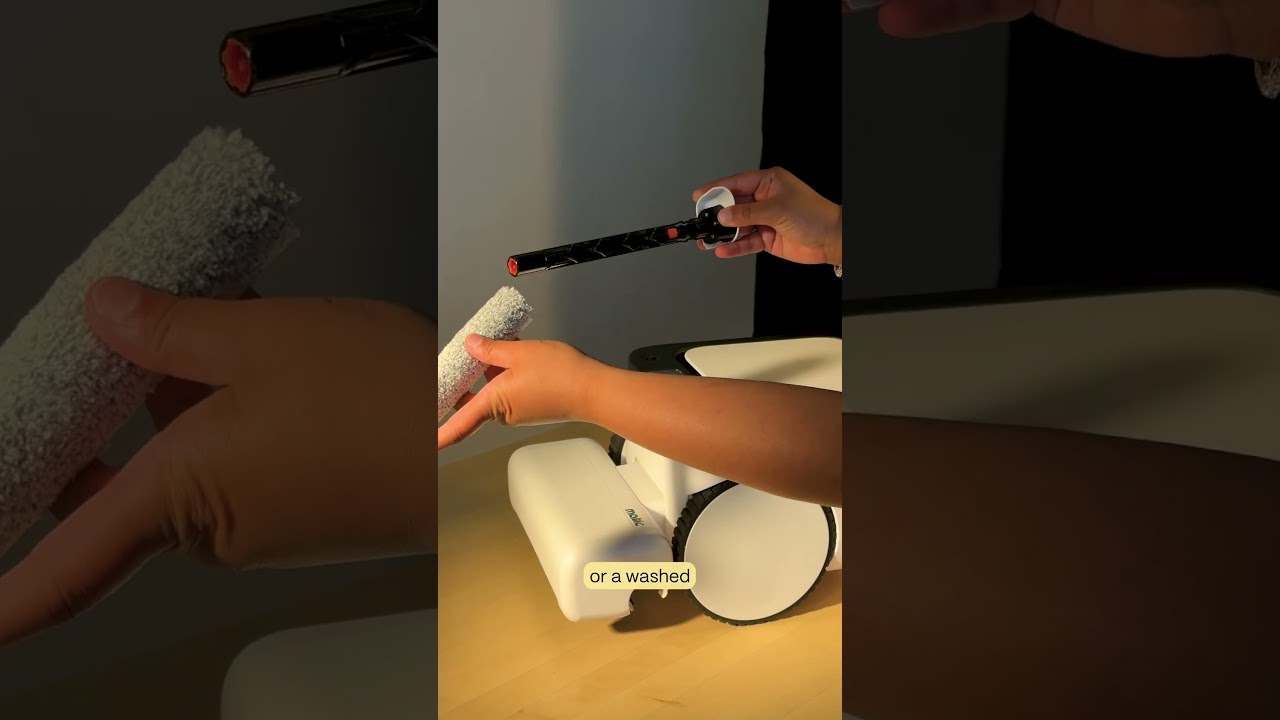
Yeah, yeah, yeah, totally. Yeah, some of the robots that use a mopping system build the mop cleaning system onto the rover itself. Onto the dock. Well, there's a variety of things that we didn't like about that. One is just you are still mopping with a dirty mop for a very long time. Like you finish the entire mopping job and then maybe you come back to clean the mop. Well, the entire time you were mopping, the mop is dirty. It also is more just mechanical complexity because now you need to have like complex mechanisms on the robot for mopping already. And now you also need to have it on the dock. You also need plumbing on the dock. You need water. You need a place to get clean water from. You need to get a place to take the dirty water away. Well, guess what? All of that already exists on the robot. And if you do smart design, you could try to build that into the mopping system itself. So that's what we sort of took as a design direction. So just to explain to people who haven't probably seen or used a Matic before. This is the front of the robot and this here is the sweeping system. I can also like remove the cleaning brush, much easier to do from the top. Right, so that's the sweeping brush. We call it the anti-tangle because the way it's designed, Hair basically never tangles on this robot, on the brush, and finds its way to the corners where you can remove it quite easily. And you don't need to go in with a pair of scissors and cut the hair out. So that's the sweeping system. This back here, this is the mopping system. So if I remove it, this is the mop. It's a plastic sort of roll, as you can see, with a microfiber towel, wrapped around it. And this is the sort of like core that rotates the mop as it goes along. Now, the way we've designed it is this cylinder is always in contact with the ground and clean water comes from the top and wets the mop roll. And now your mop roll is rotating. That clean water travels on the mop roll towards the dirty patch that the robot is trying to clean. And then the clean water is agitated, of course, by the motion of the robot. And that's how the clean water will then start to dissolve the stain or the dirt, whatever it is on the floor. It could be single pass, it could be multiple passes. And then the dirty water then obviously gets picked up by the microfiber towel as well. This is nothing super crazy. This is how people clean anything using a microfiber towel. We've just built the automated version of that. The way the self-cleaning works is we have another part in the back, we call it the ringer. So this is removable. It's removable because at some frequency it does need to be cleaned by the user. And here what you see is this edge on top of the ringer. So it's a sharp edge. I don't know if it's super visible. Let's see here. Yeah. So this is the sharp edge. So this edge digs into the mop roller as the roller's rotating, and then it forms a bead of water. That bead of water is the dirty water that the mop roll has picked up. And then this is even harder to see. Oh, but I think we can see it. It's these 2 holes in the back. Those are the vacuum suction ports where we essentially apply suction and suck up that dirty water bead. So every rotation the mop is doing, it's constantly getting clean water from the top, which is the manifold that supplies clean water, and the dirty water constantly keeps getting sucked out of the mop. So your mop is constantly getting clean. So that's the first aspect of it. I think that's a very important aspect of it. That's how we— increase the longevity of the mop. We still can't make it last forever. Just like, you know, you can use a towel, start cleaning dirty things, and no matter how much you wring it out, eventually the towel's gonna be dirty. You need to either properly wash the towel or get a new towel. So the mop does need to be replaced at some frequency. It won't last you forever, but it'll last you a lot longer because we are doing this self-cleaning operation. The second thing that we do is after every hour or so of mopping, the robot internally keeps track of this. It will decide to do a deep clean. And so this is when the robot pauses and pumps in a lot of clean water. And then just standing in one spot, it will run the mop forward and backward, and then it will suck out a larger amount of dirty water. And because when we do this, we are also able to go back and forth, this has the additional benefit of cleaning the internals, the plastic cavity that might also get dirty, as much as possible. So those 2 actions combined increase the longevity of the mop system quite a bit, right? And if you compare that with a system which is just a flat pad with no self-cleaning, Just within one room, you end up with a dirty flat pad and it's not getting cleaned. And so effectively, you end up mopping your space with a dirty mop. And to me, it's not even mopping, you're just spreading dirt around because most of it is kind of going to stay on the floor.
Yeah, it's really impressive how many intentional small decisions have been made to make sure that the dock is small and elegant and the robot is a better product overall. Yeah, so, you know, obviously the marketing is very intentional, the doc is very intentional, and Sophia has even noticed that the retail packaging is very cool and different. Would you go over that a little bit?
Sure, yeah. I think the retail packaging for sure is sort of the first interaction touchpoint anybody has with the robot in the physical world. And so we wanted to make sure that It's already very inviting and it sets the tone to expect great things from the product. So for me personally, just working on this hardware for a long time, I've tested a lot of the competitor robots. I've unpacked pretty much everything that is out there. And without fail, the most hated thing is opening a big cardboard box And then you know you have a box within a box, but then how am I supposed to get the box inside the bigger box outside? Well, you somehow figure it out. You lay it flat or you cut open the outer box and somehow bring it out. Okay, sounds good. Now the second box will also open from top down. You know, you cut open the flaps, and now you have to like dive into this thing and and pull out. Sometimes even up to like, I would say like maybe 10 kilograms. I don't know how much mass is a heavy dock. It's probably at least 10 kilograms. And that much weight vertically from this box, very, very bad experience. And then you have to sit there and you have to like cut open a bunch of tape, cut open a bunch of plastic. Before you know it, you've already spent 30 minutes just getting the hardware out of the box. And then of course the onboarding experience is another challenge. I won't go into that. So for us, I wanted to short circuit the time between, you have the box in your home, I want like within 5 minutes the robot should be cleaning as much as possible. And so to the extent that the hardware is responsible, we wanted to make the box design very, very intuitive. We can grab the box that is here, actually. So this is what it looks like. So when this box arrives, it's in a cardboard box nevertheless. However, it has to be in a cardboard box 'cause it needs to be shipped, it needs to be protected. But a very simple design detail, we add a handle on top so you can pull the thing out. You don't have to like cut open the outside box, you can just simply pull it out. And then when you do that, You can lay this thing on your floor or on a table, and then you open these latches. There's no tape to cut. You just open these latches. There's 4 of them on either side. And so I'm going to do it right now. You can open these latches, and then this last latch. There you go. And then what you do is you pull out the top box. It goes away. And then when you do this at your home, your robot's sitting there. Already ready to go on top of this base. One theatrical element we've added here, which I love, it's this ramp that opens up in front of the robot. And then all you have to do is press the play button on top of the robot up here. So you just press this button and it'll go. That's it. And then you obviously go through the app onboarding, which is a different experience. But that also doesn't take very long. I would say it's like probably a minute or 2 if you are able to put the dock in a reasonably quick time. So we have been able to achieve the goal of like, you know, get the robot to start cleaning within the first 5 minutes. And yeah, we are really happy with how the packaging is shaping up. And I think we're gonna make it even more impressive as time goes on. We have some ideas, we've toyed around with the thought of shooting confetti as the box opens up, and then the robot can just go and clean the confetti. We haven't quite pulled the trigger on that one. That one's a risky feature, but we've thought about it.
Yeah, that would be really exciting. That would be like a party.
Yeah, it's a party.
There's a lot of questions about, you know, the future of Matic and where it's going. And Rohit has asked, you know, with Matic's Spot, front, and brush layout. How do you ensure that the edge and corner cleaning is effective as well? Are there any plans for stair climbing features?
Yeah, I think there's 2 questions in there. So edge cleaning and sort of corner cleaning, I think the robot is at an advantage because we have a square shape. And so that allows us to go all the way to the edge. And it's not like we have to necessarily depend on a side brush to do it. We can just expose the main brush to the edges where we want to clean. And so we can expose the full power of the suction, excuse me, the full power of the brush as well to the edges. Of course, the side brush also helps. So we have a side brush in the corner and it really is already out there. I think we have Shipped the toe kick cleaning feature around, I wanna say like a few weeks ago, a month ago almost. And so the robot now uses its unique shape to go under the toe kick and expose the dirt to the full suction power. And it'll clean that area up and then back out and then keep doing it as it goes. And so you're able to get very good cleaning in toe kicks. And it's a similar kind of thing where the robot is able to drive right along the edge and use its side brush, which is down here, I can actually show it, to flick out debris from the edge and put it in front of the cleaning path, and then the robot can suck it up. I forget what the second question was.
Stair climbing.
Stair climbing, yes, love that. Yeah, so we contemplated it. I would've loved to build that feature. The sort of mechanical engineer in me loves to build complex mechanisms, and that would require a lot of work. Which is precisely, we didn't end up doing it. I think just for efficiency's sake, if you have a lot of floors in your home, having the same robot do one floor and then climb upstairs and do another floor and then climb up another set of stairs and do another floor, it would take all day. At that point, I would say just have 3 robots. That's how I would want it. I don't think it would be very, very sort of time efficient to have the same robot do it. And then also, in order to really build something, you have to understand this thing is still, I wanna say, 7 kilograms or something. So which is like 15 pounds, something like that. So if it falls down a staircase on somebody, that's not great. If we built a stair climbing mechanism into this, it would be a lot more risky. It's already risky because it has to go around stairs and not fall down. Thankfully, that's a feature we've been able to build and it works great. But then climbing stairs is another order of magnitude harder. And then stairs are not the standard thing. Everybody's staircase looks different. Somebody might have like a marble staircase, somebody might have carpet on their staircase. The shape is different, the curvature is different. That would be a very expensive robot, probably end up being 2x or 3x the cost. At that point, just keep the robot cheap and allow people to buy 2 robots or 3 robots. Without the risk. And so that's how we thought about it.
Well, the good news is that Matic is now available.
Yes.
You've been shipping, so the production units are available.
Absolutely.
James actually has a question about what is our process from going from prototype to production?
Sure. We're very focused on building a great design. Of course, there's economies of scale to worry about. Of course, there's cost to worry about. Of course, there's, you know, supply chain and tariffs and all of those things that we have to worry about to be a viable business and exist in the long term. But I think for us, it starts and stops at what is the customer experience. And, you know, if we can't build a product that is loved by at least some people, then there's no reason to worry about cost. Like, it doesn't matter. So that's where the design process really starts. Really heavily emphasizes building the right features and building them the right way. So the design process just really looks like making sure we understand the priorities of the user, of the customer, so to speak. So on the hardware side, it has always been superior cleaning, extremely low probability of user intervention, especially as it pertains to unstructured user intervention. So like, you know, rescuing the robot from eating iPhone cables or from getting stuck on a carpet or things like that. So cleaning efficacy, making sure there's no user interventions, making the user experience extremely good. So anything that the user needs to do should be very easy and intuitive. And within user experience, I would say noise is a very, very big deal for us. We wanna keep the noise of the robot very low. So, coming back to user experience, one of the things that are somewhat understated until somebody points it out, if anybody here has used a Roomba before, think about the process of removing the bin or replacing the brush. You without fail have to grab the robot, turn it over, and then you can access the brush and then access the bin. Matic is built in a way where you can just come from top down and There's the brush right there. You can remove the mop from the side of the cleaning head right there. So that's the user experience, right? Even the bag and the solvent tank is readily accessible from the top. It's a very small design detail. It's like, I don't want the user to have to turn the robot over because it just will spill dirt everywhere, cause all this chaos. So things like that, right? So emphasizing the user experience over the cost, for example, and then just making sure you stick to your guns when it comes to making design decisions like that. and just carrying that through. Also, just not shying away from building complexity if that's what it needs. We didn't like how mopping functioned on other robots, so we decided to make a better system. It has come with a lot of battle scars. We've fought a lot of technical issues on that project, but just keep building forward and hopefully end up with something very useful and delightful. For sure.
And I would say for me, Yeah, yeah, yeah. Um, there's been a lot of questions about your personal experience and your history, and I feel like we have to shed light on it. Um, so Jordan has asked, you know, how did you personally stay motivated through the setbacks And the long cycles of hardware innovation?
Sure. I think it would make sense to answer this question in a frame of reference of Matic because I think I definitely did not do that at Tesla. I left after 2 years. I think it comes down to why you're doing something. For me, leaving Tesla was a difficult decision because it felt like this is a dream job of sorts that I wanted for a long time. and then eventually got it after a long time, and then now I'm going to walk away. So, of course, coming from an Asian household as well, my parents were like, what are you thinking? What are you doing? Why are you doing this? I'd never heard of this startup. Why would you go do that? But ultimately, it's like I just was more inspired by the idea of building a product like this and also starting from scratch. And so that was my why. And making sure that I had a good reason to do what I was doing. The how can be figured out. You know, if you're doing something you don't really want to do, you're doing it because somebody else told you to do it, then it's going to be a lot harder to stay motivated versus if it's your own decision, you've thought through the pros and cons, much easier to stay motivated for something like that.
And in terms of your team, I know you guys are growing.
Yeah.
Can you shed a little bit of light on who you're hiring for, what you're looking for, any challenges there?
Yeah, yeah, absolutely. We're hiring across the board. You know, I think it's extremely exciting right now. We've started shipping. The customer feedback has been so phenomenally positive. We literally had to put up some bulletin boards where we are every day like pinning up love letters and, you know, photographs we get from our customers using the product. So what that means is a lot more work heading our way. 'Cause we can't be just building like 10 robots a day. We have to scale up to fill up all this demand. We also have to improve the design. So we're looking at talented electrical engineers, mechanical engineers for our team. Our team is strong and mighty. We want it to be stronger and mightier. We are very rapidly scaling up our production team. So one of the roles that I find very, very interesting is the robotics production manager. production internship that is open, and I think that one's really exciting. I wish I had something like that when I was coming up in the design sort of world where I can get hands-on experience on how to build a product that is actually shipping. So production team is scaling in supply chain for sure. We're looking for people who've done contract negotiations, people who've worked with vendors globally, people who have experience in electronics, people who have experience in hardware products. Things of that nature. So pretty much everything, we're looking for exceptional people. We're looking for people who are driven to build something like this. We want to work with people who just like see something special about building a product like this, which can go in millions of people's homes, literally. We don't have any other American company that is building robots for people's homes at a scale at which Matic is going to do. So I think there's a lot of exciting opportunities at Matic in the coming many, many years.
For sure. And there's this question of— there's obviously a lot of hard things about hardware.
Sure.
AJ has asked a really good question of, is there a feature or design element that the team thought would be easier to implement that actually turned out to be a headache when in production? Because we do it all in-house.
Yeah. Many, I want to say. I could say the bag is probably the most sort of nefarious part. So I think the reasons for having a bag hopefully are well understood. We collect dirt and we collect dirty water as well. So we didn't want the users to have to like scrape a physical bin off of whatever water or You know, dirt gets collected. So we wanted it to be use-and-throw experience. Along the way, we discovered that the bag is gonna need to be more complex than we thought. So, you know, as you can notice that it's a half plastic and half fabric kind of structure that is necessary for the bag to be waterproof. We also implemented a few sealing features towards the front of the bag so that it can actually seal with the robot. There's a wet fullness system in the back. So all of this made the bag very good and very nice from a user experience standpoint, but I think producing them has been somewhat challenging so far. However, we are quickly making a lot of progress on that. I think as we move forward in the next few months, we will— we already have these things in the pipeline. The bag design is getting simplified and we're gonna be able to produce a lot more of them really quickly.
We're at time. We have a lot more questions. I know you have written a few blog posts. Do you want to shout those out?
Yeah, sure. I think there's at least 2, if I remember. There's one about mopping. So the mopping has a lot of detail in it. I covered like probably 5% of it today. So if anybody who's interested, you could read it on our website. I think it's called The Magic Behind Maddox Mopping. And then there's another one that I wrote about the brush roll itself, which is, why is Matic's brush roll better? Something like that. And that one goes into the details of how we thought about it and how did we make it not get stuck on hair and things like that.
As well as all of our social media platforms, which is all Matic Robots. There's a lot more questions. I'm sure you can write blog posts about all of these and actuation and everything like that. Yeah. Any last words from you?
Yeah, I will just say like, you know, thank you so much for being interested and being curious about Matic. Glad to be able to answer some of these very, very well-framed and good questions over here. Hope to see much more feedback if you people end up using Matic. We know the design's great, we know it's not perfect. We'd love to see more feedback always. Yeah, and thank you everybody for coming online today. Awesome, thank you.