Mehul Nariyawala, Co-Founder of Matic - Ask Me Anything

In this AMA, Mehul Nariyawala, co‑founder and president of Matic Robots, discusses the company’s vision‑first, camera‑only approach to autonomous home robotics. He traces his background from early computer‑vision research (Histogram of Oriented Gradients) through startups Light.com, Flutter, and a senior role at Nest, explaining how those experiences shaped Matic’s focus on on‑device spatial AI. Mehul describes the technical challenges of building a fully autonomous robot vacuum: rewriting SLAM from scratch, achieving high‑accuracy mapping with a combination of classical and neural‑net methods, handling dynamic indoor environments, and ensuring low latency and privacy by processing all data locally. He explains design trade‑offs such as using only RGB cameras (no depth sensors or IMU), infrared night‑vision, a quiet low‑suction brush‑roll system, and a larger form factor that balances under‑furniture cleaning with reliable performance. The conversation covers product roadmap items—toe‑kick cleaning, dirt/mess detection, voice/gesture interaction, and future manipulation arms—along with manufacturing and pricing strategy (premium launch, scaling to affordability). Mehul shares lessons learned about hardware vs. software focus, the importance of solving a concrete user problem (set‑and‑forget clean floors), assumptions that proved true (customers want a “set‑and‑forget” robot) and false (over‑reliance on many sensors), and advice for aspiring entrepreneurs. He also touches on privacy‑by‑design, building in the US, team culture, and future expansion plans.
Chapters
Hi everyone. Hi everyone. Thanks for joining. We're excited to have Mehul Nariyawala here with us today for our AMA. He is the co-founder and president of Matic Robots, where he is rethinking what home robotics can do in an AI era. Mehul is no stranger to groundbreaking tech. His past startups, Light.com for facial recognition and Flutter for hand gesture controls, were both acquired by Google. And while there, he led Nest cameras lineup. Adding over $250 million. Now at Matic, boundaries of vision-only spatial AI to make home robotics that are actually autonomous.
Hi everyone. Hi everyone. Nice to nice to have you guys join me as as you know as Zhang Ming, thanks for the intro. For the intro. As she mentioned, as she mentioned, we are we are. We started with Matic in 2017 and started working on this robot vacuum and excited to finally get it out and do this AMA with you all. Perhaps I can start with a little bit of a background. So as Shango mentioned, mine and my co-founder's background is in computer vision. We've been in computer vision-oriented startups since 2005. His PhD thesis Navneet's PhD thesis is actually probably the foundational piece of classical computer vision. It's called Histogram of Oriented Gradients. And those who know, those who may have taken computer vision classes, you've probably heard of it. And it was just a single paper on his PhD thesis, has about 50,000 citations now. So it was a bedrock for about 10 years until deep learning methods, some of the deep learning methods took over. And we went from from Lyte.com to Flutter to Nest cameras to now doing Matic. So that's sort of a quick background along the way. But the way we always talk about is that our strength is taking computer vision as a research and pushing it into the products.
That sounds good. To start, we have a question from Ken Lee. It's, what's the most surprising obstacle you've encountered in making robots truly autonomous in unpredicted home environments?
That's a great question. So I'll actually take a step back and start from the beginning and give everyone a background on what we've been— why we started and what we had to go do it and some of the decisions we made. But really, in 2017, we left Nest and Google. Because we had been at Nest, we had been thinking about homes. And it sort of just peaked— we realized that, hey, there were 200+ self-driving car startups in the world at that point in time. There were equal amount of industrial robotics companies. But when it came to home, all we had was Roombas or Disc Robots. And initially, I had this inkling that Dyson eventually will come into this space and do a really, really great job with the robot vacuum. So I was actually one of the first ones to order Dyson 360i robotic vacuum back in 2016, even before we left Nest, and used it and realized that— Dyson has an amazing suction power and battery and vacuum components in itself. They're phenomenal mechanical design and mechanical company. But when it came to algorithm, that vacuum was probably the worst vacuum I used, robot vacuum I used, and simply because 9 out of 10 times, it wouldn't even be able to find its own dock. So that's when we realized that computer vision approach that Dyson was taking was potentially the right one, but they were really, really lacking behind. The second thing was also that it got onto— Dyson has an amazing suction power, and it got onto one of our really, really nice rugs. And because of the suction, it got stuck on it. And while it was stuck, it actually kept the vacuum on for 45 minutes, and we weren't at home. So when I came back home, looked, found the robot, and picked it up, I realized that the entire patch of the rug was gone. So that's when I realized that actually, even if it doesn't— it didn't even know that it was stuck on the rug. It didn't have any understanding, and it kept going on. It will really ruin rugs itself. And second part was that maybe the suction that Dyson talks about isn't needed. So those were some of the things that were back of our mind. And it piqued our curiosity that, look, why isn't anyone tackling this home chores, home robotics problems? Why aren't there any robots there? So Navneet and I spent about 2 months just digging into robotics itself. Prior to that, we had no sort of background in robotics. So we just spent a couple of months doing it. And very quickly, we came to this conclusion. And this was our conclusion, that the entire field of indoor robotics, and specifically robots in homes, is built a bit upside down. It was like putting a cart before the horse. And the reason I say that is because even though self-driving cars requires all these sensors and vision and amazing algorithms, There are 2 things that self-driving cars have, which is Google Maps and GPS. So at least they know where they are located onto the road and which road and where road will be going. On the flip side, when it came to indoor robots, the analogy we realized is that in 2002, Roomba did a phenomenal job when there was no AI or technology available, did a phenomenal job of building a robot which had sort of this blindfold on it, would just bounce around and clean our home. That was a really great way to start robotics. But then along the way, more sensors got added, but those sensors weren't really converging into intelligence. Robot didn't really understand which part of the home they were, whether they were in a kitchen or dining area, right side of the living room or the left side— I mean, right side of the couch or the left side of the couch. So we just realized that, look, if you're going to build fully autonomous indoor robots, then we should give it the same perception system that we as humans have. which is 2 RGB cameras and bunch of algorithm. And this is because, and this is the insight that Namneet and I have been operating on, that indoor world, and specifically homes, are built by humans for humans to take advantage or fit our perception system. They're optimized for the vision-based system. So if we're going to have Level 5 robots, and definition of Level 5 being that if a Level 5 cars drive like humans, then level 5 robots must behave, navigate, and manipulate objects, and do tasks on our behalves like humans. So if that's what they're supposed to do, then they need to have the same perception system as us. So that's where the decision came that, hey, we're going to actually do the whole thing on the device using— sorry, using cameras only, and see if we can solve the problem by giving a similar perception system. But along the way, we realized that if you're going inside homes just with cameras, then privacy is an issue. Latency is an issue because you don't want a robot that says, oops, I fell down the stairs, or I fell on your pet or kid because Wi-Fi is weak. So latency is an issue. And then the third thing we realized that the indoor space is actually far more dynamic than the outdoor space. So you can't just have a static map like Google Maps. You need dynamic maps that can map itself. So your robot that maps itself in an environment. And that's where we decided that we're going to do the whole thing on the device. So the robot can always update itself and observe the changes in the environment, delta in the environment, self-correct, as well as preserve the privacy and be really, really low latency. So that was the thought process. That's how we started thinking about it.
Yeah, no, for sure.
And what was the obstacle? Well, everything about robotics. And now I like to say that if hardware is hard, you know, there is a cliché in Silicon Valley that hardware is 10x harder than software. And I'd like to say that now that Robotics is probably 10x harder than the hardware itself. So it's a much harder thing because we had to do everything from ME and mechanical design to platform to OS-level optimization all the way to algorithms. So just putting everything together in a way where robot just works and everything behaves in an expected fashion is quite a challenge in itself. And then the second part was certain assumptions to be made along the way. So one of the assumptions was that, hey, SLAM, which stands for Simultaneous Location and Mapping, which is the precise localization algorithm, theoretically SLAM was solved in mid-'80s. There were a lot of papers published on it, and there was this assumption that SLAM is a solved problem, and there are tons of open-source libraries available as well. So we started with the assumption that we'll be able to use it. But when we started digging into it, we realized that none of the open-source algorithms had the required accuracy. The best analogy for that is that, you know, touch interfaces were available prior to iPhone, prior to smartphones. But back in those days when we used stylus, those touch interfaces weren't really that great. Or if you've used ATM or early TVs behind the seat in airlines, you know that you had to jab your finger with all the power you can muster to make their touch interfaces work until iPhone came out and made them really, really amazing. In a similar way, SLAM systems were just about 70% to 80% accurate. And we actually decided in 2020, I wanna say fall of 2020, that we're gonna rewrite everything from scratch. And that was one of the obstacles that we didn't anticipate having to solve, but we did.
For sure.
Okay.
And as you mentioned, hardware is hard, robotics is 10 times harder. One of the questions we got from Dan is, Hardware production is costly, an evolving nightmare. How do you scale from prototype to product, and why pivot away from a software background?
Yeah, so, so that's a great question, Dan. We, when we left Nest, so, okay, I'll take a step back. Between Flutter and Nest, we actually went to Nest just because we wanted to understand hardware and we wanted to learn how to do hardware. And this is because with Flutter, we did gesture detection or webcam. It was essentially Microsoft Kinect, but just using these cameras that we have. And we had these gestures, which was play, pause, previous song, next song, thumbs up to like song, shush to mute. So you can control your iTunes and Spotify using those gestures. It was great. And we built this algorithm and it became number one app in 73 different countries worldwide. But we realized that we didn't have access to this camera. So we didn't have frame rates per second. We didn't have auto exposure. So it was like building algorithms for a eye that was out of our control that might be even wavered. So we felt like we had built half the solution, and if we had access to the cameras, we could have done a much better job. But at Flutter time, we had no background in hardware whatsoever. So one of the big lessons that we took away is that if you're trying to solve a problem, you can't arbitrarily limit yourself to hardware or software. You have to say that what is the best way to solve the problem? And if that means hardware, then we should go do it. So with the problem that we had, and this is my own personal problem, I have 3 kids, I had a golden retriever dog, and I was using all these robot vacuums and just realized that they were all sort of sensors first or mechanical first. And we came to conclusion that it required a vision-first approach to truly solve them. And that meant actually doing the hardware and solving the problem using product. And that's what we decided to do. And the reason to do product as well, and this has been, Namneet, in our philosophy that If you're trying to genuinely push the algorithm to the nth level, then you have to productize it. The only way to know if your research or algorithms work is to put it to the test in a real environment, and because that forces you to go through challenges that you may not have thought through when you're just doing research. So when you publish an algorithm, you're taking it from 0 to 80, but really shipping it to customers requires it to take— you to take it to 99.99%, and that means productization. And that's what excites us, which is getting it to the hands of the users. So that's why we We decided to do hardware.
For sure. And there's definitely a lot of happy users right now of Matic. And another question we got was from Dan Zhu. For consumer robotics, what is an assumption about customers that was proven false and what was one that was proven true?
Great question. So we started— when we started Matic with a robotic vacuum, desire to make robotic vacuum, We had heard from a few folks who had worked at Nido or other places. They had given these long interviews in Wirecutter, and we had read those interviews, and they had mentioned that actually navigation inside homes in an unstructured environment is arguably even harder than self-driving cars. And we obviously didn't believe that. Self-driving cars' mistakes are much more fatal versus inside homes. If a robot made a mistake, it's not necessarily going to result in any sort of fatality. So we thought that Mistakes— there are mistakes like going over dog poop or falling down the stairs, which are really, really bad. And we call them deadly sins inside Matic. But beyond those mistakes, some mistakes are trivial. So we thought it would be easier, relatively speaking, to get the robot out and improve algorithmically in this space. And what we realized is that actually, when it comes to robots and specifically this particular problem of floor cleaning or any home chores for that matter, We as humans and customers, we want to just delegate, set, and forget. We don't want to constantly collaborate with it or rescue it or help it. And that's the part that I think many consumer robotics companies potentially underestimate, that with AI, if you're doing coding or if you're doing any sort of image generation, We tend to collaborate with current AI. We tend to ask a prompt and tell it to make different stuff, and it's sort of back and forth. And that's fine. Collaboration with AI is great. It gets us to the task, and we understand that coding is hard. So even if it gets 80% of the answer right, we are mesmerized. But on the flip side, with robotics, we don't go to school to learn how to navigate home without bumping or how to vacuum. A 5-year-old, 7-year-old can do it in a pretty decent manner. So in those scenarios, in the tasks that are trivial, when robot makes a mistake, customers get frustrated quite a bit and they think it's stupid. So there is that balance that we have to drive. So accuracy and 5 nines is really, really critical. And that was one of the things we learned along the way, which we weren't anticipating.
No, that's definitely very true. And no one ever teaches you how to navigate a room. I can't imagine how challenging it is for a device to learn that. And that relates to the question of what Dan asked about. He was skeptical of vision-only navigation, especially in darkness. He's now convinced. He's a happy user of Matic, I believe. Can you discuss challenges of on-device AI navigation?
That's a great question, Dan. I'm happy to talk at length. To be entirely honest, that was one of the risks When we started out, we really didn't know if we can just solve it using computer vision. We felt that was the right approach, and that was the approach Tesla was taking with the self-driving cars and full self-driving as well. So we thought there was an approach and plausibility into it. But we decided to do it because of a few reasons. One is that when we looked at robotics and robotics attempts over the last 12 years prior to 2017, we sort of noticed that there were Kickstarter campaigns after Kickstarter campaigns that were funded for various robotics companies. But typically what you observe is that by the time that they were ready to ship, either the robots became prohibitively expensive or they never shipped. And this is because each sensor— we had this rule of thumb at Nest, and Nest hardware experience came in really handy. But we had this rule of thumb at Nest that a single sensor you add in hardware assume 2 or 3 software engineers on a flip side as a permanent cost. So more sensors you have, the bigger the team. More sensors you have, more complex the manufacturing supply chain. More sensors you have, more calibration, more failure points, more complex the software stack itself. So with each sensor you add, complexity rises exponentially. So when you take a sensors-first approach, it's very easy to build prototypes, but then when it came to scaling, we realized that it actually gets much harder. On a flip side, doing vision-only approach meant that we just have 5 cameras, and that's really it. Those are the sensors we have. We don't even use IMU at the moment. So just vision-based approach was far more challenging in the sense that initially we'd have to absorb all the complexity in hardware— I mean, sorry, in software. And that would take a long time. But if we can pull it off, over time, complexity asymptotes. And software-based updates are much easier than the hardware sensor-based approach. That's where we can ship a lot of over-the-air updates and continuously improve the product along the way. That is 100%. But also it keeps the innovation affordable. So that was the reason why we chose to say, can we use the robot AI navigation? And it has been hard. It has taken us 7 years precisely for that long, that no one has ever done this before at the level that we have done and as optimized as we have we done. have with just 4 GB of memory on our Orin Jetson Nano platform.
For sure. And it seems like there's a lot of work that has gone into the software, but I believe there's been a lot of work as well that's gone into the hardware. And a question that Nitesh has asked is, are you considering adding an arm to your device? A common use case to me would be to move a movable object. That's what we do as humans.
Yeah, that's a great question, Nitesh. There are 2 aspects of it. So one is that I don't know if arm is necessary to move. Meaning that the robot itself is pretty dense. It has this cleaning head. Maybe there is a way for us to actually move things out of the way or move things into the proper place, even with Matic itself without doing it. And hopefully you can sort of imagine where our roadmap is going in that direction. So that's the first part of it. And then the second part itself is absolutely, you know, there will be a future where we add hands because we didn't start Matic with this idea that we're just going to build a— reinvent the robot vacuum. That's what we wanted to do. We wanted to reimagine and reinvent it. But that was always the step one. We, the— all of us who are robotics enthusiastic people or enthusiasts, we've always dreamed of Rosie the Robot from Jetsons. And that is the goal, that can we not have a Rosie the Robot? Can we not get rid of mundane and repetitive chores from our lives? So that's what we want to do. And our goal and our approach has always been that we will do it with a product-first approach. So what product we can ship along the way, but also do it the way human child grows. And this is where Namneet's computer vision philosophy has always been that we don't want to bet against nature. And nature chose us to give 2 RGB cameras versus some version of a depth sensor. So let's Go with RGB cameras. In a similar way, we don't come out as a baby and are amazing from dexterity or manipulation point of view. In fact, what we do is first 5 years of our life, we just— lives, kids just learn how to perceive their homes and navigate from point A to B. And that's precisely what we've solved in the context of robotic vacuum and matic, first matic. But then as they grow between 5 to 10, We don't give them sharp objects yet. We don't give them complex manipulation tasks. Instead, what we do is we just tell them, give them soft, unbreakable items like shoes, socks, backpacks, and teach them to move those things along the way. And as their motor skills improve, as their perception of the world gets much more accurate, around 14, 15 is when they become a full humanoid, like a body form. And that's when we trust them to do far more complex tasks. So in the same exact way, we anticipate— this robotics to evolve in multiple steps. And first step is solving perception. Next is solving manipulation, and then eventually putting everything together to say, can we have a Rosie the Robot in our home?
For sure. And, you know, Tony Lee has looked at the website, and he has seen that there are a lot of new and exciting upgrades and developments coming to Matic. So one of his questions is, Of all the exciting features labeled under coming soon on the Matic website, which one is the main focus for the team right now?
So I know a lot of you have been waiting, eagerly waiting for toe kicks, which is the space under the kitchen cabinets, as well as improved edge cleaning. So for last month and a half or 2 months, I want to say that's the only focus we've had internally as a team. And we're about to ship a version hopefully today or maybe tomorrow. As we kind of put finishing touches, which is the version, I want to say, 0.5 of Tokit. So I'm super excited for everyone to experience it and push it out there. So that's number one. Then the next, from here onwards, there are 2, 3 features that I'm super excited about. And one is really this concept of dirt detection and mess detection. And that we want to do visually as well. And this feature was really critical and is really critical Because we also, a long time ago, asked this question that what does it mean to be a level 5 robot inside home? And as I had mentioned, level 5 robot means that it should behave like humans. So in this case, it should floor clean like humans. So if it is floor cleaning like humans, then why are our robots sitting on the dock 23 hours a day? Or why they only take off when we give it a command or when we schedule it? Shouldn't they just throughout the day constantly explore our home, scout for dirt and dirty— and stains? And if it finds it, it should just clean it. Because we as homeowners and users want to live in a perpetually clean home with perpetually clean floors. And dirt detection is a key piece of the puzzle that, hey, can we just go and look for dirt and find it and just keep it clean? Or if you tell robot to say, let's say, spot clean, can it actually go into that area that you just pointed out and look for dirt and keep cleaning it until the stain is gone or until the dirt is covered? So dirt detection is a really exciting part. And then the second thing is just a very, very easy interaction point of view. So having gestures as a background, having done human-computer interaction work in past, we know that natural language instructions and gestures are the way to go. That is the future, that all computing should understand our interaction method. So first step was to add information like room labels and some other semantics like wires. But now we want to enable very simple commands like, hey Matic, go clean the kitchen, or hey Matic, go clean mess inside the kitchen. So these are the things that we are really excited about as we move forward. And then the third thing is, as I mentioned, that we believe that there is an opportunity to do manipulation and some tidying up even with the current version of the Matic. So that's the third one that we haven't publicly talked about even on our website that we are super excited about working on.
Sure. It would be an awesome world if all these advanced features could come out. And so the question is, how do you keep home robotics affordable and accessible with all of these advanced AI and upcoming features coming up?
That's a great question, Ken. And the question is very simply by improving the software. This is why we built everything on the device. Your computers, your phones get OS updates, and they get better and smarter every year without you actually having to purchase new hardware. So in the same exact way, we wanted to enable, build this vision-based autonomy where software is the key piece of the puzzle and keep improving it. So our goal is to keep improving the software, but also as we scale, reduce the cost of the hardware, reduce the cost of the sensors. By keeping it simple, the designs and motor selection and everything along the way, we can make it affordable and we can keep improving it. As we move forward, I believe whether it's robotic hands or any sort of next robot, initial versions might probably be expensive, but that's where we hope to take a little bit of a Tesla approach where initial Model S was expensive, but the goal is to democratize robotics and get inside homes by creating Model 3 or even more affordable So in the same exact way, we anticipate that we will start in a premium category, but as we scale, we want to keep making it more and more affordable across the board. And that actually applies to our bags and consumables as well. There was a question about whether we are doing a razor. We think of it as making bags or consumables really high price is a sort of a perverse incentive. in the sense that we want to make sure that you clean as much as possible. So as we scale, we want to make our bags and consumables even cheaper. And that's the goal. That's the way we are doing it. And even now, we believe that our bags are much cheaper than what might be available out there with a far better value proposition, including HEPA filter and some of the other advancements that we have made.
For sure. Paul asked a really great question. It's actually one of my favorite things about Matic is how it's able to differentiate different types of surfaces. So his question is, how does Matic's approach to mass detection and surface recognition set it apart from—
Give me a thumbs up, someone, if you can hear me.
Okay, perfect.
Okay, perfect. Okay, great. So in terms of Matic's approach, we just, at a very high level, we just came to this conclusion that if Matic can see it, if robots can see it, They can navigate it. If they can see, they can avoid any obstacles. If they can see the dirt versus mess, they can do it. In the same exact way, we tend to see our floors visually. So in the same way, can we take a visual approach to solve that problem, which is we just use cameras to say, make and try to detect visually whether it's a carpet or a rug or hard surfaces. And over time, it just gets better and better along the way. Now, there are times where it will get confused, and we do as well. But at that point in time, we can use cleaning head actuation or a few other ways to figure out the difference. So there are tricks of the trade over there, but it is really just the vision-based system that we're working on and solving it that way. And that is also the reason why our robot is slightly taller. One was through that with bigger wheels, it can go over thick pile rugs and wires and thresholds and hard surfaces and navigate it very clearly. So we just felt like, Roombas and disc robots were built for a world that was wall-to-wall carpet back in late '90s and early 2000s. Now it's much more hard surfaces, thick pile rugs, thresholds, wires. So bigger wheels allows it to navigate very clearly. But that also means that our cameras are about 8 inches high from the floor. So just like a crawling child, it has a top-down vantage point, which allows it to see the floor or obstacles a little bit better than a sort of a flat robot. If you have a flat robot, then you might have a— sort of ant-like vantage point, which is not necessarily a right way to go and detect various things.
For sure. We have a lot of questions about Matic's approach and how we're building. And Jianhao asked, how does the team approach the state estimation of the robot, especially with noise in the dynamic model and sensor data?
I think by— you're talking about how does team approach do the state estimation. You're referring to SLAM specifically? And the answer to your question is that it's a combination of both classical as well as a neural net-based method. So we have 2 pieces of the puzzle that we've talked about publicly. One is that we have image-to-voxel neural nets. So what we do is use images to detect depth and turn it into voxels, 1-centimeter cubed voxels, and rebuild the entire 3D Google Street View-like map on the fly. And that allows us to create this environment where robot knows what the distance is. And then we use a long-term SLAM. And then as I said, it's a combination of both classical as well as neural network techniques to actually use it. And I'm going to brag on behalf of our team here, but we do believe that our SLAM is 10x better than anything out there in terms of SOTA or open source. And it's really a spatial AI-based approach that we are taking into account and really It's the honest answer about SLAM is that there are things we've done at a very tactical level which are quite innovative, but it's really just going and doing it. It's a grind. There is no silver bullet there. It's a bunch of lead bullets that we've used to make sure that we keep fixing every single obstacle along the way to get accuracy at that level. And it's just pure grind. There is no sort of rocket science.
For sure. And it's definitely very impressive seeing Matic map everything out in real time.
Yeah, actually, if you're ever curious, if you have Matic sometimes, and if you are in a room where it mapped itself, just cover the crown, the black part of the robot right here, cover the crown with a piece of cloth and move it to the other part of the home where it has mapped before it has been previously. And if you remove it, it will immediately relocate itself. And that would happen in various lighting environments as well. So we've actually really worked hard at making sure that Matic Understands that. And the other part— sorry, I'll add one more thing. Another part we realize is that most robots build what we refer to as relative maps. And what I mean by that is they have to start from the dock and then map itself. So they only know their location relative to the dock. Instead, what we do is we build an absolute map. Which means there is no— and if you've used Matic, you know that it comes out of the box and starts mapping. It doesn't need to be on the dock itself to begin that. So dock is just another information in the map. There is no reference point to it. And that adds the precision level much higher because now we don't have to worry about wheels slipping or any sort of issues or dock being moved. That doesn't have any impact on the map itself. So an analogy I usually like to say is it's as if It's as if typical robots are that, hey, I can navigate a home if I came through front door because front door is, let's assume, is a dock. But if I came through side door or back door, I can't navigate. Versus we have given a system where it's much more human-like that regardless of whether you enter from front door, side door, or back door, you can navigate the home because it has an absolute map.
For sure. And it's also really awesome that it can navigate the map even at night.
That's correct, yes. So we have— thank you for bringing that up, Changming. So we do have IR LED lights onto our crown. So this part here in the middle, as well as on the top, and when we have back cameras, we have IR LED lights, so infrared lights that illuminates the space at night. And we used IR because that is invisible to us as human beings. So for us, we can't see it, but cameras do get gray images, and that allows us to do everything from cleaning to navigating in the same exact precise manner that it would do it. So in very simpler terms, it's literally like headlights for the robot, except those headlights are visible to human beings— invisible to human beings, but visible to robot.
Sure.
And thank you. Yeah, it does. Night cleaning is something that we work really hard and making it quiet so that— because one of our goals was always to wake up to a clean home. We call it Zen Rise.
Some questions about your personal experience. So with 7 years of home robotics under your belt now, if you could start over, what would you do differently? What would you do the same?
So there are a lot of great questions there. I think it's very hard to drive looking into the rearview mirror. It's always easy to connect dots in hindsight. So if I look back over the 7 years, Maybe, you know, we did do a lot of research. There are things we obviously got right and obviously got wrong. One of the things we got wrong was choosing Ambarella as an SoC platform initially instead of NVIDIA. And that probably cost us about 9 months to a year in terms of just being able to delay when we transitioned from that platform. So in hindsight, I would probably just pick NVIDIA if I could. But beyond that, nothing really has changed. Every single thing that you see on our website, every single thing that you see in our product, these are all the things we've been wanting to have since 2018, 2019, when we went back and did user research and did all the work on what product we were building. And our vision has remained consistent. Our execution has remained consistent. I think if anything, now is a— now the timing is even more better So we had this inkling back in 2017 that AI would have a huge impact over the next 10 years, as well as Navneet, my co-founder and partner and CEO of Matic. He worked on Google Coral Tensor Processing Unit, TPU. So he helped develop that TPU chip from Nest's perspective. So we knew that AI chips are coming and computes will skyrocket. And these 2 combinations would enable robotics. So if anything, I feel like that future that we had anticipated in 2017 is now here. And it's even more exciting time to get started and push the boundaries of what robotics can do.
For sure. So that's a little bit looking back, but there's a question about the future that Paul has asked. And it's about, if you had one piece of advice, what would you give to aspiring entrepreneurs?
My phone camera keeps connecting to the thing instead of mine. OK, now we're back, maybe.
It's working. Yeah.
Okay. All right. Good. Okay. So, so, so as long as it's working, that's great. So yeah. So yeah. So, so we're back. So in terms of future and what you could start with, I think one of the things that I've observed and I would kind of talk about is that we as nerds and, and robotics and people who are engineers, we're excited about robots. And we're excited about AI, and we're excited about all the technologies. But one of the things we learned back at Flutter as well, and here now, is— quick, can you hear us?
Mm-hmm.
Okay. Back at Flutter and here now is that people don't want robots. They want solutions to their problems. And robots and AI and software is just a means to an end. So if you're going to go start a robotics company, first, please pick a problem to solve. What is the problem? What is it that people are looking for? Robots are really cool and exciting, and we made this mistake, honestly. I mentioned Flutter. Flutter was gesture detection over webcam. Gestures were really, really cool and exciting, and we got a lot of love. But we learned the hard way that no one wakes up in the morning and says, today I'm going to buy gestures. That's not a product. It's a really, really cool technology and a really, really cool way to interact with your TV if it had gestures and camera enabled. So for us, when we started Matic, the goal was always to solve a problem. And the problem that I have as a family man, father, and a homeowner is that I want to live in a perpetually clean home with perpetually clean floors. I don't want to do it myself, and I don't even have time. And ideally, I don't even want to think about it. So can we go solve that problem? Can we apply technology that way? And that's really how we started thinking about it.
For sure. There's a lot of questions coming in about the actual building of the robot. A question that Dan has asked is, can you elaborate a little bit more about your pride on building in America as well as the focus on privacy?
Yeah, so that's actually— luckily, having gone at Nest and having worked at Nest Camera, we realized that cameras inside homes create a different anxiety, and families do not want to share their— which is, I'll take a step back. The realization was that homes are a sanctuary. Families, especially my wife and a lot of our significant others and partners, go out of their way to decorate it and make it a safe place for our kids and family. And that's where we can be truly ourselves. And having cameras or any sort of audio or video thing just sort of invades privacy. And Silicon Valley, there are so many amazing things about it, but for whatever reason, we have taken this data and privacy aspects sort of for granted, and we just take consumers' data without really asking their permission. And we just felt that that wasn't the right way to go about doing it, that we need to kind of take a step back and say, hey, just like our appliances don't really need data to operate perfectly for years and years, there has to be a way to build IoT devices and robots and products that are not really invading families' privacy. And in a very crude way, I shouldn't have to compromise my family's privacy just to clean my floors or just to get the dishes done. And that was the approach that was really, really powerful to us, especially in a connected world where everything can be linked online. So that's where we really wanted to make sure that family's privacy is preserved. And we felt that was the right way to do anyway because that allows for low latency dynamism on the robot. And robot can be really effective. But the best way to scale, best way to grow robot is to make sure that robot becomes your family member and it belongs into your home. And if it belongs into your home and it is sort of a family member, then it should preserve the privacy the same way other family members do. So that's the analogy we take and take it to the end level.
For sure. It's definitely really awesome that everything is stored on device. I don't think there's a lot of hardware products like that.
Correct. And then hope is that we can start a trend where a lot of people developing from here onwards go in that direction as well.
For sure. We have another question about your personal experience, and it's from Paul. Paul is curious, Mehul, how did your work on gestures and facial recognition at Like.com and Flutter shape your approach to human-machine interactions?
A great question. Honestly, that's where we learned that— the biggest lesson we learned that computer vision, AI, human-computer interaction, all those things are sort of a means to an end. And as a human, most of the time, I don't want to learn. I don't want to learn a new way to interact. So when we were doing gestures at Flutter, for example, Most of the time when engineers and research scientists do gestures, they turn our finger or hand into a mouse. And that's how Microsoft Kinect was. If you had— if you'd used it, you know, it turned your hand into sort of an icon and you can point and click. And we just thought that was really an unnatural way of doing it, that point and click was— is an abstraction we invented. What's more natural to us is our own body language, the natural language that we learn, which is English or any language you may have. And if, as computers get Smarter, they should understand us. We shouldn't have to keep learning the new ways to interact with them. So that's where the approach came that how can we make it so simple that as they get smarter and smarter, we can just give them same instructions that we might give to our child or any other person in the family.
For sure. It'd be really awesome if you could talk to your Matic like you can talk to your friends.
Yeah. And that's something that we haven't shipped yet, but that's something I'm really excited about, just simple commands, especially If you have families and kids and young kids, your phone is not on you all the time. You might be actually feeding your child or doing other chores or playing with them or making them do homework. And at that point in time, being able to just talk to Matic and tell it what to do is actually really powerful. So that's where we want to go very soon.
Even for elderly, they don't have the mobility to do such things.
Exactly. Exactly. And they don't even want to learn.
Yeah, for sure. We have a fun question and it's about Matic's marketing. So are we looking at any product placement arrangements in any sci-fi shows or movie? You talked about Rosie the Robot, any other?
Yeah, hopefully that's the way we go. I think we need to get, as the word about Matic spreads and as the word about our approach and visual intelligence spreads, there will be an opportunity and we are always looking into it in various ways to kind of highlight Matic go do it. But I think from an entertainment perspective, once we have features like voice and gestures and maybe mask detection, that's when it gets really, really interesting. And we will definitely look at opportunities to go do that.
For sure. You know, as a founder, there's a lot of challenges, and one of the big ones would be your team. How is it growing? What are some of the challenges that you have experienced when expanding your team?
I think we are a little bit lucky in the sense that robotics is an exciting field and AI is an exciting field. So there have been a lot of people interested in working with us. I think the thing that we've always sort of looked for is that do they have the product mindset? Because ultimately we want to be a product company, not necessarily robotics or AI company. And that's where we've had a good time. But I don't know. if there were any significant challenges except saying that this is a grind. I think most for us, most of the team, we wanted to make sure that they understood that this is a marathon, not a sprint. And it takes, it takes a lot of hard work to ship something that just works.
And there's definitely something magical about seeing the product develop.
Exactly. And then the journey and then a lot of it is, you know, the analogy. If you had come to our old office, I had a picture on the wall behind my desk and that kept saying, just keep swimming. So how do you find a Nemo? Just keep swimming. So how do you build a robot that everyone loves? Well, one step at a time. So that has been the inspiration for keep going for 7 years.
And another question we get, and this is a question we actually get quite often, is at what point will Matic robot vacuums be offered in other countries?
Yeah, that's a great question. We'd love to do it as soon as possible. For us, the challenge is that we are at the moment barely able to make enough to serve the demand in the US market. And then with a small team of 60 people, it takes a lot to meet other countries' requirements from translation and language to different regulations that we have to abide by. per country. So really, um, the challenge hasn't been— it's not that we don't want to sell it, it's just that when do we focus on those particular aspects. And, and so it's just serializing those things as we move forward. So first solve it for US. Once the product is complete, we'll definitely looking to expand, hopefully sooner rather than later.
For sure, that's definitely something we're looking forward to. Um, Tony has asked another really great question about, you know, your journey of creating MAD and Like, how has that differed from other startups? You know, what skills and experience have you found most useful from your prior experience?
Great question. I think we knew when we started Matic that we have to build a company and a product that takes advantage of computer vision, that we had a computer vision background, and that's what we are good at. We were quite aware back then, because crypto was really hot, that if we try to go do crypto startups, someone will probably kick our behinds who are experts in that, but our background was in vision. So I think vision is the one place that has helped a lot. And second thing was along the way, we have— we learned what it takes to build a great product, where we learned how to build an iconic product and magical experiences. So that's really the journey that we've been at, which is how do you turn technology into this, this product and experience that solves problem delightfully and simply? And, and that has been the question. I don't, I don't want to say if we've figured it We're far, far away from figuring it out. I think Steve Jobs was the only one probably who figured it out. So, so, but we're, we're, we've learned along the way how to get there and how to simplify it. And that's really the advantage we have, if there is any, from that perspective.
For sure. And, you know, one of my favorite things about Matic is I'm able to run it when I can watch TV because it's so quiet. And that experience is really magical for me.
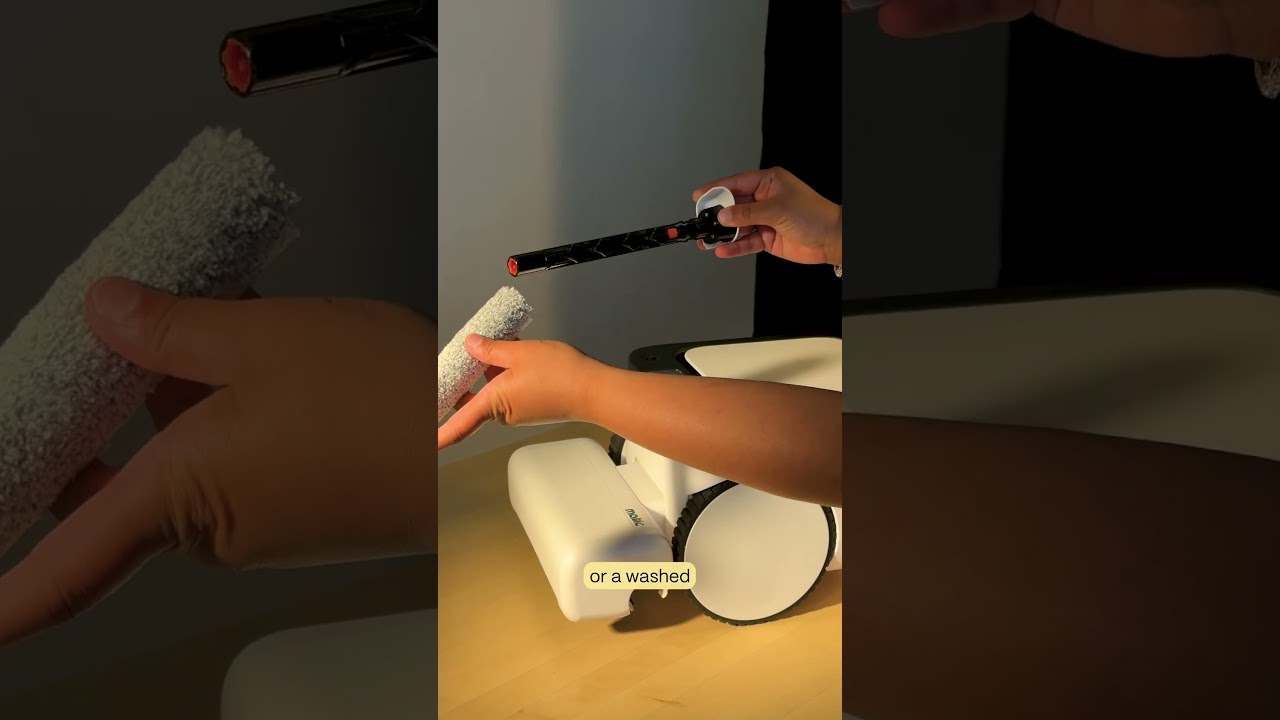
Yeah. And thank you. Thank you for bringing that up, Shengming. That really just comes down to this point of view that, again, hey, I want to have this robot in my home. Well, my home is, again, my sanctuary. That means I want it to feel at peace. And part of noise itself is also pollution. So if you're building a cleaning robot and that cleaning robot, while it keeps your floor clean, actually pollutes your home environment with noise, that doesn't make sense at all. And to be entirely honest, we were really worried about initially when we started out with Matic that Maybe with vacuum, because all vacuums are noisy, maybe we just won't be able to solve it. But as we dug into it, we realized that a lot of vacuum and robotic vacuum companies use noise as a metaphor for efficacy. So just like in past, we used to believe that louder the car, the faster it must be. In the same exact way, many vacuum companies use noise as a metaphor in the sense that louder the vacuum, the more effective it must be. be, more suction it must have. But turns out, if you purely think from a physics perspective and first principles perspective, noise is not needed and higher suction is not needed. In fact, that Dyson experience that I earlier described taught us that higher suction actually balls our rugs because my rug wasn't— was fairly new. It wasn't ready to go bald, but having a powerful suction on it for 45 minutes, because the rug shed, resulted in the entire patch of the rug getting— being gone. So if I'm even running it for a few minutes, there's a good chance that some of the threads are coming out. So that's when we just kind of looked at, hey, the world before vacuums back in the '60s and '70s, we used to have the Swiffers, which were just sort of like spinning versions without the motor, and they would clean everything. And we realized along the way that actually the best way to pick up the dirt is to nudge it. And once you nudge it, you need very little suction to get it inside the bin. The other analogy is imagine if you have a dusty car. If you have a dusty car, really fine dirt, no matter how fast you drive, it doesn't get clean. But if you just nudge it with your finger, it immediately wipes off. So in the same exact way, we realized that fine dirt requires brush roll versus the suction itself. So we spent quite a bit of time designing a first-of-its-kind hair-tangle-free brush roll that can deal with all pet hairs, long hairs, things like that, and does a really good job of cleaning without needing a huge suction power into it.
For sure. And I think one really important thing to highlight is how quiet it is. It's actually only 55 decibels.
That's correct. And it's 55 decibels at the optimal efficacy. And then you can obviously choose a higher version. But we not only optimize to be quieter at 55 decibels, it's about 6 decibels, which is logarithmic scale, lower than human conversation. Or your TV volume. So you can easily watch TV or have kids sleeping around it, which was great. But what we also optimize is to make sure that this noise is a little bit like a fan noise, that sometimes if you— I don't necessarily want to pick Dyson, but sometimes Dyson vacuums make this very high-pitched noise, and those noises are far more annoying. So it's also not only that it's quieter, but what kind of noise it's making. And we worked hard at removing every single one that is kind of noise that is annoying to us or kids or even our pets.
For sure. So there's a lot that goes into it. And there's obviously a lot of complexity that comes with all the sensors and all the different hardware parts. And Dan has a question about the problems of complexity of more sensors and actuators, greater felt in supply chain or in development. Sorry.
I think in both. I don't think it's one or the other. If you're trying to do prototype, you can probably get one of the parts and one of sensors, but the more sensor integration itself is challenging even during the prototyping stage and building stage. But it only gets more complex along the way as you try to make sure that they're working reliably and then needing to source it and really placing it in a correct way and calibrating it in a right way. So one of the things we had done was talk to as many robotics startups and robotics companies as we can prior to starting Matic. And there was this consistent element that a lot of robots actually sometimes don't work in the field or the uptime isn't as much as expected just because if you have 20 sensors, then the probability of one sensor failing every few days is quite high. So that probability adds up. So that was one of the things that I think it just complexity just goes high and there are challenges associated with it.
For sure. Another really good question about all of the mapping and complexity that is involved. Jin Hao has asked, does Matic learn when the house is quiet and people are not walking around, and that's the time it starts working?
Not yet. That's the direction we want to go. There is this— and if I were to describe how we'd like Matic to be, then I would love if Matic takes over the responsibility of keeping the floor clean completely, in the sense that I don't even have to tell it when to clean. where to clean, kind of like you said. It should learn— to take that metaphor, it should learn that, hey, kitchen, or if you have pets, maybe the doggy door area or near the doggy bowls, things are getting dirty multiple times a day. Or in my home with 3 kids living in California, the backyard door is where kids bring all kinds of dirt. So clean there 10 times a day. Understand the rhythms of the day in the sense that if most of the families in the United States, after they cook and eat, they get up and start cleaning. So maybe that's the best time to go and do vacuuming in kitchen and dining area as well. So learn the rhythms of the family and then actually do it. So those are the things that we wanted to do, which is learn over time the family, how family members behave and what are their likes and dislikes, and then do it that way. And it could be that maybe we can instruct it saying that if I'm in the room, never clean that room. Maybe it only comes into the room when no one is around. So those are all the optimizations we can do with the vision-based system and something we'll be pushing forward.
For sure. And so it sounds like things are constantly developing and we're constantly adding to it and changing to it. And Jessica has a question about, you know, what is the expected lifetime of the current model?
Great question. So we expect it to last at least 2 years. That's the lifetime we've rigorously tested it for so far, but it should probably last for longer. We don't necessarily— and that said, we don't necessarily believe that lifetime of the robot is a— limited by the hardware itself. We would like to keep it going as long as possible, but our assumption and anticipation is that just like in phones and computers, every 2 years the processing power just quadruples or doubles or quadruples. In the same exact way, we think that AI chips and AI algorithms will get better and better as we move forward. So there is a good chance that by just upgrading one NVIDIA chip, we might be able to do a lot more in terms of adding intelligence to the robot. So that may become the limiting factor where we may have to upgrade the hardware because the software and AI is just making such a big progress that the processor from 2.5 years ago or 4 years ago are no longer the best ones to keep driving.
For sure. And it's honestly so cool to see how Matic has gotten so much better in terms of going under certain cabinets or being able to mop. Deep clean, and all of these new features have been consistently coming out, and the team's been doing a really good job of releasing them.
Yeah, so I'm actually super excited. I think we've shipped about 24 app updates and about 17 releases since we started shipping production robots. So typically, we are in the cadence of doing a minor release every week and major release every month. So we expect to keep that cadence and keep improving super fast.
For sure. One final question before we wrap up is from Dan, and it is, what is an assumption you are still validating?
Oh, great question. Hmm. I guess one of the assumptions that we are still validating, and these people are coming around, I don't know if we are validating or just kind of trying to communicate very well, but one of our design choices was to make a robot bigger, which means that it won't go underneath all the furniture. That is, it will go if your furniture is about 12 inches or foot or higher, it will go underneath, no problem, but it won't go under all the lower furniture. And we had done research and we as family people, when we talked to customers, we realized that most people did not want, which is the challenge Our day-to-day problem wasn't necessarily cleaning underneath the furniture. It was really just cleaning reliably into obviously accessible spaces like kitchen, dining area, where kids are constantly making messes or pets are constantly making messes. So we prioritize cleaning that daily accessible area in a much more efficient, quiet, and optimized manner than underneath the furniture. That underneath the furniture is something one can take care of every 2 or 3 weeks. And with the cleaning head, because it can go down, it will go just like any other upright vacuum. It will extend as much as possible underneath the furniture from that point of view and then clean it. And that's okay. So that's one assumption that we made, which is different. And then second one, which I still believe is a critical one, is that there is a desire to set and forget, which means that we don't want to constantly keep changing bags or add water to it. And we have seen A lot of other companies take an approach of adding a giant dock for it. And that is something we chose not to do, at least in this first version, because we just felt like that wasn't an elegant solution. In fact, it's quite inelegant to have a vacuum that cleans the vacuum. And not only that, but it actually makes huge noise. If you've tried any of those robot vacuums with docks, when it cleans the vacuum or when it sucks up the dirt, it sounds like a rocket launcher. And it always made my daughter cry and my dog freak out. So that was one of the choices as well, that I actually don't want a big giant dock. That dock actually also has to be elegant and friendly. And we go out of our way to hide appliances behind the closet veneer in our home. So why have such a huge dock in our living room or family room? So that was the second assumption we made. And so far, So far, it's proving out to be fairly true. At the same time, we do have some ideas on how to make sure that if we ever go that route where we're creating a set-and-forget metaphor, then how does it work elegantly, and we don't have to create such a giant, giant space. So we'll see.
For sure. And then the product is definitely designed fairly elegantly where there's not a mess to clean up another mess.
That's correct, exactly. And also so that it's friendly to pets, friendly to kids. And that's one of the things we really, really spend time thinking through as well, that we don't want a robot that scares them. sort of quiet noise, the design that we have, which is a little bit more like car or expected for a robot, seems to be working very well so far.
For sure. Any final words before we wrap up?
No, thank you for all the amazing questions. It's kind of good to go down memory lane and talk about everything we've thought through. And please order today. I'm sure you'll love it. We're making a lot of progress in improving it, and in 6 months, it's gonna do things that none of the other devices in this space can do. So thanks everyone. And yeah, keep giving us feedback. We love to hear from you. Keep sending us all the feedback and let us know how we can keep improving.
For sure. And we have a really exciting Lego kit.
Yes, yes, yes. Thank you. So all you have asked questions, you know, we have this amazing Lego kit that we've created, which turns into Matic. So one of the lucky winners I'm sure Shengbing will do a random drawing and one of the lucky winners will get it. So we'll be in touch and hopefully get that Matic Lego kit to you. And when you get it and build it, please share it on social media, spread the word. That would be much appreciated.
For sure. And all of our handles on social media is Matic Robots. That's where we update everything live. And if you wanna stay up to date, that'd be where you should go. We really appreciate everyone taking the time during lunch hour. If you have any other questions or have any feedback, we'd love to hear it. It's hello@maticrobots.com.
Thanks everyone.