17 Year Old Running a $4M Lawn Care Company WITH NO EMPLOYEES!?
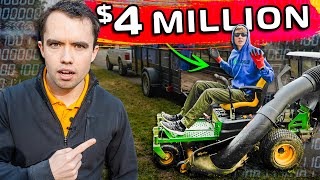
Nathan started Eagle Lawn Care at 16 and grew it to $330,000 in revenue by 2023 with no employees, using subcontractors instead. He charges $40 to $200 per mow, built his own scheduling and AI bidding software, and is testing a marketplace where contractors claim jobs and he keeps 40% of revenue.
Questions this video answers
2022: about $70,000; 2023: about $330,000.
Three trucks (two Rangers and one F-150).
$40 to $200 per cut.
About 20%.
He pays contractors ~60% and keeps ~40%.
Chapters
We're just trying to get more profit from it rather than just run like dogs. I just kept trying to expand, and each time I tried to get new guys, I had to go back. I just want to focus on what I'm good at. If you want to cheat me, that's fine, but, like, we're not going to work together anymore. I lost like 5,000. He takes the customer's check and then he won't give it to me. So I'm like, you can keep it. Just like, just leave.
This is why this business model is what everyone wants to have, but is so difficult. So your $800,000 business is going to have $4 million worth of admin. Because if you can't get a lead in and get a customer for the right price, this whole model breaks down.
Today we're in Idaho with Nathan from Eagle Lawn care services. He's 16 years old, but has already built his business above $300,000 in annual revenue. I know from my own experience that being a young business owner can be tough, especially dealing with new employees and lots of customers. Let's see if we can turn this business around and make sure that Nathan doesn't continue to get walked.
This is crazy.
So you got the two trucks?
So we have three trucks.
Okay. Oh, right, the little guy that we.
Yeah, so we just have three trucks.
Okay.
We got two Rangers and then F150.
Okay.
I like the Rangers, though, because they're cheap on gas.
Yep.
Did you have, like, any shop space or just.
So. Yeah, this is the. This is the barn. We don't keep much in here.
So you tried the electric? You got a whole bunch of them.
Yeah, yeah. So the Ego string trimmer. This is the best one.
Okay.
This one super lightweight. And all the guys, they all say they like gas until they try this.
Got it. Yeah. They're light. They last pretty good, like, throughout the day.
Yeah. So they take 10 batteries.
10 batteries?
Yeah. In a day, we're doing like 80, 90 lawns per week. Just a two man crew.
Okay.
Plus, like, some huge properties. So it was getting crazy with batteries.
Right.
We had like 15 at one point.
So these.
How much does this thing cost? Like 150.
350.
This one's 350.
Yep.
What are these?
120.
Got it. But this is probably like twice the size of it.
Yeah, yeah. This one's good. Yeah, yeah. And it's. I see it as an investment because we don't spill gas on cement. It feels clean.
So kind of break down for me. So when you started and the revenues the past few years?
Yeah. So the first year we did 70,000.
About what year is that?
And that was 2022 and then 2023 on like enough talk and then we do 330,000. Then it just got crazy. But I liked it. We're just trying to get more profit from it rather than just run like dogs. But I don't mind it.
So right now when I look at the P and L, you know, if you just look at the bottom line, it looks like there's lots of profit. Is that a matter of you've been spending all that going and buying equipment? Where's that money going now? Because, like from just the P and L, you look like you're making a lot of money.
Yeah. So that's the problem. So it's buying equipment. It's like marketing, like building new websites and stuff. And then I would say mostly just new equipment.
Okay.
Which I don't maybe have a lot to show for it. It's just because I like have to maintain all the trucks and stuff.
This year, what's been the biggest struggle has been like getting the team members because you probably. How many employees did you have in 2023?
So 2023, I had like 20 guys I like hired. And then I got it down to like, usually I had like five full time guys.
So five. Five guys, three trucks, and then you burn through quite a few of them.
I just kept trying to expand and each time I tried to get new guys, had to go back.
And. So how long have you guys been on?
So McKay's my brother. Same with Jimmy.
We used to like do like different yard care or whatnot for people. Just around the neighborhood, you know, would go and like knock and be like.
Hey, like, can we pull some weeds?
Or you know, whatever to make money. And then kind of started doing my own work. I worked in a lot of different jobs and Nathan was working, pulling weeds. He would always come home. He's like, oh, all we did today was pull weeds again. He just came to me and he was like, hey, like, you know what, I don't. Why don't I be the one who has other people going pull weeds for me? And then it was just kind of cool to watch him like build this company. And for a while towards the beginning, I wasn't really working for him. And then I started working for him more and more. I did keep other jobs. I've never really worked for him full time at his other crews. Got all of his employees. Actually in the beginning A lot of them were just my friends and whatnot, that I was like, hey, you know, you're gonna make really good money doing this. Like, you should talk to my brother. And so it's kind of where I've been. And so then I'll be a full time employee after the summer.
Are you thinking, are you guys gonna like partner up on the business? Are you still owner and you're kinda.
Hey, I'll just be like his right hand man pretty much.
Like.
And when I did live here, then he would put me in charge of like different management projects, whether it was like with landscaping, because our older brother, he worked in landscaping, so he had a lot of training with that and he taught me how to do a lot of that. So sometimes Nathan would be like, oh, I don't really know how to do this, so you know, you do this. So he'd give me the project and say, well, like, here's your budget. So if you need guys, here's how much you have to like hire guys, here's how much you have for equipment, and then you get a percentage of whatever's left.
When I look at say five guys and you working, and then I look at the revenue, the revenue seems low per team member, like 60,000 ish per year. Is that just mostly because they're part time? They don't really. The whole year, like they're not working full time.
So. Yeah. So we only work like eight months of the year.
Okay.
And then the other four, you're subbing out.
Yeah.
But you're still making money on the off the snow.
If it snows.
Yeah, got it.
If it snows.
So what do you think this. Well, this year is probably not any snow, right?
Not much. Yeah. Yeah. And the snow we did have then, I. I lost like 5,000 because I paid 5,000 bucks to do BioLife. But it turns out they didn't want one of the locations done, so it was not good.
And so like the big bottleneck for you right now, like in terms of revenues, 330.
Yeah.
What do you think can happen next year? Assuming that we figure out some of the, you know, labor, getting more team members, etc.
Like expand it hopefully to 800,000.
And what do you think is bottlenecking from that now? Is it a matter of like keeping the team members like this skill in management, managing the team? Like what?
Yeah, skill and management right now? Yeah, because I got, I had a week where I was getting, I think six calls a day, and then I put down for like three days I was like, sorry, guys, I can't do this.
Sorry.
Just because I didn't have the team members.
The big thing that's going to happen going from 3 to 800,000 is the admin is gonna go through the roof.
Yeah.
It's gonna be basically, you're gonna need full time help really, like answering the phones, setting up estimates, all that sort of thing. Do you do all of that right now yourself?
So what's actually cool about that? I built on a platform where it like auto bids it. I built like a backend Excel spreadsheet. And then the front end, people just enter their square footage and then using a tool named Eagle Measure, if they don't know what the square footage is, they just click measure on Eagle measure and it just auto sen the bids isn't a problem. It's like the dog got out or whatever.
Right.
I would want to hire someone either overseas or someone full time.
Yeah.
Just based on how much money I have. I've done a lot with like software and stuff. Just like building out websites, chatbots, marketing just. And then like hooking things up to copilot, learning how to use that with other softwares that I built.
Last year you said you're getting like six a day, and it was like, hey, we can't do this. So what's the bottleneck that's gonna allow you? Because if you're gonna go to 800,000, you're gonna get 10, 15 a day. So like, what are we doing to make sure we can actually handle that demand?
Yeah. So right now I'm building like an AI chatbot that can answer a lot of customer questions. I'll hook that up to like Facebook. I'm gonna get a new number that can connect to it and then my website to answer a lot of those questions as well as pricing questions.
Last year, did you feel like it was just a challenge with team members, like trusting them? I hear, I hear there was a little drama. So what happened with the trailer?
Oh, so this guy, he, this guy was funny. So he's like, hey man, could I just use your trailer over the weekend to move some stuff? I'm like, yeah, sure. Turns out he moves it, but he doesn't bring it back to work. And then like the next day he asked to quit. I'm like, okay. Then like a week later, I'm like, where's my trailer? Because I forgot about it. It's this one right here. We don't even use it, but that's why I sent it with him. So I Drive to his house and, like, unlock his gate somehow, and then just grab my trailer back.
Oh, my word. So you robbed him? You robbed him of your own stuff?
Yeah.
Let's go.
And then he takes the customer's check, and then he won't give it to me. So I'm like, you can keep it. Just, like, just leave. I'm not a guy to chase after money.
Really.
It's just like, if you want to cheat me, that's fine, but, like, we're not gonna work together anymore.
After learning about the trailer, I'm not so sure that Nathan's leadership skills are exactly where they need to be at to run a large crew.
And so in terms of, like, profit and loss, like, right now, is there a cash crunch or is that a matter of, like.
So I wouldn't say not a cash crunch at all. It's just more of a. I mean, like, if you want to buy a nice truck, it's like 40,000. Of course, I don't have nice trucks.
Yeah.
So cash. Cash, I wouldn't say is a problem. The main problem is just getting people to do the jobs. I'll do whatever it takes to get the most jobs. Even if I'm, like, unprofitable on some jobs. Just to, like, be the top, to get the most customers.
Based upon what I've heard, like, I've heard not zero, like, zero words about operations.
All I've heard Nathan talk about since I've been here is getting more leads using his technical experience and web design. And I think that's definitely his strength. I think it might be a better idea if he just takes those leads and then sells them off to subcontractors to do the actual work so he's not stuck in operations.
I heard all. Everything, marketing and sales. And so if that's your passion, it's just a matter of we have to look at the metrics of that. And that is, like, how much do I acquire customer for? How do I get them this through the system of my sales process? And then how do I then manage the subcontractor to actually deliver on the work? Cause that's what the customer is trying to get.
Not that I don't care about operations, but this is where my strength is.
And if you can lean into that and just realize, okay, I'm not going to worry about someone stealing my trailer anymore. Now I've got to make sure my contract is legally binding and I can somehow get my customer back if this person goes rogue.
In most businesses, you have three categories Sales, operations, and admin. When it comes to a subcontracting business, you're still going to go get the sale and get the customer, but then you're going to go hire someone else, another company to do the operations, also known as the subcontractor. But you're still going to also need to do the admin work managing the customer. And the subcontractor that you hired, this.
Becomes a whole different business. Managing subcontractors is so different than actually doing the work. Right. Because now you. You become a sales organization that has to, like, manage other businesses.
Yeah.
Because you've got to manage them and their quality. Like, when the customer complains, they're gonna call you.
Yeah, yeah.
So, like, in that contract, it's like, hey, is there demerits? Is there. Do we take away from how much we pay you if you have a yellow slip?
Yeah.
Like, those are the type of things that you'd be wanting to look at as you scale.
Yeah.
It doesn't really matter the exact price.
Yeah.
So it's not like, is it 55 or is it $57 per cut?
Yeah.
Flip a coin. It doesn't matter. Especially when you're subcontracting. Why? Because you're making 20% of it.
Yeah.
So you're going to really lose the customer over 40 cents that we're getting out of that couple dollars. So in that regard, I'd change your website to be looking more like, here's a picture of a small lawn.
Does your lawn look like this?
No. Here's a medium. Does it look like this or does it look like large? And here's the pricing for all three.
Oh, so super simple.
What is your. What does your lawn look like? Have an aerial and a front image of the. Of the property. They click on it. Here's your pricing. Would you like to accept? Yes.
Oh, that's it.
Yeah.
Super simple.
Oh, think about it. Like, think about your pricing. Like right now, if you take the. The people who are the cheapest, the bottom 10% and the top 20%. Top 10%. What's your range of your mowing price per cut?
It's. It's $40 to $200.
Okay. So how many people are above a hundred? Like, what percentage of people are above $100 per cut?
Like 20%.
Got it. So we cut them out. Right. So we say, okay, $100 is our big lawn.
Yeah.
And what'd you say is the lowest?
$40?
40. There's your 40. What's gonna be medium? 65, baby.
Because right now I have the Google my business going, but like as far.
As the, you probably get what, like two or three a week maybe from.
From Google. Guaranteed. It's like I would say like three to six in this area for landscaping and then like two to three foot lawn mowing.
Okay.
But Google my business can be like, like five a day or something.
All the traffic that you get otherwise. Because really, like, if you're going the route of we're gonna get leads and then we're going to have subcontractors.
Yeah.
It becomes a game of what's your customer acquisition cost?
Yeah.
And then what are you gonna get from that customer when you sub it out?
It's important to know what your customer acquisition cost is if you're doing any business, but even more important when you're doing subcontracting, because you need to know how much you need to spend in order to get a new customer that you can then go sell to a subcontractor. This means that you'll need to be efficient at marketing as well as track every single lead and where it's coming from. Nathan and I talked a lot about how a subcontracting business model actually works. Getting the leads, managing the subcontractors. But we took out all that, like 30 to 40 minutes of training out of the episode. So if you interested in that, just go down in the description. There's a link there. Watch that other video. It'll be super cool.
And so that's the math that you'll want to play if you're going the route of a sales organization.
Yeah.
Because essentially when you use the subcontractor model, all you're doing is you become a sales organization that just happens to sell mowing and landscaping. Now you're not going to be training guys on mowing. You're going to train them on how to go do like 25 estimates in a day.
Yeah.
You're going to train them on how to do landscaping projects. And here's how you. I want you to bid them. And then here's how you determine which subcontractor you send the job to. So it all comes down to if you have the leads, you have leverage. Right. If you can provide the leads, there's a ton of people out there wanting new customers, and they're willing to give you 10 points or 20 points and you just give them work. And you can just be like, hey, I'm going to literally dispatch the jobs. Like, what's the value? Add is what you got to pitch. Right. Because now, your website is going to turn into here's customer facing, and here's subcontractor facing. And so the subcontractor facing is going to be like, hey, you're not going to have to dispatch invoice, take customer complaints. I just need you to do the work.
Yeah.
Yeah.
And so now your job isn't managing employees. It is managing subcontractors and managing a sales team. This is why this business model is what everyone wants to have, but is so difficult. You have two buyers, you have the customer.
Yeah.
But then you also need to go sell the subcontractor. Because if you can't get a lead in and get a customer for the right price, this whole model breaks down.
Look, everyone thinks they want to run a subcontracting business because you just get the job and then you have someone else do all the work and you just get paid.
But here's the thing.
Here's the pro. Here's the positive part about running a subcontracting business. Yes. You don't need a bunch of trucks and equipment and employees. That's awesome. But you also, from a cons perspective, you also need to make sure that you manage the customer's expectations and the subcontractor, and you're liable for the entire job.
To be able to do 800,000 as a subcontractor, you need to be selling $4 million worth of revenue.
Yeah.
Because you're getting 20% of it.
Yeah.
So your $800,000 business is going to have $4 million worth of admin.
Yeah. Yeah.
So an $800,000 business for you is probably going to look like three to five people in the office, which is, again, a totally different business.
Yeah. Which is what I'm. I would say I am better at.
That's what I'm picking up on. That's why I think you should go down that route.
Look, I don't believe that subcontracting is necessarily the right path for everyone. But because of Nathan's unique ability to be able to build technology and websites and get all these leads, I do think he's uniquely qualified to build a subcontracting business, get all these customers, and focus on his strengths. His strengths might not necessarily be hiring a bunch of team members that are way older than him because we've seen they've taken advantage of him in the past. Just focusing on his strengths could be.
The thing that allows his business to go to the next level.
Because I know Nathan has talked a lot about, you know, he wants to stay Doing the mowing and subcontracting, that other stuff. And it sounds like you're more coming from an area of like, well, eventually, year one, all of that being subcontract. And so my question would be, how much would you recommend this year he keeps doing versus subcontract?
I would focus more on how many team members do you have that you think are going to be solid and just keep doing the operations. It's going to pay the bills.
Yeah.
Again, Even to replace 300,000 in revenue, you're gonna do $1.2 million worth of sales on subcontracting.
Yeah.
So keep doing this. You'll probably still next year do $300,000 in revenue from this. Yeah, but you might do 200,000 in the sales and subcontractor thing.
Yeah.
Well, then next year, what we're not going to do is increase from 300,000 to 500,000 here. We're gonna keep it at 3, and then you're gonna end up having to sub more and more of it out, and then it becomes a backup crew. Once you've developed, probably a couple people in the office. I'm looking at him because he's gonna be the one doing that.
I like talking to people. I like working with people. Something me and Nathan have talked about is as we expand the business and if we decide to, you know, grow it larger into other areas, then, you know, something we've talked about is having me manage more of the people side aspect of it.
Like, once you have those nailed, that's probably okay. We're gonna sub out what we currently actually are doing. Okay. And now we're gonna just be a backup crew. But now I know I can produce 7, 800,000 a year and even 5 or 600,000 a year on the subcontracting model.
Okay.
Right.
So just let the subcontracting come up to the point where you're like, okay, now I'm gonna start bringing down what I'm doing in house.
As far as my goal with the business. I just want to see it thrive to a point where I can have, like, my family be able to run parts of it where they can make good money, where, like, the people in it are happy to be there, they're making good money. I just like to see people happy with what they're doing, I guess.
So I've, like, seen what Nathan can do when he puts his mind to it and how hard he works to obtain his goals. So I also know that he's going to make it happen.
So Yeah, I implemented a bunch of things he was talking about. So, number one, the scheduling. So now when you go here to schedule, you know, divided by different cities and stuff. And so like, it'll send jobs to different territories based on, you know, where they schedule when you enter the zip code. And then when you click on mowing, then there's just the small, medium, large, massive. Then it's all like in one place. And people don't get confused by the square footage. Now, hopefully now when someone clicks, hey, schedule service, then it gets sent out to a contractor and it's. It's awesome. So it gets sent out a bunch of notifications to all my contractors, and then one of them can claim it. And so we're building, like, skill tags. So, like, if someone doesn't have a moa, it wouldn't be sent to them. But if they do, like, landscaping and have a dump trailer, then like dump trailer jobs would be sent to them. So we have about like 10 services on here, but we're trying to add more. And then based on where they're. Where they are on the site, we'll just show them specific services they can schedule.
After Mike Left, we did 60,000 in snow removal in two weeks. And those were all new customers. We only had one existing, and we got 40 customers all subcontracted. So it was crazy because we made. It was like roughly 20,000 in profit once everything was done. But as you can see, it's all here, all the snow removal jobs and copilot. A lot of these days we were doing like 10k in a day. There was one day, I think we did like 12,000. It was crazy. It's working well, I would say.
So I told my existing guys, I'm like, you guys better go get your own equipment and stuff. So I worked out a deal with them where they can buy out my equipment. And then I'll just have all my contractors in Eagle and then in Twin Falls, which is about a couple hours away. Then I'm going to be starting, like, not a location, but just another service area, I would say. Well, I'm just trying to expand our boundaries just so I'm kind of forced to have multiple providers.
It's been fun. I've wasted a lot of money trying to figure out how to. Which technologies to use and how to go about things. But I think I'm getting a hold of things, how to do it. I'm using these AI chatbots and then just building the backend where people can actually schedule. With Eddie the Eagle, they can schedule on site with Eddie the Eagle and then cancel services, stuff like that. So I'm hooking things up with Zap here, so that can happen. So, yeah, we just implemented this system, and it worked, you know.
So I'm actually only paying them 60%, and then I'm keeping 40%, because after we ran the numbers, if we paid them 70%, we wouldn't make enough money to be able to grow as fast as we wanted. But they're still happy with getting paid 60%, so that was good advice Mike had, too. When Mike speaks, you gotta listen. You know, I don't know how I'll ever pay him back for this, but I guess I'll try.
Appreciate it, dude. We appreciate it already. I thank you for, like, all your work with us and coming out with this video and everything. So it'll be really cool.
If your business is struggling and you want my help, go to the link in the description or go to mikeannies.comturnaround.
And I'll come show up for free.






