$200,000+ in his FIRST YEAR of Lawn Care Business… With ONE Employee! | ZERO TURN
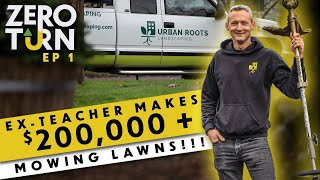
Dylan left teaching to start Urban Roots lawn care in Tacoma and hit $200,000 revenue in year one with just one employee. He spent about $3,000 on flyers across three rounds and a few hundred on social ads, chose push mowers for tight older properties, and plans to double revenue next year by adding a second truck and more hires.
Chapters
Hey, everybody. Welcome to an episode of Zero Turn. Today we're going to be talking with Dylan from Urban Roots. And if you want to be featured on a future episode of Zero Turn, fill out the form in the description down below. Let's get into it.
Hey, everybody. Welcome to this episode of Zero Turn. Today we're talking to Dylan. He is the owner and operator of Urban Roots here in Tacoma, Washington. And we're going to chat with him, learn a little bit about his business and what he's grown out here. So do you want to tell us a little bit about how you got started before lawn care? Like, what. What were you doing before you got out here?
Yeah, so I'm pretty recent into lawn care. This is my first year in lawn care, landscaping. Initially, my. My first career, I guess I went all the way through school for teaching. I became a special education teacher. I did that for eight years. And I kind of got to a point with the teaching where I was a bit, like, not totally jaded, but I was kind of at a point where I had an itch to try something new. I asked myself if I could do this for another 30 years without becoming that disgruntled teacher. Right. That are, like, you know, getting frustrated with the kids and all that stuff. So I didn't know if I could definitively answer that question and be like, okay, I could be in this for the long haul. So I was at an age where I thought I should try to make a change. And it was actually pretty good timing because we were expecting our first child at the time. And so I said, I told my wife I wanted to actually try to pursue firefighting. So we just discussed it, and then we'll go for it. So my son was born. I pursued firefighting for a while, for a couple years, actually, and it didn't pan out the way I hoped. And then I ended up talking to one of my buddies. We mowed lawns together for his dad, who owned a lawn care and landscaping company. When we're in high school, and he since then had started his own company, he decided to take me on. And I told him, hey, I want to look, see if this is something I'd like to do and pursue, and if I like it after that, maybe I'll try my own thing. So that's kind of what got my foot in the door. And of course, I guess the rest is history. I worked there a couple years, and now I decided to open up my own business.
So you started working for another landscape company. Do you feel like that really helped develop your skills. Do you think you would take that same route again with starting with a company and then working for them for a few years before jumping ship and starting your own? Or do you think that maybe there's a faster way now?
Yeah. So I think the experience I gained was invaluable. I try to reflect back on how things would have been different if I tried to jump in. And to be honest, I don't think I would create the best customer satisfaction if I just didn't have that experience from the previous company I worked with. So I do think it's important, get out there, work for somebody, learn the skills of the job, but also maybe the customer service aspects of it. If you're really eager to learn, you could probably brush up on that stuff pretty quickly working for somebody else if you're always looking to learn and take things off the plate of the owner. So that was kind of my approach and I actually went in knowing that hey, if I reach the two year mark at this company, I'm going to start my own business. So my mindset was always to go in and try to learn as if I'm going to be an owner one day.
So as far as your website goes, it looks great. It looks great. How much did you put in to get that up and running and did you do anything else as far as like setting up Google my business? Any other web tips that you had?
I did a lot of shopping around. It's hard. You're going to find all kinds of stuff out there. So people, there's a ton of resources, people who can build out websites, do things for you. I wanted to try to learn as much as I could, but I got into it and there's a lot of areas that I found that I have some weaknesses. So I decided to outsource some of it. And one of the things was a website. I was really lucky to find someone local and that was important to me to find someone local designer website developer that can do that for me. I Googled Tacoma designer Tacoma website and I ended up stumbling upon just a Google search and I messaged her. She had a really impressive portfolio and she was actually transitioning to go from more graphic design stuff to actually building out websites. So I got in there at a good time to where it was affordable for me. Yeah, she's helped me a lot in terms of the Google my business. I built that out as well and I've been really working to get Google reviews to make sure that I have some, maybe boost myself with SEO and things like that with my website.
So no, it's definitely made an impact.
Yeah.
Whether you're just getting started in the landscaping industry or you're already an established business, you're going to need a professional website to ensure your customers know how to find you and what services you offer. Lawn CareWeb Design.com is here for you to set you up, keep you going. With SEO, you can do unlimited changes to your website, all for a flat monthly fee. Check us out on lawn carewebdesign.com.
So what's our revenue you've been pulling in? How did it get started?
So I know a lot of people, they do the whole kind of working and then they'll do part time, maybe on the weekends or evenings. It was, it was a bit different for me. I just went kind of cold turkey. I didn't have any clients and nothing. It was, I sat down with my wife, we looked at our budget and said, okay, well she can cover a lot of the costs and expenses with what's going on at home with our mortgage and other bills to help the startup cost of the company. And like I said, I had a little, little bit of experience and I had studied up on marketing and things that. But didn't have any clients going into it. It was kind of like I started, I purchased a truck and got my mower started, getting my whole setup before I had any clients. And so it was kind of a leap of faith. I jumped into it and it just kind of took off. You know, it's nerve wracking. It's like, am I going to get any calls? And I got, my first client was my, my mother in law. So I showed up, showed up with my little truck set up and you know, getting used to everything and taking the mower off and it was all new. Right. And so I kind of got used to it with that. And then afterwards I ended up putting out some marketing materials and the calls started coming in.
That's, that's great. Honestly, leap of faith, that really worked out.
All right, so let's go ahead and.
Check out your shop.
Let's see what you got going on. So you have some push mowers here. Do you have a zero turn? Do you need those in your area?
Yeah, so. Good question. No, I do not. Whatever you see here is what I have. I went with this because the market we're in, I'm focusing mostly on small residential. You can go over a few blocks and have kind of a cookie cutter type community with flat lawns and you can go over a few blocks this way and you have houses built in 1890 with, with retaining walls and limited access. So I wanted to have some kind of mower that would give me good access to all the properties. So if I, if I even got stand on like a 36 inch stand on, it would probably be a little bit much and limit my access to the property. So that's. For me, it felt like a no brainer. I considered maybe a 30 inch push mower, but right now these are working great for me.
So over here you have two. It. It looks like you kind of have two of both for you and your employee to try to keep you both busy.
Yeah. So initially we started. We. I only had a set of one. One mower, one blower, one combi unit. I found that when I had some repairs that needed to be made, I was kind of scrambling. I ended up renting a mower a couple times and it was, it was terrible. It was. I think they had residential mowers with dull blades and it was just a bad experience all around. So I knew that my plan was to scale a little bit in the future and add another truck. So what I ended up doing was I just went, went ahead and I started slowly adding. I added the second mower, added the second blower and then got a second combi unit. And all that was just to kind of eliminate some of that downtime or the need for getting another piece of equipment from the rental shop, which, which was, you know, it's. It's tough when you get used to a nice commercial mower and then you go to rent another mower. That's just, it's hard. So we're spoiled now because we do have that backup. But eventually the second mower, the second blower, all that stuff will be for my second setup.
Yeah, I mentioned I have a couple commercial mowers and also a couple combi units as well. These are great, really versatile. They have different attachments. We use the edger and the string trimmer quite a bit. And of course again, I have a second set because I'm working towards building up a second mowing setup or second truck. And also it works as a backup for us if equipment is down. So this has been a super helpful, handy tool to have.
So you have all this built out. Did you build this yourself?
Yeah, yeah. Well, yeah, my stepdad helped me. I got to give him some credit. So we put up some of the racks. Of course the racks are just from Home Depot, I think, but yeah, pretty straightforward. Like I said, we. We get in there, we do a lot of cleanups, installation of sod. So we have a lot of digging tools, a lot of cleanup tools. Believe it or not, we use quite a bit of machetes with our cleanups. And these picks are great. We use them for sod removal, cleanups of really weedy garden beds. So there's a few tools that are just our go to. We take them everywhere with us.
We're here on a property with urban roots. When you're looking at a job like this, what kind of goes through your head when you're first doing an estimate?
Initially, I come in and there are some industry standards for square footage, like how much square footage the property has or turf square footage, I should say, and how long that might take to mow or maintain with your equipment. Because I have a 21 inch mower, I can kind of. That's probably something you could Google, right? And kind of figure out general numbers. When I came into it, I didn't have a real solid grasp on it. The way I looked at it was I'm gonna guess on the first few houses and adjust from there and also try to use what I find online about standard production rates. There are some variations in terms of how many curves and hills and different factors whether the client irrigates their lawn or whether it dries out in the summer. These all kind of factor into the pricing and how long you're going to be on the property. So it's just trying to guess the amount of time you'll be there and figure out an hourly rate from there and then you can get your prices on that.
How long have you had a customer like this and if for a while did you have to consider raising their prices, stuff like that?
Because I'm new to the business, all my clients are relatively new. I haven't raised any prices. I do plan on looking back at my numbers. Every time I come to a property, I time myself to see how long I'm here. So if I've grossly underestimated the amount of time it takes to maintain their property, I'm going to go back probably this winter, in the next month or so and look to see if I need to raise any prices to make sure I'm being profitable on that house or not.
So you talked back at your shop about wanting a grown expand your business. What are your goals? Like how big do you want to take this thing? Are you just thinking a few more trucks? Are you thinking a fleet?
I think that everybody kind of throws out there, that million dollar mark, right, in terms of revenue. But I don't know. That's not necessarily my marker. I don't even know what revenue is going to allow me to achieve my goals. But I would like to create a business where it's providing enough job opportunities for people in the community. The work I've done as a teacher has been kind of making me long a little bit for giving back to the community in some sort of way. So I think this is a good avenue for me to teach people skills. And I'd like to have it to a point to where I'm a bit out of the field and kind of being in a CEO position. So whatever that revenue marker is, I don't know yet. Probably a few trucks and I know it's a big lofty goal. Quite honestly, I've been investing a lot back into the business. Haven't taken a lot out just recently. Only a couple months ago I started taking a little bit of money out which only covers childcare expenses. So my wife's awesome and she's been really supporting us on the back end with making sure everything's kept up with the mortgage and all that other stuff. So super fortunate to have a supportive wife to get things going and off the ground. But yeah, it's hard to tell. I'll just keep going until maybe I hit a pain point and see if I can push through it. But right now it's been good. Putting a lot of money, investing it back into the business and hoping to scale it up.
So you've talked a little bit about working the jobs, managing the jobs. Obviously there's a lot going on. How do you go about managing your time?
It feels like there's not enough time in the day. Quite honestly, it's all been a whirlwind. The first year I started off, I put a lot of marketing material out and it just kind of fortunately hit the ground running with that. I've had to figure out like time management skills. I was kind of losing track of all the leads that were coming in, which people I responded to. So as I've gone through, I've gotten a little bit more efficient with some of those systems of checking emails, responding back, noting who I need to follow up with. So slowly I'm getting a little bit of that time and efficiency back. But ultimately I'm working super early. I wake up at 4:30 in the morning, I go to bed, you know, 10pm Roughly. Admittedly, there's not a huge balance right now in my Life. So one of my goals, of course, is to start to get to a point by this next season where getting back to more of the family and finding that balance there.
So you're located in Tacoma. What are some factors that people around your area have to deal with that maybe some people across the states don't typically see?
I suppose there'd be some variance in the property types you have. Western Washington is going to be drastically different than say Eastern Washington and Spokane or Yakima, one of those areas. Seasonality is going to be different. We're kind of in a more mild temperament climate. So I've ruled out snow plowing because we get maybe five days a year with snow on the ground. So all those things kind of factor into your business model, what services you're going to offer, you know, and also every community is a little bit different. I mean, you can drive 15 minutes one way, 15 minutes another way, and you can get a real cookie cutter community where the property layout is very kind of standardized, or you can go to an area where it's more historical and every house is a little bit different. Maybe it was built 100 years ago and retaining walls, more extravagant gardens. So those are all kind of things to consider with your area that you're in. So there's no cookie cutter way to look at it with how you approach your business. You just have to kind of know the property types on your. On your service area.
So you talked about your flyers earlier.
Yeah.
How do you spend on marketing? What kind is your marketing budget?
So to be honest, going into it being so green, no pun intended, to the industry. Right. And to just business in general, I didn't have a marketing budget. I'll be able to look back now and see what kind of return I got during different parts of the year. I know in spring it was insanely busy off of just sending flyers out and a couple Facebook ads, I'm going to kind of base my experience on that. And also I don't know if I'll send out as much marketing material in the summer and slower time when I didn't get many leads. So I don't know if my marketing budget will change much. I'll just try to be a little bit more strategic about when I. When and where I spend. But I think I sent out three waves of flyers for roughly 800 to 11 hundred dollars each. You know, say about 3000 worth of flyers this season. A few hundred bucks for Facebook ads, couple hundred dollars for nextdoor ads. So not a huge spend. Some of it was referral based. But we've just gotten very lucky with the marketing material we sent out so far.
Running a business can be difficult enough. Knowing your numbers, calculating payroll, all of it can be mind boggling. For a flat monthly fee, lawn care bookkeeper is here to help. We'll manage your expenses and we'll run payroll for you on a weekly, bi weekly or monthly basis. Check us out today.
So making the transition over from becoming a teacher teacher to pursuing firefighting to now going full time into landscaping, which one is harder to deal with? Parents or upset customers?
Ah, geez. I have to say parents for sure. Parents. Yeah. You know, when your loved ones are upset with you, that's, that's tough. So no, I would say there's always kind of that gut check if you have a customer that's upset with you. And for me, luckily we've had a pretty good streak. We're at a size where quality control is still there. We're a really small company. We can check in with every customer, make sure they're happy, do walkthroughs at the end. So I've luckily been able to avoid a lot of disgruntled customers. We've had a couple, couple instances where they weren't as satisfied as we'd hope, but we've been able to kind of recover from it and make sure that we can come back and make things right for them. So I always go into it kind of the best of intentions. So I know that coming in it's like, okay, I know I'm trying to do the right thing. So I feel down deep that I don't let it affect me too much. But. And I also know that I'm going to try my best to make it right. So even though initially it stings to have an upset customer, we can usually recognize things.
So you do walkthroughs after your job is completed. Have you. What gave you that idea? Has that like really helped? Have you seen any change in that?
Yeah, I don't know. It's likely. I could have picked that up from Mike Andes, to be honest. You know, that's one of those things he puts out there. But it's something I've done for a while. The company I work for, it was pretty standard for us to walk through and make sure the client was happy and gave a good thumbs up on the work that we did. So I think that helps a lot. Rather than just leaving the property or we try to schedule a time for the client to be home, if possible to do a Walkthrough and if they're not home, we give them a call later and make sure they're happy with it. So it's just that follow up.
So this next property, this is kind of. Well, the way we set up our estimates is we estimate mowing and bed maintenance separate. So they do receive both of those services. So we went ahead, we mowed, we try to blow some leaves out of the beds in the fall and then we kind of tackle those weeds that are growing. So yeah, and of course we always edge and clean it up afterwards.
So going from your first year in revenue, what are kind of your goals that you need to hit? Do you have any goals trying to grow into the next year?
It's interesting trying to learn, you know, what to even expect. Right. First year I was just clueless as to what's even attainable. So this year I should hit a little bit above 200,000 in revenue. So going off of that, I know that I had myself and one employee and one truck. I figure that I'm eventually going to get this second truck going. I just got all the logos, everything on it. So my hope is to hire another person. And in terms of revenue, it's hard to tell. Maybe that extra person will add another hundred thousand dollars in revenue. Hopefully if I'm lucky enough to be able to be busy enough and support a third person, then kind of add another hundred thousand dollars on that. Yeah, I feel like it's a very lofty goal, but I would like to say maybe 3 to 400,000 next year, cross my fingers.
So what's your plans for growing out your team?
You know, I watching a lot of Mike Handy's videos, he talks a lot about asset utilization. I would love to be able to go out and buy a sod cutter and buy some of this other equipment, but I'm just not sure if I'm busy enough and using that equipment enough. So like I said, the dump trailer is something I could use pretty frequently. So that may be my next thing going into next year. Growing and adding a couple more employees, the hiring process. I've had four employees. I have one currently at any given time. I've had myself and one employee a short time. I had a second helping out that was very part time. But it's hard to keep people on, get people to buy into the vision. But if I can get a really solid group of maybe two or three guys and just build from there, that'd be great. This year I'm actively marketing to try to hire somebody even Though things are slowing down, I want to try to get ahead of maybe hire someone part time, get a few jobs under their belt so when spring comes, we can hit the ground running. I would love to have that second helper, you know, pretty soon. And of course, by the end of next season, I would love to have again three guys plus myself. And hopefully that'll help me reach my goals.
So I'm here with Michael from Urban Roots and he's one of the workers around here. How long have you been working with the company?
Just a couple months. I kind of came on late in the season to help out. Caught an add on.
Indeed.
And joined on in.
There I am. Yeah. That's sweet.
What kind of experience do you have with lawn care and landscaping?
So I actually grew up on the east coast back in Rhode island or my dad has his landscaping company, so I started helping him at a really young age, really whatever he needed around our property. He probably started training me around seven and I joined up with him as a full time employee from like 16 to 19.
You're working for a small company, you and the owner. How is it working for that? Do you see a lot of growth for you in the future?
Oh, yeah. Dylan's probably my favorite boss ever. Actually. His teaching background really shined through in the beginning and just the mindset he has towards the business, that's kind of what got me in in the first place. I did my interview with him, I knew like right away, like, all right, this guy's got his head right, he knows what he's doing. We kind of have a similar vision for how this is going to grow. And I'm really happy here.
So as far as equipment goes, all that sort of stuff, what do you think you use the most on the job site?
We try to kind of balance it out. So for in our mowing route, we kind of switch back and forth on like, I'm gonna mow this one, I'll edge the next one. So there's a really good balance. I do get to use the sod cutter more often on sod jobs, I think. I think Dylan doesn't like using that as much, so he kind of gives that one to me.
How do you think that affects, like, your mindset going into work, knowing that you're not just going to be pushing the same mower all day. Do you think that team dynamic helps a lot?
Yeah, it keeps things fresh. You know, we kind of work more as equals in the fields to that extent where I'm not like, oh, I just Got to do the grunt work while Dylan does all the skills stuff. It kind of keeps morale high, I think, as opposed to just being stuck in one spot. I've done that with so many other jobs. All right, this is my thing for the day. Who. And that gets really boring really fast.
So what's your plan for building this truck out? Are you gonna go trailerless again? Are you gonna try to pick up a trailer?
The truck that I currently have, I really like the rack system I have with. From green touch racks. I'm gonna get a set for. For this truck as well. This will probably be my dedicated lawn mowing or maintenance truck because it's. It's a smaller truck, it's only a quarter ton. It can't do a lot of landscaping stuff. My other truck is a three quarter ton. So I can pull a dump trailer. I've been really waiting to make a big purchase, which is a dump trailer. Prices have skyrocketed, so I'm trying to be smart about if price is going to come down. But I rent a dump trailer from a rental facility. I would say once a week, every other week. And I could probably, definitely use it more if I had my own. So I'm just trying to make sure that I'm busy enough, I'm getting enough jobs. I require that piece of equipment, the dump trailer, to really spend money on it. It's a big purchase. But yeah, this will be my mowing truck and hopefully that'll be dedicated. My other truck is mostly landscaping truck.
So how close are your kids to helping you get out here? Are they ready to pick up the trimmer, get behind the mower, get on there?
Yeah. No. My kids are younger, so I have a five year old and a three year old. But my son, unprompted, he's like, daddy, when can I come help you? So that's kind of fun. Yeah. But no, he has his little, tiny little set of toys. He gets out there and helps me in our yard here. But no, it's nice to be an example for them and working hard and hopefully I can, you know, the work ethic that I'm putting in right now will be an example for them. For them to grow up and kind of do something. Not necessarily what I'm doing. And if they show interest in the industry, that's great, but just more so like how to work hard. How to work hard in your community and give back.
Yeah.
Yeah.
So you're not alone in this endeavor. You and your wife are working hard, paying the bills.
Yeah, yeah.
What, what impact do you think she's had allowing you to build this company, helping you fund your adventures, and helping you support your family?
So she's been huge. You know, when you get on some of these landscape forums or you get into the community and talk to people about their experience with starting up, everybody's experience is going to be a little bit different. I mentioned before, I started with a little capital, so we were able to refinance our house, get a little bit of money out. That gave me some courage going forward. So all that started with kind of a conversation with my wife about, hey, is this the step we want to take? How are we going to use our money for the business? She's been 100% supportive. She currently has a job where she's salaried and it helps us, you know, make ends meet on the back end, you know, with whatever bills need to be taken care of. So she's been extremely pivotal in terms of my success. Without her and her support, it's one of those things where truly I wouldn't have had some of the success I've seen this year.
If you guys enjoyed today's episode of Zero Turn and you want to be featured on a future episode, there's a form in the description down below that you can fill out. And while you're down there, go ahead and drop a Like and a subscribe. Thanks for watching.






