A $30,000 Zero Turn! Are Electric Mowers Worth It?!
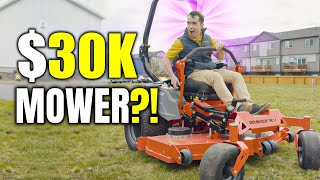
Mike Andes and Josh from Carl's Mower test the Gravely ProTurn EV, a $30,000 electric zero-turn mower. It runs up to 12 acres per battery charge and costs far less to maintain than gas models, but the high price and uncertain repair ecosystem make it a gamble for most homeowners.
Questions this video answers
About $30,000.
ProTurn EV.
Four removable batteries; about 50 pounds each.
About 12 acres of mowing.
About 2,000+ charge cycles.
Chapters
Dude, that is so trippy.
Just like you're creeping.
All right, here we go.
Like, that's super cool. Hey, everyone, Mike Andes here, landscapebusinesscourse.com today I'm very honored to have Josh from Carl's Mower here in Ferndale, Washington with us. And today we're gonna be looking at a $30,000 zero turn. This is the new Gravely zero turn that is completely battery and electric operated. Gonna have Josh walk us through this. This is not sponsored or anything like that. Just wanted to give you guys an opinion and kind of be able to see the difference between electric ver and why you might consider this down the road as the cost comes down. Or maybe if you have any municipalities or city contracts that would prefer this. And it's a great way to also market the fact that you don't have emissions, you don't have fuel. And it's very quiet, as I just found out when I drove it. So this is Josh. He's gonna kinda walk us through some of the different features. I might ask him a couple things just so he can kind of get to know what an electric mower this size actually looks like.
Yeah. What was your first response when you said, how much is this? And I said 30.
30 grand. It was the fact that you're basically throwing up a Tesla or. Or a mower. That was the question.
Well, what would you rather have a. I don't know, I'm bored.
Well, I figured for that price we could, we could almost like levitate off the ground and like do like a. More of a hovercraft.
Yeah. I think you should be able to time warp with it.
Exactly.
And in a way, you might be able to anyways. Really cool. This is a battery powered zero turn. It's all electric. Advantage of a battery. Mike touched on it a little bit is you may have contracts that require you to be battery. You've got benefits, you've got maintenance benefits. I also think operator fatigue. You hit on the noise. Have you sat on a noisy mower all day long or for an hour? You get off and you just feel it.
What about like hospitals and things? Like, do they like the lower quiet? Is that so?
Think like universities, schools, hospitals, business parks. I know some of the major tech companies around the US Are requiring mowers to be battery operated. They don't want the emissions, they don't want the noise. So it fills that gap.
Cool. Maybe show us the. The batteries in the back here, how it charges and more importantly, tell like the biggest, you know, the biggest Fear is that you're out mowing and these things die. Okay, so, but show us first. Like, this is pretty incredible, the fact that you got these massive batteries in the back here.
Do you work out, bro?
No, bro, like I'm telling you, like, if you don't have to, if you have one of these mowers, just take these in and out. You got your squats?
Yeah. No. Okay, so there you got four of these bad boys in the back. Tell us how you know how these are constructed, how long it takes them to charge, cost of that, stuff like that.
Yeah. So you've got four batteries. They're all independent. You can run on two, you can run on one with four batteries in, fully loaded. They're talking of 12 acres of MOW tying. That's a lot of ground. I mean, most of us don't mow 12 acres with the blades on 12 acres of mo time.
But hey, I'm in the field and I'm worried about running out of juice. A the blades will shut down when you reach like 90% of usage. So when there's 10% left, you kind of get this kick in the butt that says, get back to your trailer. Yeah. So that's a good thing because we don't want to push it. And you can pick up spare batteries. That's something about this. They're not built in, they're removable. They weigh about 50 pounds. So you could pull out a battery, throw a new one in, and keep going through the day. There's two ways to charge it. You can charge it on your trailer, or there's a plug in here that you can charge it in the shop at night, and it's generally an overnight.
Charge on the trailer. What does that look like, though?
So there's a.
Addition to the power wall on the trailer.
So that hook into the hook, like the trailer's power.
The trailer's power, yeah. So you'd have backup. Like guys are doing solar panels.
Like a trickle charge. Yeah, because it's not going to be as.
You're probably not going to get a full charge. But if I can, you know, if I can tend this thing in between jobs.
Right.
Might work. Right, Right.
So how long do like say 12 acres on this thing that's gonna last what, like five hours?
It depends how fast you're mowing. Right. But you're probably mowing at six miles, seven miles per hour. So you're doing. I bet you're doing three to four acres an hour. So let's say you're doing Three, three to four hours worth of solid mowing.
Now, from a number standpoint, we talked about why you might do this from a marketing standpoint or getting certain types of contracts that are going to require this. But from like a residential guy, it's obviously very difficult to warrant that. This is 30,000. A very comparable gas product is going to be 10,000. Why? From a number standpoint, maybe long term. This isn't right for someone yet. But why would this be more cost from just a use standpoint, Maintenance, things like that. What are those different features? We talked recently about dollars per hour of running a zero turn. Where does this compare against that?
Yeah, you don't have your fuel, right? You don't have your oil, you don't have your air filter, spark plug, fuel filter. All of those maintenance items are gone, which I sell this stuff. That kind of scares me, throwing my future revenue off. I suspect there will be.
This is your diversification?
Yeah, this is my diversification. There's going to be costs, right? We're going to have motors failing, we're going to have electric. It's just going to be a different thing. But you're going to save a fair amount of money. If you look at your annual maintenance costs over those. Now, does that pay for the mower difference? Questionable. Long term, I think, you know, in four, five, six years, as technology gets better, the price of these going to come down. We're going to see it on smaller platforms or walk behind mowers or stand on mowers. It's being driven, guys. This is what's happening. It's happening in the automotive industry. It's going to happen to us here too.
So. Because I'm an idiot when it comes to mechanics, obviously you run a place that does this all day long, okay? We talk about like say a dollar per hour or, sorry, a gallon per hour of burning fuel. So let's say that that's $3 in savings. What other savings in terms of like oil filters, oil, hydro oil, like, does that still need. Does that still require hydro oil? Okay, so this is my question. When it comes to one of these, when it comes to maintenance, does it cost more to fix this? Because no one knows how to work on this. And are the parts harder to get or is it pretty much the same. Same exact mower in terms of moving parts and belts and things like that?
Part of it, yes, the same mower. I think we've got the same frame, we've got the same deck. We've got the same deck lift. We've Got the same wheel bearings, but after that there are no belts, there are no idlers. I don't know what it's going to cost to fix yet. That's a bad way to answer it. But I haven't had to fix one yet. I mean, they're fresh guys. This is fresh getting out there. I suspect that the maintenance cost will be less. It will take me fixing it, not you fixing it. Right.
So for me, not a big deal. But for someone who actually knows how to fix gas equipment, probably, yeah.
It might bite them in the butt, right. They can't go home and throw a new belt on. They might have to replace a motor. Right. Which is actually your blade spindle. So, yeah, it's gonna be weird to see how it all plays out.
Definitely. The weirdest thing is the no noise part. And I think that this could be potentially pitched as a value play. Right. We always talk about like a transaction goes forward when value exceeds price. And if someone's willing to pay a premium price, then this might make sense. Now probably the one question I have when it comes to these that I've never asked anyone is how long is this going to last? Because if this can last 5000 hours versus 1000 hours or 1500 on a gas, then it really starts to make sense from the long term standpoint. Do we just not know that yet?
Talking 2000 plus charge cycles on a battery. So that's a lot. I mean, that's a lot, right? Let's say it's 2,000 days. How many days that we actually mow? That we actually mow?
That'd be like 15 years almost. And 10 years, let's say 10 years if you did 200 hours.
200 mows.
200 days.
200 mows a year.
Yeah.
200 days of mowing gear.
Yeah. That'd be 10 years.
10 years, okay. That's more than you get. A lot of times people are ditching a zero turn at 2000 hours, right? I mean, there's guys that'll run it longer and there's guys that'll be shorter. Like 2000 is kind of that sweet spot.
So will the batteries outlast the frame?
I don't think so.
Really? No.
I mean, but you got deck hangers, right? You're gonna have wear, but they're not major wear items.
So for the residential guy, like obviously 30 grand. Not a chance. I'm just getting started. When do you think this price point starts becoming competitive against the gas one strictly from a number standpoint of mowing without the value Add without the marketing piece, what does this need to come down? Because it's gonna come down in price. We've talked about this. In five or 10 years, this will be the standard.
I think it's stand on. I think a 48 stand on right where you're not bagging with it. And you need those tight areas. If you get in the 14, $15,000 range, I think you hit it right there.
When do you think that's gonna happen? Three, five years. Obviously, with the new administration, we got tax credit stuff with the whole green thing. Batteries are getting better. I just can't wait till Elon Musk gets a hold of this and makes a better one. But, like, when do you think is that? Three, five years.
It's interesting, right? Like, will the price go down or will the quality get better? Right, right. Because, I mean, Tesla, some of the, like, they've introduced models that are cheaper, which you've actually seen over the last few months, they've gotten rid of their cheap and they've just increased the quality or the performance of the battery. Right. So all of a sudden we may have a battery that doesn't go for 12 acres, it goes for 30 acres.
And I think, like, like with Tesla, some people, before they adopted this technology, they had to see it on the road for five years, right?
Yeah.
And I think, see this thing in five years and there's people like, hey, I used it. It worked great for all five years. It was cheaper. But that's when it starts making sense from a money standpoint, Right? So thank you, Josh. I appreciate it. Guys, Carl's mower here in Ferndale, Josh, is great. Come check him out. If you're local here, this is the cravely new.
What's it called? Proturn Ev.
Let's go, Ev. Thanks so much, everyone. We'll see you on the next.
I guess I have that rubber thing on there, but all the batteries, the four different batteries, right.
Sam?






