Breaking Down a $220K Lawn Care Business
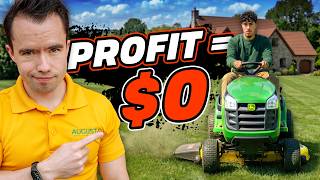
Zane's Vaughan lawn-care company hit $220K revenue in year two but showed no profit due to cash mismanagement and treating asset purchases as expenses. Mike Andes walks through the financials and operations, then lays out a six-week plan: fill truck capacity with staff, build a conversion-focused website, raise prices once full, finance the next truck instead of paying cash, and fix the Google Business listing.
Chapters
This is Zane. He runs a lawn care and mowing business and he made $220,000 in revenue last year, but his profit was negative. This is the Business Breakdown Show where we take real home service businesses and analyze exactly what's holding them back. Our goal is to give Zane a strategy to turn around the company in the next 6 weeks. So the name of the business is Mow and Snip. Mow and Snow up in Canada. Let's go ahead and take a look at the application video.
The owner of Mow and Snow, we're based out of Vaughan, Ontario, near Toronto, and we do basically maintenance in the summer, lawn care, and then snow removal in the winter. Right now I have about 2 full-time employees and a bunch of part-time guys that I need for help. Last year I did $250K in revenue. Profit, I didn't take home too much. I thought like The business is quite new. I think it's my second year, like, as an official business. So still building, buying equipment. But I would like to take more money home, have some profit. Of course, I had two partners last year. I had a lot of issues with them, so I finally got rid of them. And now I'm looking to do bigger things this year. I went big for snow removal. So far it's been a tough winter, but Seems like it's getting warmer. I wouldn't say there's any personal issues really hurting the business, just figuring out like parking situations for now. Cause right now I'm just working out of my mom's house. So struggling with that, like storing the equipment. She's always getting mad at me cause I'm taking up her whole garage, but I have a small storage unit and just wanted to get some help from you.
Okay. So Zane is second year in business. He has 2 full-time employees, a couple part-timers for the winter up in Toronto. They did $220,000 to $250,000 in a revenue, a little bit of discrepancy between the financials and what he said. He got rid of his two partners last year. And so right off the rip, a business that does $200,000, $250,000 with two full-timers, an owner, and multiple part-timers, I'm already questioning their pricing. Let's go ahead and look at their website. We're going to pull it up here. It's mowandsnow.ca. Let's look at some of the areas of improvement we can figure out here. And before we do that, let's actually look at their Google Business Profile. Okay, so we got 43 reviews, it looks like. So we don't have an address that's verified. That's definitely something I think we could improve at on the Google Business side of things and adding content. We do have some back in 2025. We made some videos, it looks like, on Google. But adding to that, got decent number of views, honestly. But I would love to see an address verification just going from a service area, which is really easy to verify on Google, to a verified address is going to really help you rank better on Google. And it's a pain in the butt to verify an address on Google and they change their parameters all the time. You submit videos, the whole nine yards. But doing this will allow you to show up on Google Maps a lot more often. Even just looking at your service area right now as you have it on your Google listing, That's a large service area, like very big. So I'm concerned by that when you're of this size to be serving that large of a service area. But let's look at your website now. So I think there are definitely some areas of improvement for the website. It doesn't adjust to me moving the screen in and out here. So on mobile device, it's not going to look good. If we look at services, so you have what I call a one-page website. I would prefer that this be a dropdown for services to all your service pages because I think you've actually built out pages like, oh, well, okay, maybe not. Okay, so we got lawn mowing. Let me go to services real quick again and click on— let's do yard cleanups. Your service pages need to be built out. You have the actual frame for it, which is mowandsnow.ca/service-page/yard-cleanups. But like when I get to the page, it doesn't show cleanups, it doesn't have pictures, it doesn't have text for just yard cleanups. And when I go to your home, you say quality work, reliable services. But if I just took out your area code, this page could work for just about any lawn care business, honestly, any business, because it doesn't even say mowing or landscaping. When someone gets to your page, I want them to know two things very quickly. What services do you offer and what service areas do you perform services in? Because that's the only way for them to know if you're actually going to solve their problem and then then continue to actually request a quote. So I think definitely some design elements here. Let's see what request a quote goes to. So here's what's interesting. Right now, when you go to request a quote, it's actually going to call you where you already have your call now button in the top right-hand corner. I would leave that and make the request a quote have, you know, go to your booking form, actually, which looks like this side one does. But I would have the whole button go to your requesting a form. Better yet, don't have it where it goes to a secondary form, a different page. Have the form right here off the left-hand side. I'd love to see it saying what areas of Ontario you service, what kind of work you do very quickly, like mowing and landscaping, for example, or snow services. And off to the right-hand side here, I actually want to see the beginning parts of the form for like name, address, et cetera. So I, as a customer, know, okay, they do services in my area for the services that will solve my problems. And now I want a quote so I can just submit the information right here. Also, the background image, even if you had lawn care, landscaping text, I still don't know that this is your picture. And maybe you threw up a drone and got this photo. That's cool. Like, this doesn't scream your local area. I could not look at that photo and immediately know Ontario, and it doesn't show your brand. So if you have trucks, if you have uniforms that look professional, show those on your website so that the cohesion of the brand is held intact. Meaning when the customer sees your truck or your uniform, You're like, oh great, now I go to their website, look them up, and I see those exact uniforms and that exact truck wrap and look and feel and brand across disciplines, which means I see it in the real world, I see it online, and then once I submit the form and I get my estimate inside my customer portal, the colors look the same, the logo looks the same. So overall, just some real brand work that's needed at Mow and Snow. So the overall grade for the website, I have to give a C-. I'm happy that you have a website relatively early on in your entrepreneurial journey. Unlocking this is going to get you a double or triple very quickly. And that's just a good looking website. We judge based upon this. And if your truck and wrap looks good and your uniform is great, but when people see that, what do they do? They go online, they search out mow and snow. And when they find this website, they're like, oh, immediately, I don't think that there's going to be a premium service. And you might be saying, well, I don't want to really be a premium service. The bottom line is if it comes across from your trucks, your uniform, and then your website that you are a premium service, you can easily charge $10, $15, $20, $50 more per hour. Like, that's impossible. There are absolutely landscaping companies that are charging $50 an hour, and there are companies that are charging $100, $150 per hour. And a lot of the difference between the two is the brand cohesion between the trucks and their uniforms, and then when they get to the website, the customer is not confused and they see this brand across all 3 of those legs, uniforms, trucks, and the website. So get that cleaned up. If you need some examples of what a great website looks like, go check out homeservicewebdesign.com or lawncarewebdesign.com. Go to the Our Work tab. You can see hundreds of websites that we've built for home service businesses. And at your sizing, this is the difference maker. Like, you can pour money in ads, you can figure out where you're going to park your trucks and all these things. But the thing that gets this from $250,000 to $750,000 is going to be your website. And you're like, oh no, you got to actually have a call to action. You got to have an ad, you have a door hanger, you have a Facebook ad driving traffic to this website. You're going to have a 1 out of 400 conversion. Like very few people are going to convert into a paying lead. I want to focus on getting the same amount of traffic, the same number of clicks to this website. But instead of converting 1 out of 400, I convert 1 out of 50. And by doing that, you would 8x the amount of leads that you get from this site. So I got to go with a C-. All right. Let's go ahead and jump into the financials that Zane gave us for the business. So first off, this is written out on paper. And I think, Zane, the big difference between where you're at now at $250,000 and getting to $750,000 in annual revenue and going from solo operator to a working GM where you have a team and you're established is going to be professionalization, professionalization of your website and now professionalization of your numbers. And I understand that, you know, paying $100 a month for QuickBooks just to reconcile your books seems like a lot, but having clean numbers that's digital is going to help you a lot. Having the numbers written down, I'm glad you have the numbers. I'm glad you know your revenue. I'm glad you know your expenses. But I can immediately see some big holes here. First off, I'm looking at January. We have $6,000 expenses, $1,000 in revenue. Okay, we lost like $5,000. February, $4,800 expenses, $1,000 revenue. We lost $3,800. March, we have $8,500 in expenses, $1,000 in revenue. Again, we lost $7,500. In April, we had $20,000 in expenses and $7,500 in revenue. So, like, we are digging ourselves a massive hole. Massive hole. It's not till July that we even make any profit on a monthly basis, let alone dig ourselves out of the hole. And for the whole year, we're only— we're actually— what is it, negative? Yeah, we're negative a couple thousand dollars. In terms of profit for the whole year. We have $219,000 in revenue and $221,000 in expenses. Now, this is why it's so important to have QuickBooks and have something that actually creates a profit and loss statement and balance sheet. Because I actually believe, I don't know the value of your trucks, but if I had to believe, you actually had probably about $50,000 to $60,000 of profit in this year on an actual profit and loss statement. The difference is you are showing as expenses you buying these trucks and trailers. So, I'm going to go out on a limb and say you bought like a trailer in January and February and then like bought a truck in like March and April. I'm just going to guess because I don't know the numbers. I can't see that. Those show up on the balance sheet. They don't show up on a profit and loss statement. A balance sheet is assets and liabilities. And when you take an asset of cash and you turn it into an asset of truck, nothing happens. Like, All of it stays the same. A balance sheet is a balance of your assets and your liabilities. And if you pay for things with cash, you might say it's an expense, but in reality, it's just turning cash into metal. It's not actually an expense to the business. The only expense is if you had a loan and then you had interest expense. But the actual asset itself is not an expense. And so this is actually not a profit and loss statement. This is more along the lines of a statement of cash flows because money in, money out. The bottom line is you probably had $50,000, $60,000 of profit on a P&L. But because you're now wrapping up your asset acquisitions, your asset purchases as expenses, it's making it look like you're not making any money. Whereas if I looked at your balance sheet, I would see that you probably acquired, I just call it $50,000, $60,000, $70,000 worth of equipment on your balance sheet. And so this is why it's so important to have a profit and loss statement and a balance sheet. And it's also very important to have it digital so it's actually reconcilable. And, you know, if you need help, you can go to Home Service CPA and we do bookkeeping, we do payroll, we do your taxes. The most valuable service for you from Home Service CPA, Zane, is going to be the reconciled monthly financial reports, which is going to be— they're going to take your bank account and they're going to look at your profit and loss statement and your balance sheet and make sure everything's lined up because this is a hodgepodge of, Cash accounting, expenses, assets on a balance sheet, and it's extremely messy. And at $250,000 in annual revenue, if you're just like, hey, I'm not gonna buy any more trucks next year, I'm not gonna get any more trailers, you're actually gonna probably make some money. So not a bad idea. However, because you are mixing and matching all of the financial reports, it's looking very messy. And it's not really until the last month of the year when you had $22,000 expenses and $52,000 in revenue. I'm going to guess that's when you collected a lot of your money for snow services, that's really when you actually get to break even. So you spend your whole year in a deficit, in negative territory. And so to prevent that, we've got to have clean books. And that is a balance sheet and a profit and loss statement inside of QuickBooks, not written down. And so I have to give you, unfortunately, Zane, a D when I grade your financial statements and your financial organization. Again, it's not the numbers of not being profitable. I actually believe if, I had a real profit and loss statement. You probably made $50,000 to $60,000 on a P&L and you took all that cash and you put it into assets on a balance sheet, which is your trucks, trailers, probably bought out your partners with some of this stuff, etc. That's fine. The reason it's important to have clean books is because it'll keep your head in the game. Right now, you feel like you're not making any money when in reality you've just taken what money your business earned last year and converted it into trucks and equipment and trailers. And so knowing that is very important because you are technically investing in the assets of the business. And it's not showing up in your bank account, but you're buying trucks and equipment, you're buying long-term assets. And so that is something to keep in mind. And certainly I would recommend reaching out to Home Service CPA as you begin to grow, because professionalization of your finances, professionalization of your website is going to be the thing that unlocks a triple over the next 12 to 24 months. All right. Let's jump into the 4L framework. The 4L framework is the 4 reasons why every home service business stops growing. Either a lack of liquidity, money, a lack of leads, a lack of labor, or a lack of leadership. One of these 4 is holding every home service business back. Let's go ahead and look through some of the problems that I see in each of these categories when it comes to Zane and Moe and Snow. So when it comes to liquidity, right now we got a bit of a cash crunch. Why? Because we have negative profits. So negative profits. Now, remember, I actually don't think it's negative profits when it comes to a real P&L, but it's negative. I should say negative cash flow. And the other problem that I'm seeing right now when it comes to liquidity is we just don't know our numbers. So don't know. And the reason I can confidently say that is because it's been written down on paper. And if you don't have something digital, this piece of paper could get messed up. I don't even know where these numbers are coming from. Is it coming from a CRM? If so, like, why don't I use a CRM? To track the stuff. Is it coming from a spreadsheet? Let's show me that. But based upon just numbers written down on a spreadsheet of revenue and expenses, I don't believe that the numbers are actually known. And we certainly don't know our balance sheet. So let's look at the leads. The next constraint in the business. And right now, the website design. So the web design is super flawed. 80% of your traffic is going to come typically through a mobile device. Meaning that if your website doesn't scale up and down in terms of size of the device or the screen that's being shown on, you are losing out on a ton of new leads. We do have 43 Google reviews, which I'm super happy about. I do think we can optimize your Google Business Profile a little bit more just by adding in pictures and video more often, responding to reviews, and then verifying an address instead of just a service area. Right now, I think you got, I think you said 2 full-timers for labor. I'm not gonna really hone in on this as a constraint to the business. It doesn't sound like you're having trouble finding employees. As you begin to grow, labor and leadership will start becoming more of a constraint. 'Cause the 4L framework is I take money, I go out and get leads, and when I get a bunch of leads, all of a sudden I need more employees. And when I get a bunch more employees, I then need more leadership. And right now you still really haven't got to labor as being a constraint in the business 'cause you're currently struggling with getting enough money to go out and get enough leads. So I really want to focus on this side. And for the vast majority of businesses under $500,000 in annual revenue, this is where they live. They need money. They need to figure out consistent lead sources, whether it be Facebook ads, Google ads, door hangers, yard signs. And this is why a lot of people ask about like, how do I get leads? How do I do marketing? Where do I do advertising? Does Facebook ads work? The reason they're asking that is because they're trying to figure out these first two constraints to growth. And then if you talk to someone who's doing a million-dollar business, they're like, I can't find employees. I can't find general managers because they've migrated and matured the size of business. And it's just a different constraint as the business grows. And so right now we need more money. We need to get more leads. If we do that, I believe once we hit $500,000, $600,000, $700,000 in annual revenue, then Zane is going to have a problem around how do I find employees, how to retain them, how to make sure that over the summer, over the winter, when there's snow, I'm able to keep my crew on and then keep them busy during the off-season, which in Ontario is actually their summer. So, That'll be important down the road. I think in terms of leadership right now, a big thing that I heard is that Zane recently bought out partners. Now, I'm not against partnerships 100% of the time, but you have to realize with business partnerships, it's not till death do us part. You will split ways. And everyone points to people like Charlie Munger or Warren Buffett as like a partnership that basically lasted until they died, until the most recently Charlie Munger passed away. However, most business partnerships don't last 10, 15, 20, 30 years. And so ironing out now, if you're going to get into a partnership, how it's going to happen when you get rid of them or when they split or when they want to leave, especially when you're a young guy and you know that people's lives are going to change. You know, in 10 years, your life is going to look totally different, whether it be marriage or kids or more financial responsibilities. And obligations. And so if you have 2 or 3 partners, in this case, 3 people, Zane and 2 partners, we're running a $220,000 business. It's not enough to sustain all 3 of you, even if you did all of the work, let alone the fact that all of you are young and you're not going to be around in 5 or 10 years likely working together. So if you're thinking about getting into a partnership, just plan from the very get with the new partner how it's going to end, whether that be how are we going to value the business when "We need to split ways." And I've had partnerships before and bought out my other partner. But it was very clear in terms of how we were going to value the business and how much I would have to pay to buy them out. So if you're thinking about partnerships, to avoid a lot of distraction, and now, fortunately, Zane is on the other side of that. Awesome. But I would imagine that last year, a lot of distraction and mental bandwidth was spent on getting rid of the partners. And that can get cleaned up if you just, from the onset of the partnership, figure out exactly how that separation is going to happen years before it actually does. Because when it actually does, usually gets really messy. But if you have a document, if you have it already written out, you already have a system for how exactly the business will be valued, how you can buy each other out. Is it over the course of time? Is there profit sharing? Is there a discount on the valuation if someone wants out? These are all little things that happen, but no one takes into consideration. And so all of a sudden, when the third partner is in the middle of a divorce, the partner they're divorcing comes in court and tries to kick their equity in the business, all of a sudden everyone's thrown under the bus. And so have a plan in place if you're trying to get into a partnership. All right, let's create a 6-week plan to make sure that Zane and Moe and Snow is able to get to the next level. The very first thing I want to do is fill to capacity. Last year, Zane, you really spent quite a bit of your cash. I would say $50,000 to $60,000 if I had to guess on these trucks, the trailers, and you paid them all off. Awesome. That means you don't have any debt. From what I can tell. And I want you to fill the capacity, meaning you right now have 3 trucks. That's amazing. So if you have 3 trucks, let's assume one of them is going to be yours and you could technically get 2 employees in 2 of the other trucks, meaning 4 employees. You could easily get this business to $500,000 in annual revenue without buying any more trucks. And that's what I want you to do. I want you to fill to capacity. And for everyone out there, Figuring out how much revenue, how many customers could I serve without buying more trucks and hiring more people is very important because you will be most profitable when you're at capacity. You have 3 trucks rolling around with 2 employees in both of them full time every day of the week. You'll be producing $500,000, $600,000, $700,000 in annual revenue without buying any more trucks. Even though last year might have seemed like a loss for you, Zane, or like you're really struggling, you've made a lot of asset acquisitions and purchases that set you up for extending your capacity and be able to grow the business past $500,000 without buying any more trucks and equipment. So moratorium, Zane, on buying any more trucks or trailers or equipment until you pass $500,000 in annual revenue. So fill to capacity is the number one most important thing. If you continue to buy more trucks and trailers that you don't need at $200,000 in annual revenue, you will continue to not have money. If you just take what you currently have and use it every single day and then Get 2 employees in each of those trucks. You can grow past $500,000 without getting any more trucks and equipment. You'll be profitable this year if you do that. Okay, the next thing I want you to do is get a new website. Get a new website. I don't care if you want to go cheaper, go something like Squarespace, Weebly. There's a whole bunch of like web design build stuff that you can do yourself, but you got to upgrade your website. The current one looks bad. If you want to go hire someone for several thousand dollars, they'll build you one. Little more custom. At Home Service Web Design, you might be a little bit early for it, but go check out the Our Work tab on Home Service Web Design or Long Hair Web Design. See the websites we've built and try to mimic some of those. But you gotta get a new website. The current one is not going to convert. And down the road, when you get a little bigger, I have no confidence driving any traffic to that site 'cause it's not built to convert clicks into leads. Okay, the next thing I want you to do is go in profit mode. Okay, so profit mode means when you hit capacity and these trucks are rolling around, you're going to be doing $50,000, $60,000 a month in revenue. I don't want you to go buy more trucks. I don't want you to hire more people. I don't want you to continue to advertise. I just want you to raise prices. And the reason I did this after number 2, which is get a new website, is because you won't need to advertise if you have a great website. If you just got a great website and then you raise prices, you're like, oh, if I raise prices, less customers will join. You're right, but I'm gonna 4 or 5x your conversion on your website. So the traffic that's currently coming there, you're gonna have 4 to 5 times as many leads. And so if your close rate drops from 90% down to 60%, I don't care. And so I need you to go into profit mode, which is raise prices after you get number 1 done, which is filling the capacity. For everyone that's out there like, Mike says always raise prices, and you go out and raise prices, You do it when you hit capacity. There is no question as to when do I raise prices. You raise prices when you hit capacity, meaning all your trucks are being used, all your employees are being used every single day, and any more customers would mean you have to work overtime and work on the weekend. And once you hit that threshold, then you raise prices because you need customers to leave. You actually need customers to leave once you raise prices on them, because if you don't, you have to turn away new customers that are willing to pay a higher price. So I need you to go in profit mode and raise prices on all existing customers once you hit capacity. I need you to determine, Zane, what is that? Is it $500,000? Is it $50,000 a month in revenue? Is it 150 recurring customers? Whatever that number is. And for some people that do snow and mowing services, it's like, I actually have a capacity for mowing. How many mowing customers can I serve? And I have a capacity of how many snow customers I can serve. I've got to figure out which of those two I hit because only Raise prices once you hit capacity. Meaning, I'm okay with you staying in growth right now, Zane. Like, get as many customers as possible. Get this website up and running. And within a matter of 4 to 6 months, you can absolutely be cashing in on your upcoming snow season and filling the capacity and raising prices in December and January of this coming year. When the next truck dies, I want you to buy a new truck and finance it. Everyone's gonna fall off their chairs. Finance next truck. Like, Mike, you're the person who says don't go into debt. The current constraint to the business is getting leads. I need you to have money, liquidity, to go get more leads. But if you keep taking all of your cash and spending on trucks, guess what you're never gonna do? Spend money on advertising. And so once you have a great website, you fill the capacity and you're in profit mode, I want you to actually finance the next truck. So that way, instead of spending $30,000 on a new truck and wasting all of your cash, you're gonna spend $3,000 down on a loan payment, on the initial down payment, and then maybe pay $700-$800 a month on a truck. And I'm okay with that because I would rather you spend $20,000 of that extra cash, that liquidity, on then advertising down the road, not right now, after we've done all these other things. But when it comes to you need another truck because one of your 3 are going to die, especially in your market, you guys drive your trucks hard, one of them is going to die. When it does, you're going to be tempted to go take the $25,000, $30,000 in your cash that you have in your bank account and go buy another truck. I don't want you to do that. And the reason I say this is because you just got rid of two partners. I believe you're in it for the long term. And when it comes to cost per mile of buying a new truck, as well as the fact that by having cash available, you're able to grow the business, that's when buying new makes sense. Now, if I thought you were just getting started, this is your second year, you're not really in it for the long term, you're only going to be doing this the next 2 or 3 years, then buy used because the depreciation curve on new is pretty steep. But if you're going to be in the business for the next 10, 15 years, and I think you are, Zane, because of your track record of getting rid of their partners and whether you bought them out or whatever, and you've got all these trucks with cash, like, I believe you're in it for at least the next 5 to 10 years. If that's the case, I want you to finance your next truck so you have plenty of cash available, because by this time you should be doing $500,000, $600,000, $700,000. The thing that's going to get you to the next level is advertising, because now you have a great looking website, you'll be profitable, and I don't want you to spend buying another truck. When the next truck goes down and it eats the dust because they're all used trucks right now, I want you to buy new and finance it. Take the capital that you have available to be able to put money back into the marketing engine and convert liquidity into more leads that will allow you to get to the next stage of growth and likely a 7-figure business. All right. The fifth thing I want you to do is get your Google Business Profile verified. With an address. This will allow you to show up much better in Google rankings, both on organic search as well as on the maps. And I don't care if you got to give someone a free $150 per month service to verify their commercial address and park your truck in front of it, put your signage and verify the address. Get a verified address on Google, not a service area. And the last thing I want you to do, number 6, is to pull services, the demand forward to fill the first 4 months of the year. So I see your first 4 months of the year as your off-season. And inside of the book, Why Home Services Are a Terrible Business, I talk about the off-season and the 5 ways to cure it. And one of the things I think you could do is really figure out how to pull demand forward from April, May, and June, pull that back into January, February, March. I don't care if you have to offer discounts. I don't care if you have to just text people through HomeWorks and send a blast text to all your existing customers and say, hey, We really appreciate you being a loyal customer. We want to prioritize your spring cleanup, get them all done before the rush that happens in April, May, and June. And if you're like, well, there's still snow on the ground, then we got to sell more snow during January, February, March. So we've got to figure out a solution for your off-season because right now your first 3 to 4 months of the season, of the year, is brutal. You're digging yourself a massive hole from a cash perspective, being extremely unprofitable, and hardly any revenue is happening. Like if you have $1,000 a month revenue in a month like January or February on a $250,000 annual revenue business, you have— means you have a huge spike. You're going from $1,000 in revenue to $52,000 in revenue in the same year. That's crazy. I never want my worst month to be less than 50% of my best month. Meaning on $52,000 in monthly revenue in December, I don't want any month of the year to be less than $26,000 in monthly revenue. So solving this off-season problem could very much look like having to do a better job of selling snow. It can mean going and reaching out to your existing customer database and pulling all the demand forward from spring into the first couple of months of the year. But we've got to solve this off-season problem, and there's 5 different ways to do it. It's all inside the Off-Season book. If you want me to come out to your business in person, Not just here at the studio, but in person. I'll fly out to your business on my own dime. I'll bring the film team. We will record everything and we will fill out this piece of paper for your business and help you turn it around and get to the next level of growth. If you want that, it's completely free. All right, just click the link below. Go to the link in the description, mikeandes.com/turnaround. Submit a video, takes 5 minutes, and hopefully I can see you in person.






