Congrats, Grant Cardone - Episode 043
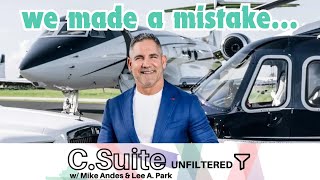
Mike Andes discusses Grant Cardone's dismissed court cases, the safety trade-offs of self-driving cars, and Brian Chesky's leadership lessons from Airbnb during Covid. Plus practical tips on conference talks and keeping keynotes simple.
Chapters
All right, welcome, everyone, to another C suite unfiltered podcast sponsored by Essentia. Dude, this bottle has been used a lot. Yeah, dude, like my dad, he uses bottles, like plastic ones for years.
Reduce, reuse, recycle. You know, that's sixth grade and get.
A little plastic in your stomach. Anyways. Okay.
All right. No bpa. There's no bpa.
I had a couple things I wanted to go over or topics while I was running. I figured we should go over it. Number one, because we are, you know, we believe in freedom of the press. We believe in.
Middle of the aisle, newsworthy topics.
Yeah. We try to diversify our sources.
Yeah, yeah, yeah. So we also are willing to concede when we are incorrect on our sources. And so I do think that the show needs to preface this one by saying Grant Cardone was not guilty of any of the things that we had assimilated to him.
This is my first note for the day. Grant Cardone is free in all caps.
So.
Yes.
So I think. I think we didn't really, like, throw him under the bus at all. No, we were just. I think the title and thumbnail actually got caught in the algorithm.
Totally. Oh, yeah.
Like a bunch of people watching.
Yeah, it's our. It's our most viewed video and it's our most disliked video because. Well, because the video.
There was no video.
Was that the one without video? Oh, yeah, yeah, that's the one without video. Yeah. And we talk about Grant cardone for, like, eight minutes at the end. So, yes, 100%. That was a clickbait title, thumbnail. 100%. Like that. But, hey, that's the name of the game.
Yeah, yeah. So he basically got acquitted with no. With no prejudice. You vote. You. You have something. Go ahead.
Well, no, I just. That's what I wrote down. So case was closed with prejudice. So that means. Meaning that the decision is final. All suits were dismissed. Some of these suits included false false claims and information, misleading omissions, misrepresentation of debts, and more. So basically, he fought it, and it was dismissed by the circuit court judge that was handling it.
He had to spend $1 million.
Yeah.
Million. 50,000, something like that.
Yeah.
So I got the public video on the weekend, but then I also joined the investor call.
Nice.
That he did the same thing. So it was. It was. And this is the thing, I think even if the law says someone's innocent, I do think they have learned a lot. Like in the three years ago, the way they advertised Cardone Capital versus now, very different. And so they learned And I still think there's a lot to learn from it. And so I was definitely taking notes throughout this whole process. And, like, I even kind of said in full defense of Grant, like, that there were certain things I learned from him, how he handled in the midst of COVID 19 and how we handle it with the investors and, like, keeping everyone aware and showing the numbers throughout. And like, hey, we're not gonna die. But the fact that you said it kind of was jolting to a lot of people, I think.
Yeah.
And made it as like, hey, we gotta sell all these books, we gotta sell all these stickers. We're gonna sell these hats that are all gonna, like, die. And so selling fear is, I think, a good tactic to sell in the short term, but long term, you scare away, like, long term investors. And so I just kind of took notes to the whole thing. Not. Not like actual notes, but, like, mental, like.
Yeah.
Because in the future, it'd be something that we'd be thinking about. So.
Yeah. My biggest takeaway. So I watched the public video. I was not on the investor call.
There wasn't a whole lot.
I was not invited. But honestly, this is what I wrote down while listening to the video. I said, I respect Grant for fighting this. Yeah, I do. I think I have a lot of respect for people that are like, I know when I'm right, and if I have to go through the court of law to prove that I. I will do it the right way. Because he even said in his public video, you know, his legal team advised him, hey, just pay him out. Like, we can buy this out. Like, and they'll. And they'll. They'll dismiss it themselves. And he was like, no, we didn't do anything wrong, so we're gonna fight it. Do you think he spent more fighting it than he did?
Oh, it's a huge. It's a marketing expense.
Yeah.
Because by now having this, he can go on the offensive and no one has any ammunition. And he can just, like, he'll raise way more money now. Yeah. Because all the people that were sidelined just like. Like, you were like, I'm glad I didn't get in.
Yep.
Like, people like you now don't have any ammunition, so you just take all the ammunition out. So kudos to him for staying quiet about it, too. Is really hard for three years to be under, like, stuff and not be able to talk about. It's like, I'm under on a couple things right now where, like, I know I'll be. I'm not guilty And I know it eventually come out like that, but, like, I can't talk about it. I can't say anything. It's really difficult when you're like, that's pressures on you all the time, and there's people holding that against you.
Yeah.
And you can't say anything. So kudos to him for that. That, to me, was actually the biggest part, because I know how hard that is when you know you're. You're not guilty and people are bringing the questions and things. And I. One of the things that I hate, I've talked about before, like, people. When people question my intentions, like, the hardest thing for me, I would have a hard time holding that for three years and not saying anything about it. And he did a good job, like, not publicly bashing the person, because he could definitely have done that. There was no settlement, so he could say what he ever he wanted if there was a settlement, then everything kind of gets locked behind closed doors. But he couldn't do that, like, as much as, like, you notice he said, hey, I offered to give him his money back, and then I was gonna fight this. There was no, like, let's settle for this. Really. Even though the lawyers brought that up, that's not even an option for him because you can't have that allegation and then not equip yourself from it. You either have to fight it or you have to, like, no one knows about it. People had already known about it. It already become a thing. You can't just go pay the person out. It just looks bad.
Yep.
So. So you have to pay the million dollars as a marketing expense to now go on the offensive and say, I'm right.
Yeah.
So he'll do that. Oh, he'll definitely do that. He's gonna clown on it, and it's great. And he will go after people that specifically charged, like, convicted him of.
Like, crimes. He now has the ability to go find them and, like, go after them with lawsuits. So I'm actually kind of looking forward to seeing that. But, yeah, I was taking a lot of notes, mostly how to handle marketing, investing opportunity. And second daily, when people do call you out and say something, it's false. Like, how you handle it.
Yeah. He did name specific, like, journalists and publications that were, like, you said that I did X. Like, that's false. You're trash. Whatever. He did go a little hard on that. He called, you know, people that used him for clickbait, YouTube trash. So.
But he never named. He never named the plaintiff.
Right.
Now, that was the thing yeah.
Which I respect. So I like it. I just think I am always going to default for, for rooting for someone that fights for what's right. And I hate when legal proceedings happen when nothing illegal happened. It just feels like the biggest waste of time, biggest waste of money. Like, like I'm a small government guy in general. Right.
So that was my first thing.
That's really all I had on it.
Okay. So I want to talk about dry driverless vehicles, self driving. So there was the cruise program, which is a piece of gm. Yep. But they are separate department, they run autonomously. So they had an accident in San Francisco. All in POD talked about it. And one of the things that I took away from it is not really to do with driverless cars, but more about technology in general. And I think it's a really good listen for all in POD about technology, where's it going and like the mindset around it. Because if you actually just take a statistical standpoint, a view of like driverless vehicles versus like accidents per mile, it is better to be inside of a driverless vehicle right now. The reason we don't do that is because by doing so you, you give up. You relinquish any power, you relinquish any autonomy, you relinquish the ability to be able to have any say in whether or not you are drunk, whether or not you are distracted, whether you're not texting and driving. Like by just giving that over to someone else, we are willing to actually take a higher risk and a higher likelihood of getting into an accident and being hurt because we have control. And the thing I took away from that is like something we talked about in the POD before is when I'm dealing with franchisees, partners, et cetera, it's like taking away someone's control is the ultimate sin. Even if it is better for them financially and better for their business. And something we're learning from a leadership perspective and the leadership team is like, we allow people to opt into things versus here's what's gonna happen. Because it's better for you. Right. If right now like the government passes law, you can only take self driving vehicles, there'd be all these articles about how unsafe it is. And like every crash is highlighted. There's thousands and thousands of automobile related accidents all the time.
Yeah.
And those aren't reported on. And there's less accidents and injuries per mile on self driving, driverless, self driving vehicles compared to regular vehicles. But the other, the one, the few that we just blow them out of proportion.
What's the sample size on that.
It was huge. So listen to the all in pod. Yeah, great stats on it. The thing is though, like for example, when you look at a blended, this is the part that they didn't really talk about from a statistical standpoint. You look at the blended average of everyone, it's still safer. However, if I don't drink, I don't eat out or I don't stay out at late at night and I don't drive in conditions like snow. Well now that would skew the results and I would imagine I don't have the data to say that I could still beat a self, a self driving vehicle in that case in terms of driving. But the blended average, like if everyone opted in, if everyone was like, yes, we want self, there'd be less accidents and less injuries because of it.
Yeah. Well how, how does it work out though? Let's say I'm driving a self driving car, I get in an accident. Like I can't sue the automaker, can I? Unless it was a faulty system.
Well see that's what Tesla is doing. They have their own insurance program. So I think down the road the automakers will be the insurance providers because now if you have a technology, you're basically going to buy insurance program that's working well and if it doesn't, the manufacturer steps in. Again, only if the type of model that Tesla's implementing works. And that is like they have full, full, full integration from top to bottom, vertically integration where they control every aspect of charging the vehicle itself, insurance. Like they have so many different layers.
Of test, but then it feels like a monopoly on that car. Yeah, right. It's obviously, it's obviously one business entity in theory. But what I'm saying is that doesn't seem fair that like they hold the keys of like, oh no, you can't say, like you can't claim an insurance policy on this because it wasn't faulty.
It'll go to court and it'll be okay, great, let's run the software and see exactly what happened. Let's watch the cameras.
Let's see. Let's like, but, but that doesn't seem fair because I feel like insurance agencies are an independent organization outside of what you're insuring against. Does that make sense?
That's a good point. But there's also something to say that if you're insured by Geico and I'm insuring by Geico and we get in an accident, well now what happens? Right, so it's already kind of there like that could happen, you know. Well let's hope it doesn't happen right now. That could happen. And there's already a process in place for making sure that it's done legally.
Mm, yeah, it's an interesting thought. Like I think I'm generally in favor of it. But yeah, giving up control is hard. Like I'm in favor of it as long as I can push a button and drive myself. Right. That's the camp that I sit in. Because I just, I don't want to give up control. I feel like I am a safe driver. Like Yeah, I got one speeding ticket when I was young and 19, you know, and you're like I have a car, woohoo. Right. But like I'm a safe driver, I go the speed limit. Like I do good maintenance on my car. Like I feel like I want to stay in control personally.
And I think that's where autonomy will go for the next 10 years. It's like it's an opt in. Right, right. And that's what's going to happen. But it's just funny. Like what's going to happen is like you opt in, you either buy a car that has it and you choose when it's on, when it's off, you maybe do it on the streets, you drive and then you let on the highway do its own thing. Like that's how it's going to happen over the next 10 years and then it will be fully adopted. But what you can't do in our case as business owners and especially the franchisees is like jump to 10 years and be like, you must do this. It is better for you, it is healthier for the, the common good of mankind will be better if we just all do this. That is true. But you can't do that. It's gonna hurt people. More importantly, not hurt them, but they will revolt.
And so what if they had? Here's what self driving cars need to do is they need to communicate with each other. So that way. No, no, no. But what I'm saying is so I pull into Costco parking lot on a Saturday, right? Worst place to be on a Saturday.
But you do it cause you're married now.
But you do it cause you're married. It's awesome. Yeah, dude got a pack of Celsius, got a nice box book, you know, a couple things. You pull into the parking lot and then you, it tells you where the open spots are. That would be cool. Now there are parking garages that do that. Like I don't know if you've been any parking garages where it'll have like a, a green check mark or a red X above the spot. But you can only see it if it's an ey shot. But if you could have all the cars communicate with each other when you pull on and it's just like oh, go straight four stalls and take a ride.
Because like they know that the, the stall next to me, for example, it's like okay, there's a spot open here. I'm going to communicate that car to come here. That'd be pretty cool.
I like that.
It could totally happen. The technology is there now. Honestly, it's just a matter of like the interfacing between the vehicles. Like Tesla to Tesla would be easy. But then now it happens if there's a dumb car.
Yeah.
That can't do that. You don't know. I pull up, it's empty. It's like no, it's not empty. There's a car there. Right.
That makes sense. Well, if they use their sensors. But now we're getting in the weeds. But I just think it'd be a fun idea because here's what I'm gonna say. Anecdotal evidence. The two times I feel like I almost get the most car wrecks are roundabouts and parking lots. Cause like someone whips around trying to get a spot from you and then they don't see or like roundabouts. Nobody knows what's going on. So I think self driving with the sensors and roundabouts would be awesome.
Yeah. And the fact that it can optimize for the closest to the door without you having to figure out. Because like I hate going to parking lots.
Yeah.
I'm not going to try to find one close. I'm just going to the furthest away and finding a parking lot walk. I'm not looping around trying to get something closer. So that would be cool.
Yeah. I'm going to be that guy though. I know I've told you this before but like I got my O2 Dodge Ram.
I'm.
I'm keeping that thing forever. So like I will be that guy where you're like oh, I think there's a spot up there. And then you just see this huge 8 miles per gallon truck just sitting there. I'm gonna be that guy. So.
Oh man. Is there anything else you got?
That's. I, I had the grant cardone stuff.
Okay. I got non financial advice.
All right. Yeah.
Do you have it?
I, I don't.
Dude, you are unprepared. Look, I figured a Better episode coming out of you with a shirt that says co pilot. Come on dude, that's bad for the brand.
Copilot doesn't have podcast on Automations yet.
Okay. The non financial advice is really good. Interview from Brian Chesky on diary of a CEO.
Oh, okay.
Yeah, he's a quirky guy.
Yep.
He's 39, he's single, he's definitely quirky. I can see why. He's gone through two relationships in the past 10 years. But the story he told of the past three years of going through Covid is textbook stuff.
Nice.
It is phenomenal. And he's a little bit like, I don't want to say corny.
New age thinking. I think in terms of like treating team members ways a certain way and stuff like that. And like some of the language to me seems super corny, but you can't argue with the results. And I think there are parts that he is saying that like employees that didn't respond well to the way he communicated. But it's still a textbook lesson for dealing with something like Covid in an industry that just got obliterated. Like went from like going to, going to go public to like 80% of all your transactions are stopped and you think you're gonna, you're done. Like the drop off there and then over the next eight months rebuild the company. It was a great listen. Diary of A CEO Brian Chesky. This past week is a good. I listened to the whole thing. Awesome.
I like it. I do have some non financial advice.
I was stalling for you.
Yeah, no, it's good. It just came to me.
Okay.
All right. But I thought about this. We have landscape summit coming up next week.
Oh, right. Yeah.
So here's my not financial advice. Cause a lot of this audience is gonna be crossover. Right. If you have, you know, speakers on stage, MCs, whoever it may be, like engage with them. You know, bring the energy if they're, if they're bringing you your energy. Because like you've been to conferences, I've been to, you know, conferences or speeches or whatever. And like when the, when the audience is dead, it changes the whole feeling of the room. And I think the speaker notices it. And I'm not even really speaking at the public conference, so I'm saying this more for the folks that are doing keynotes is bring the energy. If you're the audience, like you show them that you want to be there, applaud for them, engage with them, agree with them, whatever it may be. I think it just makes it a better Environment for everybody. You know, it's awkward in public to be the loud person or be the first person to break the ice, but I think it brings everybody closer together. If you can break down that barrier, hey, we can all have a little bit more fun together. So that's not just for Landscape Summit. That's for all conferences, public events, but.
Which, by the way, you're probably posting this next few days, right?
Yeah, I'll get it up before the weekend.
Yeah. So we'll have. This will be the last one before.
Yes.
Yeah. Cool. So today. Today we were launching. When we're recording this Wednesday, we're launching another episode of the turnaround series.
Nice.
Really good. And all those people that are in the show are coming to the.
Great.
To the event. And yeah, like this. The amount of work up in these keynotes is off the charts. And what's dumb? Not dumb, which I'll just see how the reception is. Is like I've dumbed them down to my head, which is like, I took away graphs and charts and, like, pretty complicated things and, like, just kept boiling it down. Like the simplest form of getting the point across instead of trying to look fancy or look smart. And like, ultimately, when you tear it away, a lot of times, like, you know, what I kept coming to is like, this chart is here. And I made this more complicated because it makes me look smart. And like, what's the objective is not that. The objective is I want them to actually take it and learn and do something with it. Well, then we got to strip away all the fanciness. Yeah. So we got some. It just be interesting. Like, it's simple, but, like, the concepts are the same. And I'm just like, boiled them down a bunch of times to try to make it more palatable for a keynote. Yeah. So it'll be interesting. Dude. I think the first four I'm gonna be pretty solid on, but, like, the last four I'm kind of still working on.
It's all right. You got time? Yeah, a little bit. You have so much time.
Yeah. So anyways, it's gonna be a great event. It is the most work I've ever put into keynotes, and I hope it is. It is good enough.
Yeah. I think it is a great skill for everyone to learn is learning how to explain things simply.
Yeah, right.
Same thing. Like you. I watched you through the whole process of P4P. You built it from the ground up, and then now we can literally summarize it in one sentence. Yeah, but that took, you know, two, three years. To get to that point. So it is. It's a skill that people do need to learn, which is taking complex subject or topic and then reducing it to simple words and phrases that can be understood by multiple people.
That's a very long way of saying it needs to be simple.
It's a good way of saying kiss. Keep it simple, stupid. It's a good way of saying that.
All right, that's the pot. Shortest one ever.
Yeah.






