CONTRACTS vs. PRICE PER JOB! (Lawn Care)
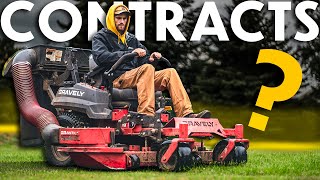
Mike Andes weighs contracts and level billing against per-job pricing for lawn care. Contracts work in year-round climates like Florida because they stabilize cash flow, but seasonal regions risk leaving you unpaid during peak months. Track crew time with punch clocks and performance-based pay to know your actual costs.
Chapters
You need to wake up.
Here you go. Hey, everyone, it's Mike Andes. And yet again, I've been dragged out by my producers in the middle of the night to watch a mowing video. Today we're gonna be talking about whether or not you should do contracts for your business. But while you're listening, we're gonna have some commentary of this lawn being mowed. But I need you to guess how many minutes did it take to mow the grass? Okay, so total minutes with two people. So if it was 10 minutes for two people, that would be 20 total minutes. Now, from last week's video, you had to guess how much did it cost for the proper be mode. And the winner of that contest was Matt Sharkey. So, Matt, please email us below and you will win a massive package to lawn caremedia.com now, today we are giving a lifetime access to landscape businesscourse.com worth $599. You're gonna get free access if you can just guess how much time it took to mow this grass in minutes. Whoever gets it first is the most accurate. Will get $599 package to landscapebusinesscourse.com without any further delay. Let's roll the tape and let's talk charging people by the cut when it comes to mowing grass. Alright, so this is Blake and he is on his phone because this is where we keep all of the data for our notes for our jobs. And the reason that he's also on his phone is he's punching in. We punch in and out of every single job. The reason I actually know and my producers know exactly how long these jobs takes is because we punch in and out of every single job. Now, I understand it's sometimes very difficult to, to get your crew to actually punch in and out of every single job. So people are like, how do you get them to punch in and out accurately? Here's what you gotta do. You gotta pay them by performance, you gotta pay them by the budget hours. And they gotta realize that having accurate data allows you to raise prices on the customers that take them too long to mow consistently. So when they understand that, hey, if we punched it out and we are consistently not able to hit budget hours, guess what? The boss is gonna raise the price. And by raising the price because of P4P, you can check out more information on that P4P software.com training. But because of P4P, they basically get a raise every time that we increase the price of the customer, which is fantastic for them. And they want to make sure we have that accurate data. So that's how you make sure they actually punch in and out. So you get good punch in and punch out times. But that's why he's looking at his phone. He's not looking at his phone because of Snapchat or because of TikTok. And if he is, well, that's fine, because again, he's on P4P. It's up to him. If he wants to take a little bit longer and drop. Totally up to him. I don't really care. He's not getting paid an hourly wage. And by the way, Blake kicks butt. All right, so we're going to roll with this crew here, and we're going to be determining how long this job takes in minutes. If you were just one person, right? So there are two of them, but you got to multiply how many minutes you're thinking by two to get the total number of minutes for this job. And again, whoever gets the closest first is going to get a free membership to landscapebusinesscourse.com now, while they're mowing this grass, we're going to talk about contracts and whether or not you should charge contracts when it comes to mowing gr. Now, I'm not against or for contracts, but I'm going to explain some of my positions. I feel like contracts are most useful in areas where the grass grows year round, where you mow grass literally every single month of the year. And maybe you have a month or two where you only mow it once or twice, but you basically keep mowing year round. That's where contracts, in my opinion, works. Okay, because level billing makes a lot of sense. Now, if you live in 60, 70% of the climate, where you have a couple months where you don't even mow the grass, or potentially in five, six months where you have snow, it's icy, it's super cold, and no one needs their lawn mowed. You probably don't want to charge contracts, and here's why. First and foremost, when you have a contract that needs to get signed, it adds another step to the sales process. And yes, you can do it digitally. You can send it DocuSign, you can have it integrated in your CRM when they sign off on it, we have the same thing, but it adds another layer, another step, step required in the sales process. But that's not really a big deal. I'm not too concerned about that because it's pretty easy with technology to get a signature. Definitely, if you're doing things with paper, do not do signed contracts, then you gotta go back to the customer's property. Like you're wasting a lot of time and money. You're just adding friction, that sales process, and it's gonna be harder to grow the business quickly. Now, contracts are also really, really good for cash flow because you get stable income throughout the whole year. So what you could potentially do is maybe you don't want to grow a big business, you just want to farm, get the best customers, you want that steady cash flow and you' not worried about massive growth and you're not worried about adding another step in the sales process. Well, then contracts might be really good because you do get that nice stable cash flow throughout the entire year. Now, the downfall, the real downfall of contracts is the fact that for most of us, we are seasonal. A lot of our work is done in five to six months of the year, and the other four, three, four months, we might be a little slower and might not be as busy in terms of the number of cuts performed on the client's property. So the problem, the problem with this is if they cancel at the end of the growing season, and as you go into the season when there's not as many cuts, they cancel. Because if they do that, you've actually performed a bunch of work in the very busy months and they, they just don't want to pay. We're done. It's grass isn't growing. We don't want to keep using your service and they stop paying. But the problem is because of level billing, you actually didn't make any money for that growing season when you were going so consistently. Because when it comes to contracts and level billing, you actually make your money in the months when you come less often. That's when the profit is really being made. Because you don't have to be there as much. You don't have to be there every single week. You could literally do it every other week or maybe once a month. And during those months is actually when you can make all of your profit. So the problem is this, because everyone's like, well, that's fine, they signed contract. Here's the thing I want to ask you. Are you going to take someone to court over $120 per month contract? And if you aren't, if it's not going to hold up in court, not only just from a legal standpoint, making sure your contract is bulletproof, like that's the first step. You gotta make sure it's actually gonna hold up in court, but secondarily, are you really gonna go to court over $120 a month. Like, literally the whole value of that entire contract over the course of 12 months is literally like $1,400. And you're probably literally trying to get the last three, four or five months of a contract. We're talking like five, six hundred dollars that you're going to court over because of this contract, that they have several months left. And then again, you might lose on a good customer because they're like, hey, I might be selling my house next year or in six months. And now you don't get that customer because you have this contract in place. So these are all things to think about. And then I know some people are like, well, if they cancel early, you can tell them that there will be a retroactive fee to go backwards. All of that is totally fine and understandable. But I just am fearful for the people that want to grow really quickly and get more customers. It's going to be a dampener on your growth. And that's okay if you want to have higher profit margins, but just grow slower. Contracts are great. Level billing is great. It's great for cash flow. You know exactly how much money is coming in every single month. And it might be something you want to look into, especially if you're in those growing areas where that you're able to cut grass literally year round. But in a market like ours, like this grass that you're looking at right now is being cut at the beginning of May, it takes us almost twice as long. That's a little bit of a hint, by the way. It almost takes us twice as long now compared to in the middle of June, July, August, September, when the grass isn't growing as fast. So if I have to do level billing on these type of months where I literally take us twice as long, we spend twice as long on the property. Well, what if they sell the house? What if they cancel? What if they foreclose on the house and they leave? Like, all of a sudden I'm stuck with having a contract that I haven't actually got any profit on. I did all the work for, but I never got the profit. And it's tough to go and tell a customer, yeah, you're canceling and you owe us $600 because you canceled early. Like, what if they don't pay? Well, you say, well, I'll just charge their credit card. You can get charge back. So I'm not against contracts. Don't think that some people think, based on what I just said there, that I'm against contracts. I'M against contracts if two things are true. Number one, you're trying to grow very quickly. And number two, if you're in an area where you have a lot of seasonality, like snow for three or four months, or you don't mow grass for three, four months out of the year, that is when I feel like contracts are a little harder to enforce as well as sell to the customer. The fact that you're collecting money from them during months and you didn't show up and there's snow, there's snow out in the lawn for three or four weeks and you didn't show up and yet you're charging their credit card. Every single time you charge someone's credit card, every single time you send them an invoice, you're reminding them of your bill. You're reminding them that, hey, you might want to cancel service. And it's very easy to cancel service when they're still on the ground and they have not seen you in three to four weeks. It's another opportunity to cancel. And that's where I get worried. So if you're in those areas though, where you have Florida and there's parts of Texas and California where, hey, year round level billing is fantastic because they consistently see you and it's not a big problem. So the big question of the day though is not about whether you do level contract billing or whether you do, you know, just price per cut today. The real question is how long did it take them to do this job? In the comments below, I want you to comment exactly how many minutes, how many man hours, quote unquote minutes it would take to do this job. So assume your answer needs to assume what one person doing the job. There were two people in this job. Gotta multiply that number by two and then do let me know. So that's one comment. And the other comment I want to know do you do level billing and contracts or do you do price per cut or do you do some sort of hybrid in between? Because for some people, hey, we don't do contracts but we do level billing. Again, might work for you to let us know in the comments below. As a community, we can learn from each other. I'd love to hear from you. I'm sure everyone else would too. Until next time on my candies. We'll see you tomorrow.






