DEBATE: Best TRAILER for Your Mowing Routes and Lawn Care Business
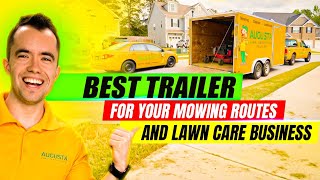
Mike Andes and Liz Naber debate trailerless versus truck-and-trailer setups at Augusta Lawn Care. Trailerless saves on capital and maintenance costs but creates scheduling headaches when mixing small and large jobs. The company has shifted 40-45% of crews trailerless, though a recent acquisition left pricing mismatches that strain operations.
Chapters
Hey, everyone, it's Mike Andy. You're listening to the Landscape business course podcast and today's gonna be a special episode. We're actually gonna do a bit of a debate about trailerless setups. And so you've heard me talk about trailerless setups in the past, the pros, the cons. But today I'm actually bringing in Liz Naber, which is the office manager of Augusta Lawn care of Whatcom county, our very first location. And so she really runs everything on a day to day basis. I'm not there a lot of. She really runs the whole place. And so we have instituted about 40%, 45% of our crews being trailerless setups. These are mowing crews that do not have an enclosed trailer. They do not have a zero turn. And so there's pros, there's cons. We're going to be talking about those today. And she's going to be kind of devil's advocate for why trailerless setups are sort of a waste or annoying or hard to schedule or whatever. Whatever. And some of these things she actually does believe in, we've actually debated. So without any further delay, I'll welcome her on the set and we'll go ahead and get started and we're just going to talk to each other. And some of these things we have gone over before and I've explained them to her and then some of them might be completely new. And these are arguments why a trailer setup would be annoying or bad. And I will give my reasoning as to why I think we should continue to do trailer setups.
So.
So first of all, welcome Liz, to the show.
Good afternoon, everyone.
Thanks for hopping on. So, first of all, explain your debacle in terms of why the trailer setups are somewhat annoying.
Yes. So last year we had four trucks and trailers and one trailerless, which we were kind of trialing how it would work. And I only used that one on little tight routes where one guy could go and do that.
20 small jobs.
Small jobs. So this past December, we acquired a. A big company. And the budgeted hours are not what we would have bid them at.
Under budgeted. Yep.
So they're under budgeted. And at the end of this season, the plan is that the guys understand that it's route density that will make get us through the season because there's so many of them in the same area and that we won't make a lot of because we're keeping the prices the same for the customer, for the acquisition and for the first season. And then we'll see where they were off on the budgeted hours and raise the price at the end of the season for the customers. So today when we were going running, we were just about to. We go to the stairs to run that I was telling you about yesterday, that we're training for the Spartan. And so we walk down the trail before we start. And on the way down the trail, I wanted to bring this up to Mike because now we have done all of March and now we're stepping into half of April. And I feel like my, my scheduling is taking like three times as long. And the challenge is for those of you who do routing, this would be anyway to, to back up a little bit. We're having this debate and I am advocating for a truck and trailer. He's advocating for trailerless setup. And I said, you know what, if we're having this conversation, there's other companies with large recurring mowing customers, big property, small properties that have the same thing. We need to have the same discussion in front of them. So I'm going to go back exactly and express my frustrations to him of what I've experienced the last couple months. So if you do your routing from your dispatch board and you are, let's say you have a, you do one city on a day, let's say you have 500 mowing customers and you're going to do 90 most today. So last year we just had the one. So this year, let's say I'm doing seven routes and I have trailerless setups, four and then at three, and then I have four that are a truck and trailer. So I've got zero turns in the, in the trailers, which would be for the big properties typically. So we want to use the trailerless setups as much as possible. So on all these routes, typically in the past I would have selected a whole group of MO's and then I would have assigned them to one guy. He would have had a truck and trailer and he would have gone for it. But now I want to take a trailer list setup and I want to give the smaller ones of that group to one guy to go and do the trailerless setup. So I'm explaining to Mike that now I have to take this big group and I have to click, click, click, click, click on the dispatch board for all the bigger ones, for all the bigger ones and give them to a guy with a truck and a trailer. And then I have to, okay, click, click, click all the lower priced ones and then I have to assign them to a guy with a trailer list. So I'm expressing all the this to Mike that it's taking so much longer.
Because in general the lower price ones are smaller and therefore less square footage. And therefore.
Exactly. But now we have these ones mixed in that are really less budgeted hours could be pretty large. And so I've been telling the guys like tell me on these routes which would kind of be better for trailerless setup. So in some of the city there's not. There's a lot of whole one way streets. So they're telling me it's still easier to have a trailerless even if it takes us 15 minutes longer to mow because we might be driving around for 15 minutes trying to find a place to park. So I've been getting their opinion and stuff. So I'm telling Mike that. So what happened this week? There's. I'm trying to give all the bigger mo's to the guys with the truck and trailer and the smaller moe's to the, to the other guys. So in this big group of MO's I had given all the smaller ones away to all the guys with the three trailer lists and the big ones to these other guys. So it's afternoon. I've had. Josh and Kent have done treatment. So they had two late nights. And then I have, okay, today I'm giving Kent a shorter route. Well, he's the one with the truck and a trailer because he has a few treatments. And so then we're getting throughout the day and it was Josh and him. And I told Josh I need to take off the rest of these treatments because I need to give you this big movie. And he's like, oh man. And I know it's going to be late for them, but it's because this one mow is big and all the trailerless guys have to come back. So that's when Mike is going to. He's telling me that it's still more efficient to have trailer lists because I'm saying, okay, if I was running this thing, I would do five truck and trailers and one, maybe two trailerless.
And.
And I would always keep the small, dense routes for the trailerless guy. He would just always go do those and maybe a couple of the other ones. So I'm thinking it's not efficient at all because I am taking mo mo mo mo all over the city and giving it to the guy, the truck and trailer because they're bigger. And so I'm expressing my frustration to you because I'm feeling like it's not.
Advantageous or profitable to be have him jumping around or the way you present it, that trailerless is always better. It's not efficient for me to send a trailerless guy to do a three hour mow. So your response to me I wanted from the new mows I have in. That's a challenge. And then if we started all the way over, have we done it right so far or if I started with just trailerless, they wouldn't know the difference. So go for it.
So really it comes down to acquisition costs. And we talked about this and that is like the reason we're having trouble and why anyone that would be switching from having zero turns and enclosed trailers or open trailers or whatever, the person that's going to have problems with changing to trailer setups with someone in the past has had a setup with a zero turn. Because if you have a property that is half an acre, yes. It's going to take you a lot shorter time to mow with a zero turn. And so if you priced it based upon budgeted hours and let's say you're charging, you know, let's say $60 per hour for mowing and it takes an hour for you to mow the zero turn lawn. Yes. By having a push mower, you're going to have a lot less efficiencies in terms of that job. You are absolutely. The larger the property, the less efficient a trailerless setup that is just a push mower without a zero turn. But the concept is this and that is that the reason we're having the problems is because we have budget hours and we have pricing based upon having a $10,000 zero turn inside of a $6,000 enclosed trailer attached to a three quarter ton pickup. Whereas yes, it's going to take longer for us to have a half ton pickup with a push mower that is.
12% the cost of the zero turn. And you don't need a big enclosed trailer. And as we found out even last week, having two enclosed trailers down in repairs because the cables broke or the tires or whatever was wrong with them.
Right, right.
And the maintenance on that is completely wiped out because now you don't need a trailer. And so the hard part is switching. And that's where we're at. Because we've had zero turns in the past and we've done pricing based upon having setups with zero turns. Therefore, when you switch to trailers, yes, it's going to take you longer on those big jobs. That being said, in the past, when you have a zero turn In a trailer, 50 to 70% of the jobs they did were done with a push mower. It were.
Right. But they had a zero turn if they needed to pull that out for that job. And they had a push mower if they needed to pull it out for the job. They just weren't stuck with a push mower.
Right. But the concept is that the trailerless setup costs $10,000 versus $30,000 for a larger truck with a more experienced crew member with a enclosed trailer with a $10,000 zero turn in it. And so for the cost of one setup with a trailer, I can get three setups with a trailer setup. And the big argument is about efficiency. Now, if you're paying people based upon P4P, they're getting a percentage of the revenue at that job, regardless of how long it takes them. And so the goal and the really, the struggle we're having is not financial in terms of efficiency because it does not affect the company.
Right.
It's affecting the crew, who is not happy when a job that could take 30 minutes is now taking 45 because they have a push mower.
Which is my agony right now because I'm trying to carefully structure it so that it's not completely inefficient. And they're not getting all of these ones that have terrible budgeted hours.
Right. So the problem for Bellingham shop versus Mount Vernon is that Mount Vernon is starting with trailer list setup.
So they don't know anything different.
Well, that's for the employee's perspective. Yes. But then also from the estimator's perspective, every single job they look at from the onset is how long does this take with a push mower? Right. Instead of how long does this take? If I have this type of mower, like, for example, the theory of, like, well, if you get a zero turn, it goes faster. Yeah, of course it does. But am I going to get a 60 inch mower? Am I going to get a 36 inch mower? Yes, the 60 inch mower is going to be.






