DEBATE: Should You Do Lawn Care OR Hardscaping Projects?!
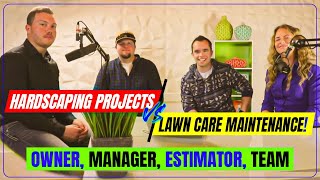
Mike Andes talks with Liz and Lee from Augusta about moving from lawn care into hardscaping. Augusta requires 50% down on projects over $3,000, has their estimator send videos and notes to the crew the night before, and learned that estimating accuracy directly affects what workers actually earn.
Questions this video answers
For projects over $3,000.
Four years.
About two years and eight months.
Chapters
Hey, everyone, it's Mike Andes. You're listening to Landscape Business Course. And today I have some guests on the show, and we're kind of rigging together the audio. We have only two mics, so hopefully this works out somewhat decently. But today we're going to be talking about projects and doing projects versus maintenance. I know this is something I've talked a lot about before and showed the pros, the cons, and today I wanted to bring some different perspectives in. So before we get started, let's go ahead and go around now. I'm not gonna introduce myself. You all can introduce yourself. Tell a little bit about your relationship with Augusta, what you do, and then we'll jump into what's happening.
I'm Liz. I'm the operations manager at Augusta in Bellingham, and I've been with Augusta for four years.
Yes, I'll go. I'm Lee.
I've been with Augusta for about two years and eight months now. Started as field worker, project manager, and now the estimator. I'm Josh. I've been with Augusta for four years. I started the same day as Liz, and I do a lot of the mowing and training new employees and kind of showing them the culture and what to do.
Cool.
So I've talked about this sort of.
Stuff a lot, but I wanted to bring the perspective of someone in the office, an estimator, as well as someone out in the field, and we'll spitball some ideas. We really have no agenda. We have no long help. We have no idea how long this is going to go or what we're going to talk about. But we know we're going to talk about projects and versus maintenance and some of the things you might think about when you consider doing projects and especially as you grow in scale. So let's preface this entire conversation by saying everything that we're talking about today is not to demonize projects or to lift up maintenance or vice versa, or to say you should or should not do one or the other. We're going to talk about the pros, the cons, things you should think about. And this was really brought about by a question that came in from Textedly, which is the platform I use for the texting platform, which everyone should, of course, text. But we had this on the last episode. We did a Q and A on it, but I wanted to talk about it more in depth to all of these wonderful people. So I'm going to read the question again, and then we're going to go through and see what kind of Topics we discuss when it comes to projects, the complexity of projects, the profitability of projects, from an estimating standpoint, from a crew standpoint, from an owner standpoint. And hopefully it'll be helpful to everyone out there. All right, question was, I'm currently doing low margin landscape maintenance and lawn care work. I have no experience with landscape construction or hardscape. I really want to grow to a point where that's a big part of my business. How do I start learning and gain experience with this offering? So on the last episode on the Q and A, I referred to the fact that we're going to talk about this a lot more so than that's hopefully what we're going to talk about today. And before we jump into it too much, I have Liz kind of give you the brief rundown of Augusta of Whatcom county, our first location in terms of our relationship with projects over the course of the past four years that she's been with us. So take us away.
So typically, Mike will go out now, Lee, and do an estimate with the customer, and it comes back to the office. We source the prices of all the materials and we put together an estimate and send it to the client. And if it's a big project, over 3,000, once they've accepted, they pay 50% down and we set up the date. Over time, we've streamlined it a lot more to be able to execute the process from the beginning to the end. Who orders what? I make sure that I'm making sure their plants are ordered and ready for pickup or delivery and there's soil coming. I make sure there are blocks for the walls and pavers and everything are ready. I talk to Lee. So let's say the job is going to be next Monday. I would talk to Lee the week before. What day do you want your soil? What day do you want your blocks? And I have everything planned for the delivery, and that's my job. And then the night before, when Lee does an estimate, he does a video for the crew. So the night before I send them the video, all the notes from the job we do pay for performance. Paid or performance. So they actually see the price and the hours. And then I set up the job for however many days. The guys know how many days it's supposed to take and the price. And then the day of, they all see what truck to take and what people will be on that crew. I try to keep the same crew leader and helpers, sometimes alternating the helpers if we need them for mowing routes. But that's typically how it works, and then once the job is done, we do a final walk through with the customer to ensure their satisfaction, and then we send the invoice for the final invoice.
Very nice. Okay, so from an estimator standpoint, Lee, you've been doing full time estimates for almost nine, ten months? Something like that? Yeah, something like that. Projects versus maintenance. Tell me a little bit about that. The learning curve. I know for you and I, it was pretty straightforward because the way we do the system with the estimate, which you can kind of explain if you want, in terms of hours, materials, things like that, but from a project standpoint versus maintenance, which is more around bed maintenance or mowing. Kind of your learning curve as an estimator?
Yeah, the biggest learning curve, I guess, was figuring out time. So when you look at a lawn, it's easy to guess. You know, 3,000 square feet, 4,000 square feet, 10,000 square feet. And then, you know, with service autopilot, we use the system where we can measure it. So it's really easy for me to either guess just based on previous knowledge of mows, or to use that surface autopilot function to measure a lawn and know exactly how big the square footage is and about, on average, how fast our guys can mow. So that was pretty easy to jump into. Having mowed for, you know, a year and a half, two years before I started estimating, I had a pretty good feel for all the properties we mowed. So it was easy to get those times down and know how much debris was coming out. Switching over to projects, the learning curve is a lot harder because project timelines can be 1 day, 2 days, 8 days, 30 days, depending if you want to do those projects. So that was a really big learning curve for me, was just figuring out how to time and price those jobs. And it's hard to know, you know, if you want to charge for price or if you want to charge for time. And that was the hardest thing for me to get used to was when I would step on a job site, meet a client, and walk through the job. I wanted to think of a price originally. Like, I was like, how much would this cost? But really it's how much time will this take? And then, like Liz said, you know, listing those materials, figuring out when we need those materials, is it on the first day, second day, the scheduling. So it's just a lot more that was thrown at me all at once versus having, you know, a mo. It's very straightforward. Oh, clean out those beds, rake up those leaves. It's like that's going to be a truck full of debris, and it's going to take a guy four hours.
Right.
But a project is going to be, you know, sometimes three trailers, debris, 60 yards of soil, you know, something crazy like that. So the learning curve, just figuring out my materials and my time was really tricky. But over time, you just kind of get used to it with experience.
Now, from a perspective of P4P, it complicates things a little bit more because as the estimator, if you're budgeting 100 hours on a project and you're 20% off, that's your 20 hours off. Just three days worth of work, someone really doing for no extra pay month P4P. So what kind of either stress or like. Because the flip side happens, like this week, you know, someone beats the budget hours by like 30, 40% in terms of estimating what kind of pressure or like, what. How do you think about that?
Yeah, there's definitely pressure originally and actually in our kind of P4P testimonial video, we did that, Josh, actually, Josh interviewed me for that. I shared a little bit about that, you know, pressure I felt from the guys because I was worried. I, you know, at that point, it felt like I was in control of their pay, which I'm not, because there is a base rate and there are always variables in jobs where someone might hit budgeted hours, someone might not. And so I just kind of had to roll with that, essentially. But it is nerve wracking to think, okay, this job, I might think that with my experience, can get it done in eight hours, but a new guy might take him 12 hours. He might need that whole extra half day. So it's part of it is knowing yourself, knowing what you and your business is good at. So knowing what we at Augusta are good at was what I had to really learn. Like, what are we good at? What's our wheelhouse? What are our core competencies? And then from there, I could kind of standardize my hours. Whether it's a new guy or an experienced guy, once we know what we're good at, it's easier to figure out those hours. Scaling that to a larger job, obviously, is harder, but if just because it's a larger job, just because it's bigger numbers doesn't necessarily mean it's not scalable or it's not still your core competency. If we're building a two course high retaining wall that's 200ft long, that's really not that hard. It's just going to take a lot of time right because it's 200ft long so it just kind of depends. There's a lot of flexibility with it but it's just knowing the team, knowing what we're about was the biggest thing I had to focus on in order to make sure those jobs would stay profitable and guys could hit their budget at hours.
And then there's the weather that's determinant for if we're in the spring and we're actually bringing soil in and using skid steers and track loaders it's going to be pretty muddy. We're going to need more time right?
Yeah and that's something I have to think about you know with weather and the conditions and you know is it like access like thinking about like gates are there two gates is we just had a big project this week that I budgeted for almost 80 hours because it was all in the backyard and we had like a windy front pathway to get to with a tiny.






