Do You NEED a Skid Steer to Start a Landscaping Business?
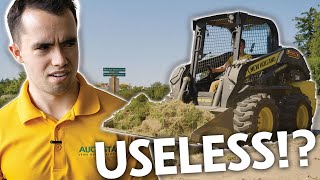
Mike Andes shows how to remove sod on a small landscaping job using a skid steer, sod cutter, and rototiller. A New Holland L220 costs around $36,000 and a Bluebird sod cutter runs $3,200 to $5,000, but he argues you don't actually need a skid steer to start out.
Chapters
Hey everyone, It's Mike Andes. Landscapebusinesscourse.com Today we are going to be tearing out grass with a skid steer. Because we have skid steers, we don't just use push mowers, believe it or not. We use this bad boy from New Holland, L220. So we're going to talk about that today. We're going to talk about the job that we're doing here using these skid steers. And this is the project from a broad, kind of high level view, the drawing that Marcus the estimator actually gave the client. So I'm going to show it to you really quickly. But tomorrow we're going to see the end of this job and I'm going to break down the numbers. So make sure you stay tuned, make sure you subscribe because tomorrow we're going to actually look at the numbers of this job once it's completed. It's like a two, maybe three day project. These are the type of landscaping jobs we love. Two, three, maybe four day projects is really where our forte is at, where we get in there, get stuff done. It's not super complicated. It's not a ton of material cost. It's not a 20 day, 30 day project where people get burnt out and there's a lot of moving parts. This is simple, simple stuff. So you can kind of see how we do these designs. And that is the extent to which we will do landscape designs if it requires, if a client requires a 3D design or some crazy, they want something done to scale or in some sort of software, all colored and beautiful, we're not going to do it basically because we can't do it. And if we can't do the drawing in 10, 15 minutes on a grid piece of paper with a pencil, if they want anything more than that, we just refer them to an actual landscape designer or a landscape architect. And they're going to have to pay that person probably at least 5, 6, 7, $800 for a simple, simple, simple design. Like this project here is really simple. But you, you're going to pay a landscape architect or landscape Designer at least $500 just to put pen to paper and make it a design like this for you, let alone if you're doing pavers or any sort of hardscaping. They're going to be looking at excess of $1,000 if they're looking into plants and different types of plants and all that stuff. So we try to keep it as simple as possible. We tell the client, look, we will give you a Free estimate with a free design. But that design is going to be pencil and paper, and we're going to take 15 minutes to sketch it out. If the project is more than that, like, it requires more than that, it's probably not really in our scope of expertise anyways, and we don't really want the job. So that's kind of our sort of gauge on landscaping and hardscaping. The type and size of projects that we're willing to take is really just whether or not we can get away with that type of design. And it reduces the amount of time we have to spend on the sales process. We don't want to spend, you know, two days or three days trying to just make a design. We want to do a quick sketch and sell the job and move on. So what they're doing here is they use the sod cutter. You can kind of see in the back corner there, we have a Bluebird sod cutter. Those are about $3,200. But actually, no, those ones are more. Those ones are like four or five grand. I'll get the exact prices for on tomorrow's video. But we use the Bluebird sod cutter. We cut out the sod, and then we were using the skid steer to take it off the lawn and into the back of the trailer. And you can see here, Ben is teaching Kat how to actually use a skid steer for her very first time. So actually training and showing how to level out the box. And then he's loading up all the sod and throwing that in the back of the trailer. So again, we are learning. This is Cat, probably one of her first times, learning how to use this skid steer. And it's really the best way to do it is on the job. And we do it also at our yard. Around the shop. When we're loading material, they can take their time learning how to use it, learning how to be safe, and making sure that everything is working well. That is the New Holland L220. And we really like the skid steer. It's our larger one. We used to have another one that was the two. I believe it was the 211 or the 213. That's what it was. It was the L213. And this one right here is a little bit bigger. It's gonna have like a 2,000 pound capacity. And this one costs $36,000. So this one cost 36,000 cash. Usually you can finance it about 40,000. It's gone up a little bit in price since we. Since we've had it now for about three or four years and we've gone through one set of tires. But besides that, been pretty straightforward in terms of maintenance and really been very reliable. We really like New Holland. I know it's a cheaper brand. Like definitely if you're looking at Kubota or a Bobcat, you're looking at almost twice that cost just as an entry level point for their skid steers. But I know there's some people that would say they are twice as good and they're like less last twice as long and that New Holland is trash and all the rest of it. And perhaps that's true, but we've used New Holland and it works really well as an entry point. And we don't use these things every single day on lawns landscaping jobs. If we use them every single day for five hours a day, probably good. Good chance I'd go after a Kubota or a Bobcat. But these New Hollands, we maybe take these out a couple days a week on projects. And then we're mostly using them for just loading equipment or loading material up at the shop. So loading bark, mulch and soil and gravel. That's when we really use these the most. That's really the majority of what their use cases. So we don't need anything super fancy or super expensive. But this one here, I really like this size. The L220. The L213 was just too small. It just. It was too jumpy, it wasn't as balanced. And it couldn't really like, you couldn't even do a full scoop of gravel without having a slight chance of tipping over. And it was just tippy, really tippy as soon as you got really high with the bucket. So this one here we have used now for several years. And we really like the balance of it being relatively cheap. Light enough to easily put in the back of a trailer like this. This is a 7 by 14 dump trailer. But we like these dump trailers because we can also use it to haul what you're seeing right now, sod or debris as well as material around. But it also can handle a skid steer like this. So that skid steer fits in there just barely. But you could not fit that in a 5 by 10 or. Or a 6 by 12 trailer. It just wouldn't fit. So you really need that 14 foot long trailer. If you're gonna get larger equipment like this even same thing with excavators. If you're gonna get larger pieces of equipment like this, you're gonna need that 7 by 14. And these axles carry 10,000 pounds. And this piece of equipment is about 8,000. So it really is the right size for this size of equipment. And that's why we have the 7 by 14 trailers is really just the. The fact that we can haul these skid steers around our newer locations, our corporate locations, we're using this, either a 6x12 or even the 5 by 10 just because they're smaller and easier to get around. And for most of our other stores, we aren't even going after projects this size where we're going to need a skid steer. We're not even going after that. And honestly, this job, you don't need a skid steer. It just makes it faster. You can see what they're doing here. They're using the sod cutter and then they're simply pushing the saw down the road and using the scoop on the skid steer to put it into the back of the trailer. But theoretically, you could just cut the sod in squares with a shovel and then move the trailer along the side of the curb and throw the. The pieces of the old turf into the back of the trailer. So even if you don't have a skid seal, need to have it to get this job done. And I think that's a lot of times when you're doing these smaller projects, it's. It's tempting to get the biggest flashy equipment in $40,000 skid steer like this one, but it's not necessarily needed or required. And if you're just getting started, you don't have to go get the skid steer. Yes, it looks cool and it's fun to drive. And you feel like you are back playing with Tonka trucks again. It's very fun. It's cool, it's great, it's fast. Make more money in a shorter amount of time. But there's also more liability. The cost of this thing is quite exorbitant and the skilled skill of the employees has to be significantly higher due to the fact they're operating this versus just a shovel and cutting the pieces of turf and throwing the back of the. Of the dump trailer. So if you're just getting started, definitely feel free. Use a dump trailer. A dump trailer is worth every single penny. But what's cool with these dump trailers is make sure you have these ramps. This is what you're seeing Ben use here. They store underneath the. The actual bed of the trailer. But then you pull those bad boys out and you can drive up a Excavator or skid steer. And when you do get heavy pieces of equipment, easily put them inside. You can see here cat's using the handheld rototiller. This is the combi system on the steel handheld trimmers. And these are about $200, but they're really good because once we use the skid steer, there's still little strips and pieces that you might have missed. And they wanted to kind of loosen up the soil. So they used the rototiller to kind of just make that soil a little better for when they're planting. And you're going to see tomorrow when they start installing the mulch and the soil and all the rest of the job. If you're doing larger areas than this, you're probably gonna wanna use more of a walk behind rototiller. That's just a lot heavier duty. But these handheld ones are great for small beds like this and this client. And this is something that is a great opportunity if you are trying to get into landscaping and projects is just adding accent. Flower beds along the edge, curb along the roadside. So a lot of times if you go to a property that was like a spec home or recently built as part of like a large subdivision, they all look the same. The lawns go right up to the curb of the road. And a lot of times that area is where the most weeds are. And it's the hardest to water simply due to the fact that the concrete is absorbing so much of the moisture. So it's a great upsell to tell them, hey look, we'll make a four foot bed that's going to kind of curve around or add some mulch, add a couple plants in there, maybe some gravel, and just add some uniqueness to the property. Especially if it's part of a tract or neighborhood that was just installed as part of a big development. They can add a little bit of, you know, their own unique flair and the landscaping can look a little more unique. So a great upsell opportunity. Four foot beds along curbs as well as same thing around the house. If people are doing grass right up to the house, where there's concrete, that's where the most weeds are going to be. That's where it's hardest to get water. That's the area where if you're in a really wet climate, you're actually the most moss growing, growing because it's so moist. So those are the great opportunity to be able to upsell, get into projects. And tomorrow make sure you tune in because we're going to show you the actual numbers breakdown on this project once it's completed and once this job is in the books. I'm Mike Andes, landscapebusinesscourse.com. we'll see you tomorrow.
Help. Help. I'm stuck in this box, and if you don't click the subscribe button below, I'll never get out.






