Financial Statement Exposed: This Company Could Go Bust!
Mike Andes breaks down Rivian's financial statements, showing how massive operating expenses and a focus on growth over profit could push the company toward bankruptcy. The electric vehicle maker has cut its workforce but still burns cash faster than it brings it in.
Chapters
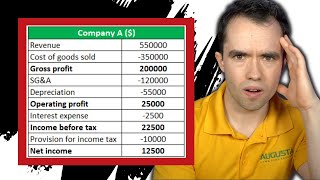
Today I'm going to show you a company and their real balance sheet and income statement and statement of cash flows and show you a company that's bleeding money and in my opinion could potentially go bankrupt if they don't change something very, very quickly. Now this company I'm talking about is Rivian, but this applies to any small business. I want to bring this down and actually show you their financial statements of why I believe this is going to happen. So Rivian is cutting its workforce by 6%. Electric vehicle maker Rivian Automotive said Wednesday that is reducing its workforce. This isn't like other, like other cuts. It doesn't say anything about the economy or EV demand. I think it's a bunch, there's a bunch of garbage. Honestly. It's so funny how I think like the media has somehow sided with Rivian and they got like the deal with Amazon and everyone just is like big fanboys of them. Let's look at the numbers though in just a second. Rivian told employees Wednesday that it will be laying off 6% of its staff, according to a company email reviewed by Barons. Riven declined to comment beyond the contents of the email. This is what said to deliver over the long term we must focus our resources on ramp and our path to profitability while ensuring we have the have the right set of future products, services and technology that will continue to Challenge Convention CEO R.J. scarringe wrote. The layoffs won't affect manufacturing jobs again like we talked about before, white collar jobs getting laid off instead of blue collar jobs. The Electric Car the electric truck maker is focused on increasing vehicle production in 2023. Rivian produced and manufactured more than 24,000 vehicles in 2022. Wall street projects production of about 65,000 units in 2023, so about 150% increase in production they're planning on in the upcoming year. And in my mind that might be the worst thing for them. Rivian ended 2021 with 10,400 employees. The number likely grew throughout 2022. An updated number should be included in the company's 2022 annual report.
The layoffs are probably a reflection of a startup trying to manage growth. Rivian had essentially no sales in 2021. Sales in 2022 and 2023 are projected to be 1.7 billion and 5.7 billion respectively. The layoffs don't appear to be a reflection of EV demand. Wall street expects at least 1.1 million battery electric vehicles to be sold in 2023. I think this number is way low. I Think it'd be more like 1.5 million, up from about 810,000 sold in 2022. And I also know that's wrong because I know that Tesla sold over 600 or, sorry, over 900,000 in 2022. So I think those two numbers are wrong. By the way, EV sales are getting a boost from the government. Many EVs, including Rivian's trucks, qualify for a $7,500 purchase tax credit. For that reason, I think we'll sell over 1.5, potentially even 2 million all electric vehicles, I believe, in the United States in 2023. All right, so their stock is literally down like 60, 70, 80% since it was. Had its high in early 2022 and late 2021. But let's look at this. All right, this is what's so cool about publicly traded companies. You can look at their financial statements and you can actually dig into what is going on in the company. So this is Rivian, if I remember correctly. Their market cap's like 17 or 18 billion dollars. Okay. But let's look at actually what the. How the. How the company is doing. All right, so if we look at. Let's see here, end cash position. So right now we're looking at the statement of cash flow. So you got three really important documents when it comes to someone's financial statements. You got statement of cash flows. You have your balance sheet and you have your income statement. Income statement is also sometimes known as your P and L or profit and loss. All right, so this is your statement of cash flows. Their ending cash position here is $13 billion. Remember that these are represented in thousands. So 13 million on here means 13 billion when it actually comes to dollars. So $13 billion in NCash. Fantastic, right? Not until you look at the fact that in this year they lost $6.2 billion, which means at their current run rate, at their current burn rate, I should say in two years they will be facing bankruptcy. Now, this is the part that freaks me out, is it's not only the fact that I take, you know, 13,000, $13 billion in cash, say, okay, there's $6 billion they're burning every year. We got two years left. What's more alarming is the more cars they make, the more money they're burning. It's not going the other way around. And for that reason, by them ramping up production, I actually think they potentially might actually increase their losses instead of just having a $6 billion loss. So check this out. That was our balance sheet. Okay, you can or sorry, that was our cash flows. This is our balance sheet. You have $22 billion worth of total assets. Now a lot of that is like plant equipment, they have factories and all the rest of it. Their actual cash in the bank, like we already saw, is about 6, $6 billion. All right, so this is your cap table. This is your balance sheet, is your total debt. They only have about 1.5 billion. Not so bad honestly, compared to how much cash they have, which is 13 billion. So what is that? Almost eight, nine times as much cash compared to the debt. So not bad in terms of cash. They have a lot of common stock. They do some stock repurchases for their, their employees, stock based compensation. But here, you got this, this is what I'm concerned about. Okay? Their revenue is $1 billion approximately for the year. And their cost of revenue is literally three and a half times as much. Their gross profit is negative $2.5 billion, which means for every dollar of revenue they got, they were spending two and a half dollars to get that money. That boggles my mind. Like, think about it like this. If I pitched to you, I proposed to you, hey, look, we're going to build this company. It's going to be revolutionary. It's going to change the world. And you're going to lose for every dollar as we scale up this business, for every dollar you put in, you're going to, you're going to, for every dollar that comes out, I should say, and revenue that is produced, you're going to have to pay two dollars. Two and a half dollars. Sounds brilliant, right? I actually think this works if you're on a fast growth trajectory and you're seeing economies of scale as you begin to ramp up and instead of, you know, two and a half, $1, now it becomes $2, then $1.50 for every dollar of revenue. And then eventually you break even, you start becoming profitable. If there's a path to profitability. That's what the CEO, in his wise words, is emailing to his employees saying, we got to cut staff, we got to cut expenses here because we've got to get to profitability. What he's saying is we can't spend two and a half dollars for every one dollar of revenue that we're getting in the door. All right, smart move. They got, they have to do this. But I'm going to prove to you, I think that this is not going to be enough to save the company. Because if you look at, over the course of their last few years, right, 20, 19, 2020, 20, 21, 2020 22. Although they got a billion dollars in more revenue this past year, their total operating expense went up 1 and a $1.3 billion. So as they're scaling, they're getting more expenses for every dollar of revenue that's coming in the door. And they're just losing money hand over fist. It's incredible. Like if you want to look through the EBITDA's earnings before interest, taxes, depreciation, amortization, when you start looking at all this stuff, it's just absolutely incredible of what's happening with a company like this that is really. Everyone has bought into the hype of what's going on. They're losing money hand over fist. And this is the part I want you to look at. Where did I see this? Where's the sga? There it is. Okay, so SGA expense, I just pulled it up. Here is operating expenses, also known as selling general administration. That's sga, selling general and administrative expenses. SGNA are the costs of doing business. They include rent, utilities, marketing and advertising, sales and accounting, management and administrative salaries. So when I go back here and I'm looking at the sga, I can look at my operating expense. It's underneath this. There it is. Selling general administrative, that's $2 billion, which means just an SG&A. They are spending $2 on SGA for every $1 revenue. Right. So $2 billion in SGA compared to $1 billion in revenue. But this is the thing. If you cut out 6% of your workforce, because if you go back to here, they're reducing their workforce by a whopping 6%. Let's assume that these are like some higher paid team members and it's going to read, it's going to increase or reduce their expend on salaries by 10%. Now I'm also going to assume that 100% of this SGA, which is not the case, let's assume that a 100% of this is just salaries. It's not, but let's just assume it is. If we take 10% off of this, that is $200 million saving $200 million when you are literally bleeding two and a half billion dollars. It's not even a dent in what their, what their losses are. So I really feel like this is a company that is doing the right things. What the CEO is saying is correct and that is the hype that they've, they've been on the Grow, grow, grow, you know, just grow at all costs. That has to end. That has to stop when you go into recession, when debt expensive and when the capital markets, the Wall street is not willing to, to to value your company at 5x what it currently is. So I think there's gonna be a rude awakening for companies like this that got debt but had a whole bunch of hype from the past few years. They bought into grow, grow, grow, get more equipment, growth, expansion, more, more. And now all of a sudden we're gonna have a rude awakening for any size company, whether it be small or massive companies like this that have been fueled by Wall street. Regardless if you have a grow, grow, grow mentality, grow at all costs. I don't care about debt, I don't care about expenses, I don't care about profit margins. If you do that, that works just fine in a bull market. And we've been there for 14 years. But when we hit a recession, you're caught with your pants down. And that's why I'm very worried about many small business owners that went into debt, grew it all expenses. I'm going to grow 50% this year and then 100%. And all they talk about is grow, grow, grow. And they how much profit are you actually bringing to the bottom line? Because in a recession, that's what really matters.






