HOW I MAKE $100/HR MOWING GRASS (using a push mower!)
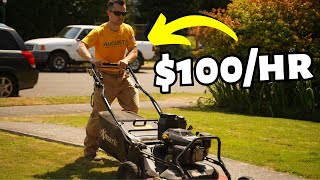
Mike Andes shows how he charges $100 an hour mowing grass with a 25-inch push mower, breaking down job pricing, crew splits, and equipment choices. He explains why push mowers work best on tight or hilly yards, and how to sequence work to avoid callbacks.
Questions this video answers
Bravo 25-inch deck push mower.
Charged $130; took 1 hour and 7 minutes.
40%.
$52.
Customer price $240 (budgeted 3 hours); Mike completed it in 1 hour 57 minutes.
Chapters
Good morning, ladies and gentlemen. It's Saturday morning.
Today I'm going to be mowing grass.
But first we have to stop at the Home Depot. Why do we have to stop at the Home Depot? Because yesterday someone broke a window. Now, they got fired, but they did not get fired for breaking the window. They got fired for the way they.
Treated the team and their manager after breaking the window and not taking ownership of it.
So we're going to wrap up the window, we're going to take it into.
The shop, make sure it gets fixed.
And then we're going to go mow some grass. Now we're going to mow some massive yards that most people are going to be saying, you need a massive zero turn. We're going to use a push mower, and some people won't like it, and that's okay. And I gotta get warmed up because literally next week I'm gonna be in North Carolina. I'm gonna be starting a business from scratch, from zero. No customers in an area, there's no Augusta Lawn Care.
And I've got to scale that up.
To a $300,000 business to do that. I'm gonna be mowing in a lot.
Of grass, but I have not mowed.
Grass in a very long time. And so, therefore, today is gonna be a warmup day. We're gonna mow two very large lawns, maybe three or four, and kind of kick off some of the rest and get ready to go for next month.
Okay, Well, I was going to get plastic, but there's just no way in.
The world I'm spending 30 or $40 for this.
Even this stretch wrap stuff is 30 bucks a roll.
Mercy.
Okay? This is, you know, discrimination at its finest.
We got large, we got large, we got extra large.
Large, extra large, Large, large, large, extra large, medium. Where the smalls.
This is what we're dealing with. Broken window, let's go. Yesterday slammed on the brake, it didn't have everything tied down in the back, and bye, bye window. But let's go get some lawns done.
We gotta pay for the window now, you know, so let's go mow some grass. Look at these beautiful stallions here. Let's go. So today we're gonna try this mower out. This is a Bravo 25 inch deck. It's made in China. And before you hate on it because we hated on it. We really like this.
At least the crew have said they like it. I have never used this thing in.
My entire life, but the crew have really liked it. And the reason we have had to do this because all these Hondas that we have lined up so beautifully over here. Honda's not gonna be making push mowers anymore.
Why?
I don't know. Maybe they like batteries more.
They're gonna go fight bigger battles.
But we still need push rowers.
And this one seems to be doing the trick.
It's not as heavy as the big skag bad boy over here, which is nice that they don't get wrong. Don't everyone freak out in the comments. We like it.
It's just too heavy for the crew.
And they're using it all day long. Whereas this bad boy cuts from China. Probably made cheaper. Seem to like it a lot. So they see it bag like a beast.
Because the way that the high deck.
Is really, really high.
So let's check it out today.
I've never used it, but they want to get.
They want to switch everything to Bravo.
25 inch mowers next year. No trailers. All ramp racks and trailer setups with just Bravos.
So we're going to use this bad boy day and see how it banks.
Fueling up these bad boys.
Of course, we're bringing a little secondary.
One just in case. This is a really basic setup. We got some tools.
We got some wire which we got.
To replace that spray tank. We got gas cans. We got a straight edge trimmer. We got a weed whacker which I'm.
Filling up right now. Got some bins.
We got yourself a blower. It's all really nice and basic simple stuff, you know.
Got a little bucket for pulling weeds.
A little wheel lock there. So I'm gonna do a mower sideways. We can hurt like a kitten. Let's do this. All right. So first impressions on this bad boy, the situation? The. The bravo I.
First thing I look at is up.
Here is because we do not have problems usually with the engine and the deck and all that stuff. We have problems usually with the controls because we use them so much. And the thing that I'm a little bit concerned about is this whole little mechanism here. Because Michael's not good at mechanisms. And this over the course of a thousand different times having to move it. I have a. I don't like the look of that. Also over here, I like this. This is simple. Turn on off. Really basic, you know, kindergarten math.
Let's do this.
Choke easy, off easy. However, when I pulled it all the way back, I actually have to like hold it down here to get it actually to stop. And my concern with that is it's based upon this Little. I don't know what this is called.
A cord.
I don't know, thing wire. If it gets loose, I might not be able to turn this thing off. But hey, maybe it just works like a. Like beautifully and we never have to worry about fixing these knobs and mechanisms.
All right, boys, let's go make some money.
Look at that.
That's a very cute look right there.
That truck back in the good old.
Days, before COVID got that thing for $5,000. Still pulling away. All right, this is our first property here. Beautiful house here. Supposedly gets really wet on the left hand side of the property here. And the neighbor doesn't like us. Supposedly they don't want us to go over there at all. So let's rock and roll.
Look at that beautiful morning.
Oh yeah, this thing is crispy, man. I love it. All right, we finished the front yard. Still gotta do the trimming, but working on the back. I. Liking the stripes. Liking the stripes, baby. I am listening to a podcast from Sam Altman.
He's the founder of Open AI. Great podcast.
Honestly, when it comes to AI, everyone's freaked out about it. I think it's the best thing that could ever happen in this industry because.
Everyone'S always worried about Podcast Pablo coming.
In, doing a 20 yard cut and wiping us out. Good old Jerry down the street. He's a high schooler. He'll be able to do it for way cheaper.
You're right.
What Jerry and Pablo will miss is that AI can make your business 50 more efficient. You can compete now on price and do it way more professionally. And guess who the customer is going to want. This is a technological revolution I am not going to miss. Co Pilot's going to be integrating here pretty soon with Open AI and we got a whole bunch of stuff coming down the pipe this summer. I think this is exactly what everyone's always wanted and as an equalizer between low price and high professionalism. And we're gonna be on the cutting edge of that.
Lake.
Guacam, baby. Let's go.
Mow this bad boy. Alright, just finished it up.
Let's take a look at the numbers on this one.
We charge $130.
It took me exactly one hour and seven minutes to mow the lawn. That's pretty good.
And this is the growing season for us.
It's pretty long grass.
I got quite a bit of grass clippings.
I got a haul away.
Not so bad though. Kept it moving full tilt on the 25 inch. I really like it so far.
Now on paid for performance we give our crew a little bit more during.
Spring rush because the grass grows so, so fast.
So on that job we give them 40% and they would have made $52. Not bad for a little over an.
Hour'S worth of work.
Let's call it an hour and a half. Even with drive time, load time, etc, you're looking at a solid 30 plus dollars an hour to mow grass. It's definitely possible. Yeah, it's hard work. I was push mowing. That bad boy would have been faster with a zero turn. Maybe. But if I'm paying as an owner for a massive trailer behind me and a massive mower, I probably can't afford 30 plus dollars an hour to pay my employees, plus medical benefits and paid.
Time off and other stuff we can afford now.
Alright, so this is the next property. It's pretty funky, it's very hilly inclined.
Lots of septic system. We gotta weed whack this whole thing. And properties like this, having a zero turn doesn't help a whole lot because.
There'S just so many tight little spots.
View over the lake and it goes.
Down in that backyard, down some steps.
So this one we have three budget hours of $240.
On this one I'm shooting for less than two hours.
Man.
I think I got this, honestly. Let's do it.
Okay.
This is a bit of a longer mow.
So the last one I listened to a podcast. This one I'm going to listen to a sermon.
It's called God Hidden and Revealed in Simplicity. It's going to be great.
Let's go.
All right, my phone's about to die, so let me walk you through this property. I'm almost finished. Just got to finish up a little bit more line trimming. So up here the whole septic area had to push mow it. Typically if that had a stand on or a zero turn, I'd probably say about 15 minutes. But honestly, the vast majority of this.
Job is line trimming.
All these side hills, septic system and this is the backyard.
Sure enough, there's a 32 inch gate, maybe even less.
So like I wouldn't be able to.
Get a zero turn back here anyways.
In the back you got again, lots of line trimming. There's a whole bunch of the backyard there that goes down, down around the fruit trees. So most of this is line trimming, honestly. And so there's a few things I do to make sure I'm most efficient. This is why I'm actually important. Right now I'm getting the weed Whacker, just strategically placing things around the property. On a property this size, it's important to do that if you want to maximize your efficiency. Especially because when you're line trimming that much, your arms get super tired so you try to break it up. But for those people that are saying well, why don't you have zero turns? The vast majority of our properties, I'd say 80% of them, we don't use them on and on properties like this, we would use them on, we probably only save about 10 or 15 minutes because the hills and the inclines, etc. However, when I go to North Carolina, you're gonna see you use a 48 stand on almost exclusively because there's just wide open flatter properties. So ultimately you want your equipment, your truck, your trailer, your mowers to match the type of properties that you're actually servicing. So for example, this truck here, I got this about four or five years ago, it was six thousand dollars, probably cost another fifteen hundred dollars to paint it, put decals, etc, we got racks and the ramp rack was probably four grand with all the racks and the ramp rack, etc, we got two line trimmers, a blower, that mower is like 700. The commercial mower I showed earlier, the 25 inch, it's about, I think it's like 1800 or 2000. So all in this entire setup you're probably looking at around 11, $12,000 fully loaded. Now in this market you're probably going to need to spend $15,000, get a half decent truck. So let's just call this $20,000. The thing is, I'd rather use this setup and yes, I have to work a little bit harder. I don't get to save the 15 or 20 minutes that I would if I had a stand on. However, I'm not having a forty thousand dollar truck attached to a ten thousand dollar trailer that holds ten, two, ten thousand dollars, zero turns and a whole bunch of equipment. And that's just sitting there when I don't really need it. And most of this property is actually weed whacking and push mine. So I'm not against zero turns, I'm really not, I'm against not using your assets, very expensive mowers, trucks, etc to their full extent because the properties that you are servicing don't require. It's not matched up correctly with the equipment. Also another advantage of having the trailer set up is I'm able to pull right inside of here. Getting a trailer down that steep slope, it doesn't look so bad. But you'd run the back of the trailer against it and then backing out of there would be a beast or trying to back down it, etc. So this is super easy. Just drive right in. It's just great access, tight spots, hilly areas, tight urban areas. So this side of the property you can see from the driveway, or it's steeper than it looks, but all the way down there, weed whacking. I can't get zero turn in there, right? So I'm gonna have to do all that with a push mower. Anyways, when you're mowing, even though I'm listening to something, I'm constantly strategizing where I'm going next, where things are placing, what I'm going to do next. You're never just like, oh, what should I do next? You're not going to make $30 an hour as an employee doing that. For example, this window, typically I would edge along this sidewalk, but if I do it going this way, I'm going to be spitting rocks by the time I get here, right into that window. And that's a recipe for a yellow slip callback damage case. So I'm going to plan and strategize. Okay, this one, I'm going to weed whacker in this direction. So everything is spinning away from the window. And then when you're moving around the property, I'm carrying this wherever I finish with the mower. So I'm never walking with the mower around. Doing everything with the mower, then going and walking and getting the weed whacker. And I'm strategically placing everything where it needs to be, including the gas can.
The bag, the mower, the weed whacker.
The blower, like everything. Looking forward to seeing how we do in this job. I think I'll hit the two hours.
Let's go one hour 57 minutes.
Crushed it.
This is the. This is the fastest growing part of the year too. It's not like this is peak summer, it's dormant or anything like that. I don't rush through the properties. For example, before I finish the property, I walk the entire thing. I make sure I don't miss any single thing. Because the last thing I want to do is come back here for yellow slip. If I get a yellow slop on this property and it only took me an hour 57 by the time I drive here 20 minutes, fix it. Let's say it takes five or 10 minutes to do that and then drive back to my route on Monday. Let's just say, for example, someone Called and complained this evening and I had to come back here Monday. My entire hour that I saved of beating budget hours would be completely wasted. And so me spending three minutes to walk around this property with the blower and a weed whacker in hand, just make sure everything was hit and I didn't miss anything, is absolutely why I'll be able to retain my pay for performance and be able to make good money. And so it pays to do a good job. Everyone's so concerned about P4Pmaking their guys work so fast, they do a poor job. And the bottom line is when they actually start making really good money, they'll realize that having come back to a property is the number one reason why they won't make pay for performance. They won't make performance dollars and above base pay. So on that property, $240 is what the price we charge the customer. I make 40% of that as an employee on P4P. Therefore I would make $96 mowing that property. Which means if you take 96 and divide it by about two hours, I almost made 50 bucks an hour on this property. Now again, drive time, load time. It was about three minutes drive from my last property. I'm still making 35 plus dollars an hour. And this is during peak growing season. I don't expect one of my brand new guys to be be able to do that. But I've been, I've been doing this since I was 11. However, it's a matter of having a strategy. When you get to the property, you get out. You know exactly what's, what's happening first. For example, I grabbed my weed whacker right when I get out of this truck, I literally go around to that side, I grab that weed whacker off the side. And since it's a property I've never been at, I don't walk the property first. I do the weed whacking because I know I'm gonna have to walk the perimeter anyways. And so little things like that, you start to learn and learn from other people.
Learn from YouTube.
If you're watching this and you're an employee, put some pressure on your employer to check out p4psoftware.com training. It's completely free training. You can check out as an employee too. Maybe you need to educate your boss about how this is going to help you as a high performer. And yeah, people that aren't high performers, they're not going to like P4P. They're not going to like the fact that they Get a percentage of their revenue because they don't bring a lot of revenue in and they like milking the clock. But a High performer likes P4P. Personally, I want to work with people that are high performers. And I think most grade A talent employees, they do too. The most demotivating thing is to work with a bunch of people that are slow, sapping the clock, taking a nap in the truck while I'm out working hard. So if you want to attract and retain really great people, pay them a percentage of everything they make for the business. And again, they're not going to go crazy fast. They have a yellow slip if they make a mistake. If a customer calls back, they make a damage case. There are sprinkle heads. If I would have hit those, it'd be coming out of my pay. So there's definitely downsides of poor quality. But high performers can make more money. And yeah, during spring rush when things are crazy and the grass is growing super fast, sure, it's not like everyone's making 30, $35 an hour. I understand that there's a lot more hurdles and things that come up during spring rush. However, during summer, during projects like think about if this was a 40 hour project and I did got done in 25 hours because I figured out a more efficient way of doing things and I worked my butt off gonna make 35, 40 bucks an hour. And it's possible. It's not easy, but it is possible. So I challenge you. If you have an employee to talk to your boss, ask them about paid for performance. Ask them if you can get paid instead of an hourly wage, you're going to get a percentage of all the revenue makes the biz. We personally give 40% of labor revenue to our team members during the spring rush because it's extremely busy, then we go down to 33% which is really where the business can make more profit. The other nine months add the year and I know if you're brand new to the system, pay for performance. There's a lot of trust that has to be in place to actually trust that your boss is doing the math correctly and not messing you up and trying to do stuff behind your back. And that's why we created P4P software. So it's a very clear way of seeing exactly what you're making every single day. As an employee and for your employee as employers, you'll to know exactly who your highest performers are and exactly what you should be doing in your business in terms of managing your labor. It's extremely important look at that. See no trailer, able to do a quick three point turn and drive out the steep driveway. Baby labor is your number one expense, your number one variable expense, and usually overall expense in your lawn care, landscaping, any labor business that's in home trades, home services, etc. You've got to be able to manage that and pay your highest performers. And yes, some people will be unhappy, and yes, some people will be satisfied and happy to hit base and they won't work hard. But the people that really want to get after it, want to get somewhere, want to be able to make some extra money for their family and get ahead in life, they're going to push the envelope. That sort of mindset is what allowed for multiple of our team members to start out as mowing grass, pushing a lawnmower, 18, 19 years old. And now they're owning their own business. And it was the mindset around P4P efficiency, cutting waste and owning their own job, and then managing their team to be efficient that led them to be able to now own their own business.






