How to PLAN for Success in Lawn Care and Landscaping Business
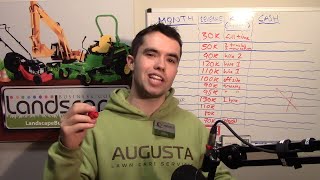
Mike Andes walks through a month-by-month planning chart for lawn care businesses aiming to hit $1M in annual revenue. Track KPIs, revenue targets, and cash-in-bank each month. Plan spring hiring, buy equipment in February, and run a December referral push to fill January. Account for 30-60 day payment delays and keep $120k-$200k in reserves.
Chapters
Hey everyone, It's Mike from landscapebusinesscourse.com if you haven't already, make sure you check it out. Landscapebusinesscourse.com Today we are going to be going and talking about 2018 and this coming year and how you need to start planning your year to really dominate your market. So if you listen to a few podcasts ago, or maybe you watched the live webinar, we had a similar graph to this which we're going to be talking about today. If you're listening on the episode today, of course you want to be checking us out on YouTube and Facebook to watch what I'm doing doing up here on the whiteboard. Now, today we're going to be talking about how you can plan for your entire year and what you need to do to have a successful year. And a lot of times what I do, every single December, is have a chart very similar to this, always a little bit longer, a little more in detail. But I'm going to give you the general gist of what you need to do to plan a year so you can dominate your market and really scale up your business. So the first thing you're going to do, as you can see here, is we have all your months here on the left. And then I got three different things that I'm trying to mark in every single month. So now this is what we're projecting. So this is how to do projections for the upcoming year and how to make sure that they align with the goals that you want. So on the left hand side, we have our month goals. In the middle here we have three different things that we're measuring revenue in each of the months. We're measuring our KPIs, our objectives, what are the main things we need to get done during that month, and then our cash flow, how much cash is in the bank. This is important. A lot of people don't talk about this. A lot of people like to talk about revenue. Not too many talk about cash. Cash is king and cash flow is super important. So we want to make sure we keep track of it throughout the year. So this is the type of graph that I would do in December. So right now, as I speak, it's early February. I did this about seven, eight weeks ago and went through the entire year of exactly what each of these key performance indicators are going to be for our business. So first of all, I actually like to write in our key performance indicators first. That is okay, I know where I want my company to be going. What is going to happen through These months, How am I going to get there? So for instance, maybe your key performance indicator. Maybe let's assume that this company is going to do a million dollars in annual sales. And so just to keep the numbers round. And so let's say that you know that you want to get your staff from five to 10 people. So let's say that in March you're gonna hire two people. So this is your KPIs, your objectives. KPI stands for key performance indicator.
So we're gonna hire two people. So obviously this is a really dumbed down graph, a kind of chart here that I'm making. I usually do this on a spreadsheet. I have much more space to write my KPIs. I usually have three, three or four KPIs or objectives every single month. But let's say, let's just kind of, just to give you an example, we're gonna hire two people in March, we're gonna hire one more in April, we're gonna hire one more in May, and it's gonna slow down a little bit during the summer. So come back in September, we're gonna hire one more person. So that will be a total of five people over the course of the year. Now let's say, okay, in order to get these KPIs working and hire these four new people here in the spring. And there's one person in the fall. I'm going to need more equipment. So one of my objectives is in February I'm going to need two new trucks.
And two setups, two equipment setups for mowing. So let's just assume we're going to have four new people, two more crews. So two crews of two, and we're going to need two mowing setups.
Two mowing setups, two trucks that we're going to buy in February to get ready for those four new people that we're hiring here. So remember, like I said, usually for each of these I have three or four. I'm just kind of making this simple for you. Let's say that in January last year it was really tough because we didn't have much work. So our KPI objectives here is to keep the crew busy full time.
In January. So coming back from Christmas holidays, back from New Year's, a lot of times people just kind of. It takes them a few weeks to get back into the rhythm of things. They take a few weeks where it's kind of like they don't really have many sales going on. The sales people aren't really going after the thing, because it just seems like, hey, we just got back from holiday, we don't really have a pipeline, we don't have a backlog of work. And so people just kind of roll into January. There's not much work. All of a sudden now your field staff start to leave because there's not enough work to do. They're only getting 20, 30 hours a week. So one of your key KPIs, your objectives is, hey, this coming year I want to have full time work in January. In order to make sure I do that, I'm going to need to have a big marketing push in December. So even the next year this same thing can be done. So we're going to do a certain, let's say down here, we're going to do a referral strategy.
Marketing, sorry, running out of room here, but basically a marketing program for referrals. What we're going to do for this is we're going to target the three or four neighbors of all of our existing clients. So that might be 7, 800 people. If we have 200 mowing clients, say, and we target four of their closest neighbors, we can now go after those referrals and try to get a bunch of cleanups, winter cleanups, maybe give them a special 10% off or, or maybe even do better than that and do a plastic gift card. Give them $50 off of a winter cleanup in January and they have to schedule it in January, thus allowing your KPI for full time work to take place. So let's fill this out now. We are now going into usually a little bit of a slower month, let's say some of the slower months in the summer. What are our KPIs during then? All right, maybe we're going to focus on in July and August. We're going to focus on training and we are going to train our team leads on project management. Maybe you listen to the project management audio seminar in the course. It's about eight hours long. You listen that with them, you go over that with them. We're going to focus on training in July. Maybe we're going to do the same thing in August. We're going to maybe take some of the field crew, some of the field team members and teach them how to do some hardscaping things, maybe how to operate some heavy machinery. Because right now it's not as busy during these months here, at least for mowing, especially June, let's say in June. We want to make sure that our KPIs maybe we haven't had team Meetings. We haven't had really good communication internally. So we want to have an off site.
This can be an evening long. This might even be a two day off site meeting that you have with your team. These are some of the KPIs. These are sort of the things I'm thinking about. And it might be opening a new shop, it might be hiring a key person, another manager. So instead of hiring one, you might say hire one crew manager, hire one team member, make this more detailed. Obviously you should be making this more detailed, as detailed as you possibly can even into these months. Several things per month, all making sure that you get to where you want to be at the end of the year. Now we start working backwards. Revenue. What's our revenue going to be for this coming year? So let's say okay, January, we really want to hit it hard. We do want to keep you guys busy year round. So January, we don't want this to be a really, really bad year. Obviously we might not make a whole lot of money cash wise, but revenue wise we want to stay busy for the guys. So let's try to do $30,000 in revenue in that month. February, we're back in the swing of things back in the new year. We have got some more equipment. We really want to be going after that $50,000 marker. Alright, March. Now we're starting to get into the mowing season. We've hired more people. Production's really starting to increase. Now we're looking at 90,000. So I'm just going to try to take some of these round numbers. This is for about a company that would do around a million dollars a year. I'm guessing once we get to the bottom. I don't have this written down already but as far as how these numbers work out. So now we go in April, things are really picking up. We're going to step it up now. Really getting full time people on board. Getting these first two guys trained down into May. Now we go. It's still staying June, it is still very busy. Not as busy it was up here in April, but it's still very busy. We're gonna drop down a little bit during July and a little bit down into August just because it gets really hot. Not as much mowing. Still can do some landscaping and things though. We're taking some time to do some training off site, things like that. September picks back up. We're gonna do $130,000 in monthly sales and revenue. October is also very busy. And then it kind of slows down here into November and then December. We don't want to just take our foot off the pedal. We want to really keep the pedal in the metal all the way to the end of the year. And let's say that we are going to do 70,000 in sales. So now what we got to do is we got to add all of these up. So I'm going to step out of here, get my calculator and we're going to add all these up, these revenue goals for this upcoming year. So we're going to take each of these months here, the targets that we have and we are going to add them up. So we got 30,000 in January. In February, we're going to do 50,000 in March, we are going to do 90,000 in April, we are going to do 120,000. In May, we got 110,000. In June, we got 100,000 in July, we got 90 in August, we got 95 in September, we got 130 in October we got 110 and in November and December. Alright, so the total amount, if you add all of this up, is going to come to the total of $1,075,000 for the year. Let me make sure I got my Math right. Yeah, $1 million. I could get this. I might be wrong on my math here, just quickly adding this up, but this is how I'm kind of looking at it. So let's say for instance in last year I did 2,000. I mean, let's say now it's two. So let's say in 2017, let's say our company did, let's just say 600,000. I don't want to get past the million dollar marker. This is the type of thing I'd be looking at. So these are not our numbers, this is not our KPIs or anything like that. This is a representation of, let's say this person wanted to break the million dollar marker. This is the kind of projection they need to know so that each and every month they can determine whether or not they're on track. Now this is the part a lot of people forget about. And that is cash flow. Or we're gonna do an entire episode on cash flow coming up. But this is another rule you need to be thinking about. So a lot of times what happens is people get cash heavy. I like to call it cash heavy. They start getting cash heavy somewhere right in here. Somewhere like August, September, October. This is when you've spent the whole year, you've paid off equipment. People are experienced. So you're More efficient. A lot of the big jobs that you might have done in the spring have now finally paid. You might have taken 60, 90 days to collect that payment. And so now you're really getting cash heavy. You've been working really hard the entire summer. The money's really coming in over the summer. It was easy to mow, not lots of clippings, very efficient, fast routes. And so you're able to get a bunch of money. I call this cash heavy. I don't like that term in one regard, but I call it cash heavy. Because a lot of times when people get cash heavy, they like to shed weight, they like to get rid of cash. And that can be a very dangerous thing to do when you're cash heavy in the fall to get rid of your money then, because you got a whole winter, you got to get through that might not be as great of sales. So let's now project. Let's say that in the bank we have 70,000. Let's just start with $60,000 in the bank. So they're going to start this year. This company is going to start the year off with $60,000 cash in the bank. I truly believe that you got to have at least a month's worth of expenses in your bank account. Really shoot for two to three months worth of expenses. And so in my detailed analysis that I do, I even go further as far as breaking out expense columns and chart of accounts and things like that. But here we're just looking at cash in the bank, cash working capital for the company. So $60,000. When we're starting off now, January's gonna be a little bit slow. And so really it's gonna be a little bit slow. It's gonna take some money out of the bank. So we're gonna start February with only like $50,000 in the bank. Buy two trucks and two mower setups. So we might finance the mower setups. Maybe if you're in the course, you know that I'm not a fan of financing your trucks. So let's say this is going to drop down to 30,000, which is getting really, really risky. Because if you have five guys already employed and you're at $30,000 cash flow as far as cash in the bank working capital, that's very, very risky. Like I said, for a company of this size, their monthly expenses are probably going to be in the neighborhood. And of during this month is probably like $40,000. During these busy months, you might be looking at $70,000 plus per month in expenses. I Would highly recommend that this company try to carry up to about between 120,000 and $200,000 in cash in the bank working capital. It really takes the pressure off you as a business owner when you have that money available. And you know that when an opportunity arises, you can seize it, number one. And number two, if something goes awry, if something bad happens in the business, you can handle it financially. So in March, and I know a lot of people will disagree with how much money I recommend you keep on hand there, but I think it's important, I don't like to do too much more than that because you're cash hoarding. And when that money could be used to grow, expand, get new people, get better equipment, make your business more efficient. However, I know that we could talk a long time about that. I just find too many people because if this person, if this guy would have maybe in back here early in the year, he had 100,000 in the bank. And so he went out and bought a bunch of stuff or maybe bought a new house and put that down payment. And so now he got low. And now you see it's February, March, April. That's when cash flow gets really tough. And if you haven't done a really good job of managing the cash heaviness and then really managing it throughout the winter, you can really have some problems here. Alright, so now March comes around, it's really getting tough. We can hire two new people. These guys are new, they need training. So now our crews aren't as efficient. This guy's really struggling. He's going down $20,000 in the bank on when he's probably paying every single week. He's probably looking at 6, $7,000 in payroll to pay all these people. Maybe a little bit less, but 5, $6,000 in payroll to pay his people. And here he is at 20 grand in the bank that is literally a truck broken down away from being out of business. That is very, very risky. So I'm gonna show the turnaround here, but you'll see what happens. So the reason this happens, the reason this happens with your cash flow in the spring is because you might start doing a bunch of work here. As you can see, we really start getting busy here in March and April. But the problem is if you start mowing someone's property at the beginning of March and you mow it all the way through March and then you bill them on April 1, they might not pay you for 30 more days. In other words, you're doing work here. You bill them at the end of the month. So the 1st of April, you bill them out. You might not get paid till May. If you aren't working your accounts receivable very well or if you're just even average like a 30 day receivable, you might not see money for really 60 days almost from the time you do the service to the time you make the money. 30 days from the time that you bill to the time you get the money. So that's pretty average. So what happens here is when our expenses are going up because we're hiring people, we're getting new equipment, we're expanding the business, everything's great. Very, very busy this time of year. However, because of cash flow and because of receivables not being managed correctly, this is gonna slip even more. You're gonna see a real cash flow. Very struggling times for this business owner. A lot of nervous nights and not really knowing what's happening in the business. Cause he feels like he's busy, he feels like he's staying active. The business is growing, there's lots of new accounts coming in, he's hiring new people, but yet there's just no money in the bank. But now things start turning around because May comes around and let's say the cash flow, it really takes a good hit. It goes up to 45k. Same thing with this next month. No, people are more efficient. We are really climbing up here throughout the summer. Sorry. And then really come August when it's easy to mow, very warm and so able to get much more efficient routes. We have making over $105,000 now in the bank by the end of August. September rolls around, we hire someone else, we kind of invest some more money back into the business because we're going to might need to get some more equipment, do some marketing for fall cleanups, etc. So on this month we're going to say that we don't really jump a whole lot in cash in the bank in October, another good month, we're going to jump up to 130,000. November rolls around 145 and 150k by the end of the year in the bank. So this is something you want to do.
This is what I would be doing. If I was looking at someone that was making this projection for the next year. I would say you're going to have a problem right here. This is where you're going to have a problem. And so what I would be doing, if you're going into this coming year, if you're watching this in Five years and you're coming. It's November, December, and you're down here and you have a bunch of money. Remember, about this is, this is the cash flow issue. It's not even in the middle of winter in December, January, people think like that's the winter. No, the winter of your cash flow is really the first few months of spring when you're very busy, but cash hasn't started rolling in yet. It takes a while for those receivables to catch up. Even if you're doing good cash flow with credit cards on file and things like that, if you have a commercial account, if you have big landscaping projects, there's a certain amount of lag time on payments and it's at the exact time when right before you get to make a big investment in equipment and people. So make sure you come into this month. Make sure you come into this month with plenty of cash. That is the goal. So when you get cash heavy, don't feel like you need to shed the extra weight. Keep the weight throughout the winter. Stay warm so that come spring you have the energy to go extra and expand into the market. So I encourage you to make sure you do this analysis. If you're on the course. There's a live video, it's the live webinar that we did a few weeks ago where we go in depth on this. And there's also a handout for you to fill out this in even more detail, as well as the same analysis for your marketing budget. So looking at what your marketing budget is at each one of these intervals, what you need to pay, what you need to do every single month. So sorry, my mic's in the way there, but we are going to do the exact same thing on the webinar. So check it out. It's in the bonus module. And if you are on the course, you're gonna be entitled to the free upgrade that was gonna be coming. I was saying at the end of April, it looks like we're gonna get even done sooner. I've been able to work quite a bit on that. It looks like even before April. I'm hoping that we get the new website for the course completely finished. I will upgrade all of the existing course members.
That new course site is going to look much better. It's going to have a lot of written blog format and lists and checklists as well as the existing videos that we got right now. I'm already recording new content for the new website and I'm really, really looking forward to it. The design is much more clean, it's much more user friendly, it's much less 1990s style like the existing website is. So if you want to get in now, I encourage you to do so. The price is going to go up to 297 once we launch the new site, but if you get in now, it's 247 and then it is a free upgrade to the new website. So looking forward to that. Thank you so much. I'm Mike andes. Check out landscapebusinesscourse.com if you haven't already. Until next time, be great because nothing else pays.






