I turned down a $10M offer... here's why
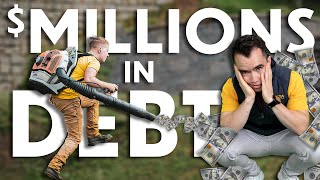
Mike Andes turned down a $10 million offer to sell Augusta Lawn Care. He chose to keep the company and grow it himself rather than cash out, weighing the financial upside of staying against the security of a guaranteed payout.
Chapters
Today I'm going to share with you why I declined a $10 million offer to buy my business and instead went to millions of dollars of debt and have continued to grow the business, owning 100% of the company.
The business is Augusta Lawn Care, and we've been growing it over the past couple years. Franchising. And franchising is. Sounds great on paper, but it's extremely expensive. There's lots of legal costs in terms of having to register in every single state and country that you operate in. There's a lot of legal and accounting costs that people don't think about. And so it' extremely expensive. And in my opinion, most franchises fail because they don't scale fast enough and they don't get past 100 locations, which is where profitably can start, usually around that 100 location marker. We are now just short of 100, 100 franchise locations, and we are getting to profitability this year. It's extremely difficult, very, very hard because the systems that we have to build are still new to us because we're only a couple of years in. And if you look at the trajectory of growth, so from one year to the next year, like the two years that we've been doing this, you've tripled the company. And so every single system is broken. Every single system has to be redone, has to be reframed, and there's plenty of things we've dropped balls on. It's very stressful and trying to scale the team and all of it being very new to me. A few months ago, someone came along and said, hey, look, we are willing to value the company at $10 million. And they were gonna give me 10 million cash, let me be clear. But you're gonna value at 10 million and then give me quite a bit of that was in cash. First and foremost. I did not do that. I did not accept it. And interested in taking on any sort of majority stake ownership in Augusta ever. I want to always stay in control of it. But for some people, when they hear that, they think I'm egotistical or the fact that I want to have control. And I'm not open to the mind of, like, growth and expansion via other people's money and investors money. And people would say, well, you'd rather have a small piece of a large pie than a large piece of no pie. And that's kind of what people's logic is. But let me explain to you from a logical standpoint why I would not take outside investment or I would not let someone buy out my Stake into the company. So the specific deal that was on the table was for $10 million. And let's just break down what that would look like. If they gonna buy from me, the vast majority of the business, and they're gonna give me millions of dollars in cash, here's why I would not wanna do that. First and foremost, almost half of that would go to taxes. Literally half of the cash would go to taxes. I would no longer have any control or any sway or say in the business whatsoever after that transaction and therefore would actually be pushed out within like six months. It was. I would have to be out of the business. Question is, well, what would I do? Because as much as I love business and I'm passionate about business and creating jobs and helping other people, what am I gonna do? I'm probably gonna go start another business that requires a bunch of capital and I'm gonna burn through all the money that I just made on an acquisition just to get another business up to the scale and size that we were currently in. And I'd be getting off a machine off of a vehicle that had all sorts of momentum. I was driving fast and going, and I'd literally jump off and go back to zero. And then in order to get that momentum back, I'd just spend the money that I made in this acquisition to get another company up and I'd waste two, three years probably getting another company up and running. So in my mind, it was the time value of money. The fact that that money that I would take is going to be slashed in half for taxes. And then the next part is the fact that I'm going to spend the money that's left over after taxes and probably have to spend it on burn. Burn rate. Getting another company up and running and getting the motor on that company fast. Well, by the time I would have done that, if I would have stayed on the original vehicle, I would have been further down the track. And in my mind, that's why so many small business owners don't ever get the progress that they desire, is because they get the track, they get the train moving down the track, and they jump off onto something else, the next shiny thing. And if they would just stayed on the same train, on the same track for a few more years, they would've been way further down the road than starting at zero on something that has no inertia, no momentum, and then trying to get that one started. Trust me, I understand. The first few years of any business is the hardest because you're trying to get the momentum started. You're trying to get the business going, and the train takes a lot of energy to get it going, but. But once it's going, it can keep moving pretty good. That train takes a lot of energy to stop, but it takes a lot of energy to get started. And that's why so many people stop and fail or quit or give up in the first few years because it's so difficult to get started. But once you've got a little momentum, in my opinion, the last thing you want to do is jump off because you're getting taxed out to wazoo, and then you're going to get on a different opportunity vehicle that now you've got to spend money, time, energy on getting that one started and figuring out new systems and procedures when you could have just stayed on the original one that was going down the track. So that's another reason why I did not sell out the company. Now, after turning down that offer, I realized just how much capital we were going to need. We're going to need millions of dollars, millions of dollars, and we are millions and millions of dollars. Debt. Personally, I'm millions of dollars in debt. Most of it's backed up by my real estate. But, like, if the business doesn't work out, my real estate is out the window. Like, Personally, I am 100% pot committed 110% to Augusta Lawn Care because I had to do that in order to retain control, not sell out equity, not sell the company and be able to still grow the business to the point where we can make it economically feasible. Because I still had to grow while at the same time realizing that I was losing money. That's like the most twisted brain fart thing in the whole world. And so taxes was the first reason why I didn't sell out. The second reason was I'd be jumping on a different opportunity vehicle that did not have momentum, and I would probably spend the money on that new venture. That would just essentially get me up to speed next couple years to where I'm currently at. We're also assuming that if I jumped off and started some other business, that I would just become, like, successful at it. We're just assuming that when that should not be given. I think the ego of a lot of small business owners is like, oh, if I was successful in one thing, I can do another thing. I'm not that stupid. I realized that I'm really good at lawn care. Lansing. I understand the industry. I have years and years of experience. I've done it for a long time. I've Seen hundreds and thousands of P Ls in this industry. I get a lot of the general concepts. If I just abandon this industry and just like switched, I don't. I have no guarantee. As much as I love business and think I could do pretty good in other industries, I'm not taking that for granted. There has been cataclysmic failures and people that were much smarter, more brilliant, and more money than I do. And they went from one industry where they're successful and went to another industry and they failed miserably. And we just cannot assume that, like, oh, I'm just gonna start another business and it'll be great because the last one was great. And then when you start to become that egotistical, that's usually what leads to failure. Cause then you start jumping bridges and you start doing things way too out of sync with when they should actually be done in terms of order and. Cause we assume like, oh, yeah, I'm so good. Like I'll just jump in this other industry and do something else. And honestly, I love lawn care, I love landscaping, I love this industry, and I didn't want to go anywhere. So it's been a tough few months. It still continues to be tough financially when you know what you left on the table. But there was a very deciding moment. One day I maybe talk about the day when I decided I am not selling. I am absolutely 100% keeping 100% of this business. And we're going to make something really special out of it. And it's going to be the hardest couple years of my life going forward. But it's going to work out in the long run. Much better financially for me, much better for the franchisees of Augusta Lawn Care, and in my opinion, actually make an impact on this industry in the next 20 years. Not five years, not three years, but 20 years. That's what it's gonna take. And so I wasn't about to give up on the dream. The thing that got the business started, and that is to change the level of professionalism in the landscape industry. I feel like we're just getting started and I wasn't gonna allow $10 million pre taxes, $4 million post taxes, and a couple years of lost time deter me from what we're going to do in this industry. And so it's partly passion and then partly also realizing that if I stay committed and it will work out financially, it will be a lot more than $10 million down the road. But the next couple years gonna be very, very difficult. And so I'm still learning, I'm still growing. And like any small business, regardless of the size, Whether you're adding five zeros at the end or 20 zeros, it doesn't really matter. Same struggles, same problems, same financial stresses, same exhaustion, same hiring problems, same systems problems. As you're beginning to grow, everything has to change and grow and there's not anyone before me telling me how to run a franchise. With lawn care. It's not like that. It's a difficult industry and I'm still learning and growing and I appreciate all of you for being along this journey. I'm Mike Andes, founder of Augusta Lawn Care and if that was helpful, watch this video here where I break down what I've learned over the past nine years. Starting out just mowing grass into what is today and spending millions of dollars trying to figure these things out so hopefully you don't have to make the same mistakes. Check that video out right here.






