Massive Job WITHOUT Self-Propelled Mower! [How to Sell More Commercial Contracts]
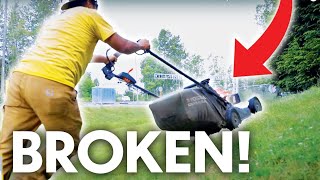
Mike Andes mows a commercial property with a broken self-propelled mower, then explains how to land bigger landscaping contracts. Find property managers by posing as a tenant, report maintenance issues to add value, and charge what the work is worth—he went from $200 to $1,500 monthly for the same job. Commercial work means fewer clients but bigger equipment costs and competition from larger firms.
There, there.
Are Mike ganies here@landscapebusinesscourse.com and yes, the truck died. And that's what you get when you get cheap chumper cables. Invest today, go to Harbor Freight. This is not sponsored, but do it. All right, so today we are mowing at this commercial property. We're gonna talk about commercial, residential and all that good stuff. But yes, before we even start the mower, before Francisco gets started, let me be clear. The self propulsion on this mower is broken. So let's just get it out of the way. I'm a horrible person. I don't care about my employees. I make them work hard and I don't give them good equipment. They should be driving bigger mowers that are self propelled and I'm a slave driver for making them do this. Let's just get all those comments out of the. Fantastic. And you're going to realize though in just a few minutes that there is a zero turn in their trailer that they're not using. So keep that in mind. But the self propulsion is not working on this 21 inch mower. So if you're wondering why Francisco here is straining and by the end of this job glistening in sweat, it's because the pore mower is obviously not working very well. So let's talk today though about commercial properties getting those contracts, how you can get them, how to get a hold of the people who actually manage these contracts. And, and this is a chain manufacturing. So this company makes chains for the army, they make chains for the Coast Guard, big chains for their boats and all the rest of it. And so you'll see in a second here they'll have like manufactured steel and pallets of steel and rebar and all rest of it. But how do you get these type of contracts? The best way to do this is actually to go through a property manager. So a property manager is going to be someone who manages the commercial real estate for an investor. So the owner typically doesn't actually figure out who does the mowing and who does the street, you know, the parking lot cleanup and the garbage removal. They have a property manager take care of that and collect the rents and do the leases and all the rest of it. So how you can find out who is actually the person getting these contracts and able to give you these contracts is just pretend like you were looking for retail space. Pretend like you're opening up a hair salon or like a tax accounting office and literally just go around as if you were renting. And what's going to happen Is the company that traditionally is leasing out these properties is also going to be the same company that takes care of all the contracts, takes care of all the maintenance on the property. So what you're going to do, if you say, hey, this property is being rented for $9 per square foot and plus triple net, for example, you're saying, great, I just need to know the property management company's name. I'm going to call them up and. And I now know who manages that property. The cool thing about a property manager, if you develop a relationship with them, they might not have. They don't just have one property. They're gonna have 10, 15, 20 properties that you potentially might be able to get the job on. If you do a good job and they really like you, at the end of the day, you want to make sure that that property manager has to do as little work as possible. Remember, their job is they get usually a cut, like a 10% cut of all the rents. That's how it works for them. So really for them, if you want to make a property manager's life easier, you do their job for them. Which means if you're there at the property every single week, if there's something weird going on, like some weird activity, or the trash is overflowing, or you see there's a repair on the property that is needed, if you're able to help the property manager do their job so they don't have to come to the property and you give them information like, hey, just FYI, there's a gutter leak on the side of one of the buildings. Or we noticed that the garbage was overflowing and there seems like there's someone living back in the trees. Those sort of bits of information to a property manager, extremely valuable. And that's the type of relationship that you need to build if you wanted to actually charge a premium price. Because the problem with commercial work is everyone wants it, all the big guys, and they're willing to do it at a very much discounted, steep discount compared to us as operators that are solo and smaller. Just getting started, going after commercial account sounds great. I still remember my very first commercial account. I charge $200 per month. Today we would be charging this customer about $1,500 for the exact same services. But why? Well, back in the day, $200 a month seems big to me. It was the equivalent of like getting two or three mowing customers that were residential. I was like, this is great. I'm going to go commercial. I got this big property and Little did I know I was massively undercharging. If you want to charge what you're actually worth and charge what your hourly rate is, otherwise on residential, if you want to charge the uncommercial, you're going to have to add extra value to the relationship to the property manager. Again, do their job for them. How can you add value? How can you tell them, hey, this tenant seemed a little bit shady. There seems like there's five parking spots. They're all filled by the same tenant. Those little things are going to really allow you to create that relationship, and that's going to lead to more sales because that property manager has the key to a lot of other contracts that you can potentially tap into. Now, you might be asking, well, should I do hard, Should I do the commercial stuff or should I go after residential if I'm trying to start a lawn care business? Let's go over the pros and cons. So the pros, like, the positive parts of doing commercial work like this one is, first of all, less windshield time. You don't have to drive around all day long. You have a very efficient route because literally two or three of these properties will fill your schedule for the whole day. You don't be driving around at the end of the day. The bane of our existence in the lawn care industry is windshield time when you're driving the from property to property. So one of the best things the pros of having these big commercial properties is less drive time. You park in one spot and you work for 2, 3, 4, 5 hours on one job site. Less fuel, less maintenance on the truck. And at the end of the day, when the blades are turning, that's when you're making money. Another thing that's really great about commercial work is less communication. I would much rather have one customer that's big than 20 other smaller customers. Cause that means I gotta invoice 20 more times. I gotta take way more calls 20 more times. I got to talk to 20 different homeowners that have different standards and want different notes and different heights of cut. Whereas with commercial, they're usually a little bit less picky because they just want the work done. They're like, hey, cut the grass. Don't mess anything up. They just want it done. It's more like they want utilitarian. They just want the stuff done. Whereas the homeowner, they're like, well, I want it to be on this way, and I don't want you to edge this area. And I want to cut down this height. And you know, last time they didn't move the hose and they didn't edge it exactly the way I liked and it went too fast. Whereas the commercial property, like go for it, they don't really care, they just want it done. So there's definitely some pros when it comes to the commercial side. Another thing is you don't need as many office people if you're doing commercial because there's less calls to handle, there's less people to invoice. You might have a massive commercial business that only services like 20 properties, but if all those properties are a few thousand dollars a month, got yourself a business. So there's definitely pros to the commercial side. Now there are some downsides. The downsides is that everyone and their mom that has a big company wants to go after commercial. Which means if you're going to be competing at Brightview and other massive regional players, they can squash you like a bug. And they will go into a market, they want market share and they will simply just price cut everybody. They'll go in there and they'll do it at a loss or they'll win the contract and be okay with a 3, 4 or 5% profit margin. And unless you're doing millions of dollars in revenue, like many millions of dollars in revenue, a.
Few percentage points in profit is not what I want to get. I got into business for I want 15 to 20% profits. And that's typically going to be found in small commercial or residential. So that's why we focus more on residential. But we do have commercial like this property. Again, people that are willing to pay a premium price for that premium service, for the fact that people show up with uniforms, they can talk to any of the employees that when they call, there's people on the phone. So there's definitely value you can add to get these commercial contracts and then be willing to pay more. Another negative about the commercial is typically you're going to need bigger equipment, right? You're going to need more equipment, you're going to need bigger equipment and you're going to need more staff. So especially if you're just getting started, residential is probably the best place to get started. Because if you're going to get started in commercial and you want to be price competitive, you're going to need bigger trucks, bigger equipment and you're getting a lot more manpower. You're going to want to go to a property, have three, four, five guys hop out. If they're going to be working there for 15 man hours, you don't want one guy going there for two solid days, usually the client won't like that. So definitely pros and cons to having commercial work. Last thing before we wrap up the video is about training. A lot of people been asking, well, should I do video training or should I have a checklist or how should I do this? We have tried video training and in the past it has not worked very well for people out in the field. If you sit someone down in front of a video, even if it's well presented, they get this like million mile stare.
They're not cut out for sitting in an office and watching a screen. They want to go out and work. So what we do is we break it down based upon the services from simple to more complex. Maybe day one they learn how to use the weed whacker and the blower. That's it. And until they perfect that, they don't move on in the checklist. They the next thing they might learn is the push mower. Then they might learn the zero turn. Then they might learn how to drive the truck, then they might learn how to back up the trailer. These are all parts of the process and I would recommend having a checklist that they work through over the course of a week, two weeks, three weeks, whatever it might be. If they have more experience, they're gonna get through the checklist pretty fast. Maybe on day three they're already running the truck and driving and backing up and all the rest of it. But it creates a system by which you know, they have to work their way through. They have all the skills required and by the end of that two or three weeks, you know, they're at to a certain level of proficiency. And best of all, they won't go completely mind numb by watching videos. We've tried it, it sounds great in theory. Greenious is a company G R E e N I E U s. They have video training for the fuel workers, but we've never seen it be super beneficial. And they don't usually gravitate it. They like getting their hands dirty getting out in the field and they can do it profitably and efficiently. If they start with basic stuff, they get good at it and they move on to the next thing. You don't need to take an entire day with your best employee to train a new guy. Take the entire day, make it an unprofitable route just by training. Okay, we're going to take this one job that should take 20 minutes. We're going to make a five hour job by training you. That's inefficient what if that person leaves in a week later? So hopefully that was helpful when it comes to training your employees. I'm Mike Andy's landscapebusinesscourse.com We'll see you on the next video.






