Math Doesn't Lie! The Perfect Service Business! (Complete Guide)
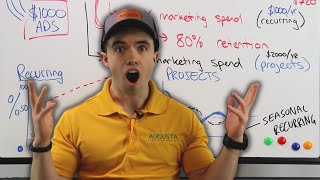
Mike Andes breaks down the math for a service business using landscaping as an example: $1,000 ad spend yields 10 customers at $100 each. If each generates $1,000 in recurring revenue and stays for five years with 80% retention, lifetime value hits $3,691 per customer. Mix recurring maintenance with projects to scale without depending on yourself.
Questions this video answers
$1,000
$50 per lead
20 leads
50% close ratio
10 customers
Chapters
Hey everyone. Today I'm going to be sharing with you how to build the perfect service based business. Regardless of what home service industry you're in. I'm going to use landscaping and lawn care as an example. This works for any home service business. Any business has seasonal work and you have recurring and project based jobs. Let's go and get started. So we're going to go ahead and assume that we have $1,000 in ad spend on this theoretical landscaping, lawn care, home service business. We're going to assume we have $50 cost per lead. Now each of these single KPIs or key performance indicators that I talk about are very important. I could spend an entire hour talking about them. More information is on them in the links in the description down below. But $1,000 we're gonna spend on ads, we're at $50 cost per lead, which means for every $50 I spend, I'm gonna get one estimate or one quote that I am going to need to perform on someone filling out estimate request form, someone wanting service. $50 cost per lead. I have talked about in the past that there being before the cost per lead, a cost per click and a way of determining other sort of key KPIs before that. But let's just assume we spend $1,000, get $50 cost per lead. That would lead to 20 leads. 20 leads times $50 cost per lead. There's our thousand dollar spend. Now we're going to assume that we have a 50% close ratio. Now I could talk for hours about close ratio. It's extremely important. It's essentially the percentage of estimates that are one that you give out to people. So if I give out 100 estimates and I get 60 of them accepted, I would have a 60% close ratio. Let's assume in this case though I have a 50% close ratio because it's kind of a middle of the road. You're not like super profit mode where you're just very high prices and a lower close ratio. But you're also not in massive growth mode where you're lower prices and you're going to be closing 80, 90% of your jobs. Let's assume 50% close ratio. Now what that means is we have a hundred dollar customer acquisition cost. Why? Because if we have 20 leads and 50% of them accept the proposal, that means we have 10 clients. And if we have 10 clients based on $1,000 worth of ad spend, that means we have $100 customer AC acquisition costs. Which means if I spend $100 on ads I expect to be able to get one customer. Again, very important number. Knowing what your customer acquisition cost is allows you to know what you can spend on marketing over the course of your business. Now, what we're going to try to achieve in the first year is a very, very, very conservative number, and that is 10x multiple on our marketing spend in the first year. Watch this. So in the first year, I want to be able to get 10x what I spent on on my customer acquisition cost, which means I'm going to be trying to get $1,000 in recurring revenue in the first year from the customers that I get for mowing, for example. Now, again, if you're in any other business, put in any sort of recurring maintenance type work in this scenario, I'm trying to get $1,000 per year per customer. And if I do that, I'm going to have a 10x multiple on my marketing spend in the first year. Now, the beautiful thing about recurring work and having jobs that you go back every week, every month, every quarter is you're able to, over the course of time, extrapolate how much actual value that customer has to you. But in order to be able to know that, you need to know your retention. That is the percentage of customers that you're going to keep from year to year. Now, if you have a 20% attrition rate, which means you lose 20% of your customers every year because they move, they pass away, they're not happy with your service, that would assume that you have an 80% retention rate. So 80% retention would assume a 20% attrition. So if we keep 80% of our customers on an annual basis, that would mean that in year one, if we make $1,000 in the recurring work, that in year two, we're also going to make $800 of revenue on average on those first 10 customers. Now, of course, we're not going to actually lower the price or anything like that. We're just going to probably lose two customers out of the 10, therefore leading to eight. Now, of course, over the course of averages as we move out across every year, we're going to lose 20% or only going to retain 80% of the revenue from these customers. But you can extrapolate over the course of the next five years that in year number two, you're going to have 640 of revenue. Year three, you're at $512 of revenue, year four, year five, et cetera. And in the first five years, we're not even going beyond that. We can assume that we're actually going to make $3691 from that one customer that we originally spent $100 for. So in, although we only have a 10x multiple in marketing spend in the first year, we can actually say that we have a 36 times, almost 37 times multiple on our marketing spend in the first five years. This is the beautiful thing about recurring revenue, because as long as I have good customer service and I keep my customers for a long period of time, this number continues to extend very far out into the future. And I'm able to trap a lot of lifetime value ltv from the customer. And in this case, the five year value of my customer for this recurring client would be $3,691. So theoretically I could say, okay, well, If I got 10 customers and I got them all for $1,000 on my marketing, I'd be able to get 10,000 or 10x multiple on that recurring revenue in year one. And then over the course of the next five years, I would expect to have 36,000, almost $37,000 from just those 10 customers. Not a bad deal getting $37,000. And from spending $1,000 now you say you're not getting actually 37, it's not a 37 times return. You're right. You're going to also have other costs now. You might only be 20% profitable on this revenue. So if we take this number and we say, okay, well, let's multiply that by 2 or 20% profit margin, you're right, you're probably going to end up with about $720. I'm just rounding in my head right now $720 worth of profit. But again, not a bad deal over the course of five years to go from spending $100 on a customer to them getting you 720, that's a 7x return on your money. 7x, that's an 800% return literally in five years money spent into a very conservative spend of marketing cost per lead, a very conservative close ratio and extremely conservative marketing spend on multiple, you're able to literally 7x your money over the next 5 years. Fantastic. If you look at the annual return, that's probably like 50, 60% just by using a service based business because you have recurring revenue. Now. The reason why most people will go after projects and the elusive thing in service based business is going after projects is because you can very quickly grow your business. Because notice this, if we look at project based, we're assuming a 20x marketing spend which Means in the first year I'm not going to make $1,000 per custom, I'm going to make $2,000 on average per customer. Now this is very common. This is why most people actually go into projects a lot sooner in their business and is because you can grow revenue much faster using large projects. Now it's not to say that projects are bad, but keep in mind once that one time project is done, it's over. There is no more money to be had for that customer. And the thing is, it's going to take me a few years to make that money on that same amount of money on that customer for recurring revenue. Whereas I could do that in the next month for one customer if I get them on a project based job. That's why so many people in service based businesses get allured in doing project based work. Because you can grow much faster. You're able to capture a lot of this revenue in your first year because one project might be a 5, 10, $15,000 job, whereas it might take four or five years to make that much money if you're doing it on recurring base work or maintenance. That's why most people as a function of revenue, a healthy business that is trying to run without the business owner being in daily operations is going to look something like this. Which means on the bottom here on the x axis, we have the number of years that goes by. I typically see year five and six is when people start to have a good equilibrium when it comes to the amount of work that comes from recurring jobs. Now this is just my opinion, but a business that has more recurring revenue is typically easier for the business owner to get out of daily operations, start managing the business and working on the business instead of in the business. There's havoc, there's less project management because these big jobs, although you can make a lot of money up front, they do take more project management, higher skill level, more organization from the owner and the manager instead of being able to have it run on systems as easily. Not to say you can't do its projects, but for a service based business that wants to run without the owner and on systems without the owner in the daily operations, this is typically what I see. And as at the beginning, the percentage of their revenue that comes from recurring work is actually pretty low. Now it's not to say that their revenue is necessarily doing this. Their revenue for all I care, could actually be looking something more along the lines of this. And that is at the very beginning, the vast majority of their revenue might actually come from projects but over the course of time, their revenue is growing, but more importantly a function of a percentage of their revenue. Now this might look like 70 to 80% of their revenue is coming from recurring work, versus only 20 or 30% now coming from projects. At the beginning, it's the flip, it's the inverse. 70, 80% of work is going to come from projects. Why? Because it's easier and faster to get those. You're going to be able to spend that thousand dollars and in year number one, make $20,000 worth of revenue. A much faster a doubling of the revenue compared to your top scenario here with the recurring where you're only going to have $10,000 worth of work. That's why people will start off with projects and it's a much faster ramp to growth. However, for the business owner that's trying to create a business that runs without them, this is the route they're going to take. Yes, you're going to get more revenue up front that are project based. You're going to be able to scale up, get a couple employees, et cetera. But the objective should be that over time, as time goes on, that more and more of your revenue comes from recurring based work. Now this is not to say that you need to do very low skilled labor like just mowing or just pulling weeds. However, if you're doing big hardscape installs, what you'll try to start doing is as you build your database, what you'll start doing is starting to have maintenance packages, times where you go back to the customer house and reseal the driveway, or you make sure that you clean out the water feature that you install. Whatever service you're installing, whether it be H vac, roofing, et cetera, the goal is to try to build this base of recurring revenue so that over time this cascading effect of recurring revenue starts to compound itself. You get more and more and more customers that over time. Now you don't need to start cheap spending this. You don't need to spend money on marketing because you have this massive database of recurring revenue that keeps pumping in more work and what's cool about recurring revenue. What's cool about these customers that stick around for a long time? They're perfect candidates to keep reselling into this option for more projects. So I might have them on recurring, but ultimately I can still upsell them and do more project based work and increase their lifetime value of this customer even more. Now what I do like about projects is the fact that it can fill in the times of the year when we as seasonal business owners need to put work on the schedule. Because the thing about recurring and seasonal recurring work, like mowing for example, is it is very, very cyclical. You can see in the dotted line of the black line here. This is kind of what I would say a lot of people's seasonality look like when it comes to recurring or maintenance type work. This, for example, would be the spring rush. This one part here where the black line goes up here, this would be spring, very, very busy. But then you kind of go into the drought in the summer, might slow down a little bit. Obviously everyone's climate is a little bit different. Then we get a little bit of a bump in fall and it drops off once we hit winter end of the year. What's really cool about projects is now because I have this massive recurring base of revenue as my business has grown over the course of five, six, seven years and the majority of it's coming from recurring revenue, this massive bulk of customers in my database, I can upsell them on project based jobs when I am slower in my business. So now instead of having this ramp of just recurring revenue only, I like the mix of a little bit of projects in there so that when there's not a lot of recurring revenue, I focus on projects. During the drought in the middle of summer when mowing is very low, I'm able to sell more projects, do a little bit of mulch installations or bush trimming or other types of projects that would fill in my schedule, thereby allowing my revenue to be a little bit more consistent compared to if I was just doing projects or if I was just doing recurring revenue. So this is the perfect service based business in my mind. If you want more advice and thoughts on this, go to mikeandys.com check out the other videos on this channel on the Build your service based business into a million plus that's built on systems and procedures and not your personality as the business owner. I'm Mike Andes. We'll see you tomorrow.






