Raise Prices, Shrink Crew, Explode Profits w/ The Augusta Blueprint
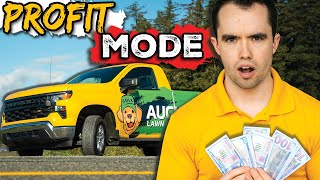
Mike Andes, founder of Augusta Lawn Care, walks through the P&L of one profitable location and how he raises prices, keeps crew small, and maximizes profit. He breaks down direct labor costs, profit sharing, and pricing strategy to grow without hiring more people.
Everyone, it's Mike Andes, founder of Augusta Lawn Care. And today I'm actually going over the profit and loss statement of one of my locations and showing all of our numbers. You're going to be able to see it on your screen and I'm going to share some of the takeaways from this profit and loss statement. This location is a good example location that is in profit mode, has been that way for a couple years. And I wanted to walk you through the profit and loss statement. So the first thing I want to look at is the cost of goods sold for the direct labor. Now, direct labor is a part of cost of goods sold. And if you add up the wages and the taxes, it's less than 50% or right around 50%, all direct labor. Now keep in mind, I put the general manager's wages inside of there, including all of their profit sharing. And the team's profit sharing is all W2 income to them. And the reason I put the wages of the general manager in the cogs, the direct cost is because they're actually in the field quite often. Now during the spring rush, they might only spend five or ten hours a week out in the field doing work, but the other eight, nine months of the year, they're in the field a lot of the time. And especially during the off season, they're basically working out in the field full time. And this is the really the differentiating factor between a location that's doing 7, 8, 900,000 annual revenue that is unprofitable versus one that's doing 7, 800, 900,000 in annual revenue and very profitable. The difference is how much management time is spent doing work and producing revenue versus driving around doing estimates, training, doing equipment maintenance and all the other things that are required to run a business but are straight overhead. They're an expense to the business. Instead of actually producing revenue outside of the spring rush, when this location is doing 80, 90,000amonth in revenue, this general manager is out in the field producing work. They're producing labor revenue, they're completing budgeted hours. If your direct labor is over 50%, a lot of times it's difficult to make a profit in your business. Now keep in mind, if you do have management estimators, office admin, that's not going to be considered direct costs. That's not going to be considered cost of goods sold, that's going to be considered overhead and lower on the profit and loss statement. Now, I heard a lot of people saying, like things like fuel should be in your cogs that's not the case. Now, whether or not someone does, I'm not going to freak out about it. But honestly, fuel is not a direct cost to like cogs. Cogs are cost of goods sold. And that includes my materials, includes my direct labor, and includes any subcontractors. Fuel is an input required to fuel my trucks, fuel, the equipment, et cetera. But it actually doesn't go into producing the work for the customer. So just a quick clarification that I saw some people make on social media. Now if we continue down, you notice they do spend a little bit on marketing. 2% of their sales are going towards marketing and advertising. We include inside of that things like wrapping the trucks, uniforms, anything with marketing advertising, we put in that same line item. You'll notice that this entire P and L fits on one page. And although there are certainly categories I'd like to break down a little further. I would rather have it fit on one page and take a little bit less granularity. If it's really, really complicated and broken down every little dollar and the categories that have $100 and $50 and $40 in postage and all these little things, it's hard for them to understand and really understand what's going on. So even at the top here, service income $449,000. I want to be able to share one page with my crew and for them to fully understand I'm willing to take a little bit of a hit on the granularity that I show them in order to be able to make it very simple and clear is exactly how I would share this with my team when it comes to open book management. Why? Because they get a percentage of this bottom line profit. All right, so keep in mind like when you look at the bottom line profit on this, this also includes the fact that profit sharing is given to the team on a quarterly basis and that the team on the field gets 10%. My general manager gets 35% and I also give some to my regional manager. So I'm getting about only about half of the profits to myself distributions. And the reason I'm fine with that is because I have not showed up to this location one time ever. I have never actually been to their shop space. This location was started in 2020. Moeing landscaping that are small like cleanups, property clamps, bush trimming, pulling out the weeds, installing mulch, very basic services. By doing this, it allows it much easier to find employees and train them up and get them to profitability within a matter of a couple days instead of weeks or Months. Also, this allows me to, as the owner, to not have to be in the operations of the business at all. The general manager runs the crew, the regional manager manages the manager. And make sure that if there's any problems making sure, the insurance, any strategy, marketing, anything like that is being handled by the regional manager. And that's. The Augusta business model is simple services, mostly recurring revenue. We're going to do 500,000 in annual revenue as quickly as possible and then go into profit mode. That is raising prices over the course of a few years to be able to generate about 800, $900,000 in annual revenue. But being very profitable with a small crew, no more than six to eight employees managed by one general manager without having a big office space, a bunch of admin people, estimators and other overhead mechanics, et cetera. I'm going to focus on this very lean model. $800,000 in annual revenue, $200,000 in profit, of which I'm happy to give some of that away to a regional manager or general manager. But I'm trying to get that 25% profit margin and then being able to copy and paste that model over and over and over again. Now, this wage line up here includes distributions that go to the team, that go to my general manager, that go to my regional manager. Also, I want you to keep in mind that this is the fifth year in business for this location. It's only been the past nine quarters, about two and a half years that it's been profitable and distributing cash to me as the owner, every single quarter. Now, before that, I got distributions, but usually in Q4 and Q1, they would be lower, or I have a negative quarter where I have to put some money back into the business, or I wouldn't be able to take any money out. But for the past nine quarters, that's over two years. Every single quarter, including the off season, I've been able to take a distribution as an owner out of the business. And that's really all I care about as an owner, I want to see, hey, I put 100 grand in this location, and every year I'm going to pull 100, $150,000 out in distributable cash. To me as the owner, that's a great investment. That's like 100% return every single year from that initial $100,000 that I put in. But the key part is that I grew to a certain size. 500,000 annual revenue. I didn't keep growing, get more trucks and hire more people, have 10, 1214 employees. I started raising prices and over the course of the last few years, as they raise prices every year, they hit capacity. Raise prices, hit capacity, you raise prices. We don't keep buying more trucks, hiring more people and expanding and staying on this treadmill of growth. We switch to profit mode and we keep it below eight employees that one person is able to effectively manage them. The vast majority of people are unwilling to get off this treadmill and they constantly grow and grow and grow. They grow themselves in the debt, they grow themselves on a low margin business that never raised prices. They haven't raised prices in years to their customers. The model that we have at Augusta is grow the business to a certain size to be able to sustain a general manager and then just every single time you hit capacity, you raise your prices. We are not going to keep buying more trucks, hiring more people and expanding for no reason. Turn this thing into a profit machine and constantly be able to invest back into our team, be able to have profit sharing distributions and make this a much more sustainable business. If you have questions about the profit and loss statement or how this location operates, comment below. If you'd like to see more of these and look forward to seeing you in future videos.






