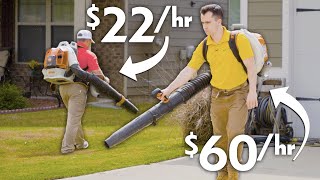
Mike Andes explains why home-service businesses shouldn't match competitor prices. A lawn-mowing job got bids from $37 to $365 per cut. Instead, price based on your costs and the value you deliver, then choose between fast growth at low prices or sustainable profit at higher ones.
Questions this video answers
$37 per cut.
$365 per cut.
Chapters
So the question really is, well, how do you come up with your pricing? There's a couple ways you can do it.
Hey, everyone, it's Mike Andes. And today I'm talking about why it's a horrible idea in your small business to try to compare prices with your competitors. Just last week I made a video where I had a lawn care job that we filmed. And I said if anyone can guess the price, they would win a $399 package on lawn caremedia.com now, the winner is going to be shown later this week. However, what I wanted to talk about today is the variety and the range of pricing that came on that video. The lowest price that was given was $37 per cut. The highest price was $365 per cut on this mowing service. Now, again, I'm not going to tell you what the number was. The actual number was today. That's going to come in a couple of days and the winner will be announced. Who guessed it correctly first? However, what I want to prove here is that regardless of what industry you're in, when it comes to home improvement services, most, most of us get started by trying to figure out our pricing based upon the competitor's pricing. And that's an okay place to get started, I'll admit. When I first got started when I was 11 years old, we had absolutely no idea how to even price lawn. And literally we just had a couple of our friends ask for quotes from a couple different local companies just to at least get in the ballpark of where they were at. However, even that a sample size of 2 or 3 is not enough to actually know what the market rate is. Because if I have a range of $37 and then $365, that's literally almost 10x as much price for the same job, the exact same thing. Like it was. I showed the square footage, I showed what equipment we were using, what the property looked like, everything. And somehow we got 10x difference. Now you say, well, that's really, really high. But there was plenty of people on 240, 250, $270, and then there was plenty of people on 35, 30, or sorry, 37, 38, 39. There's plenty of people in that range. So the question really is, well, how do you come up with your pricing? There's a couple ways you can do it. One is, is you do contact some local competitors or you work for another company and start to kind of know where the pricing is at in the industry that you're trying to work for or secondarily. Just get started and start clocking how long it takes you to work on a job site and determine the hourly rate that you need to charge the customer in order to make a Profit. Now, on p4pssoftware.com training, we talk about determining that hourly rate based upon what you pay your employees. Because. Because there should be a percentage of that revenue going towards labor costs and wages to your employees. But if you take that aside, the bottom line is this. You cannot determine your pricing based upon the pricing of any other competitor. You need to base your pricing on what it's going to take you to stay in business for the long term. And how much does it cost you to produce enough value for you to keep customers? Because if you want to, you know, I'm going to match the competition. I'm going to do $30 a cut. Great. But if you need to charge $50 a cut in order to have website, have painted trucks, trained employees that are well paid and are paid above, above the table, and insurance and a bond, if you need to do all those things in order to make any money, maybe at $50 per hour, guess what? Your customers are going to be looking for a new provider for their lawn care service every single spring. And there's absolutely going to be a portion of people that are willing to pay a premium price. Instead of paying 35, they're willing to pay 45 or 50 in order to not every single spring. Be looking for another landscaper, be looking for another janitor service, be looking for another handyman. These are absolutely home improvement industries that have become so price sensitive because you can always go lower. You can always lower your price. Always. And make the deal close. But what's much more difficult is realizing that adding value to the equation is also another way to improve your close ratio and get more jobs. But improving value is harder. It's very easy to change price. It's very easy to cut the price and get the sale. And that's very possible. But what's a lot harder is figuring out how is my presentation. Am I not a good salesperson? Do I not have good eye contact? Do I not have good verbal cues when I'm talking with the customer? Can I get the estimates back to the customer faster? Am I making sure that I have a professional image in terms of website and people answering the phone? All these things contribute to higher value. And you've got to make sure that if you're having high value, your price needs to be high enough to make sure that those things are paid for. A lot of people will listen to me and like I'm going to have a great website, I'm going to have great uniforms, I have great employees and I'm going to have great systems and I'm going to have marketing a great logo. I'm going to ensure my business do everything correctly legally and everything else. And then they charge so little that they go out of business and they're like oh, it was wrong. Like, you know, those things don't matter. I should have lowered my prices. No, what you should have done is realize that having a high enough price to stay in business and be profitable is the right thing to do. Even if it means slower growth of the business. You might have to grow your business to a million dollars over the course of five, six or seven years by growing and picking the best customers that are willing to pay that premium price. Instead of. There's absolutely where an owner can go in and build a million dollar business in one or two years because simply what they need to charge in order to produce their valuable product is low enough to compete with the competition and beat the competition. That's how you scale really quickly is when you have a high value product and a low price in comparison to the competition. But if you in a market where it's actually difficult to have a high price, you've got to realize it's going to take much longer to grow your business. But you should not necessarily be long term committed to this low price strateg. Now watch this video here though where you might actually want to take a low price strategy in order to have a high close ratio and then as you scale the business then raise the prices down the road once you've convinced the customer that you have a high value. Check that video out right here.