The Sales Tactic behind My $50M Home Service Franchise
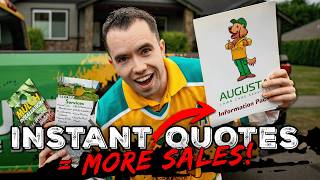
Mike Andes built a $50M home service franchise using door hangers with instant quotes and transparent online pricing. A mass-text campaign to past customers generated 50+ estimate requests in 24 hours. He breaks down the funnel metrics that matter: cost-per-click, cost-per-lead, and close ratio.
Chapters
An underrated way of getting more customers is using what we call instant quote door hangers. Essentially, I'm able to assess the property and able to give an actual price for the service. Now we have door hangers that simply just talk about our services and more generic. But I like to be able to give instant pricing when it comes to doing door hangers. That way, when the customer gets the door hanger, they are immediately making a buying decision. Instead of where I have to hit them five or six or seven times for them to actually even recognize my brand, I'm actually putting a buying decision in front of them. And so, for example, this one's for mulch. It's going to talk about how much mulch, the quantity, any notes, and I'm going to actually put a dollar amount with this instant quote. Now, the thing I like about instant quote door hangers is the fact it's all just a math game. It is simply a matter of how many door hangers can I put out per hour and how many leads do I get per hour. That's it. Thing is, you're not even getting leads. You're getting paying customers. Because how we set it up is they actually take a photo of this, they send it to us via email, and they're accepting their estimate. So if I'm doing a mult install instant quote door hanger and I put 799 put it on the door, they're they sent a picture back to me. This is an accepted proposal. And so all I need to know is first off, how many door hangers can I put out per hour? Now, I'm not going to knock on every single door, but if you did, you'd probably increase your clothes ratio. You'd also do less door hangers per hour. Let's assume I do 100 of these per hour. That would assume I'm in a pretty dense neighborhood. If you have to walk one or two minutes between every single house because you're in a more rural area, you're not going to be able to get a hundred out per hour. So I need to know how many of them can I put out per hour. And then if I put out a hundred or a thousand, what percentage of them are going to actually respond back with the accepted estimate. Estimate. Once I know that math, I can determine my customer acquisition cost and then be able to pump money into that system over and over again. Also, I really like door hangers because I can actually target individual neighborhoods and I can use these door hangers if I have a customer that I'm actually servicing their property. I'm going to do the five houses, the three across the street, and both neighbors. I'm going to hit them up with the door hanger. Now, as you're doing door hangers, there's really two ways to be like put these out. And that is one. I can actually put the real price as walking up to the property, assessing what needs to be done in terms of scope of work. This is going to take a lot more skill of the person that's putting out door hangers because they actually need to know about pricing. That's one way to do it. I really like being able to do a whole bunch of door hangers before I even leave to distribute them and just do small and large properties that way. All I'm distinguishing when I walk up to this property is this is my left hand, my small ones, and in my right hand these are my large ones. And is this a small or is this a large property? Is it going to be as accurate? No, but it's going to lead to way more of these being distributed per hour. And the person that's distributing them doesn't have to actually be an estimator. They just have to literally distinguish is this a small property or is this a large property? And a lot of times if you're doing neighborhoods, a lot of the properties look exactly the same, have the same square footage and are about the same size. So you can kind of round in terms of pricing with all these ideas for getting more customers. Seems appealing, but in the back of your mind you're saying that's fine for spring and summer, but. But I can't get any customers during the off season and during the winter. I'd love to invite you to Blue collar summit coming up in January 2025 in Seattle, Washington. It's a three day event. There's gonna be a ton of speakers on the Friday. I'm gonna take an entire day and solve this problem for you once and for all. We're gonna figure out how to ensure that you keep customers coming back to you throughout the off season. And you don't have an offseason because off seasons will keep you pour. Go to blue collarsummit.com, book your tickets today and we'll see you there. All right, so we talked about doing instant pricing in person when you're at the client's house, but now let's talk about doing instant pricing on your website. A lot of people will shy away from sharing any sort of pricing on their main website because what they think is that customers are then going to be turned away and without trying their services, they're going to be turned off by the high prices. Here's the thing, the people that do that, you don't want them as customers anyways. And you prevented yourself from going on doing an estimate, meeting the customer, only to be met with the fact that they think it's too expensive. And so if you have a great looking website, they're going to assume much more value and they're going to reason the fact that you are going to be a little higher in price. But that's what they're paying for. They're paying for a premium service and they expect premium prices. And if you don't want to attract those type of customers, don't have a website in the first place, don't have logo decal trucks, don't have uniforms. But if you're trying to have a premium price with premium customers, sharing your prices won't scare away premium customers. And so it reduces the tire kickers. And the people that are always price shopping, the people that are gonna complain a bunch about your prices, they're not gonna take upsells, just share the prices on your website and get them away from you as fast as possible so you don't waste time on them. The thing I love about instant pricing, especially if you actually allow them to accept an estimate from your website, is it reduces the amount of steps required in the sal. I don't have to go visit them at their property, I don't have to create the estimate and then send them the pricing and then wait for them to click accept. It is all done immediately and instantly from the website. If you're afraid of sharing your pricing on your website, keep in mind that with the transparency of information now online, people already kind of know the general pricing that they're supposed to be paying for your services. They've already googled, like how much should it cost to replace X, Y and Z or do maintenance on my property? They've already googled it. So just give them the pricing to be able to share that you're top of the market or you're in the middle of the market. And if you just wanna share a article kind of sharing your pricing philosophy, great. But most ideally give them the ability to see your prices and then check out or accept an estimate directly from your website. It saves your admin time and it saves you from going out and spending time on customers that are never gonna accept from you anyways. There are three really Important numbers you wanna know when it comes to sales in your organization, that is cost per click, cost per lead, and customer acquisition cost. I like to think of it as a funnel. At the top of the funnel, all of the clicks that come to our website from all of our marketing come in the top of the funnel. And usually it's pretty easy to be able to determine the cost per click. So on Google, if you're running Facebook ads, all sorts of online platforms, I can determine the cost per click to get someone to my website. There is a cost per click associated with that. And usually it's pretty easy to determine how many clicks you get from a paid ad. And Facebook and Google will tell you exactly how, how much you're spending to get a click to your website. But clicks don't pay the bills. They are not customers. I want to know how much do I have to spend to get a paying customer? Well, once I get clicks to my website, I'm then going to have some percentage of those people fill out an estimate request form or call me or send me an email, and those people will become leads. Now, what that is called is our conversion rate. And that conversion rate is mostly determined by is your website structured and designed in a way that gets as many people that have clicked to actually submit an estimate request form. And if you want to see good examples of websites in home services, go to homeservicewebdesign.com or lawn carewebdesign.com and you can see sites that are optimized for the best conversion rate. I want to make sure that people see my brand, that it's easy to call me, it's easy to submit an SM request form. It looks great on mobile devices, it loads really fast. These are the type of things that will increase your conversion rate. Now, I don't even care about my conversion rate because that's just gonna get me a lead, I'm gonna get cost. My cost per lead is now, how much do I have to spend on marketing to get enough clicks to get leads? In other words, people submitting estimate request forms, but those don't pay the bills. So some percentage of those people, I need to actually close them. So a lead is, hey, I want an estimate. I'm not gonna be able to close every single one. That's my close ratio. And that is the number of accepted estimates divided by the total number of estimates that were sent to customers. And this is the close ratio. Really the thing that you can fix, the thing that you can affect the most in your sales ability. So everything we've talked on this video, most of it will have to improve the close ratio. You showing up on time, you being quick to the estimate. All the things we've talked about are mostly going into improving this close ratio. Here's the deal. If we go ahead and spend $1 per click. So I have to pay Google or Facebook or someone $1 to get one click to my website. Great. Let's assume that one out of 20 is my conversion rate. Which means out of 20 people that click on my site, one person submits an estimate request form. That could then assume that my cost per lead is $20. But then if I have my close ratio, what percentage of those estimates actually became paying customers? Let's say my close ratio is 50%. 50% on a $20 cost per lead would assume then that my customer acquisition cost is $40. And knowing that number is very, very important because it tells me how much I need to spend to get one paying customer. And if I know how much I have to spend to get one paying customer and then I know how much that customer is going to spend with me over the course of the year, two years, or their entire lifetime, in other words, their lifetime value or ltv, I'm able to make educated decisions in my business as to when I should invest into marketing. Alright, so we talked about the funnel starting with clicks and moving all the way down into an actual paid customer. But now I want to talk about keeping customers warm. Because once we get them through this funnel, acquire the customer. Now we've actually going to think of it like having a bucket here with all your existing customers inside of it. So assuming someone gets through the filter, they go through conversion ratio, then they get close, they come at the bottom here and they fall into the bucket of your business. Now the problem is there's going to be some sort of churn. There's going to be some number of customers that that fall through the bottom of this bucket through these leaky holes. If you can plug these leaky holes and actually get customers to stay by having great customer service and all the things we've talked about in running a great business, less people will fall out the bottom. However, there is going to be people that turn or leave your business, they're unhappy, you don't do a good job, et cetera. The goal of keeping customers warm is to be able to get them to come right back to the top of this funnel re engage them. Even if there's customers that did a one time project and they're Only in your bucket, inside your business for a week or two, they're going to fall at the bottom, but they're still inside of your contact database, inside of your CRM, and inside a software like Copilot CRM, you can mass email or mass text message them and immediately try to reactivate them. And what's crazy is the customer acquisition cost here is exactly zero because I don't have to pay for the click. So if I don't have to pay for the click to come in the back and the top of this funnel, it cost me exactly $0 to acquire the customer. And assuming they accept the estimate. So the question is, how do you keep customers warm? First off, don't let customers go 612 months before they ever hear from you again. Even if they've done a one time project or if they've left your business and they've churned out. I want to try to reactivate them. How am I going to do that? I'm going to try to sell them other services that my company offers based upon the time of year. For example, in the middle of spring, I'm going to be pitching mowing and lawn care, spring cleanups during the fall, leaf cleanups and preparing for the winter, etc. So these messages that I am sending to the customer via text or email, I'm trying to reactivate the customer. Inside Copilot we have what we call email links, which allows you to set it up where you can pitch a service and say click here to get an estimate and they click there. It takes them to a thank you page on your website, any URL, and then you can have that email or text message going to you saying, hey, this customer is looking for this specific service. Get them a quote. This allows you to reactivate the customer over and over and over again. And this is going to massively improve the lifetime value of a customer, especially your one time projects. Because they usually only stay in the bucket of your business for a couple weeks or while you're doing the project. You've got to reactivate them and get them back to the top. This is what allows a more established brand and more established business to be super profitable because they just simply get all their new jobs from reactivation of contacts inside their database. They don't have to keep paying the Google and Facebook gods for more and more clicks. They don't have to keep doing door hangers and all these other things because they just keep reactivating clients they've served in the past. So inside of Copilot have A mass email strategy and have a mass tech strategy where you're constantly keeping those leads warm so they constantly are hearing from you. And I've had it before where I've sent someone an email every single month for a year or two, and all of a sudden they're. They click on a button and they ask for a $20,000 project. Boom. I paid nothing for it. Besides simply staying in touch with them and keeping those leads warm. They've already put their hand up, said, I need service. They've already paid an invoice, and they've already done business with you. They already know like and trust you. Reactivate them back to being a paying customer. For the sake of an example, I'm actually going to show you a video from a couple weeks ago from one of my general managers that set out a text blast inside of Copilot CRM and got over 50 the estimates within a matter of one day.
All right. Hello everybody, this is Corey at Augusta Bellingham. I wanted to let you know in. In on something that happened today that I think might be valuable to everybody. Let's do a mass one click text to all of our clients. They kind of just build some lead flow that way. And I sent it out to everybody. And within the first 24 hours, we got over 50 estimate requests. With the help of command center, I was able to basically I could have out 31 estimates today. And, you know, with a couple of different things that had come in for me, I had a field crew lead that came in. I sent out a total of 29 for today. But I just want to let you go guys know that like, I'm like just now done with that. I'm super pumped. And this marketing message has been so successful that it's basically like doubling down. I will, I will tell you one thing, is that everybody I didn't get to today, I sent a personal. I. I sent a personal text. I just mass texted, hey, it's Cory again. I just want to let you let you know, like, I wasn't able to get your estimate done today, but I'm going to be at your property first thing Monday morning. And what I said is like, I'm going to have something productive submitted and ready for you by the end of Monday afternoon. Have a great weekend. And within like three minutes, I got 10 responses. Out of like 18 texts, I got 10 responses that was like, oh my gosh, thank you so much for letting me know. Have a great weekend, Cory. It's like, okay, so there might be something in that so, anyway, I wanted to share that with you guys. I hope you all have a great weekend. I'm cooked. I'm so tired.
This.






