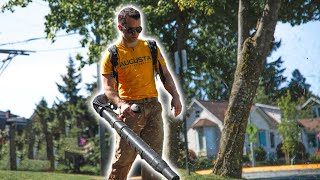
Mike Andes shares how his landscaping company gives frontline crews 10% of quarterly profits, but only if they hit perfect attendance. One unexcused absence cuts their share in half; two wipes it out entirely.
Questions this video answers
10% of profits
Must be present for the entire three-month quarter and show up on time every day (one minute late counts as late).
The profit-sharing payout is halved (example: $700 → $350).
The employee loses the profit-sharing payout entirely for that quarter.
Mike Andes (landscapebusinesscourse.com).
Chapters
Hey, everyone, It's Mike Andes, landscapebusinesscourse.com and today I'm going to talk to you about profit sharing. Now, we have profit sharing programs for our general managers and for estimators and people like that. But today I'm going to talk specifically about the profit sharing program that we use for our fuel crew guys out in the field mowing lawns, doing landscaping every single day. In my opinion, the most important people in your business because they're actually the ones making you money. Selling jobs, answering the phones does not make you money, costs money. It's an overhead. People actually out in the field working hard are the ones who actually earn the revenue for our businesses. So when it comes to profit sharing, I feel like they need to be part of it. They need to have skin in the game and really care about the efficiencies of the business because they know it has a direct correlation with the profits. So what we do is on a quarterly basis, we give 10% of profits to the frontline employees. Now what we do to make sure they earn it and it's not just like, you know, expected and like, you know, everyone just takes it for granted is the fact that they do earn it. They have to show up every single day on time and no calling out last minute, you know, unexpected or unexcused absences in order to get that profit sharing. So how we do it is, let's say, for example, there's, you know, $700 worth of quarterly profit sharing for each employee. They, they need to be there for the entire three months. They can't show up two weeks before the end of the quarter and get profit sharing. It's not fair. They need to be there for the entire quarter. They need to show up every single day on time. If they're one minute late, they're considered late. If they're, if they, if they cancel 20 minutes before they're supposed to be at work and they say, oh, I'm sick, I'm not showing up today. That's an unexcused absence. So what we do is if they do that one time and a quarter, that would half their profit sharing. They go from 700 to 350. If they do it a second time, it wipes out completely their profit sharing and there's no more profit sharing for them. What this incentivizes is people, number one, sticking around and staying for the full solid three months. It also incentivizes the fact that, and compensates for the fact that when someone's training and they're new the first month, they're not as efficient, they're not as profitable and they're potentially actually taking time away from the people training them. And on P4P that affects the trainer, they can't make as much money. So it really calibrates that and it makes sure that everyone is accountable to each other by showing up on time. Because again, on P4P, unpaid for performance, if there's two guys working together and someone shows up at 7 o' clock to load up all the materials and get everything going, someone else shows up late at 7:40 and just jumps in the truck and goes out and mows. On P4P, they're going to make the same amount of money because it's a percentage of the revenue. But it's not fair the fact that someone was late and they're going to make the same amount. So profit sharing though, take that into account and literally being one minute late could cost you hundreds of dollars on your quarterly. Profit sharing is what we've used to be able to keep them incentivized, to stay efficient, stay profitable and stay engaged and caring about open book management where we share the numbers and they actually care because they get a piece of the profits. Until you do that, until you give them a piece of the profits, don't expect them to care about your numbers or how much you charge or your hourly rate or how profitable or unprofitable you are. You've got to give them a piece of the pie skin in the game. I'm Mike Andes, landscapebusinesscoursourse. Com. We'll see you next time.