This Client Complained: I Didn't Apologize!
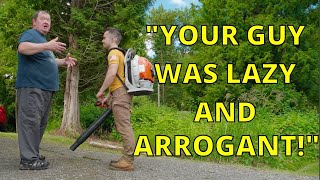
Mike Andes handles a customer complaint about missed mowing and crew appearance. He walks the property, clarifies what the customer wants, updates the job notes, and explains his pricing and damage policies without blaming his staff.
Questions this video answers
June 11, 2021
30 minutes
$40
About every three years
Chapters
Hey, everyone, it's Mike Andes here. Landscapebusinesscourse.com Today we're going to mow this lawn. It's a lot of trees mostly not a very big lot. Not a lot of lawn. But we're going to make some money and hopefully you can learn something about mowing lawns and making money in your business. And yes, there's an unhappy customer we're going to have to deal with today.
You made it back just in time.
Yeah.
Last week.
Yep.
The person who did mowing.
Was here maybe 15 minutes and he didn't do. I was very disappointed.
What parts were missed?
Several.
Okay.
You know, he's supposed to do this side and this side. And he only did one row, one push of the mower up.
And.
Trimming. He didn't do any trimming hardly at all until I mentioned. Hey, well, you know, you're supposed to get around this tree in the back.
Okay. Because I have a note here.
It says, does not include edging. So I just want to make sure we're clear. I'm assuming there's no edging in general.
Really.
There's really no edging.
Right.
What do you consider edging? I mean.
Right. I think that's probably the confusion part.
Is because it says, no, it does not include edging. But what he probably was doing the line, not thinking the line trimming needed done. So I'll make sure that they take that note off. That way it's not confusing because usually edging is like against concrete, which you don't have any. So that's why they would that. But that might be his confusion. So I'll make sure that they take that note off.
Tall, skinny kid with kind of dirty blonde hair.
Yeah.
And pulls a white trailer behind his truck. He doesn't do a very good job either.
So.
But everybody else. I really like everybody else.
Yeah. I think that's probably the confusion.
So what I'll do is I'll not. I'll do it today.
I'll touch base the after.
But I'm going to tell them to take that note off there because that's.
Probably why he's confused.
He thinks there's no trimming in general, which obviously is not the case. So I'll make sure they take that note off there.
They always take their trimmer and everything.
Weed whacker and go through and.
Yeah.
You know, I call it a weed whacker.
Yep.
Yep. No, I'll.
I'll knock it out today and then I'll touch. Basically make sure you're happy for it today. That way I can make sure they're clear.
Well, that would be great. I just. Like I said, everybody else except those two.
And yeah, it's probably that note, but I can make it clear. Better notes, and that way each time.
They come, it'll be more consistent.
Just something else said that I really don't. He was dirty. I mean, the guy was filthy. He needed to wash his face. He needed to do something with his beard and his shirt and his pants were just. He was filthy.
Yeah.
I don't see any filthy on you guys.
These are the video guys.
This guy looks familiar. He's been here before. He was learning how to push more.
And he was going.
Now he's been relegated to the camera now. No, no, I'll get done today. I'll touch base with you, and then.
We'Ll update the notes. So that way each time it's already in there. Yeah, sounds good. All right, I'll see you in a few minutes.
You catch any of that?
Of course I do. Yes. Let's go.
Whose one?
Mine.
Oh, were you here last time?
No, no, no, no. Oh, okay. I think that was whoever has a beard on the house.
Okay, Okay. I get the feeling he was talking about Caleb. No, that he was talking. I know he was talking. He's talking about Austin. But his two descriptions both fit Austin. The first one and the second one. Because it's like, I don't get that mentality with, like, customers of, like, a lawn care business. It's like it's dirty work.
I know.
It's like. Well, I was about to.
Yeah, he was working hard.
Okay.
All right, so this property we are.
Mowing, we includes the strip along the street.
It includes the front and backyard.
Does not include edging, which we might have to change that note now. Blow off hard surfaces and hallway clippings.
That's the whole job.
Let's go and get started. See how long we got.
We got 30 minutes on this job.
So $40 is the cut price.
And after this one, I'm going to talk to the client.
Update the notes because there's specific things he mentioned. Like, he. He likes to cut really short, and he wants the edging. So we got to update these notes a little bit and make sure he's happy before we.
All right, so let's go ahead and add some color commentary and go over some things in your business that we can learn from that little exchange with the customer and other business topics. So first things first. Customer issues. When they come up and a customer is talking to you directly and complaining about something going on the business, a certain service team member, etc. I'm always really trying to be solution oriented and not just wallow in all of their negativity. For someone like that that just kept bringing up the same thing over and over and over again. I'm not going to keep, like, apologizing, for example, I'm going to be like, okay, well, what can we do? And that's why I kept going back to the fact I'm going to change the notes. I'm going to do a walkthrough with you when I'm done with this service and not just sitting there like, oh, this is wrong, and this is wrong. I don't like this and I don't like that. I'm not going to like, sorry. Oh, yeah, I apologize. I'm really sorry about that. Yeah, I'm really sorry. Like, okay, well, what are we going to do to change it? I'm going to change the notes so people aren't confused. I'm gonna make sure that we put the height of the grass that you want. I'm gonna put it on the notes.
Going forward.
I'm not gonna have the no edging. It can be kind of confusing. Even though potentially is correct. I'm gonna make it more clear. Next thing is, when it comes to culture and team, I really, truly believe, especially if you're answering the phones or you're in the office or you're out in the field like I am this day, and taking and meeting customers and they're complaining, never ever, there's no reason whatsoever to throw your team under the bus. Even if whoever was here before, which, by the way, it wasn't Austin before. But if regardless, regardless of who it is, or even if you're wrong, they are wrong. Do not throw your team under the bus. Especially in this situation where I didn't have all of the information. If a customer calls you and is complaining, don't just immediately default to assuming that your team is wrong and that you messed up and the customer's not always right. And to do that, in my opinion, throws your team under the bus. You're basically telling your team that you don't trust them and that whatever the customer says, you're just gonna bow down to. I think that there's absolutely a balance, but do not, in my opinion, throw your team under the bus. It would've been wrong for me in that moment to pull up the job history, see who was there last, mention the person's name to the client. That would have all been very wrong for me to do. It's going to prove to your team that you do not stand up for them.
And.
And your first trigger is that they were wrong and that they did a bad job. That's always my last trigger. My first trigger is the job. Notes are incorrect. Potentially, this customer is unreasonable. Those are the things you want to go to first, then default to. Potentially your team was lazy or whatever it might be down the road. But don't jump to that conclusion first and throw them under the bus. It looks bad to the client and it looks horrible towards your team. Assume that they're trying. And like, you should notice, I did not apologize one time that whole exchange. I was sorry that he wasn't happy, but I was not sorry about the fact that the guy was dirty at the long of an end, a long day, and the fact that I can solve this issue very quickly by changing the notes in your property. If you tell us what you want. Again, if you're gonna fire, if someone's really bad, like in your business and they're doing bad work and you're getting in place all the time, go ahead and fire them. Just keep it in the backyard. You don't need to tell the customer, oh, yeah, like, that person's not very good. And I'll talk to them. I'll talk to them. Like, just keep that stuff in the backyard. It's kind of my opinion. You'll notice here as I'm trimming, you might notice on the head of the trimmer, there is two labels, two stickers that we put on there. We use this sticker that is laminated. You get these laminators and these label makers off of Amazon, like 20, 30 bucks. And then you buy cartridges of the rolls of the stickers. But what we do is we put the sticker on there. It's laminated, so that way it can actually withstand the rain. And we put two different things on there. One, we put the date that we purchased the trimmer, because usually every three years you need to replace your trimmers. They just start to become maybe four if you're not using them much. But usually every three years, we have to replace them just because you use them so much. And over time, it takes longer to change the spark plugs, pull them 100 times in a cold morning, and we'd rather just buy new ones.
So when you talk to a customer like that, I don't actually consider that a complaint. He didn't actually complain about anything to do with the actual Lawn service. He complained about how long they were here and what they looked like. So in my mind, like that's not a yellow slip. That's not anything a complaint. Like if the guys work a whole day and they show up here to their last property, what do you expect them to be looking shiny and clean in a tuxedo? So it's just not going to happen. And then some people like this will just complain because they think they're. The service goes too fast. Like 15 minutes. It's about right. They probably got this done in 15 minutes. I just did the property for the first time ever. It's a 15 minute lawn. There's no edging to be done and you don't want to do edging because those cars are way too close to trying to do any sort of edging. So I understand the notes. We'll clarify them a little bit though. And now I'm going to mow it and make sure it's nice and short because that's what they like. Always a good idea to check your gas before you actually start the job. There's nothing like having to stop the job halfway through and walk what, maybe 40, 50 yards to come back and fuel it up. Always check your fuel while you're next to the truck. Same thing with like weed whacker line. Like don't wait till you run out. Check it now when you're close to the supplies.
The other thing that we have just to wrap up my final thought on the trimmer on the sticker, we also put the sticker on there on what truck that trimmer is assigned to. So the date which we purchased it and the truck that trimmer is assigned to. So each trimmer, it has a specific truck that stays on all the time. And so we know exactly where everything should be at. Alright, let's move on to damage cases. Some people asked in the texting group about damage cases. If you're not part of the texting group, by the way, you definitely want to join that because that's where you can get direct access to me with Q and A. And so in the description below, text the word landscaping to that phone number and you can send me direct questions when I ask for them. So there was a question about damage cases. And the specific landscaper that was texting me said that in the past week he's got a warped mower deck from an employee that hit something. They broke a fence and they broke a piece of, of a siding off of a house. And all these things obviously have to replace and he's wondering, should I reduce their pay by like a dollar per hour for the next few months? Should I take that out of their paycheck? What should I be doing? So I do feel like there needs to be a level of accountability. You cannot, in most states legally take money out of someone's paycheck if they are getting an hourly wage. So if you say, hey, we're going to pay you $12 per hour to mow lawns and then they make a mistake, you cannot touch that $12 per hour. You can't touch anything above 40 hours. If it's overtime, you're going to now be paying them, what, $18 per hour. You cannot touch that money almost in every single state. It's illegal to do that. But with P4P pay for performance, if their base pay is say $12 per hour, but then they're getting a percentage of labor revenue and they end up earning say, $20 per hour on their mower because they're really efficient, that extra bonus that potentially you can tap into if you've made it very clear that the $12 per hour is their hourly rate or their base pay, and then anything above that performance, dollars wise, is on the table for damage cases. So another reason why P4P pay for performance is so important, again, that's where the employee gets a percentage of the labor revenue. Because now the performance dollars are on the table. If they are making damages, and we are, we try to be as nice as possible with this. I don't want to take money out like they worked hard. But if it's someone that's habitually making mistakes, that's when our office managers, that's when our general managers are going to take money out of people's paycheck because it needs to be the counterbalance to the fact that we're paying them based upon speed. And that is if you break stuff because you're growing so fast that there's going to be money coming out of your paycheck because of that.
Another question from the texting group was about monthly prices versus price per cut. So one school of thought says, hey, we should charge a monthly price for all the mowing and weeding services or whatever services I offer to the client, and they're just going to pay that same monthly fee year round. So here's my opinion on this. I really love that model, that consistent cash flow every single month, because it's so much better to budget. It's so much easier to manage your cash flow during the slower months. If you have a lull in the summer or in the winter. It's much better for cash flow. The reason I would say you should not do it is because it adds frictions to the sales process. So if you're at the point of business where you're not really trying to grow very much, maybe that's the time when you start to implement 12 month scheduled billing throughout the whole year. But if you're trying to ramp up quickly, price per cut makes the most sense to customers. You can sell it very quickly, and that's the fastest way to grow. However, most of this has to do with which climate you live in. And if 12 months a year is even feasible. Is this fine, though, up front?
I'll blow this off, obviously, but is this okay?
Yeah.
That's something else you didn't do last time. Yeah.
Okay.
You know, I've been pretty happy with just about everything. Those two guys. Yeah.
Okay.
That tall skinny one that pulls the white trailer behind him.
Okay.
Yep. I'll send you this whole thing. Yeah. And there's only two breaks. Okay.
I'm sorry, but.
Yeah, copy.
I'm in my 60s and I've. I did this when I was 18.
Yeah.
I had a guy come in with an excavator.
Danny's in here somewhere.
Nice and level and smooth. And I put 30 yards of topsoil in there.
Oh, my goodness.
And now there's holes.
Oh. In Texas, it's Wednesday.
The cottonwoods are starting to ride out. The mushrooms are coming up in the spring, and they're not even good mushrooms.
They're not the type that you can cook with or the type that you could eat and get.
Hi. All right, well, I'll get things blowed off. I'll update. I sent you my. All my notes too, but the.
The first.
Are you a boss type guy?
Oh, no. We're just out here trying to make some videos for ads. Advertising and stuff today.
So get a discount.
I know, right?
Could be the model.
And if I would have told him that I was the boss, I would have chewed him out for saying our guys were lazy. Takes everything in my power not to, like, really go after someone when they say that. Oh, yeah. All right, so on that job, we had 30 minutes budgeted. We got done 27. So even with the extra walk through, talking to the customer, all the rest of it, we still got done before budgeted hours, so that's good. How do you feel about Dell? Well, Del and I are friends now.
But.
I don't really appreciate when people say that guys are lazy. They're working out in the field, especially because I know our guys aren't P4P and they're working their butts off all day.
So if you saw a guy, which I'm gonna go back and see who.
Was here and what time they were here, but I can almost guarantee at the end of a day, so they're. They're dirty. We just went through a bunch of rain, so they were probably a bunch. There's a bunch of mud. But to say that people are arrogant and they don't like to work, that was like, the brink of me about to me like, oh, actually, I'm the boss and I'm going to let you go as a class.
But we persevered.
I don't want to tell them I am the owner, because if I do, next time the guys come, he'll just use my name and say, oh, the last time the boss was here and said X, Y, and Z. And I don't want that happening. So, Del, I love you now.
Hey, it's Mike here, and I just want to say a big thank you for watching the video. Trust me. Click the other video over here. It's really, really awesome and it really helps the YouTube algorithm.
So click it.
Just. Just go ahead now.






