this near death experience EXPLODED my business!
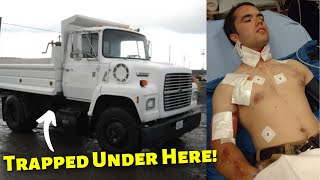
Mike Andes nearly died when his hoodie caught in a truck's power takeoff in 2016. The accident forced him to build systems instead of doing everything himself, which let him scale Augusta Lawn Care from one location to over 80 across North America while working far fewer hours.
Questions this video answers
August 4, 2016.
An old 1990s F700 manual dump truck (manual PTO).
About 10–12 yards of material.
Around 2–3 yards of cobble rock.
Over 80 locations around North America.
Chapters
So it was August 4, 2016. At the time, I had a relatively small lawn care landscaping business with about four or five employees, Several trucks. In the morning, I would always go and show the jobs to the crews and show them exactly what to be doing, because I had done the estimates. So on a specific day, I was going to take the dump truck. At the time, we had large dump trucks. It would hold 10, 12 yards of material in the back. And it was an old dump truck. It was like a 1990s F700, really old. And it was a manual. And the PTO is also manual. So you'd pull up the lever, and basically, if you don't know what PTO is, PTO is power takeoff. It's what gives the dump truck all that ability and strength to actually dump material out. So I was delivering, like, only like, two or three yards of cobble rock, and I was dumping it on the driveway of a customer. My plan was to dump it there, show the crew the job, and then drive the dump truck back to the shop, where I would continue the rest of the day driving around, doing estimates in another pickup truck. So they got started like usual. I had three of my crew with me. Nathan, Josh, as well as Max show up to the job. I dump. I'm going to dump everything out of the truck. And the power takeoff lever inside of the cab hadn't been working for, like, a week or two. And so what we had to do is actually go underneath the dump truck and manually turn the lever, which the lever would usually just be engaged by literally a cable that went up to the. To the cab where I would pull the lever. So it literally is a matter of that cable being broken. But for the past week or so, I just hadn't had time to fix it or take it into the shop. So I went underneath the dump truck and would just push the lever forward and dump. And we'd been doing this for, like, a week or two because we just didn't have time. We were really busy. And so I got underneath the dump truck again early morning, getting the crew ready for the job. I had walked the job with the crew, showing them exactly what they needed to do. I went underneath the dump truck to dump out this material, and I turned it on. And as I was coming back underneath, coming back out from the truck, the pto, the power takeoff, the thing that spins really fast underneath the truck, caught my hoodie. And so in that moment, it was like a split second, but it seemed like probably, I'd say five seconds, but I know, it was like a split second. It took my hoodie immediately, and all of my hoodie and my shirt underneath, my T shirt underneath, bunched up around my neck, and it was basically trying to strangle me. And I remember it pulling my head up, and I was now looking out underneath the dump truck as it was trying to basically snap my neck. And a lot of times what happens in that case is someone's arm or leg appendage or their head, in this case, gets stuck into a pto. If it sucks you in, it can just take you for a ride. Because the amount of power you're not stopping the PTO on this thing, this thing could dump easily £15,000. And it's not going to, you know, me. £140, £150 is not gonna do anything to it. So it caught my hoodie wrapped up, bunched up everything to my neck, around my neck. And then again in a split second, I was looking out underneath the dump truck, and I just remember thinking, like, this is how it's gonna end. Like, I'm gonna die here. Because there just immediately, as soon as it happened, I knew it happened. And I immediately, like, there's just no shot in the world I'm gonna get out of this. I just remember looking up it pulling me, and I was trying to force my head down, and the. My shoulder was hitting up against the gearbox and on its sharp corner. Sorry. It was on this side. My apologies. It was on this side, and it was shooting down into my bicep. And you can actually still see some of the scars on the bicep, even several years later. And that was where the gearbox was digging in, but holding me from going, like, literally starting to flip around this pto. And in a split second, all of a sudden, all of my hoodie and my shirt just ripped open and I fell out of the dump truck. And my shirt and my hoodie were just now flailing inside the pto. And I was just. I dropped out. I was bleeding. I had a big cut around here. This was all just blood. And, like, just because my skin had been compressed so much, it was like this oozy, orangey, like, almost like grease that was all over. And I couldn't move. Like, I just fell out because it probably cinched a lot of my nerves and around my neck, and so I couldn't move it. I just fell out. And so it was just obviously just rushed. You know, you're being rushed with adrenaline. And so I was like, hey, get me out of here. Like, I do not want to be the customer's property with an ambulance coming, like, get me out of here. Fortunately, the shop was only like three, four minute drive away. So Josh jumped in my pickup truck and drove me back to the shop. And it was just crazy. The fact that day kept going. The crew finished that job and then I would go on to. They would take me to the clinic. The clinic was like, we can't help you. This is beyond us. They call the ambulance, ambulance rushes me to the hospital, and they put me in like a body, like a cast, body cast. Because I thought perhaps I broke my neck. And I kind of was like in and out. But I still remember driving to the hospital and everything. My dad, they called my dad and he followed me in to the hospital. And then literally later that day, I'm still in the hospital and I'm video calling the guys from my hospital bed to show them the next job that they're supposed to be doing. Cause they did it like, they did it in like four or five hours. And the next one, that afternoon, they still needed me to do the walkthrough. So I did a video call with them from the hospital bed. And so why are you talking about this? The reason I'm talking about this is because that day changed my life forever when it came to business. It also changed my personal life, my spiritual life, et cetera. But it also really affected the way I looked at business. Because what I realized that day is that if I would have died and if I would have been wiped off the map, there's a really good chance my business would have collapsed. It definitely would not have grown into what it is today with over 80 locations around North America. And I was very fortunate at the time to have some really great employees and really great team members at the time. All of them, Josh, Nathan, Max, to go complete the job and then go do the next job. And they were fantastic. They helped. The next couple weeks I was recovering and couldn't work outside and was having bandages and doctors visits and things. They kept the fort down along with the other employees. And then Liz, at the time, she'd just been hired in the office and she held everything together. But at the end of the day, I realized that I had to create systems for my business. I had to create something that even if I got hit by a bus and or a gut ran over by a dump truck, or went underneath the dump truck and got sucked up into it and broke my leg, like, I had to know that the business would keep going on. And That I would not let my customers or my employees down by building a business that revolves so much around me that if I was to be removed, it would fall apart and collapse. And so when I started to look at my business, I said, look, it's not fair to my employees that everything be hinged on me, not fear my customers, that if something happens to me, literally they'd have to go find another vendor. And so it's in the best interest of your customers and your employees and your personal finances and your future to make sure you build a business based on systems. And in that moment in the hospital room, going through an MRI and a bunch of X rays on my arms and all the rest, and even as I do this right now, I can feel the pain of all this scar tissue that went really deep here. All of that forced me to realize I had to build systems in my business. That is the exact moment I decided to start landscapebusinesscourse.com and teach other landscapers the journey over the next several months that I changed the business and built it around systems and simplified the estimate process, built it to the point where I did not have to show the jobs to the employees, they could do the jobs without me, based upon a video that I did not need to answer the phones or be involved in the sales process or any hiring. Building systems is what allowed me to scale the business. It is what allowed me to work going from 50, 60, 70 hours a week of working in the business every single day, doing all the estimates, simplification all those systems, allowing me to work an hour in the business and it still run much more profitably than it had prior. And so if you're right now building a business and you are doing everything and you're juggling, you're the master juggler. And without you, if you cannot confidently say that without you the business would fall apart, You've got to step back. Don't make yourself and your business and your employees go through what I had to go through. That it takes a near death experience for you to realize that your business is built on your personality and how good you are at selling and how good you are at managing people and how good your sniffer is when it comes to finding good employees instead of systems, procedures and simp simplified processes that are duplicatable and can be followed over and over and over and over again. Don't take that near death experience for you to realize that. And because of that and what I document in landscapebusinesscourse.com to make the business better. Because of that, it's now become a business that's multiple millions in revenue and has over 80 locations around North America. It works simplification systems, procedures and not making everything in the business hinge on you.
And at the end of the day, your employees will be better for it because their jobs are not in jeopardy based upon your health, your mental state, how you're feeling. Instead, they can come to work confidently knowing the business runs on systems. Your customers know that if you got hit by a bus, they'd still be taken care of.
I highly recommend don't take, don't make it take a near death experience for you to realize that systems and procedures will lead to a better personal life for you, a better financial life for you, and a better secure future for you, your employees and your customers. I'm Mike Andes, the founder of Augusta Lawn Care. We have over 80 locations around North America. And whether you want to check out landscapebusinesscourse.com or mikeandys.com lots of resources on there for you as a small business owner to grow your business using systems instead of your personality. Because one day you might not be as fortunate as I was to be able to walk away from that dump truck. And without that, without that second chance, your business might just fall apart, letting down your customers, your employees and your family.






