This ONE Strategy Made My Lawn Care Business $10M in 90 Days!
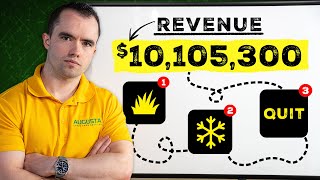
Mike Andes of Augusta Lawn Care added $10 million in annual revenue in 90 days by fixing Q4 collapse. His five strategies: shut down unprofitable work, sell existing services harder, add snow plowing and winter services, and launch a separate brand. One franchisee grew Q4 revenue from $93k to $373k in two years.
Questions this video answers
March 7, 2025
170 locations (current); earlier in growth he referenced 130–140 when seeking advice
$10 million in annual revenue
Q4 revenue increased by 36% across Augusta Lawn Care
74 owners (augustalights.com built for 74 owners)
Chapters
This video will show you the secret. I used to add $10 million to my lawn care business in just 90 days. My name is Mike Andes. I'm the founder of Augusta Lawn care. We over 170 locations around the world. And last year we added $10 million in annual revenue. By using this secret, I'm going to show you the five different ways to implement this exact same thing in your business to get the same results. Last February, I went out to Las Vegas to acquisition.com's headquarters, and I was with Alex Hormozi. And really I was int to him from my friend and coach, Dr. Trevor Cashy. Dr. Cashy allowed me to be able to have the opportunity to ask Alex a couple of questions about my business. And so Augusta Lawn Care, we've had growth over the past several years, and ultimately I believe we need a thousand locations in order to be able to have the impact I want on the industry. Currently we're 170. At that time, we're at 130, 140. And so I asked, what do we need to do to get to the next level? What do we need to do to really scale this? He really zeroed in on the unit economics of the franchise, trying to get it to where every single owner is able to make 800, $100,000 in annual revenue and a $200,000 net profit. And he said, hey, if you can make it where the average franchisee makes $200,000 in annual profits, you'll sell a thousand of these, no problem, super fast. And so I started to boil down and start to research as to what are the actual physics that are keeping businesses, whether it be inside of Augusta or inside of any home service business, away from making $200,000 in annual profits. It led to a lot of different things. First off, I saw that people didn't have a finish line. They just kept growing their business and buying and hiring more people as if that was the end goal of the company, is to just get more trucks and hire more people. In reality, if your goal is to make $200,000 in profit, your goal should be to increase profits and to increase profits, we should probably have a point where we stop growing the business, instead raise our prices, because a business that does, say, $800,000 in annual revenue, if you raise your prices by 20%, you would immediately have $160,000 in profits. And so I think the vast majority of home service businesses never stop growing their business and just keep growing as if hiring more people and getting more is the goal and so first off, we had to establish how big of a business can we build that is scalable and is able to. You can actually produce this and have a finish line. And for me, that was $800,000 in annual revenue. That's a point where most home service businesses, you know, six to eight employees max, have one general manager or the owner operator. And there's been plenty of studies that say that one general manager can effectively manage six to eight people. This is why the military uses these number of people in their teams. And it's the easiest way to be able to copy and paste the model for Augusta. But any home service business in terms managing that number of employees makes it feasible. So six to eight employees, $800,000 in annual revenue, $200,000 in profits. I look at every business as sales, operations and admin. Sales side is getting the work. Operations part is doing the work. So dispatching actual training, getting the crew members to go out and do the jobs, and then there's admin. And as greasing the gears required for the job to get done, that's going to be answering the phone, emails, payroll, everything associated with admin. And so as I begin to look at Augusta and say, okay, what can we do to try to get point where we are making 800,000 in revenue, 200,000 in profit, six to eight employees. We automate a lot of the sales functions using technology, AI and then operations. Our general manager focuses on the team and the admin side. We can handle our command center for our owners at Augusta Nation. That was the model. But really I started to tear back like, why is this not happening? In theory is good, but why is this not happening? And I looked through every location that we had in terms of their profit and loss statements and all of their reports. I also looked at over 150 other businesses outside of Augusta, Lawn care, and that included tree companies, janitorial companies, and several other home service businesses. And between almost all of these businesses, I was able to identify the common issue with every single one. And that is that we have a Q4 collapse where one quarter in the year we have negative profits or our revenue drops by more than 50%. And if you have that problem in your business, it's going to keep you poor. And this is what makes home services a bad business. And here's what's crazy. When I analyze all of those financial statements of hundreds of small businesses in home services and I removed just one quarter, just one quarter of their profit and loss statement, their average profitability went up by almost 80%. 80% by just removing one quarter from their annual statements. And if you removed it, we actually had really good businesses. If you were able to increase your profits by 80%, you'd probably fall in love with your business again. You probably wouldn't want to quit. And so in July, August and September or Q3 of 2020, I started to execute on these five different ways to solve Q4 collapse. I'm going to tell you exactly what they are, because in those three months, we are able to increase the revenue of Augusta longer by $10 million. And so, after looking at all of the data, I started just asking myself, okay, so what happens if we know that there's one quarter in the year that we just have no leads are coming in? Everything's just super slow. What if we just shut down? What if we laid off all of our employees? We laid them off for three or four months and said, hey, when you come back, we'll give you a return to work bonus. And everyone's like, well, I can't afford a return to work bonus. That's going to cost me $2,000 to convince them to come back. It's costing you 10, $15,000 of unproductive labor for them to sit around and do nothing. But you're just keeping them on because you're afraid of losing them come spring rush or when it gets busy again. And so I begin to realize that if you actually break down the cost of finding, interviewing, training, and getting a new team member up to speed and profitable, you're many times looking at 5,000 to $10,000 just to get profitable and efficient. So I am very happy to pay them a thousand, $2,000 to say, hey, if you come back in three or four months, I'm going to lay you off and shut this place down. That actually might be the best thing for your business compared to just keeping unproductive labor full time throughout the off season and losing your shirt. And as long as you don't have a whole bunch of loans and debt and fixed expenses like big fancy shop space and fancy trucks and equipment that you don't use, you might actually be able to shut down the business for three to four months and only be burning $1,000 or $2,000 a month in fixed expenses. But if you have a whole bunch of debt and big payments, you're never going to be able to use this first track. So then my next question was, okay, I'm not a huge fan of shutting down. Seems like a bad business idea, especially if I have a General manager that I'm going to have to pay on salary. There's just no way I'm going to be able to shut down my business for three or four months. And that led me to the second idea for solving Q4 collapse. And that's, what if we just did a better job of selling the current services we offer? And this works in a lot of markets where you might have a decrease in leads, but they don't go away completely. You could just do a better job of selling. You could use instant pricing on your website. You could do better following up on phone calls. Instead of calling someone like, do you have any questions? Mr. Jones actually have a reason for calling them? Not like, I was just following up to see if you got the quote. Those are weak ways of following up on an estimate. Instead, be like, hey, I have one spot available next Thursday. After that we're booked out six weeks. Do you want to take that next spot? We got a limited time promotion. It's only today I'm able to give you a 20% off. These are reasons to actually do a follow up phone call. There are so many different ways to improve your sales process. You say, well, leads drop dramatically in my off season. In Q4, all of a sudden I go 50 leads a month. Down to 20. Well, what if you took those 20 and you closed every single one of them? You might get just as many sales as during your busy season. So that was the next track is like, what if we just sold more and better of what we're currently doing? And so at Augusta Lawn Care, like we sell mowing. That's our main service. And what if we just did more of that? Like, yes, there are less leads. And yes, maybe we only mow bi weekly or monthly during that season, but people still need their, their grass mowed in some markets. So what if we just did a better job of selling? And what if we were able to upsell our custom so much that we were able to make $3,000 from every customer, whereas our competition could only make $1,000 from every customer? Well, if that's the case, I could probably afford to spend a lot more on advertising, even during the off season. So that was the second track is like, what if we just focused on doing what we're currently doing, Mowing more and better. We do more ads, we're able to upsell customers more so we can increase their lifetime value and continue to spend more on advertising even when customer acquisition cost is high during the off season. And then I was like, okay, well for Some of our markets, we can't still sell mowing. What if we add a service that doesn't require buying more trucks or a whole bunch of equipment, but would able to be actually busier during the off season? So for us, that snow plowing, it's like, look, I still have the trucks for mowing. I'm going to throw a snow blade on them and we're going to go do plowing. Or I'm going to throw a salter on the back and we're going to go spread salt. I don't need to buy a bunch of more equipment, I don't need to buy a bunch of space. I can serve the same customers. But the snow has an opposite demand curve of mowing, which means when there's snow on the ground and everyone needs snow services, there's no mowing happening. And when there's a whole bunch of grass growing and people need their lawn cut, there's no snow on the ground. So this was the third track is get an adjacent service that is next to and you don't need to like go start a brand new company. It's kind of adjacent to what you're currently offering and you're able to serve your existing customers, but it has a different demand curve. In other words, I'm not going to go and do deck building in order to solve my off season Q4 collapse, because Deck building also is super busy when grass is growing. And so just adding another service is not the solution for track three. If I just add another service that has the exact same demand curve as my existing service, I'm just having an incredibly busy spring rush and an even worse off season. So I've got to find an adjacent service that is busy when I'm usually really slow. And that's the only way I add an adjacent service to my business. Don't have to buy a bunch of new trucks, don't have to buy a whole ton of equipment, but I have to retrain my entire crew and stuff. It's pretty basic, but it's a different demand curve. It's busy when my normal services are very slow. For some, some areas of our markets we don't have snow and so you couldn't really add the adjacent service. So then the question is, okay, what can we do if we can't mow the grass and it doesn't snow? Well, we can sell maintenance through the off season to our mowing customers. And this is where the idea of winter services came in about. So what we do is we sell a recurring maintenance package to our mowing customers and say, hey, we're going to come to your property every two weeks. The grass might not be growing much, so maybe we mow it once or twice, but not very much. We're going to be doing all these other services, blowing off your walkways, picking up branches, trimming bushes, pulling weeds, edging the lawn, making sure that we get any of the gutters that might be filled out, any branches that fall from a windstorm, we're going to clean all of that up. If it's really icy or gets really cold, we'll put some salt down. These are the winter services maintenance packages that we sell on a recurring basis throughout the winter. Because ultimately I want to be focused on recurring revenue. There are three different types of jobs. You have one time jobs, you have reoccurring jobs, and you have recurring jobs. One time jobs, they happen one time, pretty straightforward. You're never going to have to reinstall the septic system, right? It's a one time, you install the bad boy. Now reoccurring jobs are going to be usually fixing and repairing that septic system occasionally. So it's not one time, but it doesn't happen frequently and it's not happening on a schedule. But it happens, period, periodically. So maybe once a year, every quarter, you would go out and make some repairs, something would break, a pipe would break as you go fix the septic system. But then the recurring revenue is what I'm really after. The recurring revenue is I'm going to that septic system every quarter, regardless if it's broken or not. So I'm not making repairs, I'm not fixing anything, But I'm going to do a system check. I'm going to ensure that there's good flow, I'm going to ensure that everything is working just right and that there's nothing that could potentially go off the rails down the road. That's recurring maintenance. Many times in home services we go after the big one time jobs because you can grow your business really, really fast. Get a 15, 20, $40,000 job, a massive contract, you can grow very quickly, whereas with recurring it's usually smaller amounts. For example, like if I'm mowing someone's grass on a recurring basis, every single week might be 50, $60. Whereas if I'm installing their new landscaping, it might 20, 30, $50,000 that I can get from a one time job. And so for this reason, a lot of us get sucked up into one time jobs because the fastest way to grow the business. So even Though I can't necessarily use track one, which is shutting down the business, or I can't use track two, which is selling more and better, which is more mowing and maybe it doesn't snow, so I can't sell an adjacent service like Snow plowing my fourth service. That fourth track of solving Q4 collapse could be simply selling a recurring maintenance package throughout my off season to my customers. So I come more frequently offer at a lower price. For example, I'm going to do a fall cleanup for my customers and I'm going to a spring cleanup. Maybe this one's $500 and this one's $500 as well. That's $1,000. But what if instead of doing that, which is a reoccurring job, fall cleanup, spring cleanup, I sell them this recurring maintenance where I come every couple weeks for $50. They're going to save like 50% and keep their property looking good throughout the entire off season. It was a win, win. It's win for my business because I get more recurring revenue, I get more consistent revenue. And then for the customer, they save a lot of money and their property looks good the entire off season. Now, even after the the first four ways of solving Q4 collapse, there was still quite a few locations inside of Augusta that I noticed still might not be able to get out of Q4 collapse. And remember, Q4 collapse is defined as any one month you lose money, it was negative on cash flow, or any one month where it's 50% less revenue than your best month of the year. So I was doing the math and still like 20, 30% of owners still wouldn't be able to solve Q4 collapse. So that's when the fifth trap for solving Q4 collapse came about. And that is starting a new brand. And that's where actually Augusta Lights came to be born. And we've built a whole brand new website in that Q3. In these 90 days that we were really focused on this, we built augustalights.com for 74 of our owners inside of Augusta Lawn Care and they launched into doing Christmas lights. Now everyone loves, loves starting a new brand, getting a new llc, getting a new website. But many times people jump to the fifth track when really they should be focused on cures. 2, 3, 4. Just sell more and better. Just sell an adjacent service where you don't have to get new trucks and start a new llc, just do winter services or do a recurring maintenance where you already have all the same systems and tools and teams already trained up on it. It's Just recurring revenue. Most of us jump to. Honestly, track five too soon. And the reason I always give a warning around track five is because we all love that initial starting phase of a business. It's so fun and it's addictive. And so I really encourage people to. Before they think they need track five, I would focus on the other tracks first and see if you can't solve Q4 collaps without having to add the complexity that comes along with adding a new brand. Because you're gonna have to train your crew differently, you're potentially going to dilute your marketing efforts between the two different brands that you have. You might confuse customers. These are the risks associated with a new brand. The shiny object syndrome, going from one business to the next is why many home service business owners never get rich. They never stick with the same thing. You're like, oh, I've been in business for 20 years, but you've started 10 different businesses, and so you've on average only spent a year or two on every single one. And when I look at home service business owners, I see their success as much more exponential compared to being linear, which is I see a lot of them. It takes five, six, seven years. Five, six, seven seasons. Five or six, seeing what spring rush is like to be able to actually see the success they want to see in their business. But the vast majority of us never stick to it long enough because we're constantly jumping from one thing to the next to the next to the next. So track number five of starting a new brand comes with a massive asterisk, and that is don't have shiny object syndrome. Don't get distracted. But if you need to start a new brand to solve Q4 collapse and attach a different business that is able to have more revenue during your off season, go do it. And for Augusta Lights, it's perfect. Our mowing season ends off in October, November. And October, November, December is the busiest season for installing lights. And then what happens is January. You got to take the lights down, put them in storage, and back to February. We're getting ready for spring rush. And what have we done? We solved Q4 collapse. And so these are the five tracks. And I dive super deep in these on mikeandy.com workshop, it's completely free. And I'm going to give you a lot of details for hours on each of these individual tracks that you can use to solve your seasonal problems. And you're going to mix and match some of these together. For example, some of our owners, they did a little bit of Track number two, where they sold more mowing, they did a better job of more and better. But they also added a little bit track number four, and they did winter services. But the goal is to not have any negative cash flow month or any month month that's less than 50% of revenue compared to your best month. Now, what were the results? Results of these 90 days? Focusing all of our time and attention on these five tracks inside of Augusta Lawn Care. And I'm just using my business example so you know the impact it's going to have on your business. And we're not done yet. We have so much more we're packing in to make these five tracks better in 2025. But in the 90 days of Q3 of 2024, when we focused on this, it increased the revenue across Augusta Lawn Care by 36%. For Q4, our worst quarter of the year, we increased our revenue by 36%. And I genuinely believe if you focused on these five tracks and actually looked at your off season as the biggest problem in your company, it's the biggest domino. And you think, well, marketing is important. What about advertising? What about my logo and what about uniforms and what about my pricing? These things are important. These are important problems in your business. But the big rock, the big thing that's going to actually move the needle for your company is solving seasonal revenue, is solving Q4 collapse. It is solving where there's portions of your year where you lose money. And the reason I'm so passionate about this, because I still remember when I first started Augusta Lawn Care, I would spend 70 to $100,000 of profits in Q4, wasting it. Why? Because I wanted to keep my crew busy. But I had no leads coming in. I had horrible cash flow and negative cash flow. So all the profits from the first nine months of the year, I would just burn them in Q4. And that is what was keeping me poor. Use these five tracks and solve it once and for all. Now, to wrap up the day, instead of you just taking my word for it, I wanted to use one of the owners inside of Augusta Lawn Care has really executed well on solving Q4 collapse over the past few years. So I'm going to read exactly word for word what they said when they were Talking about their Q4 collapse and their journey in having recurring services and adding even Christmas lights in this past year. So our first year with Augusta was 2022. We offered winter services to our customers and most of them opted out. We started out in December with about 50. These are recurring customers and kept 25 of them through the winter. There was much confusion with teams and our customers and was not a fan at all. By the end of the season, our revenue for Q4 was $93,431 with a total loss of $75,000. That's a lot. And I still remember being there and it's horrible losing all the profits that you work so hard for the whole year being lost in Q4. All right, next year. This is fall 2023. I almost decided not to do winter services due to the frustration it caused in the previous year. However, we decided to try it again. We did $162,000 and had about a a $44,000 loss for the quarter. They started out with 148 customers on winter services and kept about 110 customers. This year we introduced Christmas lights and we did just over $60,000 in revenue. We have right at 180 customers on the books for winter services and have done roughly $106,000 in revenue just for December. Q4 revenue was $373,580. Pretty good turnaround. I'm very thankful that we did not give up on winter services and incorporating Christmas lights has definitely added more cash flow. We still have our G guys on and hope to be able to keep them all through the winter. So this is actually the breakdown of what Jason and Tracy did at their first location over the past few years. Q4 2022, $93,000. Q4 2023, $162,000 and this year Q4, 2024 they $373,000 and they entered the Seven Figure Club and built a business that did over $1.2 million in annual revenue. Go to mikeandys.comcomworkshop and figure this out for your business. I promise you you will not regret it.






