We Followed a Mowing Crew... They Were SLEEPING!
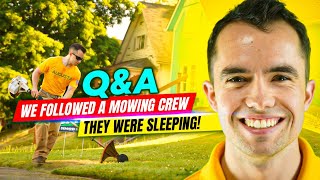
Mike Andes catches a landscaping crew sitting idle with one worker asleep, then walks through why pay-for-performance beats hourly wages. He covers tracking systems, hiring, pricing strategy, and whether to rent or buy shop space.
Questions this video answers
May 21, 2020.
$18 per hour (base pay).
$12–$13 per hour.
Age 45 and up.
Approximately $55,000–$60,000+ annual household income (as a target threshold).
Chapters
Hey everyone. Hope you're having a good day. I'm in my car right now and I was running a little bit late. I was planning to get back to the studio and do this at the studio for everyone, but was running a little behind. So let me get set up here. And today's gonna be a little interesting because I'm gonna do something I've never done before, that is follow another company's crew. I've never done this in my entire life. And the reason I wasn't planning on it is first of all, I'm at this place getting a smoothie and my teammate got me that last week as a moment of appreciation that we do for our team meetings. So I got moment of appreciation, which is I haven't done that before or haven't had one for a while. So I'm enjoying my smoothie. But while I'm enjoying my smoothie, I look over and there is another company over there. Let me see if you can see them. See if you can see right there, the back of their trailer and their truck over there. And I've been here about 10 to 15 minutes. I went and talked to a gentleman that was standing over there. He's working and he said they've been sitting there for about an hour and a half in their truck. Who knows what they're doing? So I'm going to do is, I'm going to do Q and A right now. If you have questions, you can post below. But.
If they move, we're gonna follow them and see, see what they're up to today. So they're not really competition with our company because they mostly focus on commercial. But I do know that company and kind of what they're going through. And so it's interesting. This is what, this is why P4P is so important is exactly this. We got a truck sitting here for an hour and a half. And this is why a poorly managed company is, is going to lose money in this industry and why our industry gets such a bad rep for success rate of businesses is because employees sitting in a truck for an hour and a half, you're not making money on that route. No chance in the world today. So if they move, we'll go over there and see what they're up to, follow them to the next job and see how long they sit the next job. Otherwise I'm going to take this out and answer some questions. If you have questions, comment below. Anything and everything. And, and then we're gonna be.
Crew and see if, see how they do so let me open up my laptop, but go ahead and any questions just comment them in below. I will pull up the feed on my iPad here. Sorry, you guys have a horrible angle. Let me switch this around.
Okay? No, I can't do that. Okay, never mind. All right.
Something happened last time where I was horrible. So what I'm gonna do is I'm going to look on my iPad, I'll see your comms there. So any questions, go ahead and comment below. We're gonna follow this crew if they move, if they don't move, we're gonna go drive over there and see what they're up to in their truck for the past hour and a half.
All right.
Just opening up. I'm going to see your questions coming in in just a minute.
All right, here we go.
Just opening up now. I'm watching double cool. Alright, so if you have questions, go ahead and comment below. But again, this is why P4P is so important. Having your crew actually care about how quickly they're completing work is paramount because you as the owner, that's all you care about. You care about efficiencies and you're caring about getting the jobs done on time. And if you don't incentivize your crew to do exactly like literally as I sit here saw, but there was a yellow truck that just passed by, an Augusta truck as a trailer set up.
And like they're incentivized to go out and kick butt. Now. That being said, I know this company is gonna about 40 to 50% less than we do. And that's what they're getting, right? And so people always wonder like, how in the world are you paying so much for per hour for an employee? Well, like we expect them and we train them to be working all day long so that we can afford that. And P4P is what's going to allow you to do that. So I'm gonna drive over there. I think because these guys haven't moved for an hour and a half, I don't see them moving anytime soon. Okay, Alberto, thank you for your question. If you guys have questions, comment below. Alberto asked, what's the feedback on the P4P from employees overall? Again, like at Landscape Summit we went through the whole process, but basically you do have to get them to buy into it. It's important that they actually agree with the concept. They agree that's a positive change. And so in terms of the buy in from the employees, the initial part, you really have to work with them to show them the numbers and show them that they are going to make more money. But the feedback, initially it comes down to a vote. So we do a testing period and then we vote on whether or not we're in switch from hourly to P4P. And then since then, we lost a couple people right at the beginning. And then after that, really P4P is the foundation of everything we're doing and most the employees are on board with it. There's always going to be one paycheck where someone is discouraged because they worked their butt off and, and they don't. They just hit base pay, which for us is still 18 bucks an hour, which is not horrible, but it's still like demoralizing somewhat. That being said, they have to kind of take the good with the bad. And that is, I should say, take the bad with the good because there's times where they make, you know, 25, 26 plus an hour mowing lawns in the summer when once things are going faster. So the bottom line though is they're incentivized not to sit in their truck like we're watching right now and do absolutely nothing for an hour and a half. Which, if you just join me, we're watching this truck and trailer over here from another landscaping company that has been sitting there for an hour and a half, according to a construction worker. Sit over here working and I've been here about 15 minutes, nah, 20 minutes now, watching them do absolutely nothing sitting in the truck. And we're at a commercial facility. And this is one reason why commercial properties are tough too, is because on big property the guys will get, they're more likely to get worn out and then just sit in their truck for a long time. Like if this was a 15 minute thing, I get maybe on break, I got to give them the benefit of the doubt. But when it's an hour and a half, like, my goodness, that's a very long break. And I promise you it's taking all profitability from the route today. And so let's go ahead and drive over there because.
Let'S see here, let me flip this around. Let's show you where we're going here.
Drive over here and try to crash. If you guys have questions, go ahead and pop, post in the comments below. Let's see if I can do this discreetly. One second here. So this is the company we're talking about here. These guys have been sitting here. Oh, looks like they're taking a nap. They are taking a nap. Oh my goodness. Both. One's taking a nap, the other is on his. Listen to music of some sort or something like that. Okay, I'm gonna swing around.
See here.
So again, like that's why P4P is so important. And honestly.
Like, you know, obviously it's like, hey, well don't hire someone if they're gonna do that. Or you can fire them. But they're not incentivized. Like those guys are not incentivized to go to the next job. They obviously do not care enough to go to the next job. And that's simply due to the fact that they're not getting paid to go to the next job. They're getting paid by how long they sit in that truck. And so.
Or any other type of tracking device for your trucks is also really important if you're not using P4P. So at least you can track the trucks and notice if it's. If they're sitting in the truck, is sitting on idle for a long period of time, it'll give you a warning. If the truck is sitting at a location for three hours, you can track that. And against the fact that you know, it's only supposed to take like 30 or 40 minutes for the job to get completed. So I'd recommend.
And we still use them even though we're on P4P because we like to have one. So Liz at the office, she has a computer open. She sees all the trucks live on a screen moving around and so she uses it more for routing and scheduling purposes. But if you don't have P4P, unfortunately you gotta have those trackers on your trucks just to make sure like you'll look at the end of the day, someone's done like three jobs and they were supposed to do like eight or 10.
And it's because if you're not tracking and managing your budget hours versus actual hours that they is taking to complete a job, they could literally be sitting in the truck like these guys are over here. So I'm gonna drive back to my spot real quick and see if I can get first.
See if they've moved. Any questions, go ahead and comment below. But I know peeper P isn't an easy change and I talk about it a lot because it becomes so second nature. No, they're still there. Alright, see if we can get this. You're gonna see out my window.
So no, let's see here. Just try to be as screwy as I can. But they. Oh, I see they got a hot and ready pizza from Little Caesars. Oh, the one guy saw me in the passenger seat. But the other guy's taking a siesta. The driver is taking a little nappy. Little nappy on company timey for the past hour and a half. Goodness gracious. Like, how can. How can we run profitable businesses? And this is the thing. Nobody wins in that scenario. Nobody. Not the customer. They're not getting work done. Not the employee and not the owner. And you're like, well, how is the employee losing that scenario? The employee does not get the benefit or the satisfaction of actually doing a hard day's worth of work and earning their pay. And they don't actually learn the business. They don't learn about efficiency. They don't learn about productivity. Like, literally, I am now, from where I can see them now.
Where I can see them, I can see the head of the driver tilted back, taking a nap. Goodness.
And this is what's crazy, is I know that company. I know where they're at right now, and they can't be affording to pay their employees to take naps. So, again, if you're not on P4P, you've got to track those trucks, and you've got to track budget hours versus actual hours on all your jobs to be able to determine if you are even being efficient at all or if your guys are just sapping the clock, taking naps. Like, it's crazy. So it's funny, most employees have, like, this sense about them when they know the boss is around. If you come around and check and they're working hard and everything. Well, if you're not managing your numbers and managing budgeted hours and managing how long they're on each job, you just don't know what they're doing. And if you don't have a system like P4P, you better be tracking those things. So any comments or questions, go ahead and post below. Next 10, 15 minutes. I can answer any questions. Doesn't have to be about P4P. Any sort of business questions, marketing, anything you're going through right now. Love to help if I can.
I know it's middle of the day, so not too many of us are able to hop on. But if you have any questions, go ahead and comment below.
Let's see what's happening. Right now.
We are finishing up version 2 of P4P software. Looking forward to that. We are. We planned a trip in September for Josh and I to travel across the entire country, meeting all the franchisees in person at their locations and doing a video shoot for them. That's exciting.
And what is happening? Oh, yeah. Yesterday I was down at Mount Vernon's location and helping them a little bit. And they're starting to pick up. We're really needing another, another crew, another setup, another employee down there. So good to see that one growing and expanding down in Mount Vernon. All right, Derek Duran, here come the questions. So if you have questions, comment below. I'll answer as many as I possibly can. Hey Mike, what are the top factors or indicators for identifying your ideal market or neighborhood? Example, median house value, median household income, median age. Good question. So this is actually a question that came in on the texting platform as well. Someone text me about this the other day and that is.
About finding a demographic that works really well. So I do a lot of this because when people ask about joining the franchise, my first thing is that I go into their marketplace and see if it's even a viable territory in terms of lots of our target demographic and the tools that I use. One of the main one I use is actually the USPS EDDM tool where you can go and see every single neighborhood. You can see the income distribution as well as the age distribution. And so those are really important things. And to be able to know in that market where are the pockets of affluence, where are the pockets of neighborhoods that we actually are going to target once we start a franchise. So that's one tool I would definitely use. It's free USPS eddm. And for someone that I remember the question that came on the texting app, they're actually wondering how you use that just literally search USPS EDDM and is a tool that will walk you through the whole process. But I would use that software and that tool also just to look at age demographics and income demographics to find ideal market according, like what Derek's asking here, those neighborhoods are really important to be able to see what are the age demographics. So for us we're looking for age demographics that are 45 and up. Then in terms of income it's a little bit different because every single market is going to be a little different, right? So for here in Washington state, you know, the average income needs to be 55, 60 plus thousand a year, whereas some of them looking at, for other franchisees, if it's 40,000 or 35,000, like that's considered middle class area and their cost of living is so much lower. And so I'm looking at more of a distribution and you're going to need to look at what is the income distribution in the whole county or state or city and then compare that to the data you'd get from the every door direct mail tool where you're going to say okay, like is this middle median? Is it above average, below average? And begin to think about that way. Carlos Rodriguez asked, I have no leads coming in right now. What can I do? I have just sent an email to all my customers. So yeah, like in terms of no leads coming in. Carlos had asked the question last week too about the Google Ads. He's been spending a whole bunch of money on Google Ads. This is when there's no leads coming in it can get a little bit scary because you cannot predict your growth and you cannot forecast and you don't. Especially if you're selling non recurring work. It's tough to fill a schedule if you don't have recurring work and no leads are coming in. And that's what we're seeing a lot of right now. I'm seeing a lot of three, four man companies scaling back to solo crews because they're running out of leads right now and their one time work has dried up with this whole virus. And so in terms of finding new leads that's when you get scrappy. Like if you don't have the money to go out and spend on leads and spend on Facebook or spend on Google or spend on Nextdoor, like there's a hundred ways to spend the money but if you don't have that money to do that you've got to go and you've got to get scrappy. And so scrappy might mean door hangers and then knocking on those people's doors the day after. It might mean going into project managers offices and talking them and giving them a plate of cookies. These are all things that you've got to get scrappy on if you're not going to be spending money in order to get those leads. Stan Smith Hey Mike, we are. Oh there's a long question. Hey Mike. We are a commercial only lawn maintenance and janitorial services company. We currently are around 400,000 in revenue and I'm wondering when it makes sense if ever to make the move from renting to purchasing your own location. We currently rent a 300 foot square foot office space and 1500 square foot shop area for about $1000 a month, all utilities included. Really appreciate all the sound business advice and great content you provide. Alright, so this is a good question. This is actually where we're at right now with the Mount Vernon location because as you saw probably a month or two ago we started it in a storage facility and we're currently still there. But we're growing really quickly and we're going to need more space. And so we've played with the idea of buying some land. We've played with the idea of renting some land. So what it looks like is going to happen, and I'll definitely get a video of this in a couple weeks, is we're going to be renting some land from some people that have a bunch of property and they don't mind us dumping clippings and branches. And so a couple key things you got to remember. Number one, if you're going to buy the land, make sure it's industrial, light industrial use or commercial, which is tough because that increases the value of the property tremendously. And that's what makes it very expensive. That being said, light industrial. Light industrially zoned land is much cheaper than commercially zoned land. So if you're going to be looking for a place to buy, I would recommend looking for light industrial, local market. That being said, be very aware of this is a great, great key if you're trying to buy, and that is a lot of houses back in the 40s and 50s, or even set up to the 70s were built on light industrial land, which was like at the edge of a city. They just threw houses on, like double wides. You can sometimes buy those places for like, nothing, hardly. And then just literally demolish the house, take it off if it's a mobile home or if someone just like literally was parking their RV there and make it into a good shop and get it very, very, very cheap. And so that's the one recommendation. And a lot of people, they. Because it's industrially zoned, they. And but there's a house on it, they just think, oh, it's like only worth what the house is on it. Well, sometimes the land underneath, if it's industrially zoned, is worth more than the house. And so we've seen that down in Mount Vernon, we looked at a couple of those properties, but we ended up going with a place where there is land we're renting at 300 bucks a month, which is going to allow us to park two trucks, a storage container, and dump unlimited amounts of yard debris. That's the kind of deal I want to look for. And that's what we're getting. And so the storage container is like 20ft long just for us to have some dry storage. And so that's the balance in your case, Stan, specifically $400,000 in revenue. You rent 300 square feet of office and you have a 1500 square foot shop area for about 1000 bucks a month. That's pretty good. Now you have janitorial services, which means you're going to need some indoor space for your equipment and things. Because with landscaping, lawn care, our stuff can go outdoors mostly. If you're doing janitorial, you might need some more indoor space like dry storage, and you might not be able to get away with, you know. That being said, if you have enclosed vans, for example, all of your equipment and your supplies can stay in there. So it's just about getting creative. Like, honestly, sometimes you need to stop thinking about shop area or office space and think about parking. Are you really looking for shop space and office space or are you looking for really just parking? Because I know some, some places. Another quick tip here for you. If some places will have like shared office spaces or where you can buy like one room, that might be the way to go. And then literally just park your trucks in the parking lot of that shared shared office space. I've seen this work a bunch where retail centers are being turned into shared. You can park your trucks in the parking lot and then and then inside and literally pay a few hundred bucks a month for that, for that space if you need the office. So it's really going to. Obviously your unit economics in terms of like $400,000 a month in revenue, you can afford $1,000 a month. So I wouldn't say you're overpaying right now. But if you're trying to grow or, you know, expand buying a piece of property, it's going to come down to what that cost is. Do not go out and spend $400,000 on a commercial piece. Highly recommend you don't do that. That $400,000 is going to be a big mortgage. That mortgage alone is going to be about.
2,000 plus dollars a month, including taxes and property taxes and all that good stuff, insurance. So I would recommend in that scenario renting land if you need to. But again, remember, you might just need parking plus some office space instead of, you know, an office space and a shop where you park your truck. So keep that in mind. Remember that that's an absolute expense, is an absolute sunk cost. Your customers don't really care if you're a mobile company like lawn care and janitorial. Your customers really don't care. It does not affect the customer experience. If you are at a big nice shop, they care about you coming and doing services. So I'd rather invest in the things that are going to affect the customer experience and minimize the shop expense. Office expenses, etc. And like you said Stan, when you have an office, it's not just the office space. You gotta like have the office staff now. You gotta have computers, you gotta have trash service, you gotta have all these other things like a phone, Internet with the utilities included, a thousand bucks a month. That's pretty good because those things add up. And so like even with the franchisees, that's why we do command center is simply due to the fact that like when you add an office, it's not just about hiring an office personnel now. It's about like all the utilities and all of the upkeep and you're in a lease and all this other stuff. And so it can get a little bit hairy. Carlos responded back, I have currently stopped paying for advertisements. If you were to try one or two forms of paid advertisements, which would you recommend looking into? I think I've mentioned it before. I would do Google local services, I would do Facebook lead forms and I would do next door ads right now. Again, that changing all the time. Brian Conner asks. We are currently producing 50 to 60 thousand dollars a month with our three maintenance and one enhancement truck. Eight team members. We have a maintenance division manager overseeing four teams handling scheduling, training and estimates. I am handling our treatment division, 140 clients, approximately $75,000 worth of treatments and about half of a truck for a full time technician. I can also handle billing estimates for this division, planning, marketing decisions, client questions. I can feel the pressure and I'm worried we will not be able to fully capture our growth potential and training quality control. I am thinking about either hiring our first spray tech or a field supervisor. Which would you advise? I would always recommend when in doubt. If there's a balance that you're trying to decide between, if you can go for the person that is going to produce revenue. And I know that kind of goes against. Some people say it goes against what I usually talk about that is like delegation and finding people to do other things in the business. But if you are deciding between, if it's even an option between someone out in the field versus someone that is doing managerial or estimates or office work, go for the person that produces revenue. Like if you're deciding right now whether or not you should be on the spray truck versus, you know, doing the spray work yourself or hiring that position out versus you hiring out. Like sales, marketing and the office side of things. Hire out the worker. Like get, get someone hire someone's going to produce revenue for the business and let you as the business owner step into the role it's non revenue producing, that is you're not doing the work yourself and not producing hourly time to the customer because you're going to be the most efficient at those non billable hours and you're going to be the most invested in the scalability of the business and the marketing and things and hiring and all that. So I would recommend in general, if you have a decision to make, like if it's very obvious that you need someone in the office or very obvious that you need, you need an estimator, then you go do that. But if you're deciding like do I hire out the work in the field or do I hire out the non billable like management stuff? Hire out the work you want to. The more people you can hire that is actually revenue producing, the better. Sorry, I'm just looking at this company and seeing if they've moved, but they haven't. One thing we're always managing is and looking at is revenue producing employees versus non revenue revenue employees. What I mean by that is like how many people do you have in the field compared to the amount of non. Like first of all, if you're the estimator and salesperson, like you're non revenue producing, you don't produce revenue for the business. In terms of out in the field, if you have office staff, if you have an estimator, those are non billable hour positions. And we're always looking at the ratio between people in the field versus people that are not actually doing the work. And you want to make sure that that is constantly monitored so that you're not over managing things because at the end of the day if someone's not producing revenue, they're just managing. That is coming off of your bottom line. And so you got to make sure that stays in check. And traditionally I see a range of anywhere from eight to four people in the field per one person that's non billable, that's an office person, an estimator, an owner, something like that. And the reason there's that range is because it's gonna depend on your service mix. If you're doing more projects, you're going to need more staff in the office and you're going to need a project manager, etc. If you are doing commercial maintenance, you're also going to need less people managing because it's bigger projects, less time to deal with customer relationships, et cetera, etc. Whereas if you're doing residential, a lot more customers, a lot more phone calls, a lot more estimates, a volume of Estimates. So it's just a balance. There's no right or wrong, there's no good or bad. It's just making sure you keep a track, keep track of your non billable people in the field versus people in the office. So as I'm sitting here, we still have this truck over here from this other company. You can kind of see right there. That's the tip. I'm still sitting here. They've now been there. I've been sitting here for 40 minutes and they haven't moved. And the guy that was doing construction said they were there for an hour and a half. One guy is sleeping, one guy is on his phone and they still have not moved. And I fully intended on following them during this Facebook Live and seeing where they went next, but they're still sitting there taking a nap. So again, like, I'll say it again, if you're not doing P4P, you need to be tracking budgeted hours versus actual hours. And you need to see if there's a difference. You need to be seeing if that's a trend with a certain employee and then having a conversation with them. You need tracking those trucks to see if they're sitting like this for two hours now, over two hours, doing absolutely nothing. Like you've got to be tracking these things. All right, any more questions? Comment below. There's no more questions. Next 60 seconds, I'll go ahead and log off. I really wish this truck would have moved because we could have followed them. But I'm gonna pass them one more time here. And we're gonna see the result of poor management of your employees and not creating a system around pay for performance. This is what it yields. And then they wonder, like, I know for a fact that this company has job ads out right now trying to probably get work done that these guys should be doing.
And here they are. I'm just trying to be discreet here. I don't know if you could even see that. I couldn't look at my camera. But that is what sinking companies right there, they're going out and hiring people to perform the work that those guys are not doing. That's basically what's happening. And I also know that they're hiring at 12 to $13 an hour.
And that's why they have to only do 12 or $13 an hour is because in our market, you know, they could do 18, they could do at least 15 or 16, but they can't. When their employees are doing that. Everybody loses when there's inefficiencies and waste in the business, the employees lose because there's no money to pay them more. The business loses because that company, I know for a fact, is struggling and they're not profitable. Number three, I don't know that they're not profitable. That type of, that type of setup and that type of system is not going to be profitable. That's what I meant there. Number three is the customer doesn't win because right now those guys should be at another property servicing someone's property and they're not, they're late or they're not doing at all. Who knows?
Brian Conner, thank you for the insight. Also, we are super happy with our move to pay for performance. We appreciate the support during conference. Your team was super welcome, welcoming and helpful. Awesome. Thank you, Brian. Appreciate that. So I hope everyone, you know, obviously I was hoping we could follow that crew for the day, but I think enough was said. You know, seeing that one of them sleeping, one of them's on their phone for the past couple hours sitting there doing nothing is a testament to what you gotta do with your culture. And what you've gotta do is pay for performance. An absolute necessity. And if you're not gonna switch to P4P, you need to be tracking budget hours, you need to be tracking actual hours. You need to see the difference between those two. And if there's a trend with an employee, you need to address it. You need to have trackers in your truck to be able to compare how long they said they were at the job versus long their truck was parked at the job. And trust me, you can pick these things up pretty quickly. But anyways, hopefully that was helpful to everyone out there today. Have a fantastic rest of your afternoon and we'll stay tuned for more content this weekend.






