What I Wish I Knew When Starting a Lawn Care Business
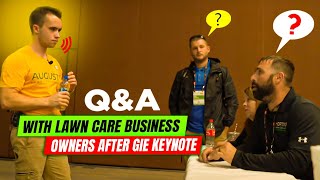
Mike Andes shares operational lessons from running a lawn care business: hire carefully and check references to reduce injury claims, use accountability systems like yellow slips, set a $40 minimum for mowing, and aim for $80 per man-hour revenue. He covers pricing models, employee pay ranges of $12-$18 per hour, and how to scale to hundreds of accounts.
Questions this video answers
$40 minimum for mowing.
300 mowing accounts.
He said he never has seen a landscape or mowing company successful with an hourly rate under $40.
$80 per hour per man (on the job).
Employee pay examples ranged around $12/hour (common) up to a stated minimum of $18/hour for some operations.
Chapters
Hi.
What's your name? Haley. Yeah, I'm White. Cool. Burnaby. You're like right next to me. We were just saying that. What's up?
So we have, we're from a big landscape company up in Vancouver. We do like a yearly summit kind of thing with all of our staff.
Yeah.
What other topics do you.
If you listen to the podcast, Landscape business course. I have a whole bunch of stuff on there, like everything. So yeah, just listen to that and if there's something that I can help you guys with, just let me know. Yeah.
Because we're always looking for like.
Yeah, yeah, totally. Yeah, just let me know. And then I have, I have a conference. A lot of people from Vancouver come down.
Yeah.
So for to balance down. But yeah, if they listen to the podcast. Are you the owner?
No.
Okay. If the owners listen to it and they want me to come, just let me know.
Let him know.
Yeah.
Another question. Do you have any claims or like injuries that happen on the crew?
We've had a couple. Not super bad. We've had. Have you just had one? I'm assuming we have.
Well, I mean our claims management is.
Like one of our biggest expenses.
It's huge.
Like everyone's always injured with big injuries and all these.
Right. Yeah. So hiring is the thing. You can't fire someone cuz they got hurt. Yeah. Right. So yeah, for us too. So. And like fake claims are hard to fight and so it's in the hiring process. You got to catch that, you know.
Calling someone's references is telling you like why they leave their job. Unless it's like they move, there's a reason why and if it's that they don't give a glowing review, it's something like that that's gonna happen.
So you believe in doing reference jobs?
Huge. Oh yeah. Huge for hiring. Really? 90% of my. I'll take someone that kind of average in an interview, I'll call three references. And if they're all like, this person is the best employee we've ever had, we would take them back in a heartbeat. Like, then I'll hire them. If they're good for another employer, they're gonna be good for you. If they weren't good or they're even average for someone else you don't want to be. If it's not a glowing review and a reference, I'm not gonna hire them because that's what happens is fake stuff.
Do you have any other tactics you use to determine who's gonna be a good fit?
I asked them what they talking About. I ask three references after that. I say, what will. What do you think? X Employer, I say their name is. So first of all, who is your direct supervisor? Mr. Jones. Okay. How do you spell their first name? How do you spell their last name? I'm writing this down in front of them. Then for them to know I'm actually gonna do this.
Yeah.
And I say, so when I call Mr. Jones, what will he say about your performance? What will he say about your being on time? What will he say about your whatever? And so then they all of a sudden, like, oh, he's actually gonna call him. And even a hesitation.
Exactly.
So how do you deal, too, with, like, someone. Your whole yellow slip system? So we have a big thing at our company where, like, Commercial Strata. Commercial.
Yep.
Yeah.
Where, like, they hate being shamed. Like, shame culture is a big thing for us. And it's been like. Because we kind of used to do that as well. And then it got a really negative response. And then everyone was like, no.
Like, what do you mean by shame?
Like, public shaming or like, with the elsewhere system where they have to announce it to everybody that I up and, like, you know, like, what do you do about that?
How is that shaming, though?
I guess it's the accountability thing.
Right.
They don't want to be accountable for their problems.
Well, then they should work for you. Right. So, like, the thing is, if they really care about shaming, for example, it means it's going to make more impact when you do implement the yellow system. Because they don't want to be, quote, unquote, shamed. Right. So I. I still think that is the attribute. Like, if they didn't care, everyone's thought the yellow system won't work. Right. But what they actually think it's shaming and they hate it that much. They'll make sure they don't get it. Yeah.
You are hiring a lot of people that don't have a lot of experience. What we find is many people join, and because they don't have experience, that's awesome.
We'll train them.
But they quit after a day of rain or they quit after a week. It's too hard. Do you have that issue?
It's all about the references that should be caught in the references.
Even if they can't.
Like, they think they can handle the job, but they've never done a physical job before.
So if they haven't done a physical job, that's different. Like, if they haven't done. If they never were done a physical job, I'm Working worried. But we had.
Because we do hire those people. And some, you know, some work out great.
Yeah, yeah. So it's getting down to the references, though. If they're. If they never had physical labor, but their references are like, this person kicks butt. They do whatever they need to do. If they don't, aren't. They haven't done it before. They'll figure it out. They're gonna figure out how to work hard.
Okay.
Right.
Wow.
Okay.
You're really impressive.
Well, thank you. You guys have. We're back. Oh, hi.
So, okay, my question is, okay, have a set price of like, say you're.
Going to mow yard.
Is it like, this is the amount that I'm going to charge to drop my gate. Like, how do you do that?
We have a minimum.
You do have a minimum?
Yeah. We have $40 minimum for mowing.
We're like 45.
Okay. Yep.
But I.
Before I started making the 45, if it's a $30 yard, I'm going to do it for 30. So I definitely need to stick to that because I don't want to rob people.
I want to be the good guy.
So.
But I like your standard of what you said.
I don't need good guy stays in business. Charging 30 and not making money on it means that you eventually have to close your business. You don't have to go find someone else. The good guy will charge what they need to make a profitable business.
So it's like, okay. So really he needs to be like.
I want my minimum.
If you don't.
Whatever. You know that minimum to be. For some people, it's 30. For some people it's 35. Whatever that is for you, just stick to it.
So franchise is every franchise.
There's one spot open next week. I have several calls. I'll be making the call in the last one.
And we have another group in February.
So do they all follow the same business model?
Yes.
Two weeks paid.
So there's some things that. So legally, there's certain things you can't dictate. So for instance, that we cannot dictate what rate they pay in terms of, like, what we can give the systems is how we do it. So I'm following very much like what my. I'm a franchisee of Anytime Fitness. Very much like, hey, this is how to do it. You don't have to. But if you cry about it, we're gonna point you back and say, you didn't do this.
Right.
So that's how we're operating. That's how we do it. This is what we recommend. We recommend you server solpi, we recommend you do automations. We're going to preload it all for you. We recommend you do performance. We recommend that you do the leads this way. We recommend you do the estimates this way. But if you don't want to do it, fine, go for it. But if you cry about it and come back to us, we're going to point you right back.
Because it's very hard to dictate another business owner. You own the business as a franchisee. For me to dictate what you do is legally very hard. And so because too if they do that thing.
You'Re doing is working.
Yeah. But for example, say they do pay for performance. Right. But they're not doing something else. And I dictate they have to pay for performance. I say if you don't do pay for performance, your franchise is lost, you're out of business. So they do pay for performance. But let's say they don't do something, their prices are way too low, for example, then they go out of business, they go bankrupt and they come to court and say I want bankrupt. Because pay for performance. The judge is going to say, was that dictated to you by the. Yes. So that's why as a franchisor you can dictate certain things, but you really gotta be careful what you do dictate. Like I can dictate the fact that they have to be a certain color and it has to have a certain. I dictate. They have to have our website, things like that. But if I dictate something like you have to pay your employees 18 an hour and they come back to me in court and say I'm out of business because of that. It is dictated.
You can't do that because different state.
Law.
And just so many things like that though. Even like I can't even dictate the fact that like they do. Right. Because there's certain laws on privacy in certain states.
Right.
So I say, look, this is how we do it, this is how you should do it. You know, no one's gonna care. But like if I dictate it and they for some reason a customer sues them because their neighbor got saw on a video, then I'll find them video. Gotcha.
How many people you got next week on the phone?
4. Just set up a call with me.
So like off the top of your head, so you say you do more lawn care than you do ye.
Landscaping.
Is there?
No, not really. We do about 60 landscaping. Hardscaping stuff to the 40 in terms of revenue.
So you feel like you make more money in mowing than you do.
We make the exact same. Yeah. Because we're doing a pay for performance. Everything should be the same.
Yeah.
I told you earlier that I didn't think I can make a million dollars mowing. Then you come in here and said you can.
So offered up how many, how many accounts did you like, do you have now, do you think like residential accounts?
Got 300. Mowing. Mowing.
I'm in like almost 85.
Yeah.
So do you mow them every two weeks or do you put them on?
Do you mow them every day? You say yeah or mow, but. Well, both. We mow weekly or bi weekly?
Whatever they prefer.
They're going to charge 50 more if they're bi weekly.
Write this down.
And so they get charged 50 more. So if they're a $40 mo, they're gonna be 60 if it's bi weekly. And we're gonna dictate certain ones starting next year where they cannot do bi weekly because it was just getting so fast overgrown in the spring.
In the spring, something I did that worked out pretty good for the bi weekly customers. I told them, I said, I can't go two weeks. It's gross. Too much. I said, I'll charge you half because I'm already there in the neighborhood. 90% of those customers, I'll charge you half. But I'm not weed eating. I'll just cut it. So then you're not taking this much grass off of it.
Yeah.
Then you trim the next time, then.
The next time when they pay the.
Full price, I trim it works when you're always there. What's tough though?
It works out.
Yeah.
As long as you're there, it's fine. What's tough is though when you have crews. Right. Because now like the different crew is coming back and they're wondering why it's not edged. Yeah. And like. So just the admin kind of like calling the customer, setting that up, putting the notes on the next visit. All of that is just like I don't even.
You owner operator too.
Yeah. I've only got probably two people that I. Everybody else I cut off.
Yeah.
I said if you're bilingually, I'm not the guy.
Yeah.
That's the biggest thing I've learned probably from him is telling people no.
That's his thing.
I'm like, because if somebody would be like, hey, what's it charge?
Money.
Cut my grass 40 bucks.
Could you do it for 35?
Yeah, sure.
Well, then you start figuring it out on paper, and you're like, well, I just gave away half the profit.
That's what I need. And you. I think you pointed it out.
About how much I need to operate, you know, per hour. You touched on that. If I. You said 60. That in my area, I feel like that's the going rate. But me and her got to talking on the way up, and we feel like we need more. So if we were thinking 60 in our head, I'm thinking, like, 75 now.
So.
For mowing or for landscaping?
For mowing. Strictly mowing. Me and one guy.
Yeah. What do you pay your employees? Like, on average, 12. Okay. So I. I usually one person. Yeah. Usually a 12. I'm not seeing a 75. Usually I am seeing more like a 60 to 65.
Okay.
Traditionally, just based on, like, numbers, like, I see all the time, usually a 75 is gonna be someone that needs to pay someone at least 15 bucks an hour, 16 bucks an hour just to work. It's like, we charge 80, but I also, like, our minimum is 18 per hour. That's just based upon what I see. If you can run a system where you have $12 going to employee and they're making 75, like, you're gonna make a lot of money.
So Your minimum is 80.
No, $80 per hour. Per man. Hour. When they're on the job.
When they're on the job.
Correct. Yeah, it's 60. It's as low as 60 for landscaping.
Like, cleanup stuff, somebody making. How do I break the down to what I need to run per hour, what my company needs to make per hour to run. How. What was it say?
You say that traditionally, 40 is. I never have seen a landscape of mowing company that's successful with an hourly rate under 40. Never.
So it's got to be over 40.
Yes. Based on what I've seen, yeah. If it's under 40, like, if you run your. Your budget hours again, like, you start to clock in, they clock and clock out, and you start seeing it, and you get the hourly rate.
Yeah.
That's what you're talking about.
Yeah.
Thank you for watching. Yeah. So if you're doing that, like, under, then you have a rate. Like what I would do if I was like, okay, if it's under 60, I'm gonna raise the price. Maybe it's 62, 63. I'd leave it for now because. Pretty profitable. At 12, your labor is that low.
But, I mean, that's $12 an hour. He Makes good money in our town. Well, he don't work for me no more.
Our minimum wage is like 725, 750.
I mean we' the home of Elvis.
We don't, we're poor.
$12 an hour for a, for a mower is good in our town.
Yeah, you're making good money.
And he quit.
So.
He'S loading trucks that could retire at a plant for 75 a night loading 18.
And it's, and he's, it's work.
He's killing himself. So. But anyway, so you're, you're saying clock in, clock out, then I can know what I need to make per hour. That's what you were saying, correct?
Yeah. Like right now, if you're just guessing it at 60, like you really gotta start tracking your time.
Yeah, that's what I'm saying. So that, that's where you're at, Start tracking.
Yeah, yeah.
So you saying like I got, man, I got one stop. So I got like a.
40.
A.
60 and a 55. And then an old man, I mow his hillside. That takes me three swats for ten bucks. That's one stop in the neighborhood. So that's pretty good. And we're there two and a half hours. So that's 175 right there. Two and a half hours, that's pretty good.
165. Sorry.
So yeah, I just, just I'm going to give you a shout.
Yeah, sounds good.
Definitely.
For sure.
So, oh, back to me asking, so do you know your yards every 10 days or.
Never 10, just weekly or bi weekly for us. Just for scheduling purpose.
So is your weekly people on like a one month pay like one time pay a month? Like do you other offer?
No, it's alart. So each, each service is built differently. So there are going to be times they have five in a month. Yeah. Okay.
All right.
So do you have any.
Year round customers that pay one solid thing per month? You do these such services and this is what they pay for. You sit down, put a pen and pad to it.
And you don't do a pen and pad, but we do sit down.
So we're still gonna do it based on budget hours though. When we dispatch that job, the crew has to see budget hours.
Yeah.
So we're not just gonna be like, okay, it's like $1246. We'll give a you for 1200amonth. Right. It's got to be 1240, whatever. The hours work for each one.
I think I've seen a podcast you.
Did on that See Isaac. Thanks for coming, brother.
Hey, are y' all going to the Echo after party?
Hey, do you mind? I don't know what's at.
It's from 6 to 9 at the mega Caverns.
So just text me the address. I'm like lost.
When I get in the car, I'll text you.
Cool. Thanks, Isaac. What is that?
To dinner?
Is that the dinner?
Yeah, they have a whole bunch of stuff they're doing down there. Get a bunch of giveaways to have catered food and stuff like that. It's all underground.
Yeah, I'll come. Just text me.
For real. What is that?
What do you think about like the subscription model for Mo?
I like it. It's the problem with it is that it the only issue I have with this quantity pay for performance. Because if you do say like $99 package, $199 package. $199 package. You're just banking on the fact that some of them are worth really should only be charging 150. And some of them you are losing out on the one, the 250 ones. Right. So you're very much siloing them. Whereas I'm going down to the minute on budgeted hours. Right. So if I'm paying based upon budgeted hours, I can be really tight on that versus it's tough to be like, hey, you're gonna get charged, you know, $100 a month and then teacher guys telling them, okay, you're gonna make 30 bucks every time because they're going to show one and it's going to take them 10 minutes and the next one will take them 30 minutes. And it's very hard for them to compute and it's just very difficult. So I love the subscription model. I love how it works in terms of financially. But for pay for performance, it's very difficult to convince an employee to mow one lawn that's half the size of the other for the same amount of money for them.
Yes.
Right. And yes, you can be like, well, it averages out because it does, but it's just not going to compute. It's much easier for them to compute time versus how much I make. So.
So could you do it to where you like as far as charging the customer? Because this is what I'm pitching my customers right now. Fertilizing pool service, cut the grass. The only thing I don't do is irrigation. And I'm just going to partner up with another irrigation every week. Yes.
They're gonna sign a contract.
I got two of those.
Yeah.
But my season's only nine months out the year.
Where you from?
Ohio.
Ohio.
Okay.
Around Cincinnati.
Yes.
You're gonna have to sign a contract.
But I was gonna say, like, then say the mowing's a thousand dollars a year or so, 100 bucks a month. Well then couldn't you just pay the guys, break it down that way?
It's very, it's crazy because it gets very. A lot of like, you got to make it as simple as possible. Like every day you should to be able, able to run that. They should be able to know. You should be able to tell pretty quickly how much they made. It's very difficult. You're like, look, guys, wait for the end of the month and then we'll figure out how much you made. Right. Like the closer you can get the incentive to doing the absolute work, the better.
See, I thought it would make it perfect because then your budgeted hours that you built the customer for, you already know ahead of time to pay your guys.
Yeah, but they're gonna, they're gonna have issues with budget hours and you can, they can't move it now. Right. Like if there's a job that's really long and they're like this, we can't get this.
See, I don't do anything that's more than probably two days worth of work right now.
Right, Right.
Most of mine's the general manager.
I don't post budget hours for pay for performance. I love the subscriber model. Love it. I like the monthly full service breakdown. It's hard to do a paid for that. We've lost some of our full service customers, which is painful, but it's just because it's harder for the employees.
I sat down and figured out how many mowings they was going to get. And you know, I'm on their property every week when, when mowing's done, we. They both have pine straw, so I trim twice a year, pine straw twice a year. And I averaged it all out. You know what it will take and the hours and the labor and all that. So I guess I did it right.
They took it so cool. We gotta run here, but do you, do you have a question?
No.
Oh, you're with these guys. Yeah. Yeah. Okay, cool.
Hey, nice to meet you, brother.
You as well.
Thank you, man.
We'll talk next time.






