Why Americans Are Broke AND ALWAYS WILL BE!
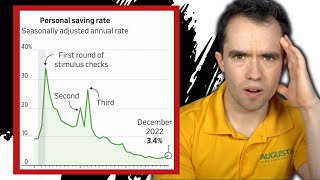
Mike Andes breaks down why American consumers are running out of money. The personal savings rate collapsed from 35% in early 2020 to 3.4% by December 2022, while inflation stayed above 5% for 19 straight months. Home sales hit their lowest point since 2014, and tech companies like Google cut 12,000 jobs.
Questions this video answers
February 1, 2023
3.4% (personal savings rate, December 2022)
8.8% (2019)
About 30–35% (early 2020 spike after first stimulus)
19 straight months (through December; CPI >5%)
Chapters
The US Consumer is starting to freak out. The flush saving accounts and cheap credit that helped keep American spending at high rates since 2020 is disappearing. No kidding. That's what happens when you stop, you know, printing money. What happens when you stop, you know, giving people money from doing absolutely nothing and not working when we needed workers the most? That's what happens. The engine of the U. S. Economy, the consumer spending, is starting to sputter. No, I. I really hate the fact that we kind of get lumped into the fact that our economy is. Has to do with consumer spending and not production. Right. I. I hate the fact that we are. We have a. We're a net importer instead of an exporter. We have so many resources, materials, technology that we could export. But that is a different topic. All right, let's keep rolling on. Retail purchases have fallen three of the past four months. Spending on services including rent, haircuts, and the bulk of bills was flat in December after adjusting for inflation. The worst monthly reading in nearly a year. Sales of existing homes in the US fell last year to their lowest level since 2014 as mortgage rates rose. The auto industry. This is crazy. Posted its worst sales year in more than a decade. It a stark turnaround from the second half of 2020, when Americans lifted the economy out of a pandemic, helping the US Avoid what many economists worried would be a prolonged slump. Okay, so this is exactly what happened. It says here they kept spending, government stimulus, flush savings account and cheap credit even as inflation picked up. So this is what we're dealing with. Check this out, though. This is the personal savings rate. If I try to zoom in here. Let's see if I can't. Can't get closer. There we go. This is the personal savings rate, seasonally adjusted annual rate of people speaking saving money in the United States. Check this out. All right, 2020, 2021, 2022. Look at this. Before COVID you can see about nine, nine and a half percent of people's income was being saved. Then you get this spike all the way above 30%, almost 35%. At the beginning of COVID was the first round of stimulus checks. Everyone's freaked out of their mind. And it's funny. What's crazy to me is that it takes few fear and panic for people to start saving money. And like, oh, I should probably not buy this third outfit in a third different color because I don't know if I'm gonna have a job tomorrow. And so it's amazing to me that bad times and horrible economic fear is what causes us to have good behavior. It's incredible. It's literally like we need a spanking in order to be able to act appropriately financially and make fear fiscally wise decisions. But that's what happened, you know, early 2020 Covid hits, everyone's freaked out, people are losing their jobs. No one knows what's going to happen. But literally within a matter of a couple months, that savings rate plummets because people realize that the government's going to step in. They're going to not make you pay your rent, they're not going to make you pay your mortgage, they're not going to kick you out of your house. You're not going to have to pay any store student debt. You're not going to. You're going to actually get more money for staying at home and you're going to get a stimulus check as well. It was absolutely insane. So people put a lot of money aside because they're fearful. Then the second and third stimulus check comes. But by then we kind of figured this out, like, hey, the government's just going to keep giving us money. So the savings rate didn't spike as long or as high as it did prior. And now here we are at 3.4% savings rate for the United States in December of 2022. I don't think this is going to get any better, honestly, because a lot of people are going to get a whole lot less on their income tax return this year simply due to the fact that they don't get their child tax credits and they don't go to a lot of other credits that came last year. And I really think this is going to continue to go down, potentially down to two and a half percent or less. And in doing so, you are putting yourself at massive jeopardy. Like, there's so much risk if you have a $50,000, $50,000 per year job. Okay. And that would mean that you're putting about fifteen hundred dollars of that aside in savings every year. Every year. And I know it seems out of touch, say, oh, fifteen hundred dollars, not a lot. I understand that. But when you take a percentage of someone's income and realize that it used to be 30%, 35% just a couple of years ago, and now we're struggling to save a tenth of that 3%. It's incredible. I think that the moral of this entire story to me is don't allow the government or any other exterior extraneous circumstance or force predict or tell you how you should be spending your money, both in a like as spending as if there's no tomorrow, like we did in 2020 and 2021, or like there is now. It's like conserve, don't spend, don't buy a house, don't invest, don't start a business. That's the kind of rhetoric we're going to be hearing over, over the next 6 to 12 months. Check this out. This is a share of US adults whose monthly expenses were more than their income by household income. So this is basically if you were making more than $100,000 between 50 and $100,000, or if you were making less than $50,000, if you're making less than $50,000 now, 7.2% of people are spending more than they're earning. They're upside down. Like they're every month they're going backwards. And that's a very scary thing. And the bottom line is we've been doing this literally since COVID started. However, because of the free money, it didn't matter because we could keep the gravy train alive. But in doing so, this is what's crazy, and this is why it's gonna crush the middle class, is because by giving everyone money and us all having this inflated savings rate, and then we just completely spent all the money by spending all of that cash, it created the cost of goods and services to go up, I. E. Inflation. Because when you have massive demand and then restricted supply by shutting down a whole bunch of the supply chain and manufacturing and factories, you do all that, guess what, Price goes up, demand goes up, supply comes down. Both of those, it's like a double whammy. Either one of those things would drive price up, but when you combine both of those, like, we didn't cope with COVID that's why we have hyperinflation. Things go through the roof. And now, at the same time that inflation is its highest, we now have people saving the least and having the least amount of surplus money after their expenses. It's incredible. Annual inflation as measured by the Consumer Price index remained above 5% in December for the 19th straight month, the longest streak since the early 1980s. Spending Consumer spending accounts for roughly 70% of the economy. All right, this is, this is incredible stuff. One factor making forecasting very difficult while an unemployment is trending at a half century low. Big companies like Amazon, Goldman Sachs, Microsoft, you can list it off Google. Write down the list. All of them are cutting massive amounts of jobs. Just last week, 12,000 jobs lost at Google. One thing that I'm very happy about, I can't say happy. It's not a good word to say when people are losing their jobs. One thing that is interesting to me is that right now the job losses are happening from massive companies. But you know who needs workers more than ever before is small businesses. Look at the amount of people that are cutting jobs from these. The likes of Google and Amazon and Facebook and these tens of thousands, hundreds of thousands of people are being laid off and being fired. However, at the exact same time, at the exact same time, small businesses in America need workers more than ever before. This is my. I was screaming about throughout 2021 and 2022, and that is when you looked at these job reports. All the jobs are being sucked up by these massive companies. And people were bragging, politicians were saying how many millions of jobs we added this quarter and all the rest of it. But when you looked at the actual labor statistics and when you looked at the actual numbers, 95% of those jobs were going to massive companies. Companies with 500 or more employees. And small businesses were struggling to get anybody. And I'm somewhat relieved by the fact that some of that pressure is going to come off of us as small business owners now, because these massive companies aren't just using cheap money from Wall street and pumping into hiring anyone that has a pulse, therefore making it very difficult for us as small business owners to find anyone to hire. Very interesting. I'm not happy about it because whenever someone's losing a job, it's never good. But it's interesting to me that the dynamics of this happen has changed. The positive layoffs, he said, is part of the crunch that I'm having to consider now what's going to happen if I no longer have an income. This is what a recession looks like. High inflation. People are not saving money and people are borrowing money at all time highs. There are. There are signs of labor market weakness. Employers are shedding temporary workers at a fast rate, and people who lose their jobs are taking longer to find new ones. And meanwhile, the number of hours worked a week has declined for two straight months, according to the Labor Department, resulting in a slowdown in workers take home pay. Because guess what you do before you usually lay off people. You start to reduce the entire workforce's hours. This is something we have worked with, even in my businesses, is like, do we cut everyone's hours or do we lay off a section of people before it picks back up? Whether it be seasonal workers or whether it be virtual workers or whether it be out of state or remote, Those might be the first people you cut or you reduce their hours prior to a layoff, things are slowing down again. I don't think it's a bad thing. We're, we're kind of getting back to what normal looked like before COVID messed everything up. You know, this is a small business owner doing tattoo shops. I've been doing this for 15 years now. I've never seen that people calling up and saying they don't have the money to spend right now or can only afford an hour because their current situation is pretty bad. For now, first class tattoo isn't like this. Prices because the baseline level of demand remains strong, some 250 clients are still on the waiting list. Also weighing on many consumers, the rapid increase in rates in the past year tied to Fed tightening has pushed the cost of all types of debt higher. Mortgage rate truths of 20 year high last fall 20 years by the way is before the crash of 2007 and 2008, some 57% of consumers were concerned about making house payments. Get this 57%. Almost 2/3 of Americans that are homeowners were concerned about making housing payments in the fourth quarter according to survey, up from 48% in the third quarter. This is incredible. This is what's going to lead to the massive shift in my mind in public perception and public fear around the economy is when housing starts to take a plummet. The increases are gradually starting to slow down consumer spending, though it may take a while before the effect is full fully realized. So I truly believe this is going to be a very interesting time. I don't think we're going back to 2007, 2008 where houses were 50 down, but we were absolutely seeing the air come out of the bubble that we created with 2020 and 2021 in all markets of the real estate market, the labor market, the stock market, all of this, we're seeing simply a correction back to the mean. The previously generous jobless benefits and direct federal payments to households caused the share of income Americans save every month to hit new highs in 2020. Since then, the saving rate has fallen to roughly 3% of monthly income for more than 30% at the start of lockdowns in 2009. In 2019, sorry, the year before the pandemic, the rate was 8.8. So we are saving less than half of what we did before COVID And this is the problem is we got also used of three stimulus checks and years of like literally years of not paying on student debt and mortgages and rent. We got so used of that that we Are not as Americans very good at doing one thing, and that is cutting spending. Not only do we have a really hard time with this in the personal sector and personal finances, our government cannot do that. That's why no one will get elected that wants to say we need to cut, cut back on expenses. We need to balance the budget. We need to create a surplus instead of a deficit that will never be popular politically. And our Americans are horrible at saving and cutting out the things that they want to buy. And so once they've been put on that morphine, once they've been put on the drug of you can buy things, you don't have to pay for stuff. You're get free money from the government. We will never, we will never be able to have the restraint to say, I don't need to buy that. I don't need to buy the new iPhone. I don't need to buy the new Tesla. And now people are freaking out, oh, my goodness, my Tesla is now 20% less than it was just a couple months ago. It's like, well, like, yes, it is. And you're not going to be able to afford the payments because now the interest that you just had on that loan is now twice as much as it was a year ago. That's what's going to happen. And unfortunately, we as consumers are very poor at being able to change our psychology around money and realizing that in a time of abundance, yeah, you can go spend. Government gives you extra $1,200. You can go spend that money. That's fantastic. Get a little extra vacation, get a little extra here and there. But when you start to get addicted to spending money, it will drag you down for many, many years. And breaking the habit of spending money is extremely difficult. Proof is this article right here. Because we got so used to free cash and now we are literally saving less than half of what we are we were saving prior to Covid. Debt goes up, saving goes down, and we enter into a recession. That's what happens when those two things collide.






