Why Most Lawn Care Businesses HIT A WALL at 2 Employees
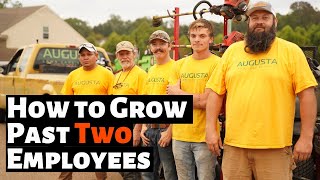
Mike Andes tells Sam why lawn care owners get stuck at two employees and how to break through: treat hiring like marketing, onboard new people yourself for two weeks, and use profit-sharing and open-book management to keep them. Hire before spring when the labor market is tight.
Questions this video answers
Within a few minutes of someone walking out the door (hiring on the spot).
Two solid people.
Chapters
How, what do you do to keep people? Like I've had an issue with like employee retainment and stuff. I was just wondering like what, what do you do that. I know you do the P4P but what do you do that that helps to keep your people? Other than just a pct, how many.
Employees do you have right now?
Well, I had two. Well, we went in the winter season and it's just, just me right now.
Got it. And then next year you plan to get like to maybe three or four. Is that kind of your hope?
Yeah, yeah, it'll be. If next year goes well, it'll be me and a landscape crew, me and a landscape truck with one other person and then two on maintenance. So it'd be a total company.
Yeah. Like this is really, you know, at the end of the day this is a tough industry, right. It's typically entry level and even, you know, for our company we still have turnover, right? It's not as bad as a lot of places, but we still have turnover. Right. And so you still have to replace people and the people leave and they randomly leave A lot of times it's not like it just kind of comes out of the blue. So I think the big thing is just focusing more and this is something we're going to talk a lot about conference and that is focusing on marketing to find employees the same way that we would market to find customers. Right. So actually having a process and you're really thinking about, okay, in terms of customers, I would make sure I have a good estimate proposal. I would make sure I have a good follow up process. I would make sure I have a good onboarding process and getting their credit card on all uncount. I would make sure that I'm a presentable when I go and meet them at the estimate, I would make sure I answer the phone. All of those steps can be translated over to well, what are you doing in terms of marketing to get employees? Are you doing that interview in a same professional manner? Do you have an actual checklist of questions that you go through in that interview? Do you give them a job offer right away? Do you wait one day and get their references? Like back in the day we would require three references and we had to get hear back from them and we'd maybe give a job offer two, three days later? Well now in this market you probably aren't going to have that luxury. So if someone's good, they're going to go get five job offers the next day. Right. And so what I would do if I Was you is really think out what is the process that you're hiring somebody and then how do you onboard train them? And not, not just like hey, once I have a job offer, it's done. It's like do I follow up with them? Do I actually train them? Then do I have like. Then it's a matter of retention. The same way that we try to keep customers happy, we to try with customer service and all the rest of it. It's like, well, what are you doing for your employees? Do you have offsite meetings? Do you have profit sharing? Do you have open book management? Do you have P4P? These are all the things that would help retain an employee. And it's not the perfect science because the industry that we are in is entry level. And so the number one way to help protect the business from that is simply simplification of the business and run on systems so that when people do leave, not if but when they do, because people will, that the business doesn't fall apart. So like this year, did you lose both those two people or just like the end of the season you let them go?
Yeah. Let them go.
Yeah, yeah. So you know, even if it's a matter of like when you let someone go in the fall, you can try to stay in touch with them throughout the winter so that when next spring rolls around that you're still into contact, they know what the start date is because hopefully those two people will train your next two people. Right. So do you think those two people will come back next spring or not?
Probably not one of them. Okay, so let me, let me rephrase that. I did, I let one go and the other one move but with no notice. So he kind of quit. He went, he went back to Kentucky and you know, it was one of those. Well, he was supposed to come in Thursday and then Thursday morning I get a call at 6am.
I'm getting kicked out of my place. So there's no notice. And it was funny because it was even one of those deals like where somebody goes way over the top to tell you like, hey man, if I'm ever not going to be here, I'll let you know. And at worst case, I give you two weeks and he let me know that morning and we were doing, we had £18 sod to do that day and we're supposed to have him. And it was so funny. But yeah, it was a mess.
Yeah, like, you know, it's, it's part, part of the industry and at the end of the day like how, how.
Do you, do you screen people, like when you get people that when they come into your business, do they, do you screen them like background text? Or you just like, how do you do it? Because it's not enough time. If you're trying to get people and you need help, what do you do?
Yeah, we used to do references, drug tests, background checks, the whole nine yards. But now with the labor market the way it is, we are hiring on the spot. We're giving them a job offer within a few minutes of them walking out the door.
And you're just weeding them out as they go.
Yeah, and I think the bottom line is creating a culture that you can weed them out. Nice thing is that your size, you. You're going to have direct contact with them throughout the day, right. So you're going to know pretty quickly if they're good or not. What I would say though is you're going. You need two solid people before you get busy in the spring. So I would really encourage you to really start trying to focus on higher, like in January, because you need those two people solid so that when March and April rolls around, you can go get to more people without drowning yourself. Because this is what a lot of times happens is this, is, is this your first, first winter?
No, no. I've been doing this about, about nine years since I was 16. So cool.
So now you're, you're kind of just playing now to grow it now, Is that kind of the plan?
Yeah, I've tried, I've tried. I've tried for a long time. I had two people last year and I had two people this year.
And this happened. A lot happens a lot. Because what happens is, you know, you.
See it all the time, but it was the word. As soon as I stepped out of the truck, everything just goes downhill.
Yeah, totally. Yeah. Like, like the thing is what so many times happens is you usually have two employees. They let you either let them go or they leave for the winter. And what happens is come spring, you basically, you know, if they're gone, you go higher when you need someone, right. You're like, okay, March 1st, let's go find someone. Well, by the time they're trained up and half decent, it's a middle of April, you're drowning in work. You don't even have time for interviews. You'll literally take anyone with a heartbeat. You'll say, hey, hop on the crew. So again, you've deviated from your system of how to train them. Maybe like for you example, I always recommend someone has less than three or four employees have it where every employee comes through you, right? So you've hired them, you say, hey, tomorrow you're going to be with me. You know, get, we'll get your employee document signed. We're going to have an hour, we're going to go over, you know, how pay works here. We're going to work all your bank details, all whatever stuff out. But then you're going to be on the in the truck with me for the next one to two weeks at least. And in that time, you're going to be the one that's going to be able to determine whether or not they're a long term fit. You're also going to be the one that trains them on all the standards that are required, right? And then you can offload them to another employee. The problem is if you hire someone right when you need them is you don't have time to train them. You literally just like, hey, just go do this job, I'll drop you off and I'll go do estimates and I'll go do mowing while you get this project. And now they have no connection with you whatsoever. Right? So I think the biggest, you know, the biggest thing I would say is, you know, hire people earlier so that when, when, when the rush comes and you're hiring other people, you already have a couple solid people. That would be like my only kind of bit of. I see it so oftentimes the two employee thing, not getting the third one. As soon as you go to three employees, there's going to be an at least one employee per day that will not work with you.
Sam.






