Will Robot Mowers Put You OUT OF BUSINESS?
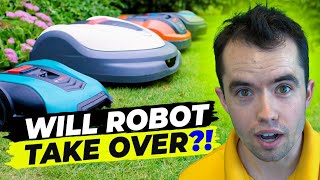
Mike Andes warns that Amazon, Home Depot, and Google pose a bigger threat to landscapers than mower makers. As robot mower prices fall from $1,200-$2,000 toward $300-$400, routine mowing could become commoditized, undercutting the $200/month customers now pay. Landscapers who shift to higher-margin services may survive the shift.
Questions this video answers
About $1,200 to $2,000.
Around $300 to $400 per unit.
About $200 per month.
Sam.
Foreign.
What's up everyone? It's Mike Andes. You're listening to the Landscape business course and today we're talking about robot mowers and I'm hoping you all can hear me a little bit better. I'm going to be doing Q and A after this, but I've been working very hard on getting this set up where now the camera is actually from the dslr. You should be able to hear me good. No longer am I on helium, no longer does it smell sound like I've been, you know, smoking crack or anything like that. So hopefully everything is sounding much better and it looks good and I want to do this these more often and we'll address topics and then have live Q and A. So really looking forward to it. We're going to be talking about robot mowers as I'm talking about that. Feel free to leave comments down in the comment section as well as leave any sort of questions for me to get to after that. So I'm going to go over from the perspective of potential, like what could threaten us in the industry from robots, what also are the opportunities for the robots. And I actually feel like this is really important to note that the robots and the robots coming and trying to take us out, the robots are coming to get us. I really think there's a huge opportunity and we're going to go over that. Then we're going to talk about what parts of this industry really could get wiped out by robotized mowers and what's coming down the pike as it gets harder and harder to find good employees. As I have said in the past, this will be the hardest, the hardest year in this industry to get good labors and we are finding that to be so. So first off, I want to give a big shout out while everyone's joining right now, Whether you're in YouTube, Facebook, the group on Facebook, whatever it is. Thank you for joining me tonight here on a Friday evening. I wanted to give a special shout out to Chuck. Chuck is actually one of our general managers out in North Carolina. He's been just crushing it. I felt like I needed to address and kind of give him recognition here live tonight. He is our new general manager out in North Carolina. He's getting his third. So he came in February for training. And so it's been about five weeks, four or five weeks, and he's getting his third employee in his third truck literally this coming week. Just got new shop space. He's just killing it over there. I want to say a big thank you to him. He's been working long, long hours just busting his butt and I really, really appreciate it. He deserves all the credit and a big shout out to Chuck over in North Carolina. All right, so let's and talk about robot mowers. So I first of all this is the funny thing. I really don't feel like robot mowers are going to come as a big deal from like Husqvarna or Honda or whatever of these companies are the manufacturers. I actually feel what's going to make robot mowers mainstream is a big company like Amazon, Lowe's or Home Depot coming in and being willing to take this beast on of robot mowers and be willing to take a massive, massive loss for one thing. Data. Alright, so whether you look at what Google local services is doing, how Google is now getting involved with home services, whether you look at the way that Lowe's is so integrated with Porch, which is also a home service based kind of business, these are the type of things Home Advisor, these tech companies that have billions of dollars, they could literally put a robot mower on every single lawn in America if they really wanted to. And they could do it all for the sake of data. Data is what pushes these companies valuations to the moon. And trust me, the next frontier for these tech companies is the home. It's no longer going to be just digital, it's going to be how do we actually get in contact with our customer. Whether you look at Amazon prime and Amazon Air where they're trying to like deliver things to the home. Just think about it, what if Amazon, they figured out okay, you know, what if we have a robot mower in everyone's lawn that is a Prime member, we can actually deliver the package and now conceal the package inside of the mower until the, the, the, the client comes home. When the client comes home, the mower will drive over into the delivery area next to the porch and then set, when they, they come over, scan a barcode, it opens up and there's their package. No longer a security threat wipes out a big issue with mail. Package delivery like that can happen like that and I don't feel like it, you know, Honda, Husqvarna Steel. In my opinion they're not going, they're not going to have the marketing, they're going to have the brand awareness, they're not going to have the power to be able to actually distribute these to consumer the way that a big company would come in. For example, what if Home Depot comes in and says okay, we're going to put an orange little mower on every single property here. Oh, and by the way, steel, you're going to make them for us at a third of what you actually are selling them right now because we're going to order millions of them. So instead of them costing $1,000, we want you to make them for us for 300. And we're going to put our little Home Depot sticker on there. And we're going to be at Great Data because we're the square footage of the property. We're going to know, we're going to have cameras on this device, we're going to be able to know the all about the house, the patterns of weather, everything that we could potentially sell the customer based upon their home's climate. Like, trust me, that's where the threat is. If you're really worried about robot mowers coming, you need to be worried about Amazon, Google or one of these other massive retailers getting a hold of this and using this as a brand and data play. Okay, so that's the first thing. The next thing is as the cost of the machine goes down, this is when it starts to get really, really interesting for robot mowers, as the cost of the machine. So right now, to get a good robot mower, you're looking at least, you know, between 1200 to $2000. As that cost comes down, that's when robot mowers have the potential to actually take root in the market. And as that, as the cost of that machine goes down, there's going to be an increased pressure on our prices because we becoming a commodity. So what technology does is it makes service become a commodity. So whether you look at taxis becoming Uber, whatever technology you want to look at, the service, the actual service becomes commoditized with technology and therefore bring the cost of that commodity down. So if we're mowing and the cost of these machines comes way down, like I'm talking 3, $400, you can get one of these bad boys, put it in your lawn and it's going. Now all of a sudden, why would someone pay us $200 a month to mow their lawn.
When for 300 they can get a lawnmower that is silent, that is super user friendly, that mows 24, 7. The lawn always looks good. They don't have to worry about employees coming to their property. They don't have to worry about a truck blocking their driveway. It's just seamless and beautiful, all for the low cost of just $300. So as that low, that price of the machine comes down, that's when you're going to get a little more concerned, because it's going to put downward pressure on our prices because now the consumer has a benchmark price that is something that we can't even compete with. Like $300 one time, and it'll mow your lawn for years to come. That's pretty tough to compete with. All right. Number three is from the perspective of these manufacturers and things like that, as the security of the device improves, as the user interface improves, as do the gates improve, when you don't have to put a perimeter line anymore on these robots. So, for example, in my opinion, one of the biggest issues with these robot mowers right now is a lot of them. You have to install an invisible fence along the perimeter of all of the lawn. Just you wait until the GPS technology gets good enough to where it can be within a matter of inches and know where it's at. And you don't have to put a line in the ground. And literally the first time you walk it around the property with your smartphone, you've set it on all the corners and it just remembers all those GPS coordinates and does not no longer need a line to be installed because there's people that are making a lot of money right now installing the lines in the ground, on the perimeter. But just wait till the GPS technology gets good enough. Just you wait till again, you just get a Google partnership with like a Home Depot and all of a sudden instantly down to the inch it can track on that device, where it's at. That will happen. Okay, so eventually the perimeter lines will not be needed, and that will absolutely be a massive barrier to the robots taking over. All right, so now I'm going to talk about some of the opportunities because I really feel like overall, this is a massive opportunity for us, and that's the robotized mowers. So I feel like, number one, when a robot is like, if I ever, if robots ever took over and I just see robots all over my, you know, market, it would be a massive opportunity because, look, the person that buys a robot mower is, does not want to mow their lawn. They're lazy, they have too much money, they want more time, whatever it is, they don't want to mow their lawn. So if they don't want to mow their lawn, there's a really good chance they also don't want to weed their beds, trim their bushes, install their mulch. They don't want to pressure wash their Driveway, clear out their gutters. They don't want to do any of those things in their lawn or their yard or their landscape. And therefore, every time I would see an orange steel, orange Home Depot, you know, maybe it's an orange Amazon. Whatever. Whatever comes along. Whenever I see that robot mower, the first thing I would be thinking is, that is a potential opportunity for upsells. Because guess what, number two. So number one opportunities when it comes to robot mowers is the fact that if I see them on someone's property, it's like a big waving red signal saying, hey, I'm a customer, like, right here. Hey, I don't want to do lawn care landscaping. Like, come over here. I need your service. Because guess what? Number two. Mowing is your lowest margin service. It's a loss leader. If you actually look at the margins of specific things that are done on a property. For example, blowing things off, you edging the lawn, weed whacking all those things, you know, pulling weeds in the beds. The loss leader, the lowest margin service while you're on the property is the actual mowing itself. You're like, oh, no. Like, I make way more money mowing than I do weed whacking. No, no, no, no, no, no, no. Because guess what? If someone is gonna. Is currently you're charging them $50 per week for their mowing service and includes mo, edge, and blow. Guess what if I could go to someone's property and charge them $30 instead of 50. But the robot mower did all the mowing, and I did the edging, the bush trimming, the, you know, the line trimming, blowing off the sidewalks and the walkways. Because the thing that is the lowest margin is the mowing. I need a $10,000 mower to go back and forth, and yet I can have a $400 weed whacker and edger literally doing all the other work. A blower, $500 on the backpack blower, blowing things off. I no longer need a big trailer and a massive truck to be pulling all of my equipment if I don't have the mowing. So, again, the mowing is your biggest cost and your lowest margin service. So I'm actually really, really pumped that a robot mower comes along and is able to do the things that are the lowest margin. By the way, a robot can edge. A robot has not. Has yet the power to blow things off or think intuitively about what weeds the pool in the beds or trim bushes. Like, we're a long ways away from a drone coming and shaping a bush. We're a long ways away. So if you're worried about mowing, trust me, this is a massive opportunity because it's literally taking away the thing that's the lowest margin service so that we can send our crew there with less of an equipment. Set up a smaller truck. Literally. You could show up in like one of those little Honda or Ford, connect little vans, like little minivans, or even a car. You could show up with a car because all you needed, a weed eater, a blower, you know, some gloves. Because the robot is doing the mowing, which is the big what is usually needed for a truck and for a massive trailer and for the big equipment that's heavy, all the brakes and the tires and the maintenance and training employees on using those, that equipment no longer needed. It's an amazing thing. If I can have the robots mow and I can edge, blow, trim, do all the add on services that are higher margin, that's where the money is going to be made. And guess what? That leads to number three, because this is a huge opportunity due to the fact that it solves our labor issue, it's going to be harder and harder to find good employees. I want those employees to be doing higher margin services. That is the trimming, the edging, the bush trimming in the.






