Write-offs! Equipment We Purchased for Year-End Taxes
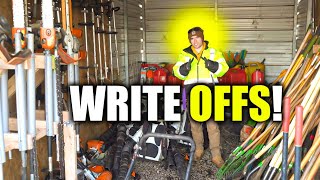
Mike Andes tours his Bellingham landscape shop to show year-end equipment purchases for tax deductions. He bought eight 30-inch mowers at $2.5k each, nine ramp racks at $2.5k each, and Stihl blowers and Kombi systems. He notes that an S-corp structure avoids the 15% self-employment tax that a single-member LLC pays on profits.
Chapters
Hey, everyone, it's Mike from Landscape Business Course. And today we are at the Bellingham shop and I'm going to show a little bit of the stuff that we have purchased at the end of the year, really for tax purposes, and give you hopefully a couple ideas. If you watch this before the end of the year or even as you're planning for next year, again, the only reason you would buy things at the end of the year for tax purposes is because you've been profitable. If you haven't made a lot of money, you probably should be buying new stuff. Okay, so when people talk about, oh, they're buying things at the end of the year for tax write offs, you don't need to be doing that if you just got started this year and you're not gonna be making much profit or you're gonna lose money. You only need to buy things if you need them, number one. And number two, if you've actually been profitable and it's leading to a tax write off. Okay, so I'm gonna walk you through a couple different pieces of equipment and things like that. Throughout the process, I'll hopefully drop in a couple nuggets about taxes. Some of it will be super boring for you, but for some of you, it might help a lot. So first things first. The number one rule of tax write offs when it comes to equipment and lawn care is you need the equipment. Don't buy the equipment because you want the equipment, because you want to look cool in the equipment, because this looks nice. That's stupid. You want to buy the equipment because you need the equipment for the upcoming spring, and you're going to have to buy it anyways. Don't buy it because the write off. Buy it because you need it anyways. But by buying a couple months earlier, you're saving a substantial, substantial amount on your taxes. Okay, so what did we buy? We bought several of these backpack blowers. These are the BR600s from steel. And I'm very proud of myself that I actually know what the model is, because I never know that. We bought a whole bunch of the Combi systems that are new. When these things hit about three, four years old, we get rid of them. Why? Because it can take 20 or 30 pools on a cold morning for the employees when they're getting started. We don't want them to go through that. It's a pain in the neck. And so what we do is about every four years, even if they're here and they've been maintained well, we usually just get rid of them. Because not worth all that time every fall and spring cold morning for them to be pooling on it for two or three minutes. It's very wears them out. It's bad on their P4P and it just is bad for morale when equipment doesn't work. So we usually every four or five years, like some of the ones we threw out this year, I think we threw out three or four we've had for like five or six years. So we threw them out, we bought new ones. These heads cost I think about $375. These are the elevens, I think. Something 11s, whatever. Yeah, something 11s, 111s, something ours or whatever. There's a 130, but they're too heavy. The 111s are a nice mix between commercial but light enough. So use the Kombis. And then we also have the straight, the actual, the shafts that are the FS131s. And these are the ones that actually have the whole shaft here. These are the Kombi system. We like those because they can adjust to all of our attachments. So these are our attachments. They're working on this right now. It's not done yet. You can see they're building it. It's basically a platform for all of these attachments to sit in. So when they want to go on a job, they can grab a weed eater, grab a hedger attachment, you know, grab a metal head for BlackBerry bushes, a pole saw. And then on here we have like dull and sharp chains. Whichever ones they need, they can put. And when they're done using it, they can put it back on the dull one. So this is still being built, but I think it's pretty nifty. They take pvc, they put these in here, they sit in here really nice, much more organized. And then you got extensions for them. Weed eater heads. Very, very cool. So during the winter, as we come to the end of the year, if you're looking for tax write offs, we've gone through blowers, we've gone through trimmers that are old. Get rid of them. You can see this guy back here. Had this guy for ages. I think he's probably six or seven years old. Handle's broken. We have a zip tie holding together. Probably gonna get retired. Poor guy needs to go to a graveyard. So he's gonna go to equipment heaven and we're gonna buy a new one. And then also attachments. And as well as in your shop, if you're gonna start organizing things, remember, if you're gonna pay Your employees. It takes time and money. Get that done in this year. So it's a write off. Cause it's payroll. And so, you know, these two by fours purchasing all this stuff, it takes them a good half a day to kind of build all this, put it all together, get that done this year. Now let's go check out the 30 inch mowers and the ramp racks that we also purchased as an end of year expense.
All right.
So back in here, they're doing a bunch of maintenance on these. These are all the 21 inch Honda mowers. These are our backups for the trailerless setups. So they're here. And then what we purchased though is another one. Oh, parking brakes on, duh.
What we purchased though is more of these 30 inch mowers. So you can see here they are working on some stuff, putting up some racking and things. But These are the 30 inch mowers. We got 1, 2, 3, 4, 5, 6, 7, 8, 8 of the 30 inch. These are 30x mowers. Okay. Remember, they're different than the regular x/30s. The 30x has the Kohler engine, which is bigger than the Kawasaki engine. All right, so they're 30 inches. Again, they're kind of cool because you can do a side discharge by popping the side part off. You can do side discharge as well as bagging. And we use these on our trailerless setups. These cost about $2,500 with tax and everything. They're about $2,700 if you get end of year deal. You might get them a little bit cheaper, but you can get the regular ex mark 30s for a little bit cheaper because they have the Kawasaki. Now if you are in a market where there's a lot of rain, you probably want the Kohler because when it gets wet, the grass gets wet and the engine is not really. The Kawasaki engine is not really powerful enough and it leaves a little strip of grass and it clumps up quite a bit. So the Kohler has a little more power and it allows you to still cut when it's wet. And we have a lot of rain around here, so we needed the bigger engine. Literally. We waited for that until we converted to 30 inch mowers. Until then, we were using the Honda 21 inch mowers. So again, $2,500. We bought a couple of these at the end of the year, brand spanking new only because we knew we were going to need them in the spring because we were starting two more mowing setups for the upcoming Spring and we knew we'd need them. We did not buy them because we thought they were cool or because we wanted backups. We did it because we knew we need them anyways in the spring. We might as well purchase them now and get a little bit of a deduction on our taxes. Now you might be asking, should I be an llc? Should I be an S corp? What kind of tax implications does that have? You, you need to talk to an accountant for your specific situation. But in general, an llc, any sort of distributions, that is profits that you get are gonna go directly onto your tax return and you're gonna pay taxes on them, but you're also gonna pay a 15% self employment tax. And that's the part that kills you on a single member LLC is that you pay 15%, then you pay your regular ordinary income tax bracket percentage to the federal government, to the state, whatever you might have. In Washington state, we do not have a state income tax. We only have federal, which is great. I'm glad I don't live in California and have to spend like 12, 13%. It's ridiculous. But when an LLC you're gonna get, you're gonna have to pay 15% self employment tax on any profits, okay? Whereas with an S corporation you are going to have what's called pass through entity, which means any profits in the business that go directly to you, which basically means you just pay your ordinary income tax on the profits on the business. There's no 15% self employment tax. Now that changes all the time. In 2018, the Self Employment tax went down considerably. Okay? But every administration, I guarantee you the next couple years, this is going to change. You're going to see tax brackets change, you're going to see percentages change on the self employment tax. You're going to see the change in corporate tax rates. All of that stuff is going to change. But the biggest difference with the corporation is you make a separate tax return. It's not, it has nothing to do with you. You pay yourself as an employee, you take a W2 from your own business and then any profits left over is taxed at your ordinary tax income rate. Hope that makes sense. Let's head over to the ramp racks. That's where we store these bad boys for our trailerless setups. And, and we bought, I think nine of these bad boys in the past few months. All right, so this is the ramp rack. This is one of nine that we have purchased and are installing on our trailerless setups. You can see another video Lee has made that Does a walk around on this thing. I'm not gonna walk through it in detail. Gonna walk through the numbers of it. Because these bad boys are about $3,000. We do not get the headache rack and the big, you know, shelf in the front that costs a little extra. If you go to ramprack.com however, we just buy the simple model. So it cost us $3,000. But as a franchisee at Augusta, we get a big chunk off. 26%. Let's go. So we get 26% off because we're franchisees at Augusta. And so they only cost us about 2,120. 200. But then with delivery, it's about 2,500. So let's just say this is $2,500. 1. We bought nine of them again, year end. We don't need them now, but we will in the spring. Cause we're switching everything over to trailless. If you watched previous videos, you saw me have the aluminum racks that would come off of these ball hitches. And then we'd put like the 21 inch or the 30 inch mower on the back, the push mowers. So no more. No more of that. We are now having the ramp rack where this thing will come down. I'm not gonna be able to do it here. Cause up against the office, whoa. This thing comes down. It's spring assisted, so it's not too heavy. And then we're going to be able to store the mower in the back and still have plenty of room to dump clippings. Because we have to have clippings stored and hauled around here, which stinks. Watch the other video about the ramp rack that Lee did about how we set up the racks. But here's the example of them being set up. One of you gave me a great idea of using some product to make these look green again because they were kind of worn out. But we do get these racks from trailerracks.com again we get 15% off because we are franchisees, bless their hearts. And so we will get racks for all of the ramp racks. We'll get the trailer racks. And so all in with the racks and the ramp all in, we're looking at about $3,400 and that's per truck. So we got nine of those. Again, another year end expense. Again. We know we needed them. We know we were expanding by two trailerless setups next spring. So we got these Again, another tax write off for 2020.
Again, another tax write off for 2020. Nice.
Oh, man. Okay, so now I just need to close it out, right? Yeah. Okay. Do it someplace else so you can cut it.
We didn't really. I guess that was last year. Nevermind. Okay.
So whether you're watching this before the end of 2020 or you're going to be thinking about this at the end of next year when you become more profitable, when your business has grown some, these are valuable lessons to learn about taxes. Like if you look at your personal expenses and let's say your tax bracket is 30%, all right, 30% of your income going to the government. So it's probably a good idea to figure out how you can reduce that. And again, you're not trying to like do tax evasion. You're trying to use the law to make sure that you are able to pay less taxes because the government wants you to buy more stuff. They want you to hire more employees, they want you to invest in real estate, they want you to buy stocks, they want you to do those things. So what I do is like a nice good little boy. I go buy what they want me to buy. So they give me tax benefits. So if you're watching this before the end of 2020 or you're going to be doing your taxes in the spring of 2021, if you have taken the PPP loan or the EIDL grant or the EIDL loan or a disaster relief loan from fema, you need to make sure that's on your taxes. All right. I feel like there's gonna be a big issue in about six months from small businesses that do not claim the PPP or the EIDL on these years taxes. If you got money from the government, you got it. It's taxable. Like it's money, it's income. Okay. The new regulations that are coming out are allowing you to use PPP money and then if you bought stuff to be able to deduct from your like as a regular expense, that's all new regulation and legislation or whatever that's coming out. It's probably going to change as always. But you got to make sure you claim it in 2020. Right. But regardless of you're watching this in 2020 or beyond, hopefully that some of these things help in terms of what can you buy. You need to make sure you need the stuff and that you're not doing it just for the tax write off you're doing because you need the equipment. It's going to improve the business and you're going to buy the equipment anyways. But you can just do it a couple months earlier so you can get the tax write offs. Hopefully you learned something. I'm Mike, Andy's landscape business course. We'll see you in the next one.






