026: Cyndie Spiegel on Online Communities, Women, & Respect
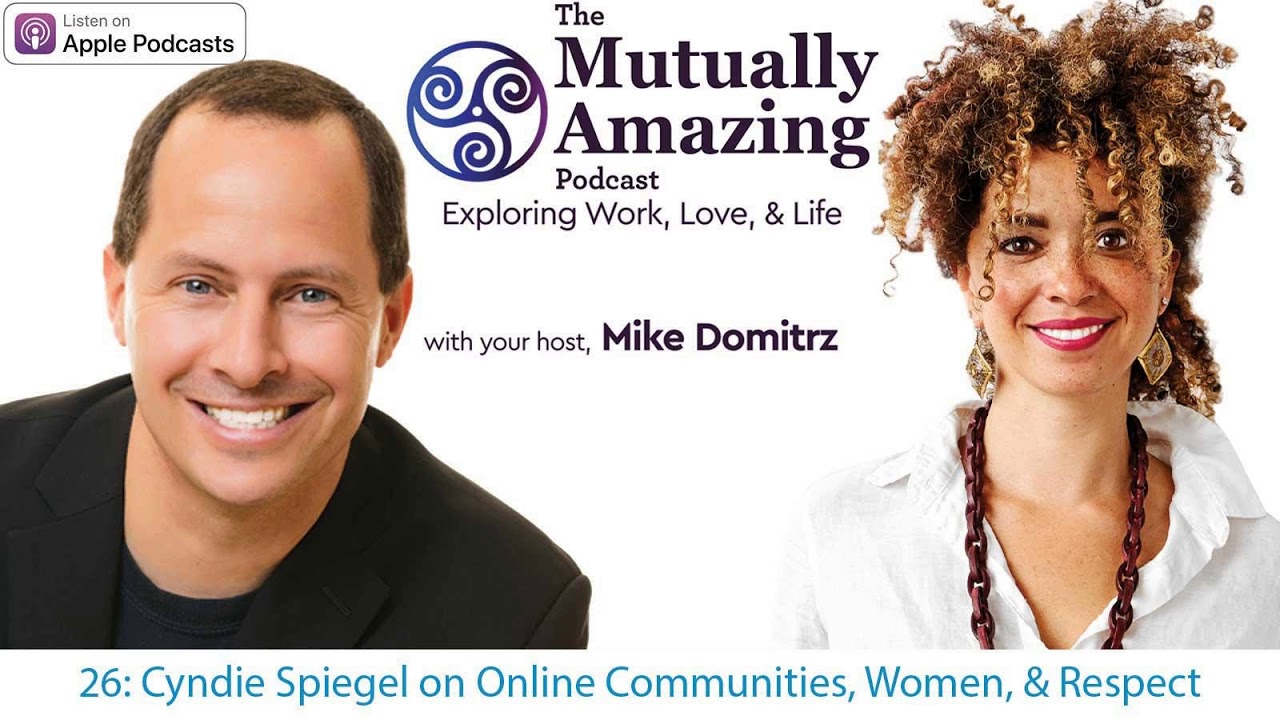
In this episode of the Mutually Amazing Podcast, host Mike Domitrz interviews TEDx speaker, community builder, and author Cyndie Spiegel. Spiegel discusses the pervasive shame and competitive dynamics among women that stem from socialization, body‑shame, tall‑poppy syndrome, and imposter syndrome. She argues that civility—defined as listening without needing agreement—allows women to have powerful, growth‑promoting conversations. Spiegel explains how these dynamics are reinforced by gendered expectations (e.g., women must be “nice”) and how they manifest in schools, sports, and workplaces. She then outlines her two women‑only online communities, The Collective of Us (a small‑business accelerator) and The Community of Us (a broader conversation hub created in response to political turmoil). Key practices for building and sustaining these spaces include: acknowledging and naming insecurities, modeling vulnerability, setting ground rules, mindful listening, and encouraging members to share honest feedback. Spiegel also addresses why women‑only spaces are necessary in a patriarchal society, how allies can support without centering themselves, and the importance of bridging relationships among women to move beyond the desire to see each other fail. The conversation closes with book recommendations (Brené Brown, Seth Godin, Pema Chödrön) and a discussion of Spiegel’s upcoming book, A Year of Positive Thinking, which offers daily doses of courage drawn from her mixed‑race, single‑parent upbringing and her experience as a small‑business owner.
Chapters
Welcome to the Mutually Amazing Podcast. I'm your host, Mike Domitrz, with the Center for Respect. The episode you're about to listen to was recorded when this show used to be called the Respect Podcast. So, you might hear that mentioned during this episode. Well, let's get to the show. And this week, we have Cindy Spiegel with us, a TEDx speaker, community builder, small business coach, and author As of December 18th. Woo-hoo! She's also founder of 2 online communities for women, The Collective of Us, a small business accelerator for women, and The Community of Us, an online hub for conversation and change-making community amongst women. Thank you, Cindy, so much for joining us.
Thank you. It's my pleasure. And I love that you added in the woo-hoo. So thanks for that, Mike.
Well, it's exciting to have a book out. Every time one of my books has come out, I'm woo-hoo. So we should woo-hoo each other. Absolutely. Well, thank you. Definitely. So diving right into this, you do focus on women in community. With that focus, what role does civility have in regards to community building and respect? And I guess that's an odd question for me to ask because people go, why? What does that have to do with women in community? Isn't that all community? Yes, absolutely. But you specifically work with women in community, and this is a topic you actually said, hey Mike, let's talk about it, that civility. So how does that play a role in community building and respect?
Yeah, I think particularly amongst women, and this was partially what my TEDx was about, but I think we have a certain dynamic that we don't talk about, and there's a lot of shame amongst the relationships that women have with other women that is really debilitating when it comes to our own success, when it comes to empowering one another, and when it really comes to helping each other thrive. So when it comes to civility, you know, I think we as women in particular really have to— we're incredibly polite, you know, by nature. We've been socialized to be polite. But I think civility goes beyond that, right? Of us that we are listening to one another and not necessarily needing to agree, are able to have powerful conversations and empowered conversations with one another regardless of whether or not we're coming from the same belief system. And I think in so doing, really listening and hearing one another challenges our own beliefs and allows us to grow and thrive. And I think without that sense of civility, you know, there's just always a continuing of arguing with one another, feeling the need to disagree, feeling the need to stand our ground, and collectively it's what the more we can come together in a place of hearing one another, listening to one another, and really pushing up our own— pushing up rather against our own boundaries, there's only a benefit in that for all of us collectively.
And what do you think has gotten to that place where our society has pitted women against women so frequently?
Yeah, you know, I think a lot of it is how we as women are raised in this country, right? I think we are just socialized differently. You know, if we think about how we raise, you know, young girls versus young boys, everything Everything from sportsmanship that is taught to a lot of boys but not necessarily to girls, from the way we dress. We'll dress our little boys. The example I like to give is how little boys go out in just Speedos to a beach, but even as a little girl at the age of 6 months old, she's— there's a certain shame in having to cover up, right? Cover up everything that you own, but your little brother doesn't have to. So there's a lot of body shame and a lot of shame that we've taught our children from a young age, especially girls. And I can go on. For that for a long time, so I'll stop there. There's also a certain unconscious gender bias that we have, right? Even as women, we expect other women to behave in certain ways, and when they don't—for example, we expect women to be nice, right? We expect women to really have these communal qualities, and so when a woman doesn't demonstrate that, we don't like her, right? We're judging her, and we're judging her harshly. So even though these unconscious gender biases that we see often come from men, they also come from women. As much as we don't want them to exist, we are also pushing. Those biases on each other when we expect women to be nice almost before anything else. Now, I should clarify, I'm certainly not suggesting that women shouldn't be nice, but that shouldn't be the expectation. We don't meet a man and expect a man to be nice before anything else. It's nice, it's a benefit, it's a lovely thing, but it shouldn't be the fall-to expectation, and I think right now it tends to be. Another reason that we really sort of pit one another against each other, and society has taught us this, is there's something called the tall poppy syndrome, right? We view strong authoritative women as bitchy. We view them as aggressive or overly aggressive. And when we think about that unconscious gender bias that I just talked about, you know, that falls into it, right? We want women to behave a certain way. And so when we see authoritative women, oftentimes we want to cut them down. So if you think about how tall poppies grow, right? And this is a term we talk a lot more about in Australia, or they, I should say. I am not Australian. It's heard a lot more about there than here, but it's how we as women really cut one another down. We don't stay in our own lanes. And by that, we mean not getting too successful.
I used to coach high school sports and I coached men's and women's and they were separate seasons. So you coach them separately. And it was interesting what you would see happen, much what you're describing, which is if, let's say a guy was better than another guy and I coached swimming in the pool, it was, I'm going to beat him. I'm going to, I'm going to get as good as him and I'm going to beat him. But culturally, the, the women, many of them have been taught, if so-and-so's excelling, we have to just rip on her.
Yeah.
Like, we have to trash her for being excellent. This is about the social experience, not about excellence. Exactly. So you would knock the person of excellence. Now, it doesn't mean all women did this by any means, but you could see this difference in how genders were taught.
Yeah, that's such a great example, right? And you have that very specific experience with working with students, you know, and coaching them in that way. And yeah, that's exactly what we do. And I think truly—
Now, to be fair, there were, there were Absolutely. So we're not making it sound like, oh, but, but you could see how that was, how women were taught that unhealthy belief system.
Absolutely. From a, from a very young age. And I think a lot of that, Mike, really stems from shame. A lot of shame that we have about a lot of things. And oftentimes our own insecurities. I talk a lot about the imposter syndrome. And it comes from that. And we don't recognize that term maybe when we're 14 years old. We don't know that term. But it's that feeling of we, we don't expect to succeed, right? We don't— we never— we don't really understand how to, to be in our best self. We don't understand how to win and be okay with winning. And so we always constantly feel like we're failures, no matter how successful we become. And I think that all comes back to really how we pit against other women. And so much of it stems from ourselves, not just from the way we were socialized.
And so you build these communities, these online communities. What is key to Moving forward with those struggles for women and bringing them together at the same time?
Yeah, so I think the very first thing that's key, especially in building these communities, is, you know, first and foremost, I ask women to be very clear about how they feel, to recognize their own thoughts and feelings about other women. Meaning, don't pretend that it's all roses and rainbows and butterflies all the time. Sometimes we are jealous, sometimes we are insecure, sometimes there is a sense of distrust. And until we actually acknowledge that, we can't get beyond it. But the second we get beyond it, we can start to do something about it and really shift the dynamic that we have with one another.
And that's powerful. So how do you create that in a community?
Yeah, so I do it from the stage often enough, but also I think it's about a certain, rather, vulnerability. And when I approach any new community that I'm building, the very first thing I will do is admit how I have felt, you know, and to set a ground— to set the ground rules and the groundwork for building a community that trusts one another. trust, no one's going to be authentic about how they feel. So one of the things I always start off with is, this is my experience with women. I work in this space and I still feel insecurity pop up, you know, when a beautiful woman walks into the room or a successful woman walks into the room. I don't pretend that doesn't exist. And in so doing, I am giving these other women permission to acknowledge that as well. Now let me be clear, by acknowledging it, it certainly doesn't mean that it's It doesn't mean that it's something we want to perpetuate. It simply means that we are acknowledging what is, right? We are then— the next step to that is really redirecting those feelings and understanding that those insecurities are never about the other woman. It's always about us, right? So first, we're recognizing what is, and then we're redirecting those feelings and taking responsibility for the thoughts that we have, because we can change our thoughts.
Yeah, it's having that mindfulness in that moment of why am I projecting this? Why am I getting so angry right now? All of these concepts, but it's self-awareness because it doesn't feel nice to have a partner go, why are you so angry right now? That's, that's not exactly helpful. But if I can have self-awareness and go, why am I doing this? That puts us— and this is true for all genders— that puts us in a very different mindset of how dare you tell me I'm angry right now versus why am I angry right now? Why am I feeling this right now?
Absolutely. And it's so much of the work that I do. It really, it's It's based in self-awareness. And to me, again, you know, you said it perfectly. Nobody wants to hear somebody say, why are you so angry? But if I can come to that myself, then I'm much more likely to do something with it.
And you're great at being able to do this with community. So why does it matter that we feel empowered to build community?
Yeah, it matters because the more we can get women together, the more we break down this sense of needing to pit each other against each other or against one another. The more we can do this together, the more we empower one another and the more we are permitted Permission givers for one another. It's one thing for me to say, you know, for me to behave in a certain way, and there's certainly a lot to be said for seeing this work in action. It's another thing to be doing this in community with other women and all of us acknowledging our truth. All of us acknowledge where we are insecure, and growing from that place together will happen a lot more quickly.
And you— so you create separate communities so that— is it more of that like-minded goals? Because you have the small business accelerator for women, and then you have the online hub of conversation and change-making community for women. Is that so that we can come together based on common goals?
Yeah, I think a certain commonality certainly allows that conversation to be easier, right? The first community I built was the Collective of Us, and that was really built based on my working as a small business coach with women. And it was really about collectively bringing them together to have these conversations and learn from one another. The Community of Us, however, is a little bit different because the Community of Us was really built in response to President Trump. And this I built a year ago when I felt as though women were not— we wanted to have important conversations. We didn't know where to go. We didn't even know how to have these conversations. And so the community of us is really built on a foundation of women regardless of whether or not you have common interests, right? You don't have to have a business. You can have a business. But this is really saying, I want to surround myself in a diverse community of women who don't necessarily see and think like me because I know that what's happening in the world right now isn't serving me. And right now everything I'm doing is siloed. So I need to, to really explore outside of that. And this is where they come for that.
Curious, do you find in that community, does it draw both people who are supporters?
Yeah.
Or is it mainly people who, no, I cannot stand Trump? That's a very good question. Do you draw a little bit from all, or is it mainly draw, nope, this is our audience?
So interestingly enough, no, I do not draw Trump supporters. I am a Black, white Jew with a gay brother. I do not draw in Trump supporters naturally. With that said, it's not, we don't talk about politics within the community. That's essentially how it started. That's where I got the idea to start this community. But there are women within the community that have very different beliefs, right? They're different colors. They're different, you know, they speak different languages. They're from all parts of the country. These are women that would never cross paths with one another in their regular lives. So the idea of bringing these or building this diverse community, but it is not— the foundation is not who you voted for. In fact, I don't care who you voted for. Because who we are, you know, beyond, beyond who we voted for, are human beings. And that's the core of where I want to start from in order for us to really change the outlook that we have on our beliefs, the outlook that we have on this country and what is possible and really in the greater world. And we need to do that regardless of what we believe in, who we voted for, or what color our skin is.
Yeah, we talk often about the show that every human being deserves to be treated with dignity and respect. And no one vote they make should eliminate that, or one supportive should eliminate that. If they're a human being, they deserve that. And speaking of dignity and respect, you create these safe spaces specifically for women, and, and they're women-only spaces. Now, in my line of work, we talk about having these— having spaces where somebody can feel community. For some listeners who are going, why do women need their own spaces? How do you answer that?
And it is a question that I've gotten a lot. The reason we need our own spaces is because we live in a patriarchy, right? We live in a patriarchal society where we are not given a place to just be. We feel like we are constantly scrutinized by everyone and we need to be able to be with other folks that understand where we're coming from. And quite frankly, I don't think it's just women that need their own spaces. I think it's any group that feels like they are on the outside of society for whatever reason that is, and that's not for us to decide. We all need those safe spaces to go, to be honest, to be authentic, and to be intentional and to really come up with a game plan That only folks like us can understand.
Yeah, I mean, ironically, there were men-only spaces forever. They were called golf.
That's exactly right.
I mean, a lot of private golf clubs were men-only, and, and still, I believe there are still a few that exist, uh, but until the last 5, 10 years, many didn't switch. And people did, you know, while some people would say that's not right, it didn't— people didn't throw a fit about it. They still use those places. People were not embarrassed to be members of those places. Uh, and so now we recognize what was wrong about that, right? Because those were places of massive community and influence, and they were saying you're not allowed versus creating a safe space for people to have conversation. There's a big difference in those two. So how do you explain that if somebody says that? Well, wait a second, if I don't let you into a business because you're a woman, I want an all-men's business, that's gonna be— that's gonna be ridiculed. Why, why is that ridiculed, but this space is safe?
Yeah, because we don't— we live in a patriarchal society that is already driven by men. Right? So women aren't necessary. So we're not trying to add to that, right? The idea is that we have to find a space that is outside of what currently exists as the norm. What currently exists in the norm in our society is a male-driven society. No matter what anybody says, it's just the truth, right? We design for men. So much of our businesses are built with men in mind. We really have to be able to work outside of that space. So having a safe space for women or having a safe space for, you know, African Americans or having a safe space for anyone for that matter, It has to be separate from that. It has to be separate because we don't live in a society that sees women as equal. And as such, women have to have their own spaces.
Yes. To be without fear.
Yeah.
To be without those consequences.
Absolutely.
Absolutely. And so now you have these communities where, in your case, it's communities for women, where women are able to come forward. How do you build mutual respect within that community? How do you weave that in?
Yeah, that's a great question. And I think first and foremost, anyone who is building a community of any type has to show, you have to demonstrate that, right? And that sense of mutual respect starts with mindful listening, right? I'm not going to cut you off. I'm going to listen to what you have to say. Whether I agree or disagree, I'm going to listen. I'm not going to multitask while you're having a conversation with me because a lot of our conversations are on video. So quite frankly, people could be doing a lot of things, but they don't, right? And I think building that in really has to do with how we respect and listen, how I, as the leader of these groups and founder of these groups, how I treat the women that are within these groups. And I think that sets an example. But more so than that, these are women that are, that have consciously chosen to be a part of this community for a reason. And they are incredibly respectful of one another.
And you specifically use the language that women must bridge the relationships they have with other women in order to thrive collectively. What does that mean?
Yeah, again, if I go back to the shame that I think we feel about ourselves as women, you know, the tall poppy syndrome, the imposter syndrome, all of these beliefs that we have that don't make us feel great about ourselves, we're ashamed of. We're ashamed that we wanna have, we wanna see other women fail. We are ashamed that we don't feel good enough. And until we can acknowledge that, we can't ever get beyond it. And by bridging this relationship, partially that starts with us. That starts with us acknowledging how we feel and being able to admit that in a group of other women. So here's something I do at the start of a lot of my talks, right? I will ask this one question and I say, how many women in the room have ever wanted to see another woman fail? Now oftentimes what I'll do is I won't put my hand up. No one will raise their hand. The second I put my hand up, I kid you not, every single woman in the room raises her hand because we've all wanted to see another woman fail. And we are so ashamed of that that we'd rather not admit that out loud. But the second we do, it empowers us to take a certain level of control back over how we see other women. And we can— when we can laugh at ourselves and at the things that we've been ashamed of in the past, it certainly changes the way we perceive ourselves. And perceive one another. And that will slowly build that bridge to say, I don't not want to think about you this way. I don't only not want to think about you. I want to help you thrive. But we first have to get over our own stuff and our own shame.
And so let's say someone's listening to you going, all right, Mike, I don't identify as a woman. How can I be of support to this journey?
First, listen, right? You don't identify as a woman. So when a woman says she feels a certain way, believe her. I cannot stress that enough. Do not get defensive. Uh, do not argue or try to make excuses as to why she feels a certain way or why a behavior has taken place. Simply listen. Start there.
Yeah, because we want to make it personal, don't we? I mean, we want to make it like, are you saying I did that? Or how did I do that? Instead of just realizing this person's having emotions and feelings that are natural. It might not be about you at all. Now it might be, but, but it might not be about you at all. We tend to want to think it's about us or That we can solve it. So instead of listening, we're solving it.
Yeah. And I think that that is more likely the case, right? When we're talking to somebody who identifies differently than us, they want to fix it. First, there's a certain defensiveness, right? As in, uh, I have to defend myself whether or not I'm talking about you or not. There's the sense of having to defend, but then there's— there oftentimes comes in, I want to fix. And we as women can— we can handle a lot of things on our own, right? Sometimes we just need to be able to speak our truth.
How did you get to where you are today? What was your journey to here?
Yeah, so interestingly enough, I worked in fashion for 15 years, and I, you know, that was my career. I loved what I was doing. And what I realized, or I saw very early on in my own career, was that women would step on each other. We weren't trying to help each other succeed. We would step on each other because essentially it was like the last man standing is the one who will be the most successful. And probably the most important thing that I learned in that career was that Probably 2 or 3 years ago, before I had left my career at that point, which I left 5 years ago, I really started to do a lot of self-work, a lot of trainings and yoga teacher training, for example, not to become a yoga teacher, but really just to understand the philosophy. I started to do— I started to really get into exploring what I believed, my own belief system. And as I did, I realized that it wasn't in alignment with the work that I was doing in the world. The way I built my first community was literally by going out on social media and saying, I think we as women really need to come together to talk about how we're running our small businesses. Is anyone interested in this? And that was how the Collective of Us started. And that was, I believe it was 3 and a half years ago. And it has just exploded since then. And I've been asked to speak about this topic. And obviously speaking is a big part of what I do. But it really started from a social media post that was inclusive and wanting to have this conversation with women.
So it was a social media post you put out to see if anybody wanted to have this conversation. A bunch of people said, I'd love to have this conversation. But from there, you actually have to build a community. You have to create a space. How did you get them to actually go and join the community? Because that's a whole different— it's like when people said, oh, if you put a podcast out, I'll listen to every episode. And everybody knows that that's not going to happen typically. Or, oh, if you make that one piece of clothing, I'm gonna buy it. And they don't buy it. So what happened? What happened that you got them to take action?
Yeah. Well, the very first thing to understand is that the collective is different, right? And so the collective is what I'm talking about as it started on social media, and that was several years ago. So by the time the community of us started, I had already built a social media following and I had already had the credibility. So folks knew that this is work that I do every day and it's the way that I live every day. And so there was a certain credibility. But when it comes to starting any community, community starts with one other person. So, I didn't think about this and say, how can I get 900 people to sign up? I thought, how could I get one other person to join this conversation with a perfect stranger? And, I put that out on social media. I sent that out to my newsletter and slowly people started to join. And then, it was word of mouth from there.
I love that because we do get caught up in how to— when you have a podcast or you have an online community, you easily can get caught up in How do I get 100 listeners? How do I get 1,000 members? How do I— and it is what I love about what you said is that all that you need is one other. There needs to be 2 of us to have a conversation. And I think what we often forget about is if that one other enjoys the conversation, you can ask them, who would you like to invite in?
That's right. That's right.
And now we're more— and then they ask, who do you want? And now we're multiplying. I love that. So brilliant.
When I first started The Collective of Us, actually, that was part of what I asked of women when we went through the first round of it. I said, you know, if you love this, I would ask that you write a blog post and you talk about it. If you don't love it, then I just ask that you give me your honest feedback. But I asked for that upfront, right? And that's actually what led to the success of the Collective of Us several years ago was the women in the Collective of Us. It wasn't me. I didn't have a following at the time. I just had an idea and I was able to facilitate a really powerful conversation. It was via the word that these women, these initial 20 women spread.
That's powerful. So it did start with those 20. And so how many you at now?
It's, it's 120. And that's only because I only allow in 20 at a time and I only launch at one That's the Collective of Us. The Community of Us is bigger and will continue to grow, but the format will be changing in the new year.
Well, that's exciting. I mean, that every year you fill, that's fantastic. So congratulations.
Thank you. Thank you. Now it's a, it's a powerful group and I really had to consciously decide the goal with the Collective of Us is not to grow it to a substantial number. It's to keep it an intimate group of women who really build solid community.
Yeah. Awesome. And of the books you recommend people to read, 2 of them I'm very familiar with, one not as much, but Braving the Wilderness by Brené Brown, Tribes by Seth Godin, very familiar with both of those. When Things Fall Apart by Pema Chödrön. Now I know of— It's Pema. Pema Chödrön. I've always said that wrong. Okay, thank you for that. I've always known of Pema Chödrön, but not this book. So could you explain what about this book?
Yeah, When Things Fall Apart. So Tribes is obviously, it's more in the sphere of business. Braving the Wilderness, self-help. So, Pema Chödrön is— I want to say she's a Buddhist monk. I could be wrong about that, but I think she's a Buddhist monk. I have gifted this book more times than I can count. And I haven't read it actually in a very long time, but I have to tell you, it's one of those books that makes us realize how— this is going to sound negative, so bear with me— how small we are in the world. You know, meaning in relationship to everything that's happening around us, how we fit into the greater world. And When Things Fall Apart really teaches the message that we are always going to be able to get back We're always going to be able to figure it out. And she does it from a very philosophical way that is incredibly understandable for folks, whether you consider yourself spiritual, religious, or not. And I think it's enough. Yeah.
Yeah. What I love about How Small We Are in This World is that it takes the stress off.
Yeah.
Like, hey, you know, get over yourself. You don't have that much control. You don't have that much say in the world. So take it easy. You know, you don't have to worry about everything being right. Because if it's— if you're wrong, it's— the world's not gonna end tomorrow because of you being wrong.
Yeah, but doesn't it feel that way?
Yeah, it can feel that way. And that's why it's so— I love when writing goes into that and says, hey, you know, it's like that idea if you pull back the— first of all, just your neighborhood, how small you are. Yeah. And then you pull back your community, and if you live in a large city, you're not— you're not on the— you cannot be found.
Yeah, that's exactly it. That's exactly right.
And that we're just to your city line. So, you know, I— it's— it is profound to realize, hey, take it easy on ourselves.
Yeah.
I, I love that.
Absolutely. And the other important message that she talks about a lot is moving towards pain, moving towards difficult situations as opposed to running away from them, which is the message we often hear from society. She talks about really honing the ability to move towards what is challenging in an effort to open our hearts and to really understand ourselves and one another.
Powerful stuff. Yeah, very Buddhist that suffering is part of the process. You don't try to run away from it. You understand this is part of the process. It's part of the human experience, which is beautiful. And so, you have your book coming out.
Yes.
And, yes. And, what's your book going to be about?
So, the book is actually already available on preorder and I just saw we were number 1 in sports psychology. I don't know how that happened, but that's— I'll take it.
Congratulations.
It's called A Year of Positive Thinking: Daily Inspiration, Wisdom, and Courage. And, the thing What I would like folks to know about this book is I am a very unlikely candidate to write a book on positive thinking. I don't believe in rainbows and butterflies in the sense that everything is perfect all the time. And a lot of how I built my own reputation is being very honest about the ups and the downs of being a woman, of being a human, you know, of being mixed race, of being a woman who runs a small business. And so this book is very much meant to give small doses of courage every day. You know, it's not— you shouldn't buy the book and expect it to say, this is how you're gonna change your life. That's not what I do. I'm not capable of that. I don't think anybody's capable of telling us that. But it is almost short doses of courage and wisdom, right? Spoken from a language, a very human language, you know, a language of experiencing the pain of living and also being able to come out of that. And one of the things I said in the beginning of the book or in the introduction is, again, I'm an unlikely person to write this book. I grew up in poverty in New Jersey in a single-parent household. You know, I would never have thought that 35, 40 years later I'd be writing a book on positive Positive thinking, but it is a skill set that I've honed and that I've studied. And I think all of us have the capacity to change the way we think in an effort to really live our lives in a way that feels in alignment with who we want to be in the world.
I love the COVID I'm looking at it right now. I think it, I think it brings in— I can only guess that it seems by knowing you that it brings in your culture and you.
Yeah, it really does. What do you mean about that when you say it brings in my culture and me? Why would you say that? Because I know we've obviously met before, but I'm curious what your thoughts Right.
Because, you know, you, as you've mentioned to our listeners several times, hey, I'm not the likely candidate. I'm this, I'm this, I'm this. It's not the mix we think of, right, that makes up you. And I think when you see your book cover, the sides create this unique mix, uh, not in the same place, not in perfect alignment, um, to each other. I like that. It just— and the color of it, everything.
Awesome. I love that you actually saw into it that quickly. Usually it takes people to see, to really look at it for a while. But yeah, you're exactly right. It's the sort of the this and the that, right? It's the non— it's that life is not always balanced, right? And what do we do with that? So, I love that you spotted that right away on the COVID Well done, you.
Well, I appreciate that. Thank you. And for everybody listening, by the time you hear this, it's out.
Yeah.
So, keep in mind, you don't need to preorder. You can get it, A Year of Positive Thinking. Of course, we'll have the links for all of this on our show It's CindySpiegelForEveryoneListening.com, but that'll all be in the show notes if you're wondering how to spell that at RespectPodcast.com. Thank you so much, Cindy, for joining us.
Thank you, Mike. I so appreciate you having me on.
Oh, absolutely. And we'd love to hear your questions, your thoughts, and your ideas. And the best place to leave those with us is on our Facebook page at Facebook.com/MutuallyAmazingPodcast. Of course, you can always contact us on our website at mutuallyamazingpodcast.com. Remember to subscribe to the show so you automatically get it every week. And if you could take one moment to leave a review, that really helps other people find the show, which we are greatly appreciative of. So thank you so much for joining us. May you make today and every day a life full of mutually amazing relationships.








