06: Sean Stephenson talks respect, agendas, and self-development
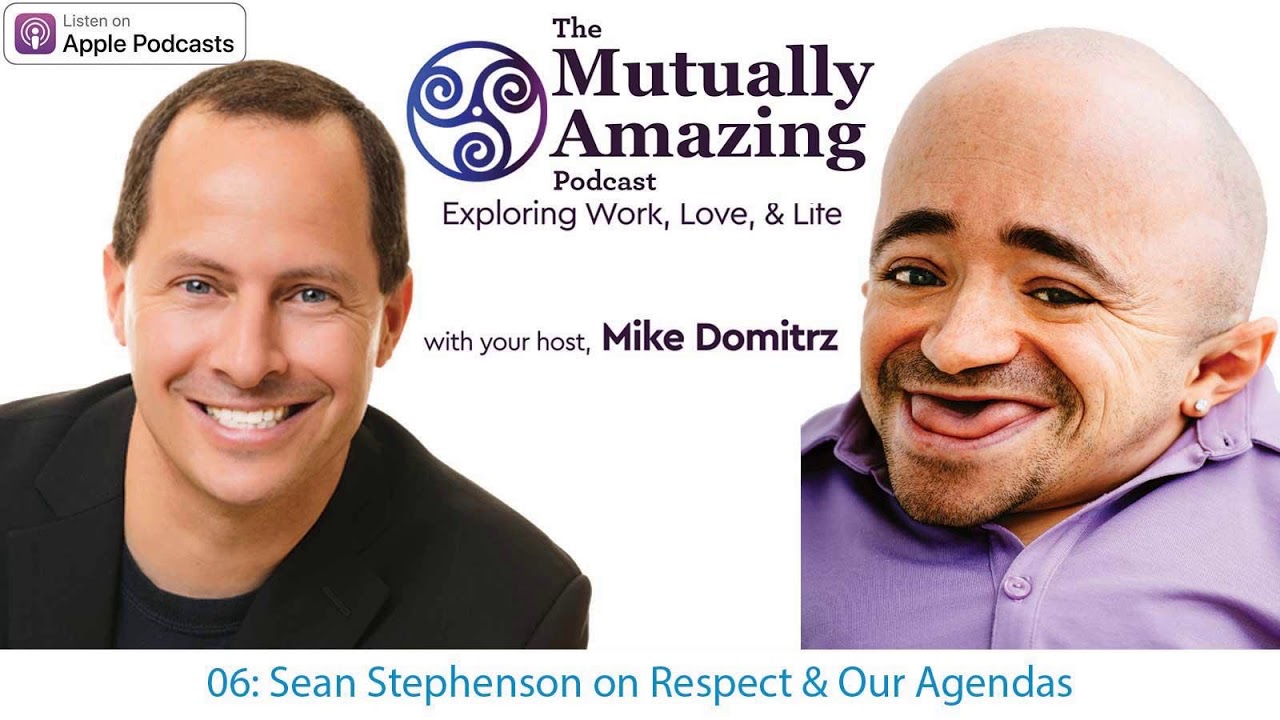
Dr. Sean Stevenson, a motivational speaker born with osteogenesis imperfecta, defines respect as acknowledging value and trust as acknowledging agenda. He argues that stating your intentions upfront, whether in sales or relationships, creates the mutual respect that people fear asking for directly.
Chapters
Welcome to the Mutually Amazing Podcast. I'm your host, Mike Domitrz, with the Center for Respect. The episode you're about to listen to was recorded when this show used to be called the Respect Podcast, so you might hear that mentioned during this episode. Well, let's get to the show. All right, I am super excited today because I get to have a friend of mine, a brother of mine, not by blood, but certainly by all other methods. We've known each other for so long. We built the early years of our speaking businesses together, up on the phone until 4:00 AM, trying to make a difference in this world together decades ago now. And so happy to have you on. So this is Dr. Shawn Stevenson, a dear friend, brilliant. You may know him because you may have seen him on TV. That's correct. For instance, the Biography Channel produced an hour-long feature on his life called The 3-Foot Giant. Giant, but he's also worked with companies like Nike, Whole Foods, Apple, Walmart, Sharp Healthcare. He's shared the stage with presidents, billionaires, business moguls, celebrities, and the Dalai Lama. It's just amazing, Shawn's story. Now, Shawn, obviously I know your story inside and out, but I'm going to let you tell the brief version of it so it comes from your authentic voice to give everybody a little background on how you got to where you are today, helping organizations and individuals really develop to where they want to be?
I'd say the most fascinating part that people get really zoned in on when they're learning about Shawn Stevenson and what I have to offer is they're intrigued by the container I'm in. That's where it starts. Being born with a rare bone disorder called osteogenesis imperfecta, also known as brittle bones disorder, doctors told my parents I'd be dead within the first 24 hours of my life. And my joke on stage is 39 years later, all those doctors are dead, and I'm still here, the only doctor remaining. And I have a very clear message to rid this world of insecurity. I've had to face a lot of my own insecurities, still do to this day. And my mentors over the years have really groomed me, and I'm so grateful that they have pushed on me. And to look at what can I do with the time that I have to make the biggest splash on this planet while I'm still here and hopefully create a body of work that outlives me beyond. And I met you, as you said, through that process of evolving. And Mike, I consider you my friend-tor. You're as much a friend as a mentor.
Thank you.
And my goal here today is to share with the listener and the viewer how I have built up an internal world that is a very peaceful space and one that I think then creates a space externally that can help that permeate into society. And by no means am I perfect. I've made a bunch of mistakes. I'm continuing to make them. As I've learned, if you're willing to observe your own ego and really work on yourself, forgive what you've done and move forward, you can really create some cool things with the time you got here.
And you have, you already have, in addition to what you will do going forward. How do you think respect played a role both in your early years, maybe where it was a struggle to figure out how, what I'm going to do here, what my path is going to be, And then on each juncture along the way.
If I could define respect for me, I think respect is acknowledging value. And the moment somebody doesn't feel valued, their body doesn't feel valued, their intellect doesn't feel valued, their emotions, their spirit. When we feel devalued, we don't feel respected. It works the same from within. So if you aren't acknowledging your own value and you aren't seeing what are you doing right, And what are you proud of? And what are you grateful for? When you're not willing to go inside and acknowledge your value and what you've created, you won't be able to respect yourself. And therefore, it's very hard to give something to somebody else that you won't give to yourself. You can do it. There's a lot of people that are nice to others that aren't nice to themselves. But it's a lot easier. To have peace externally if you have peace internally. I also kind of merge something else in with this respect conversation, which is trust. I believe that those are 2 pillars of gaining somebody's rapport, gaining rapport with them. And if respect in my definition is acknowledging value, then trust is acknowledging agenda. That if you are clear on what your agenda is and you are actually truthful about your agenda and you're not saying one thing and doing another, if you are clear on your agendas, people can begin to trust you. And then if you make sure that their value is acknowledged, the second you know someone's agenda and it's accurate and you know they respect you, you will allow them in. To coach you, to lead you, to guide you. And the moment pain arises, the moment you pull back and go, ow, why'd you do that, is the moment that somebody feels that your agenda wasn't authentic or that you actually didn't really believe that they were valuable and you were just going through the motions to try to win them over. And what I found is As long as we have that bond of this person sees our value, sees my value, and I know what their true agenda is, we can create such magic together. You don't even need to— this is what blows my mind— you don't even need to like somebody to trust them because you could see them and they could be clear about something that you're like, yeah, I don't want anything to do with them. But at least when you know what their agenda is, you know what you're dealing with. I always have a problem is when people express an agenda that's false, right? They tell a girl, oh, I love you, when they really don't love them. I care about your children's wellbeing, when they really just care about your money. And when we get those mixed agendas, and then on top of it, they don't really truly see our value, they just came up with some pat response, it's really hard to build a bond.
Let's talk about that. Yeah, let's dive into this because I can remember back in my early days and even, you know, a decade ago when I would send out an email and you'd learn from people who say, well, you know, take the email strategy this way. So, they don't really know what you're seeking is this over here. And you think, okay, they know what they're doing. I'll take that formula. And you suddenly notice, wait, nobody's wanting to respond to my emails a year later. Because you created an— you thought you were doing the right thing because you were mission-based. You know, topic-based, you believed in what you're doing, but it wasn't a clear agenda, right? You're better off to say, if you're a salesperson, yeah, this is what I'm selling. Yeah, because I believe in it. That's why.
So we sell a lot through our company. We hold live events. You're actually going to be speaking at one soon. And by the way, I've been looking forward to that for 4 years. When we start that event, we come right out and say, look, we're going to pack this weekend together with great people, great material. And then we're going to, at some point, we're going to We're going to make an offer to you that may or may not be for you. And it's only for those that want to continue the party with me. They want to continue to learn and be guided and have the kind of fun that we're going to have. If that's not of interest to you, just listen and see what you can learn about sales in general and do what you want. You are free to follow your intuition. And by setting that standard, being very clear, I'm going to ask for fun tickets. Money, right? I'm gonna ask you for your fun tickets. In exchange, I'm gonna give you more fun and learning. And is it okay if I do it in a way that you get a ton of value for what you already paid for, and I'm just sharing with you an opportunity if you want to continue the party? Is it— do I have your permission to make that offer to you? Everybody says yes, right?
Exactly, because you're being upfront. But it's amazing how when we're raised in this society, we're taught, don't do that. Don't show your cards.
Because we think it's not gonna work. Right. Because fear. It's fear. It's also because, let's be clear, Mike, and I know you know this, but the listener needs to know this, and that is human beings can make a lot of impact financially and movement By screwing people over, right? And so if you are, if you are interpreting that, oh, I need to screw people over to make movement and income, that's an incorrect statement because that's one way. It's not the way I like to roll. It's not the way you like to roll. It's not the way I think your listener would want to roll, right? But when you're naive and you're just getting your start and you see somebody and you see that they're getting financial success or they're getting more exposure, you think, oh, I guess I need to be. A jerk, right? And it's not true. That's— there are many ways to get inside a house. You can either put dynamite on the side of the wall or you can use the key. They'll both get you in. They'll both gain you entrance. One's going to have a far less devastating impact.
Yeah, that's a great analogy. I love that. And so we were talking there about the fact of how we go about being upfront and being honest. What do you think is the number one fear people have in that moment? 'Cause the agenda is everything. That's— we have agendas with our family. We have agendas with our work.
The word scares people.
Yes. Right.
They don't—
they didn't want to say, I have an agenda, right? They don't want— I don't have an agenda. That's the number one defense you'll hear. I don't have an agenda. We all have agendas.
What I think they mean is, I don't have a negative agenda, right? And so that's why you need to be very clear about The difference between empowering and limiting, draining and recharging agendas. And I think it's very healing. It's very healing to be clear on your agendas. And if I could take it into the realm of romance for a second, on my first date with my wife, I said, I would like to sleep with you someday. And she was like, What? Like, what kind of guy said— I didn't say it in a slick, gross, pushy way. I just said, someday I'd like to sleep with you. And she said she trusted me in that minute. That was the moment she realized, like, she was like, oh my God, this guy just made it very clear what his agenda was. It didn't mean that I wouldn't be your friend if we weren't gonna do that. It was no manipulation. She's like, but that was the moment I knew I could trust you because you told me an actual authentic agenda. I'd never heard a man Confidently say that. I say that same thing when I get into a sales call. I say to somebody, listen, the opportunity I'm going to offer you is going to be 10 times what you're going to pay me. So I do not feel bad whatsoever in the exchange of receiving the energy that you worked hard to gather, because I'm going to 10x what you're paying for. So I want you to know I'm going to get really excited by taking your money because I'm exchanging something way greater for you. And they're like, heck yeah, let's do this. Now, not everybody says yes, I'll pay, but everybody says let's have the dialogue.
Right.
I just want people to be excited to have the dialogue, whether it's about romance, whether it's about— whether it's about income, whether it's about progress, movement, making an impact. Let's, let's not be afraid to ask for what we want. If they say no, they say no.
How do you think that plays? What would be an example you could think of where that plays in family dynamics and putting the agenda out there?
Uh, making it very clear the standards that you set for your children as a parenting role. You know, like, I have a very clear vision of you graduating with a great GPA. I have a vision of you Working really hard on your mind, your body, and your spirit. I'm not asking anything from you that I am not doing myself. You're going to see Dad will be in the gym. You're going to see that Dad works hard at the office. You see that Dad works on his relationships with your mother. I'm not asking anything from you that I'm not willing to go first on, son, daughter, whomever. Being very clear on a vision that you hold. I think that is OK. Having a family mission statement is setting an agenda. I think it's really good to also pull the agenda out of the kid. So what do you want out of this life? What are some of your goals, sweetie? Or even in a marriage, how can I best support you? So Mindy and I— you were at our wedding. And you know that I married my wife because I couldn't afford her coaching rates. And I wanted her to coach me. Because she's the wisest, most beautiful person I know. And Mindy's goals are printed out next to my goals because I want to be able to see what's important to her every day. I want her to see what's important to me every day. And I came to her multiple times and said, let me know what matters to you on this life. I need to know what matters. And so I, I push on people to see what do they want. And so, I think when it comes to a family dynamic, making no apologies for having awesome standards. But here's the difference is nobody's going to be perfect. There are going to be so many days you're not going to want to get back up.
Yes. And kids can feel, if they don't understand this correctly, they can feel that that standard is an expectation of perfecting that.
So that is an imperfection of the communication from the parent then.
Yeah.
And not an imperfection, but just a lack of clarity. And so that's why it has to be— it's the same thing as like, I heard this great mom talking about raising a child and she said, when a child is learning to walk, funny coming from somebody that doesn't walk, but when a child is learning to walk, you have to encourage them a Yeah. A million times if necessary, to when they fall and they hit their head, they bump their butt. When they fall back, you pick them back up again and you're just encouraging them. You got it. You got it. Good job. Good job. And you keep going. And so you are both holding a standard of, you're going to walk. We're going to make this work. But also, everything that you do in the process of learning to walk, I'm going to support you and love you and be proud of you because you're You're in this process. Okay. And so when the kid's like, but you have this vision for me, say, yeah, but not a day goes by where I'm not going to celebrate you for just being who you are. You don't— I love the quote by Byron Katie. There is nothing that you can say or do that can stop me from loving you.
Absolutely truthful. Any, any parent, any loving parent should get that message 100%. And I love that you say to them that, hey, When you tried to walk, I lifted you back up. I supported you. I helped you do that. I'm going to do that with whatever battles or mistakes or failures that you have. And I'm going to celebrate your successes, but I'm also going to be there. You're going to fall. I fall in some way or form every week, every day, in some way or form. There's a, there's something that doesn't go right.
Yeah. And there's, there's something that I also like that has been a caveat when I'm working with people is to say, and at some point when I'm, coaching or in their therapist or their friend, at some point in the process, sweetie, you're gonna blame me for not being where you should be. And I want you to know I'm gonna love you even when you blame me. And I'm just gonna patiently wait until you realize that I'm not the reason why you don't have what you want.
That's powerful.
Yeah, I'm not the reason why you don't have what you want, even, even how you feel, right? I love my wife. I know you love Karen, right? But yet we are not responsible for their feelings.
Yeah. And that, that one is huge because a lot of people feel, wait a second, I'm married. It is part of my responsibility to be responsible for their joy and happiness. But more and more research has shown that actually creates an unhealthy relationship. You should be able to be happy even on their worst day. They should be able to be happy on your worst day. And you should obviously be able to be, you should be able to be unhappy on their best day.
Yeah. In our marriage, Mindy and I call it this, you need to be a self-cleaning oven.
Yeah. Right. I love it. But it's hard to do. It's hard to do. Cause you, like when you're on cloud nine, right?
It's hard not to do. It's hard. Yeah.
I mean, you and I just had a conversation before we started this. We're both on cloud nine right now because of things going on in our in our work and organizations. And the day that cloud nine pops, we're like, woo, this is going amazing. And the, the last thing you want that moment is your partner to go, well, it's not going amazing for me, blah, blah, blah. And we're like, not today. You shouldn't be saying that today. This is my day to be cloud nine.
That's the way I used to be. Yeah.
I've made the mistake. Absolutely made the mistake. And it's not fair. They're experiencing their life in their moment.
Talking about respect, the moment you are disrespectful Which is acknowledging, right? The moment you are not acknowledging a human being— it's not even— it's not even valuing, now that I think about it. It's acknowledgement in general. It's the moment you don't acknowledge their feelings, acknowledge their ideas, acknowledge their statements, acknowledge their mannerisms. The moment you stop acknowledging them, you deal with problems.
Yes.
You deal with problems because, look, I can be on cloud nine. And if Mindy's not, the most loving thing I can do is to listen to where she is, because this is what partners do. Though sometimes— and we don't mean to do it— but sometimes it happens where we try to see if we can rock that person out of their good day because they're pissing us off, right? And the most loving thing I could say to her, and she said to me before, is, babe, I love you, and I'm not gonna come down in my frequency. Because that's not going to pull you up.
Yeah, that's brilliant. Love it. It's so hard to do, right? I mean, what's interesting is when we're on cloud nine, it should be the easiest time to be compassionate because we have all this energy, but yet we get caught up in, let me be in my place, right? Let me be in my place. Don't you dare dent that.
That, that right there though is from the psychology of the outside world can control my feelings.
Right.
Because if you don't— like, I don't buy that anymore. I used to, but I don't buy it whatsoever. And so the moment I think that somebody can take me out of my bubble, I'm delusional.
Ah, so can you go a little deeper there so everybody can understand? Because this is key to respecting yourself.
Yeah, yeah. The moment I think you can shift my frequency is the moment I become a slave to you. The moment I be— I go on a roller coaster, that is what he— where you can energetically manipulate me. And it's the moment I'm delusional. You are not responsible for how I feel. You can neither make me have a good day or make me have a bad day. You can influence me, but you can't change me. I have to do the lifting. I— nobody can do Sean's push-ups energetically or metaphorically or physically. I have to do them. And so if I'm on cloud nine and I come home and Mindy is angry or overwhelmed or upset, and I'm like, damn it, why can't she be on the same plane as me? I am being delusional because she doesn't need to do anything to support my bubble. That's my responsibility. Now, I might say to her, babe, if you would like me around this evening, I'm gonna need you to say some nicer things about me. If you do not want to say nicer things about me, I'm okay with going out and doing some things in the office or whatever. And I'll— just text me when you feel that the storm has rolled out.
Right. Because this is, this is really important for abusive situations, right? Because we don't— you don't want the person listening right now thinking, oh, I have to tolerate. They're in their space. I'm in my space. So I have to tolerate that because I'm responsible for my happiness, they're responsible. So how do you help people understand there's a difference here in what we're describing?
Light is both a wave and a particle. So is light one or the other? No, it's both, right? So you need to be able to respect your own boundaries and also maintain a level of a standard for how you want to be treated, right? So no one is responsible for how you feel. But you are responsible for respecting your boundaries and saying to somebody, if you're going to speak to me that way, or if you're going to ever put your hands on me, or if ever you're going to try to do that demeaning behavior, I'm out. I may be either out for the night, out for the month, or out for my life. But you got to determine. And I look at it whether it's in a relationship that could become abusive, because I've been in abusive relationships where I was mentally, emotionally abused. I can tell you it came because I only had half the equation. I thought it was only a wave or only a particle. I thought, well, I need to be responsible for my own feelings so they can keep beating on me emotionally, energetically. Then I woke up and went, whoa, whoa, whoa! That's only half the equation. The other half is I've got to draw a line in the sand and say, this is the level of respect that I request out of human beings that are in my presence. I tell people constantly, you don't have to worry about knowing where you stand with Shawn. I'll let you know.
Right. So let's say the person who is in an abusive situation, since we went there, uh, is in an abusive situation and has serious physical fear. There is actual danger to their life. So there is the separation of, geez, if I say those words, they could kill me in the next hour. And there is it, that at least I know those words to be true to me. That maybe I am not in a place that I can verbally say those words right now, but I know them true to be— to be true to me. Is that the key there?
Yeah. Well, and it's deeper than that, which is it starts within you first.
Right. It's starting to know that I deserve to be treated a certain way. We're not saying that any blame at all on the abuse. You're referring to it starts with me knowing I deserve to be respected.
We're talking about your own worth and value.
Right. Correct.
That starts within you. And then if you are in that toxic place, let's talk about that, because I've been in toxic places. Sometimes it takes a while to plan your escape, and you need to be loving toward yourself in the process. It's kind of like the movie Shawshank Redemption. It took them a long time to chip away at that wall and let the little rocks out in the, in the yard. And sometimes that's what people need to do. Now, sometimes it's so dangerous that they got to figure out a way to get out there faster. And neither you nor I are in any of these people's shoes. So we're not saying we have 100% understanding of them. However, we have 100% appreciation and acknowledgment of the pain they're in. And I personally believe That negativity, and all violence is is negativity that's just not been dealt with over time, and then it just gets worse and worse and worse and worse and worse. Usually nobody nobody starts out violent; it's it's built up over time. Now, when you meet somebody who is verbally, physically, emotionally, sexually, intellectually, whatever it may be, manipulative and abuse abusive. That was a stew that they've been cooking in for a long time. And that doesn't make it right. But what I have learned in working with these people as a therapist is some of the best things that you can do is know that you need to keep yourself away from toxic people, toxic energy, toxic places. And sometimes it may take you time to plan your escape, but you better have a plan. You better know how you're going to get out of something that is dangerous, either physically, emotionally, or any of those other levels. And I will tell you, it takes courage to leave something that you, you fear. The fear for your life is something that's so clear for people to see. But what about people that are being abused spiritually, energetically, emotionally? They don't leave scars. Mean words don't leave physical scars on the body for the police to see. And so that's sometimes just as hard, if not harder, to be like, wow, I need to get away. This is killing my soul. This is draining me. And what it really comes down to for me and what I've experienced, speaking only for myself, is what do you want from life? What do you want from other people in terms of what standard are you willing to hold? Mindy would have never entered into a relationship with somebody that was physically abusive because the moment somebody was even slightly degrading to my wife, she would have been gone in a conversation. She would have never given them a second date and never responded to their calls, like, because she has such a high threshold bar of how she will be treated.
Right now, I want to be clear, if someone's listening, we're also not implying— because you don't have— you did— you weren't taught that bar That it's your fault. Like, many did it right and you did it wrong. It's a matter of, no, can I shift now? Can I shift the paradigm to know I deserve to always be treated with that dignity, with that respect? Because I can choose that this roller coaster doesn't have to exist forever. There's a point I can choose to get off. That's the planned escape. There's a point because I deserve to be treated. So how do you help someone? We're getting towards the end here, and I know it's tough to do quickly. In 30 seconds to a minute, what's a gift you can give someone To help them realize their value?
Yeah, it's what Mindy had to do, and anybody would have to do to get to that level. It's— you have to have impeccable self-care. If you take care of your mind, your body, your spirit, you are exercising to pull out the toxins, you are journaling to acknowledge your own feelings, you're meditating and praying, you're surrounding yourself with empowering people, you are reading empowering messages, you're listening to programs like this, you are continuing to put yourself in empowering environments, it makes it easier and easier to head in the right direction. Because if you want to respect yourself, then you have to take care of yourself. You wouldn't trust a nurse or a doctor that didn't take good care of you. You have to be the great person first to take care of yourself first to get the strength to know what you deserve.
Love it. Thank you, Shawn. Now, for all of our listeners, your book is Get Off Your Butt. It's an awesome book. And people, it's not just talking about the physical butt, it's talking about the butt I would, bud. And it's sensational.
Easy.
Yeah, it's sensational. In addition to your own book, what's a book that you think is a game changer for people's lives that had a major impression impact on your life?
I would say The Four Agreements by Don Miguel Ruiz.
Awesome book. Yeah, yeah. So we'll have that link for everyone listening. Sean, you know how much I love you. Thank you so much for sharing with everybody on today's show.
Absolutely.
We'd love to hear your questions, your thoughts, and your ideas. And the best place to leave those with us is on our Facebook page at facebook.com/MutuallyAmazingPodcast. Of course, you can always contact us on our website at mutuallyamazingpodcast.com. Remember to subscribe to this show so you automatically get it every week. And if you could take one moment to leave a review, that really helps other people find the show. Which we are greatly appreciative of. So thank you so much for joining us. May you make today and every day a life full of mutually amazing relationships.
Thank you.








