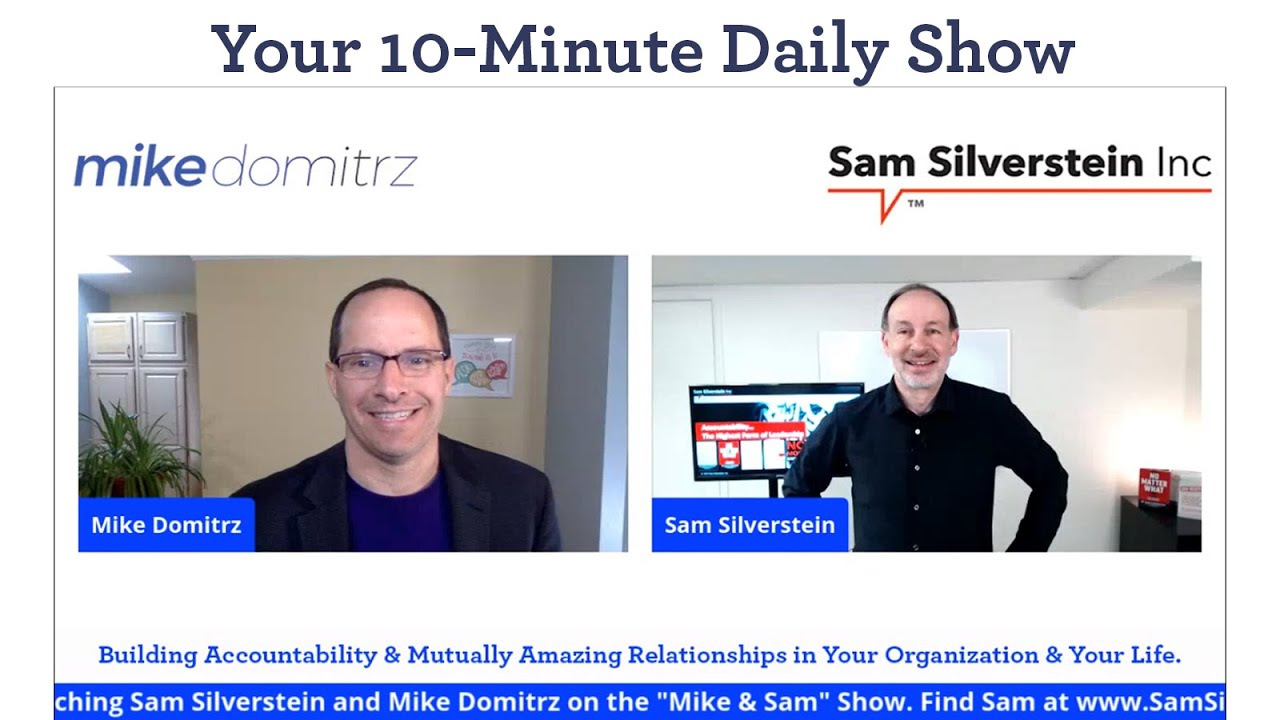
In this episode of the Mike and Sam show, hosts Mike Domitrz and Sam Silverstein examine Benjamin Franklin’s quote “Well done is better than well said.” They debate its meaning, noting that while the quote emphasizes action over words, it can overlook the power of acknowledgment and positive language in motivating people. The conversation expands to the challenges of staying productive while working from home, including isolation, distractions, and emotional fog. Both hosts share personal strategies for maintaining focus: setting a weekly priority, asking the “focus question” (what must get done this week), using the “eat the frog” technique to tackle the most important task first, practicing gratitude, and gently returning attention after distractions. They stress the importance of both doing and saying the right things—recognizing achievements while also getting work done. The episode ends with a call for audience interaction, reminders of the show’s schedule, and a request for reviews.
Chapters
Hello and welcome to Mike and Sam. It is Monday today and we are going to discuss a quote by Benjamin Franklin I have right here in my hand. So let's talk about that quote. The quote is, well done is better than well said. Benjamin Franklin. Uh, Sam, what do you think of that quote?
It's a good quote.
I I'm not so sure it's a good quote.
You're looking for more. I know you're looking for more.
No, it's not even that.
You know, before we even get into it, the thing that gets me about quotes is what's the context? We don't know what this was said in context to. I said it's a good quote because, well, it's Benjamin Franklin, and come on, how, how, how can you, uh, how can you downplay Benjamin Franklin? Um, but what's the context? I think in this situation What Benny's trying to say is that it's not about talking about doing something. It's about getting the job done. Don't just talk about it. Do it. Get it done. And I think that we see ourselves in a world many times where talk is cheap. People are talking about stuff. Oh yeah, I'm going to do this. I'm going to do that. Well, are you doing it? Are you taking the steps necessary? Are you making the changes that you need to be making? Are you learning what you need to be doing? Are you getting it done? Bottom line, are you getting it done? All right, I'm gonna say yes.
I'm gonna say yes, and we're allowing an improv game because I believe that all that's true. And the problem with that quote is it's disparaging and it's lacking the understanding of how powerful our words are and what we say does matter and the impact that it has on people. And so I think when people say well done is better than well said, Actually, if you do an amazing job every day at work, and your supervisors, a lot of people, their supervisors or managers do not give them credit for it, do you know what will happen? They will do less quality work down the road is what time will tell us, because they will feel less valued. Self-esteem will go down; people's productivity will go down. So I believe it's well done and well said. And that's the key to success.
Well, and, and so this is what makes it very interesting is, is obviously in any of these situations with a quote, you can What's in between the lines? And I want to thank Blake for popping in and sharing that comment. Thank you, Blake. And for others, feel free to post whether you're on YouTube, whether you're on LinkedIn, whether you're catching us on Facebook. Put your comments in. They show up. We love to have a conversation. We love to hear what your thoughts are. Maybe you have a different take on this. We want to hear what your take is.
Yeah, and if they didn't jump in right away, I want to make sure they know what we're talking about. The quote, well done, is better than well said by Benjamin Franklin.
And so I think we're looking for an argument here. And so the argument—
You and I argue, Sam?
No, never. We would never do that. But here's the thing. Let's go to, you know, it's not always what you say, it's how you say it. And so I think that's also important. I think it's important to say things properly. I think it's important to be kind. And as your point, and I agree with you, it's important to acknowledge people. acknowledge what they've done, what they've accomplished, their importance, their successes. It's real easy to pick on all the negative things, especially when we're under the gun, when we're under pressure, as so many of us are right now. And when you use the right words at the right time, you can make a big impact on people. And while I don't think that Benjamin Franklin was trying to Ignore any of that. And I don't think that's what he was addressing in that quote. I do think the quote just gives us this great foundation to have this conversation about both the activity of speaking with people, acknowledging and communicating, and the importance of simply getting it done.
Yeah, and that is so important. Why do you think people struggle with getting it done? I think right now, this is a really powerful conversation because People are struggling to get it done because of what's happening emotionally. Uh, they are in a fog. They are in a place of loss. I saw a really powerful quote the other day that said the— uh, in fact, it was just the other day, a meme that said your, your version of productivity is based on the norm of 3 months ago. That is not the norm of today. Therefore, be sort of— be compassionate to yourself. And yet we need to get stuff done. Like, if you're going to be productive during this, you got to get stuff done.
Well, yeah, there's multiple things here. One, being productive at home in an environment where you are not— where you are A, not alone, and B, not with coworkers is totally different because you're— if you're— first of all, when you're with coworkers, you inspire each other. You can encourage each other. You can help each other. I don't have to text you. I don't have to call you. I can just simply say, hey, Hey, Mike, what happened with this or with that? Many times, if you're within shouting distance. And so, the speed, productivity, communication is so much quicker. The other thing obviously is in working from home that there's just, if there's kids at home, if there's someone else trying to work from home, there's distractions. If there's someone that's not working from home and they're just watching TV all day, no matter what it is, there's so many things that do get in the way. And so, I think that we have to acknowledge that. And if we don't acknowledge that, we're kidding ourselves. The key though to me to getting it done is going to come back to focus. What is it that we're focused on? We put things off. I know I can fall into that procrastination trap. So, the question becomes, am I focusing on what I can't control or am I focusing on what I can control? Because in that moment, if I'm focusing on what I can control, then I can say, okay, well, this is what I can control. This is what I can do. I'll get this part done. Let me get this done. And then once I complete that small step, then I can move to the next.
Yeah. And we have to also keep in mind that you and I both have people at home with us, but there are people out there who are not at work, working from home and alone. And that can be really tough because sometimes the kids and the spouse and all is at least human beings around you. And that brings a quality to the day that when you're alone, alone, and you don't have your work people with you, oh, it could just feel like, what is it? Why do I matter? I'm on an island.
Well, and that's why society's greatest sentences in jail is solitary confinement, you know?
Right.
That's where they put you. And so there's a reason for that. And so solitary confinement at home is certainly not good, not good for us. And all those things come into play. So, but let's go back to that original quote. Let's go back to—
Well done is better than well said.
And so, let's acknowledge that, yes, we need to compliment people. We need to acknowledge what people are doing. We need to communicate with people. But how do we get done what we need to get done right now? What are the 1 or 2 things that you would focus on, Mike, so that you can get done what you need to get done?
Yeah, I always like, I always like the question you brought in, which is the focus question, which is if there was only one thing I was going to get done, I'll say not today, I'll say this week, because that really tells me my focus. If I think today, then I might be losing the big picture and only the short term. If I think only a year from now, I might be only thinking the long term. But when I say if nothing else gets done this week, what must get done, it tells me this week's priority. Okay, now what can I do today about this week's priority? And so it allows me to make it both long-term and daily. And, and then the key is do it immediately to start the day, right? The old eat the frog first to start your day is absolutely true with this, because otherwise other things come in and these distractions we're talking about can take over our day. I know that if I don't do it right away, there's a good chance It's not going to get done or it's going to be rushed later in the day. And I'm going to be working late at night when this could have been done a lot sooner. What about you, Sam?
Yeah, you know, and I just noticed Roger said focus is key and can be hard with interruptions and distractions. And that's really, that's really key. And I think, I think that if we look at that, what's, you know, you know, I start every day with saying, asking the question, what am I grateful for? What's the one thing that I that I have to complete, that I have to get done today. And then I think distractions are good. I think they're okay. And I think that's reality. And I think what we have to do is just be mindful and recognize, okay, I've been distracted. That's fine. I got a little mental break. Now I'm going to return my focus. And so once you've identified what it is that you want to achieve this week, what you want to achieve today, Just when you get distracted, step back. Don't tear yourself up. Pat yourself on the back for recognizing it. And then let's get our attention back on focus so that we're not only well said, but we're also well done.
I love that, Sam. What a great way to wrap up today's episode. And folks, you know, we'll be back tomorrow, 1 o'clock Central Time. Find us on youtube.com/SamSilverstein, youtube.com/CenterForRespect. And of course on iTunes, Mike and Sam, we would love, love, love for you to put reviews on iTunes. That helps us go up the search engines and that helps people find Mike and Sam.
Tomorrow, as an exception, we'll be on at 11 o'clock Central Time, just a reminder.
That's right. Thank you for correcting that and catching that. Way to be on focus, Sam, and get it done. Take care, everyone.