13: Bruce Turkel discusses Respect in Advertising with Mike Domitrz
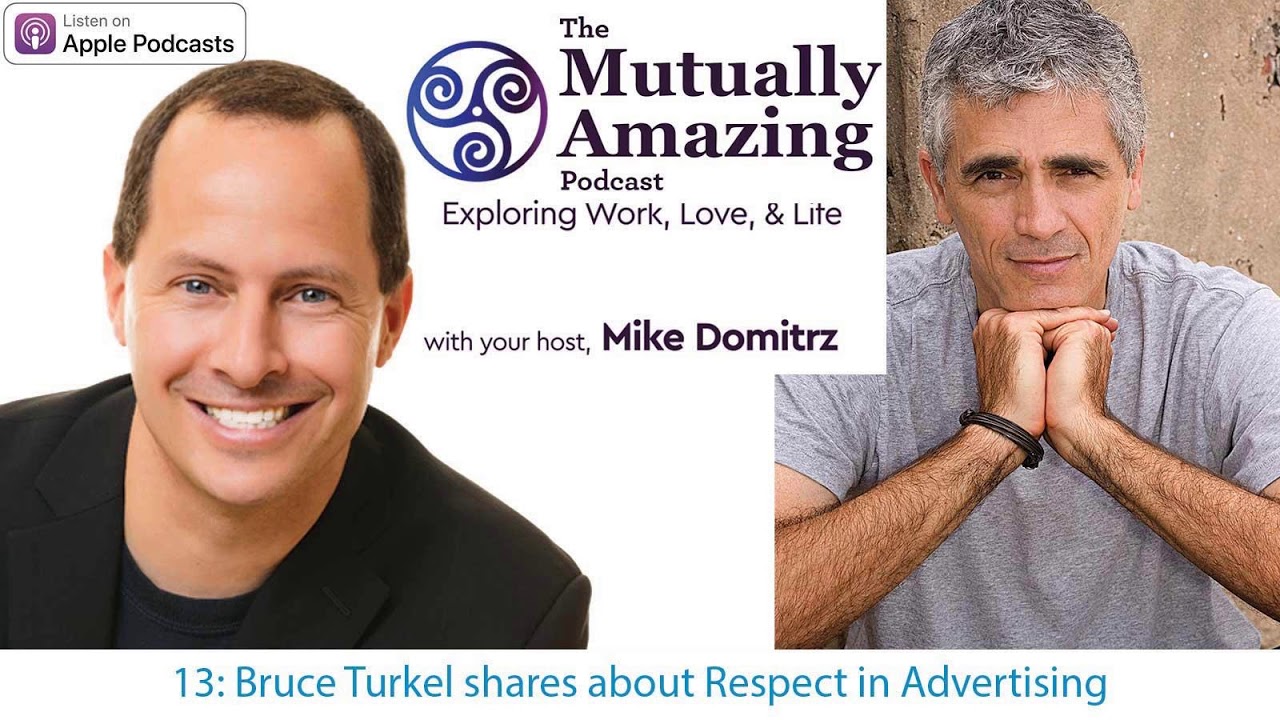
In this episode of the Mutually Amazing Podcast (formerly the Respect Podcast), host Mike Domitrz interviews branding expert Bruce Turkel. The conversation explores the dual nature of marketing—positive (engine of the economy, providing value) versus negative (manipulative, selling unwanted products)—and positions respect as the essential differentiator. Turkel argues that respect is not passé but is being sidelined by cheap, brutal communication tactics that prioritize speed and impact over dignity. He links this shift to broader cultural and technological changes, noting how new media (TV, internet, social platforms) initially repeat old paradigms before evolving. Leadership is highlighted as the catalyst for restoring respect, with examples such as Starbucks’ response to a racial incident and Dove’s body‑positive campaign. Turkel introduces his "All About Them" philosophy, explaining why marketers often fall into self‑centric messaging (personal insecurity, pre‑internet necessity to self‑promote, lack of training) and offers practical steps to become consumer‑centric, including the CC2CC framework (Company‑Centric → Consumer‑Centric). The dialogue also touches on the democratization of voice via social media, the importance of serving audiences with useful, entertaining, or editorial content, and personal influences that shaped Turkel’s respect ethic (parents, music, books). He recommends three books—"Orbiting the Giant Hairball," "Designing Your Life," and recent reads like "The Undoing Project"—that inform his thinking. The episode concludes with calls to action for listeners to engage with the podcast.
Chapters
Welcome to the Mutually Amazing Podcast. I'm your host, Mike Domitrz, with the Center for Respect. The episode you're about to listen to was recorded when this show used to be called the Respect Podcast. So, you might hear that mentioned during this episode. Well, let's get to the show. This week, we've got a very special guest, also a friend of mine. I love having friends on the show. That is Bruce Turchiello. He's a brand builder, keynote speaker, TV commentator, and author. If you watch any business news on cable, you've probably seen him, whether it was MSNBC or CNN or Fox News in the past, you've seen this guy. He's also— I've gotten to know him and I realized he sees things others of us just don't see. And that's one of the cool things about getting to talk with Bruce. So Bruce, thank you for joining us.
Thanks for inviting me, Mike. You're right. It's fun to do this with friends.
Absolutely. And you and I are going to get into a decision you made recently and publicly via blog. It's really powerful. Before we get into that, I want to talk about how you view respect and its role in advertising and marketing. For everybody watching and/or listening, Bruce is a guru in the marketing branding world. That's what he's known for. He's worked with some of the largest brands in the world. How do you feel that respect plays a role?
You know, there's 2 ways to look at marketing branding. I think there's 2 ways to look at a lot of things. There's the positive way and there's the negative way. And you hear people talk about the negative way that advertisers and marketers try to convince people to buy things they don't want, don't need, and can't afford. And that's certainly the negative way of doing it. Or you can say the positive way, which is that advertising, marketing, branding is the engine of the economy. It's what keeps people interested. It's what keeps people involved. It's what keeps people engaged. If you're running a business, it's what allows allows you to actually provide the products and services that you provide because people are interested in them. If in fact you're a consumer, it allows you to find out what's out there, what's available. It also subsidizes a lot of media that we take advantage of, whether it's radio or television or online or any of the things that we don't pay for. Part of the reason we don't pay for that content is because of advertising and marketing. So I, of course, prefer to look at the positive side of it. That being said, then respect becomes very important because if you're going to do this from a positive point of view, then in fact you have to be careful not to be selling people things they don't want, don't need, and can't afford, but instead to be demonstrating to people why your clients' products and services, or why your products and services actually will make your customer's life better. That's what the respect is about. You're providing something of value. I tell people that when I speak, when I write, when When I commentate on television or when I create marketing campaigns, I want the stuff I do to be useful. I want it to be valuable and I want it to be enjoyable. In order to accomplish those things, it has to be respectful as well.
What percentage of advertisers that you see out there, companies selling, do you feel fall into that negative stereotype that brand is such harmful viewpoint of advertising and marketing that people get? You know, the old stereotype, which could be unfair, that used car salesman stereotype. How many people do you feel that are out there? What percentage that is manipulative, that it's not based on respect, that it's based on emotional and psychological manipulation just to sell?
As soon as you use the word percentage, then you're asking for metric metrics that I don't actually have. I don't know what percentage. I do know that often the pieces we remember, the pieces that put a bad taste in our mouth, tend to be those. I mean, you used as an example the used car salesman. Now you're thinking of the sleazy guy, the polyester jacket, the sleeves rolled up, and the guy who's just trying to get you into a car and get your money. But again, think about the other side. You have to get your kids to school, you got to get to work, you want something safe, you want something reliable. A used car salesman who knows what they're doing and is intent on providing service is not like that at all. But what do we remember? We remember the negative stereotype, and there's plenty of it. Believe me, I am not making excuses for for the industry or for the negative practitioners. I'm simply saying that what a lot of us do, in my opinion, actually makes the world a better place.
Oh, I agree. And that's why I said that whether it be an unfair reputation of that used car salesman, because we buy used. So, I'm not somebody that runs from a used car salesman at all. If you find the right person, they're wonderful and they get— they do take care of you very quickly. But it is, you're right, it's that negative impression people have. About—
that's right—
marketing advertising. Because the media environment is so confrontational right now, do you think that respect is passé?
Passé? No, not at all. I think respect is less and less prevalent. I think what's happened is there's an old political saying, there's no margin in the middle. And I think what you find is that a lot of the practitioners will avoid names for the sake of whoever's listening and might have an opinion different than mine. A lot of the practitioners are using the basest, most brutal forms of communication because they're always easier, cheaper to use, and they always hit hard. I mean, getting hit with a bat is a pretty low-level communication receipt, right? If I want to convince you of something, I could try to convince you. I can quote the masters, I can give you good information, or I can hit you with a bat and say, if you don't believe me, I'm gonna hit you again. It works. It just doesn't work well, and it's a brutal backward-facing way of getting your point across. And I think that's what we're seeing now. We're seeing that so many of these backward-thinking strategies are working that people are utilizing them. So no, I don't think respect is passé at all. I think that respect right now is taking a backseat in many instances to things that maybe work a little quicker and a little stronger, but don't ultimately work better.
So there's a documentary out now at the time we're recording this on Mr. Rogers called Won't You Be My Neighbor? And this discussion is actually prevalent to that because he talks about when TV came forward and really hit its mainstream, how it was the lowest forms of comedy that TV was turning to— the pie in the face, the violence, the cheap violence. And he was so offended that why would such a wonderful tool Why would a wonderful medium be used at the lowest common denominator to spread these messages? And that's sort of what you're saying right now, is that there's so much of that lowest level being used, uh, that it's overwhelming. And you— so the question became in the documentary is, can there be a place? How do you get back to that place where respect can be at the forefront, where you can think on a higher intellectual level in the advertising? What do you think it would take? for marketing advertising to have that paradigm shift, to go to a place that's really built on respect, dignity for the consumer, for people watching?
I think what happens is over time, technologies and use of new technologies adapt, and they adapt progressively and get better and better. So when movie cameras were first created, the silent movies, all they did was record plays. Because plays were the way— theater was the way you presented a story. And it never dawned on anybody that you could do something different. So what did they do? They set up the camera, they set up the tripod, and they filmed the play. Then someone said, wait a second, we don't have to keep this camera in one position. We can actually take it outdoors. We don't have to make believe we're on a wagon going to the Wild West. We can actually go out and film it. And they went out and changed the way they did that. When television took over from movies, took over from radio rather, what did they do? They took the same radio characters, the Amos and Andys and the Lucy Balls and all of those who were on radio, and they simply put them on television because it never dawned on anybody that you could create a new paradigm, a new visual language with this new technology that you had. And what we're seeing now because of where the internet has gone is that people are saying, okay, I have this new technology. I can go on a Facebook, I can go on a LinkedIn, and I can change people's opinions. And I— same thing that marketing and advertising has always tried to do. And what did they do? They use the old tools and techniques. But over time, what happens is those things fall by the wayside as people start to see different ways of utilizing the tools. Now remember, there's an old saying in marketing: does marketing take its cues from popular culture, or does popular culture take its cues from marketing? Meaning, if you see somebody wearing an outfit on television that you like, you go out and buy it, or you took your cue from popular culture, or are the people who are putting out popular culture walking on the streets and saying, oh, I like what that guy's got on, and then moving it into popular culture? And my answer is, it doesn't really matter. As I see it, it's a back and forth. It's a constant give and take. So if what's going on in popular culture is of a lesser respectful nature, less of a regard for people's individual rights, people's individual space, however you choose to define it, then you're going to see that reflected in popular culture. And then of course, the popular culture— I'm sorry, the actual culture builds on popular culture and vice versa. As you see respect returning to the mainstream, you will also see it happen more and more in marketing materials. It's a constantly moving, constantly self-perpetuating, self-feeding process.
And what do you think it's going to take for respect to come to the forefront in either one so that that cycle you mentioned, you know, If it comes to the forefront in society, then marketing will follow, or if marketing leads, what do you think it's gonna take for that to happen?
Leadership, people standing up and saying, this is the way things go. I mean, if you think about respect, if you think about respectful behavior throughout history, you can find certain benchmarks in history based on people, based on leadership, and whether it's religious leadership or political leadership or business leadership or technology leadership or medical leadership, Irrelevant. You can find the different fence posts— signposts, rather— where respect, concern for the other became the way you get things done. Conversely, you can also find times in history where the opposite was true, and you can see where those trains were driven, to completely mix my metaphors. And if you think about the statues in a park, You never see a statue with a group of people pointing in any direction. In fact, the only statue I can think of with a group of people is the flag raising at Iwo Jima, where all the GIs— the Marines, rather— are putting the flag up. Every other statue is one person, tends to be male, but that's because of the way history was written, right? But one person on a horse with the sword pointing, because it's these leaders that show us the right way to proceed, the right way to move forward, and the right way to behave. Unfortunately, it's also leaders who drag us backwards and show us that the other works as well.
Yeah, my wife was driving by a billboard this weekend and stopped and took a picture because the billboard— and I'm paraphrasing— was a simple statement but powerful. Something along the lines of, who I love should not be able to get me fired. That was the whole billboard. And you thought, wow, that's a power— that's an important discussion. We obviously— and the line of work I do, we believe strongly in that. Respect and dignity for all. But you don't see a lot of billboards like that. That are— if you do, it tends to be, as far as from a moral or civil comment, it tends to be of a religious organization.
Well, remember that for a billboard to be there, someone had to pay for it.
Right.
And so in order for it to be paid for, it has to be an institutional viewpoint, because you're not gonna pay for it. A billboard costs between $3,000, $10,000, $20,000, $30,000 a month. You have those good feelings that who you love should not get you fired, but are you willing to reach into your bank account and buy that sign? You're probably not. So most opinions that you see in popular marketing tend to be institutional businesses, governments, associations, religious institutions, and so on and so forth, because they're able to put their money where their mouth is. They're able to go out to their constituents and say, we are going to promote this view. Viewpoint. What's changed in today's society is social media. Social media has completely democratized communication and completely democratized information and completely democratized the individual's ability to go out and make a message. So one person can go out and say something on social media that we never could do before. This, this broadcast that you and I are doing is a perfect example. Neither one of us is investing the kind of money that billboards would cost to get our opinions out there. And so what you're going to see is more and more popular speech become more and more widely disseminated. Of course, when that happens, you're talking about non-sophisticated marketers who don't understand how to use marketing tools yet, and they're out there screaming into the chasm and hoping they hear something back other than their echo. And what gets somebody to scream back the quickest? Being provocative, saying something that will clearly upset somebody else. That's how you get the back and forth if you don't know how to utilize creativity, if you don't know how to utilize psychological tools and techniques to get people to pay attention. And so as this social media gets us more and more democratized, what you're going to see is more and more low-level marketing until the populace learns how to use the tools.
How do you— who do you feel is a good example of somebody that is leading from a moral conviction and getting messaging out there? I can think of one that for the past decade, it was the Dove campaign. And the Dove campaign had the, the women in underwear and saying all shapes and sizes, that everybody is of value, that we should be able to love your body. And actually, I know Stacy, one of the original women in that campaign, is a friend and a fellow speaker, an NSA member. They were leading the way at that time. Who do you see leading the way right now? Who are some top brands that you see saying, hey Mike, they're taking on social issues and in doing so maybe taking risks, but it's in alignment with what they believe institutionally?
Well, it's not only through marketing, it's also through corporate behavior. So for example, we saw what happened when Starbucks had that issue, I believe it was in Philadelphia, where 2 African American patrons were waiting for a friend didn't purchase anything. The manager called the cops, and that became a big issue. And we find that offensive on a very basic level, right? Which is that didn't happen to the white patrons, it happened to the Black patrons. Therefore, we're all offended. But it was offensive on even a greater level to Starbucks' authentic truth, which is that they provide what they call the third space, the place you and I can go and have a meeting and use a bathroom and have a cup of coffee and chat and air conditioning and lights and Wi-Fi and all of that. So in response, Starbucks could have very easily said— Howard Schultz could have said, it's one store. It happened once. It was in Philadelphia. We have— I don't know how many stores they have. We have 28,000 stores around the world. Come on, give us a break. But he didn't do that. Instead, what he said was, this is unacceptable. He didn't blame the manager. He said, we have not done our jobs making sure that everybody in our universe understands the way we treat our patrons. And therefore, we are going to commit ourselves to providing a respectful environment. They closed all their stores for half a day. They did training to all of their employees. They are committed to continuing training. They committed— they've already hired 10,000 veterans. They're committed to hiring another 10,000. They're committed to hiring another 10,000 inner-city Black, Hispanic, and other minority workers. They are committed to keeping their bathrooms open for people who don't have access to bathrooms. They're doing it on every level. It's not simply look at our advertising, although the advertising reflects exactly what they're talking about. And they're not making jokes about black coffee, you know, which they could, right? Because that's the quick way to get that message out. But instead, they're saying, this is who we are, this is what matters to us, and this is what we're going to do about it. But why? One guy. It was Howard Schultz who came back from being, you know, he had moved from CEO to founder to chairman of the board to whatever, but he came back and said, no, no, no, it's not going to work this way. Here's how we're going to do it. One guy on a horse with a sword.
And your book's all about this. Your latest book title is All About Them, right? Which is what we're talking about right now. They made it about their alignment of their customer and their client and their demographic, not about just getting out there and defending themselves. That would be all about me, right? That's not who I am. That was one fluke like you're describing. So when we talk about All About Them, what do you think, why do you think we fall into the trap of whether you're a speaker, an expert, a big large institution, organization, of getting— making it about ourselves, right? Look at me, look at my product. Why do we fall into that and how can we be more aware and present to making it about them? What are steps we can take to make sure we're making it about them every day?
Well, there's 3 reasons why we do it. The first one is just personal insecurity. Look at me, look what I've done because I need to build myself up. I need to feel good about myself. That's for a different show and people with different expertise. Um, but the other 2 reasons that we do it— reason number one is because in the old days, read pre-internet, if you didn't blow your own horn, if you didn't tell people who you were and what you did, who was going to tell them? There was no way for anyone to find out about you. If I was interested in having Mike Domitrz come and speak at my event, how could I find out about you other than calling you? And saying, hey Mike, would you send me a videotape? Would you send me a brochure? So you needed to go, look at me, look at me, look at me. But today, before I call you on the phone, I know everything I want to know about you. And the key is that I want to know, because some people go to your website, go to YouTube, look things up, go to Google. They're what we call the belt and suspender people, right? They wear both because they want every detail. Other people don't care that much. They don't bother. But you being out there yelling, look at me, look at me, look at me, look at me, is a fool's errand because that information is available. I mean, we used to say, imagine if we each had a magical device that knew everything. Siri, Cortana, Google, Alexa, Echo know everything. So being out there and yelling, look at me, really is no benefit to it. That's reason number 2. Reason number 3, the simplest one of all, no one taught you this. Nobody said when you're marketing, when you're branding, when you're building your business, stop talking about yourself. You know about it when you go on a date. You could be that guy on the date who says, yeah, I did this, then I did this, then I did this, then I did this. But you understand that if you do that, the conversation is not going to go very far. But when we talk about our businesses, nobody said to us, look, here's the way you do it. But look at the best advertisers. Look at how they promote themselves. And what you'll see is They never talk about themselves. Apple does not tell you why their computers are better. They don't talk to you about speeds and feeds. They don't talk to you about technological advancements. What are they saying right now? Behind the Mac. And they show a picture of a person with a laptop, and they show the person behind the computer. And the billboard I saw yesterday, the guy's like this. Now, you don't know what he's looking at. You don't know what this means. It could be, oh my God, I just declared bankruptcy. It could be, oh my God, look at my new granddaughter. You have no idea, but you have been in that position before. And so they're not talking about their equipment. They're talking about you and I. They're talking about the experience of being behind the Mac. When they had their campaign Think Different, they didn't say think different because we have an M17 megahertz processor. They talked about the people who have thought different in history— Joan of Arc, Leonardo da Vinci, Thomas Edison, Albert Einstein, and so on and so forth, Mahatma Gandhi, Martin Luther King— and why you can be like them, why Apple empowers you to do this. We see these messages all around us. We see the best companies, the best marketers do it. We just have never been told that's how you do it. Now you've been told.
Well, I love that. And so you pick up the book and we can all learn that, and, and that becomes really important To talk about. So how does someone help people find— like you said, you can do anything to find anything you want about people. So are you referring to the fact that you need to be serving up content? You need to be serving up valuable information. If you're going to put yourself out there, put it out there in a way that you're serving, right? That you're providing helpful information so that if when they are searching and they run into you, they see somebody who aligns with what they're looking for. Is that what you're referencing there?
Yeah.
Versus look at me, No, no, let me just— hey, I've got some info, helpful information here.
That's right. And information is only one way to look at it. It can also be entertainment. It can also be explanation. It can also be editing. I mean, for example, some of the most popular sites on the net are travel sites, because when I travel somewhere, I don't know where to go. So I look for people I trust. The reason I think that Anthony Bourdain was so successful was we could relate to him. We felt his pain. We felt his Normalness. He was one of us. What we should do— he became our editors. We went to Paris or we went to Peking, we could see what did Anthony Bourdain suggest we do. So editing is a great thing you can provide for people. Hey, here's what I know a lot about, let me help you have a better experience. Travel, food, music, uh, electronics, software, whatever it is you know about, providing that level of, let me help you. I use an algorithm in the book, CC2CC. The first CC stands for company-centric, the number 2 stands for TO, and the second CC stands for consumer-centric. How do you take what you know, company-centric, and how do you transfer it to your consumer, and more importantly, to your potential consumer? And that's what you're talking about. Put good content out there that is things I want to read because either I'm interested in the information or I find it amusing or I find it thought-provoking or I find it provocative or I find it helpful. Again, I don't know what your interests are. You don't know what my interests are. But if you're an expert in something, you know what it is you can provide. And you have to demonstrate to people that by interacting with you, with your materials, their lives will be better.
And so is the mistake that some people are making today in thinking when they put out a video or they put an article, they put something out in the world, is they're thinking, what do I need to say to get attention versus what is the best way I can entertain, serve those who would enjoy this the most, right? Instead of just saying, look at me versus how can I be of service or of entertainment? Is that what you're referring to there? That idea that, hey, I'm gonna do this video 'cause then I'll be the one everyone's talking about. Versus, I'm gonna do this video because nobody's saying this right now and we need to have this conversation.
So, I love the word serve because if you say serve, that includes inform, entertain, excite, edit, whatever, because it all fits under the umbrella. Yeah, you don't want to be the little kid at the pool on the diving board going, look at me, look at me, look at me, look at me, look at me. And at that point, there's only 2 things he can do to make it worth my while. He can either do a perfectly executed double backflip Or he can jump up in the air and belly flop and make me laugh, right? There's nothing else that kid's going to do that's going to make up for him interrupting me. Think about old-school marketing. You'll look at me as the foot that someone sticks out in the aisle of the airplane or the movies that you trip over. It interrupts your, your day-to-day. It makes you pay attention, but it's not necessarily a good thing. And the provocative statements tend to do that. Whereas the person who says, Oh, you're going to Des Moines? Well, let me tell you some great places to eat. I've never been to Des Moines before. I'm interested. I want to hear that. That'll make my life better. And when you go to this restaurant, you know what, the maître d's name is Christina. Tell her I sent you and she'll take really good care of you. Wow, now I get to travel like a local. That's awesome. Very different than the person tripping you and saying, hey, here's some coupons. When you go there, you can save money on stuff.
Yeah. One's respecting your time. One's respecting your intelligence. And today's show's, obviously, all of our shows are all about respect. For you, Bruce, who instilled respect in you the most through your growing up, through your development, through the business years?
There were, I think, probably 3 or 4 people who did it. The first 2 were my parents. My parents were real sticklers for this. My dad's belief was you do the right thing because it's the right thing to do. I remember when my friend Alan got $5 for a B and $10 for an A, and I came home and said, hey, Alan just got— Alan wasn't that smart. I don't think he got that much money, but Alan just got $25 for his report card, Dad, and look at it, you owe me $70. My father looked at me like I had 3 heads, and he said, what are you talking about? I said, well, Alan gets $5 for a B and $10 for an A. He said, you're supposed to get A's. That's your job. My job is to clothe you, feed you, house you, teach you about the world. Your job is to be the best you can be. Now, I'm not saying that you might not get a D occasionally or a C and that's so terrible, but your job is to do well. There was no reason why, there was no explanation why. It was the right thing to do. And I saw my dad do that in business, and I saw my dad do that in all his social activism. My parents did the first anti-segregation sit-ins in the South in Miami in 1955. My parents did amazing things. My mother was just as upright, but also added an intellectual component where she wouldn't just say it's the right thing to do. She would give me 5 books that I had to go read that explained throughout history why these things mattered. And then when I was in the orchestra, my orchestra leader and my— crazy enough, my band leader, because I was a musician in school— both of the two of them really instilled this idea that music is this ideal that you strive for. And the reason you strive for it is because you have to respect everyone who's come before— the composers, the musicians, the audiences— and that if you get up and you don't do a good job, you're not only disrespecting yourself, but you're disrespecting this entire tradition of music, and you're disrespecting the people who are listening to you. They didn't say you had to be perfect. Hey, we were junior high school musicians. We weren't that good. But the point was, you're doing the best you can do because you respect yourself and you respect the people that you are producing this music for, and you respect everyone who's come before you and has laid the path. So we stand on the shoulders of giants, and that's how we become giants ourselves. And I think that is a clear indication Of why respect matters.
I love that. And you spoke to your mom giving you books to read, and I know you're a big reader. Obviously your book is one that we will have a link to for everybody, All About Them. You also told me about 2 other books that you're a big fan of, and that is Orbiting the Giant, uh, I believe it is Hairball, uh, by Gordon McKenna.
Orbiting the Giant Hairball.
Yep. Yep. And Designing Your Life by Burnett and Evans. Can you explain what about these 2 books you love? Well, let me—
let me— you brought up 3 points. So, first of all, my mother and books. I had brunch with my mother yesterday. I left with 2 books. I need to read The Undoing Project and The Sense of an Ending. So, my mother still does that to this day.
That's awesome.
Designing Your Life is sitting right on my desk. Designing Your Life is a great book. It simply talks about what is it you want out of life. It was a class in Stanford that has now become the most popular class at the university, and every student is required to take it. I had to take it. And they make you do something that I thought was fascinating. They make you write just a 30-minute one-pager. It's easy to do a business plan. Here's where I think my business is going. Here's what I think I want to accomplish. And on and on and on. A couple of pages later, they ask you to write a life plan. Here's what I want to accomplish in my life. Here's who I want to be. And then they say, okay, now put the two of them together. And do you find a sense of congruity between the two? Does the business plan help you achieve what you want to do in life? Does the life plan help you decide what you want to do in business? Amazingly enough, I had never thought of that before. And my guess is the people listening are going, I never thought of that either. So that's why I like that book. Orbiting the Giant Hairball, which is back there on my bookshelf, is a book written by the guy who was the creative director for Hallmark, for Hallmark cards. And he's the one who took Hallmark cards from just having The plain sappy greeting cards to all those little wacky cards and cards that talk to different groups and different people and different interests. And the entire book is about moving forward towards being the ultimate manifestation of who you are and why you matter while bureaucracy, entropy, all the other forces try to drag you back. Except you Even though those are big words, by the title of the book, Orbiting the Giant Hairball, you can tell that he doesn't take it seriously. And so, he's talking all the time about why you matter, why art matters, why music matters, why you need to express who you are. And it's just really an inspirational and a wonderful, wonderful book.
I love it. Thank you so much for sharing your brilliance with us, Bruce. I know you and I just recently got to spend a little time together. And being around you, your energy, your spirit, your brilliance is always awesome. So thank you.
Wow. Thank you.
We'd love to hear your questions, your thoughts, and your ideas. And the best place to leave those with us is on our Facebook page at facebook.com/MutuallyAmazingPodcast. Of course, you can always contact us on our website at mutuallyamazingpodcast.com. Remember to subscribe to this show so you automatically get it every week. And if you could take one moment to leave a review, that really helps other people find the show, which we are greatly appreciative of. So thank you so much for joining us. May you make today and every day a life full of mutually amazing relationships.








