15: Abigail Manning on Triggers, Boundaries and Authentic Health
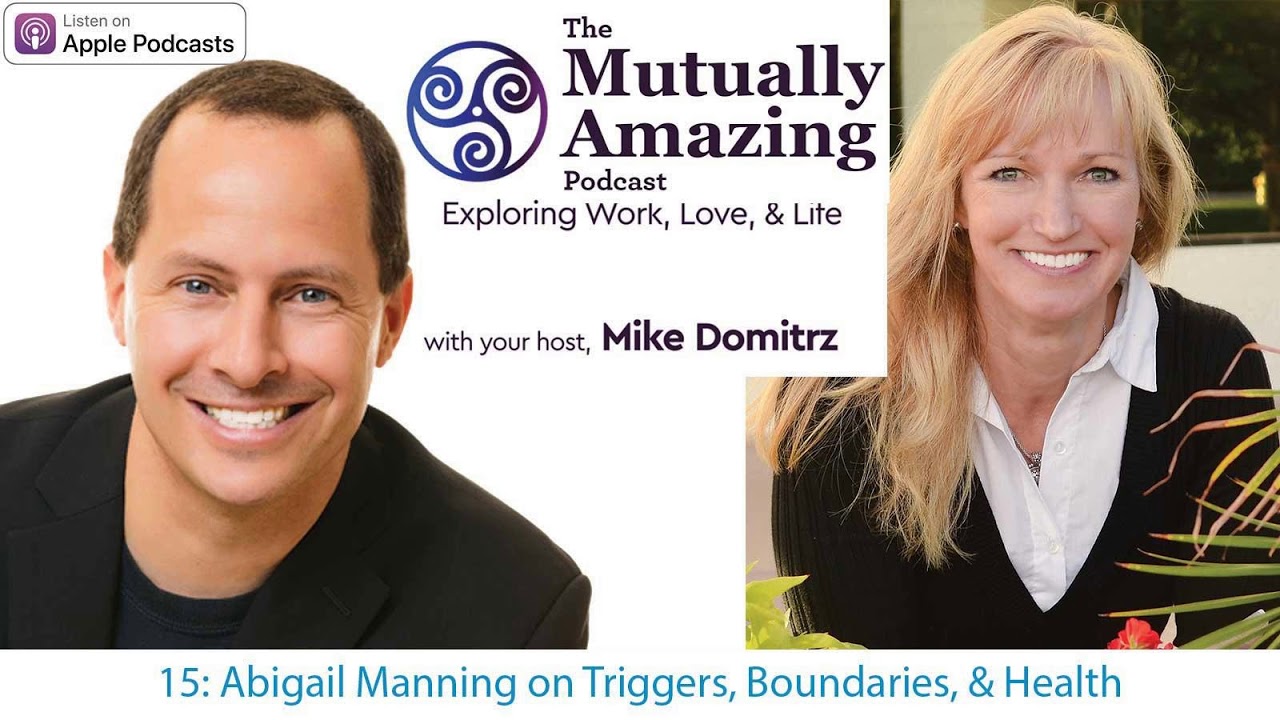
In this episode of the Mutually Amazing Podcast, host Mike Domitrz interviews Abigail Manning, an awareness creator dedicated to authentic health and ending abuse. Manning shares her personal journey from an eight‑year‑old vow to stop the cycle of abuse, through decades of therapy and self‑education, to founding her company Create Awareness, Change Lives. The conversation explores the nuances of a "do no harm" philosophy, the inevitability of triggering others, and the responsibility of creating trauma‑informed, consent‑based spaces. Manning offers concrete communication tools for supporting survivors—such as thanking them for sharing, affirming their courage, and asking how to help—while warning against pity‑laden responses. They discuss the importance of asking permission before physical contact (e.g., hugs) to respect personal boundaries and prevent grooming. Manning defines abuse as repeated mistreatment and outlines red‑flag behaviors, emphasizing that patterns, not isolated incidents, signal abuse. She introduces the concept of "authentic health," encouraging listeners to identify and rewrite negative self‑stories (the "tape"), reclaim personal power, and become their own source of validation. The episode also highlights influential resources, including Brené Brown’s work, that shape her approach. The dialogue concludes with practical advice for listeners to cultivate respect, kindness, and authentic health in themselves and their relationships.
Chapters
Welcome to the Mutually Amazing Podcast. I'm your host, Mike Domitrz, with the Center for Respect. The episode you're about to listen to was recorded when this show used to be called the Respect Podcast, so you might hear that mentioned during this episode. Well, let's get to the show. And welcome to this episode. Today we have Abigail Manning. And Abigail is an awareness creator of authentic health to prevent and end all forms of abuse. With a positive and proactive approach, she brings insights and answers to how we can each lead healthy and happy lives. Abigail, thank you so much for joining us.
Well, thank you so much for having me on your show, Mike.
Well, thrilled to have you here. Can you give a little background on what it is you do?
Sure. Um, so as you said, I'm an awareness creator. So what that means is a proactive and positive approach to helping others see where maybe they might be lacking in having true authentic health. And the whole reason behind it is because I came from childhood abuse by both my parents and domestic violence as an adult. And as an 8-year-old, I took a vow in front of a mirror to end abuse. And so this is my next chapter of life. And this is my next mission, is to help others learn the lessons that I have learned, but hopefully a lot easier and faster, quicker, and with a lot more positivity than the way that I learned them.
And at 8 years old, you looked into a mirror and said, I'm going to end this, this, this pattern. I'm not going to let the cycle repeat, is what sort of sounds like you described there. I'm going to make a different path for myself. Where does that come from at 8 years old?
Right. Well, and what it is, is that it was— I devoted myself at that point to love, respect, and kindness.
I mean, that's mind-boggling for a lot of people to hear it and say, wait, an 8-year-old? Committed to mine and stayed with it, right? Because a lot of when we're young, we'll go, oh, I have this, this goal and this dream. I'm, I'm going to do this. I'm going to do this, or I'm never going to do that. And that changes very quickly as we get to teen years or preteen years. So can you— what kept you focused?
What kept me focused was having firsthand experiences of harm. And so I really only have one rule. And when I raised my kids, it was do no harm. At all costs, do no harm. And the next best goal is to have love, respect, and kindness for yourself and for others. Now, it doesn't mean that that was easy. It doesn't mean that I didn't understand. I didn't understand abuse. I didn't understand it at all, but I was committed to those values: doing no harm to someone else because I knew what that felt like, and I did not want to do that to anybody else. And what do I want the world to be? How do I want the world to treat each other? I want there to be safety and trust and respect. And for me, those words have always kind of boiled down to love, respect, and kindness. And so unfortunately, because I didn't understand abuse, I went through the pendulum swing of marrying someone who is not of great health and being in that marriage for over 10 years and then swinging out of that. And that's what I mean. I've learned all these different things by going through $20,000 of therapy modalities and reading and going to crisis center. PTSD hit me really hard. I was like, okay. I have to really understand this and be able to explain it in a way that I can understand it. And so other people saw that and they started asking me, can you explain to me what you're doing and how it's working so well for you? So from that, I started this company, Create Awareness, Change Lives, where we go and we speak and we do workshops and training and keynote speeches and things like that to help others learn what I did along the way, hopefully way back at the early stages and signs of unhealth and disrespect. So we can stop it there and make it into something positive and proactive for all of us.
Well, I appreciate your openness there because while at 8 years old you made the commitment, it took 20-plus years to figure out the journey, right? Which is true of a lot of us. True of a lot of us. I mean, in, in a do no harm philosophy, which I'm a big believer in, and when I teach my all-day workshops on how to do training on sensitive issues, we talk about do no harm. At the same time, you have to also make sure that you're not doing harm by doing no harm. Because that, that can actually happen. You can think so much about, I don't want to harm anybody in the room, that you do harm at the ability to impact and to teach and to connect because you're so working in fear of not doing harm.
Right.
And that's not what do no harm means, but that's what people can interpret it to mean. And you can live it. It sounds like you went through some of that in your own personal life.
Correct, and I agree that you can't— and we're not a world where we have to be— I don't want to be in a world where it's overly polite. One of the things that we are is transparent. Transparent can be firm. It can be direct. It can still be polite and kind, but it's no longer a doormat and you don't withhold information. So I help people and by one of the realizations that I had was the crisis centers told me, when you do this work, it's not when, You absolutely will trigger somebody else. So it's a matter of knowing you're going into that, giving a space that's trusting and safe for people to really vulnerably feel it, because I'm about authenticity, right? Not just this robotic kind of, I mask my feelings. But someone is going to get triggered, and how do we help them? Because that's the first step. When you first realize, whoa, I have a problem, or, oh, I didn't know that that was me, or, I didn't think I thought about that word that way or something. So being triggered doesn't have to be a horrible bad thing. It can be a realization that this is the first maybe eye-opening experience that you're like, I'm ready to be better. I'm ready to be healthy. I'm ready to have control over this and not have it have control over me.
Yeah.
So that kind of helped me flip it into the positive like it's okay. I am going to trigger people and that is okay but I have to have the responsibility which I take very seriously of letting people know that they can trust me. they're safe with me and that I truly, truly do care about them and their well-being.
Yeah, and you're not intentionally triggering people.
No. Oh, no, no, no.
There are people who do that, right? We see people in the media and in politics who go out and say insightful things intentionally to incite, to trigger in a different way than the kind of triggering we're talking here, but it's a form of triggering. And so you're saying, hey, no matter what I do, someone can be triggered. So I'm out of control of that, but I am in control of the atmosphere that I create in which that takes place.
Right. And trauma-informed approach is really important. So I would never go out of my way or try to ever trigger someone in an unhealthy way, right? In a harmful way, in overstepping their boundary lines. But understanding that you're going to do that is— and you're doing it from a loving place, you're doing it from an I-care place, and this is the way you're gonna have to face it. Because if you don't face the beast, the beast is always going to be there. So I don't care if your beast is addictions. I don't care if your beast is that you're with somebody abusive or that you are abusive yourself. You've got to face the beast in order to stare it down, understand it, and be able to walk away confidently from it. And you can do all that in a very healthy way. So the question is always, am I being helpful and healthy, or am I being hurtful and unhealthy? That's my measuring, and hopefully I'm never hurtful to somebody and I'm always being helping and healthy for them.
How do you help somebody? How are you supportive of someone? Uh, you had once— we, you know, get suggested questions for our shows, and the one question is, how do I treat people who have been through abuse with respect and not pity? So how do I give that person that respect and pity? Because we see it all the time in my line of work. From the stage, I'll tell people the number one mistake I see people say to survivors is, oh, I'm so sorry.
Yeah.
Which is meant as loving and caring, completely comes off as total pity. It, it, like, I'm so sorry, and it feels like, I'm so sorry that happened to you, you know, it didn't happen to me, but so sorry it happened to you. And how you know it's pity is because the majority of the time the survivor will respond with Oh, it's not your fault. Which means they're now counseling you for your reaction to them, which tells you— which tells you it was pity. That's a dead sign that they felt pity right there. Uh, it was not a moment of empowerment.
Correct. And, and that's interesting. I've never thought of pity in that way. Um, and what I want to do is help both sides. So when someone really cares, they— I don't think they want to do pity. I think they don't know what to say. Correct. And that's why giving people precise Words is everything in those moments.
We do that in our programs all the time. Here's exactly the words you can use that can make sure that you're empowering each other in respect and admiration. What do you teach for that?
Well, I teach to be authentic. I teach to be honest. I teach that being direct, so having eye contact with a person and saying something like, thank you for sharing that, or you are so brave, or I didn't know, how can I be of support? Or, oh, I mean, even to me when people— I see people all the time kind of go, and so I just move on into what I do really quickly because it gives them permission not to have to respond and react, because we all feel like, oh gosh, I mean, none of us want anybody to be abused. So if you can just come back with, wow, I didn't know, how did you get past it? I mean, go to the positive. What could I do to help somebody in the future? Is there anything specific I can do for you? And that's the number one thing, people don't know how to respond. You don't have to know how to respond, just be yourself.
Yeah, and if you can learn language that can help you be comfortable in that, then use it. Like, we teach the same thing. We teach, thank you for sharing. We'll say, thank you for sharing. Clearly you are strong and courageous. What can I do to be of support? Because that opens the door. And the reason those 3 steps are so important— one, thank you for sharing lets the person know, I've come to the right person. I've come to— because the fear is, do I— is it okay to share with this person in this moment? That's often a fear. For a survivor. Is this a safe person to share with? So when you open with, wow, thank you for sharing, oh, oh, okay. And then when you say, uh, you know, clearly you're strong and courageous because you shared, right? I mean, that's true. So that's honesty and validation at the same time. Reinforcement's a better word. But then to say, how can I be of support? I love that. They might, they might say, oh no, I just, I just wanted to share. Okay. But they might be like, oh, I just wish there was someone I could talk to. Oh well, have you talked to the local crisis center? Have you talked to— and you give them options. It creates this exploratory option for them to get the resources and support they deserve, which is so, so important. And for anyone listening, this goes to any difficult news someone ever gives you. Doesn't have to be a survivor. Somebody comes up to you and says, my dad passed away last night. Oh, I'm so sorry. Where do you go from there? Yeah, you've got nowhere to go from there. Somebody says, they, you know, my dad passed last night. Wow, thank you for sharing. You know, how can I be of support? Now they see somebody trying to engage, not just, uh, let's move on from this uncomfortable situation.
I love it, I love it. In fact, I wrote it down because I, I'm a big thank you and please person. Call me old-fashioned, but I still really like using thank you and please With people all the time, even people I know, my family and everybody. Just thank you for helping me with dinner or something like that. That acknowledgement, everything you said was just to me spot on, perfect and beautiful and brilliant. To acknowledge, to thank, to prove that you're a safe person, you're a sincere person. I love it.
I appreciate that. We've always taught it from stage and in all my books. We teach that same statement. It's just people don't have the skill. And a lot— I love what you said about be yourself and be authentic. Sadly, some people are afraid to do that because they have been taken as being callous in the past. So they feel, if I'm myself, I could do harm. So, well, what if I could give you this little phrase? And if you said it from yourself, if you said it from your authentic self, with these words, it's going to come off as you and be loving and caring and supportive.
Right. And one other thing I'd like to point out real fast, Mike, is that the person who has the difficult thing to explain, like you said, whatever that happens to be— a death in the family, coming out for the first time talking about abuse or something like that— that person is coming from a place where they've already been shamed, blamed, judged, isolated, ridiculed, minimized, all of that. So they're kind of, at least in my case, I was very nervous and I would watch people and the moment that they would kind of look at me like, oh, like that, shut it down. This is not a safe place. This person's not going to be able to understand. And so the turtle pulls its head back into the shell real fast. So just know that when someone comes to you, it's an act of bravery. When someone looks really strong on the outside or you see them as being very strong or successful or capable or confident, We're all the same on the inside. It's really scary to come forward. And strong people, I know, because I've been called a strong person more than once in my life, it's scary to feel weak. It's scary to feel not in control of how someone's going to respond to you, not that we can control it. So just know going into that, that's why I like telling people to be really authentic, you know, and just like your connection with that person. And a lot of times you don't know that person. But you— it could be just someone you've met. It happens to me all the time, and I will, I will start with a compliment for them of like, you know, I'm honored that you told me.
Yes, because what you said there is so important about the concept of that took them strength to share with you whatever the difficult news was. So to honor that just means the world to people, and, and we should be honoring that. Now you talk about something that is what I've been doing for decades Which is to ask first. Ask first. And you talk about it specifically when it comes to hugs, because in my world people think, well, Mike teaches to ask for a kiss, or Mike teaches, you know, before sexual intimacy to ask. But you say, hey, why should I have to ask before I hug someone? And you teach in your work why that's important. So let's go to there. Why is— why is it respectful to ask for a hug versus just assuming, look, I'm giving you a hug because that's loving, that's supportive? What's the harm in me just giving them a hug?
Yeah, right. So it goes down to, you know, our healthy boundary lines, right? And so what is healthy for you may not be necessarily healthy for someone else based on their life experiences. So for example, if someone— that was the first step of abuse, let's say, because that's what I specialize in, is preventing and ending abuse. So if someone was abused by, let's say, a parent who comes up and the first thing they do is they come up towards you face-on and they put their arms out towards you, that person knows they have to go into fight, flight, or freeze mode. And so it's unsafe. And when our brains get hijacked, we don't know how to respond until we are taught how to respond, until we're taught what those warning signs are and what is ours to own versus the other person. Is everyone out to attack you that's going to hug you? No. But until we can get that through our brains and really assimilate it into our bodies and our responses and we can understand it— so there's different techniques like EMDR, there's somatic, there's EFT. On how we rewire our brain so that we don't automatically jump into that reactionary fight, flight, or freeze mode. You think you're being friendly and kind, and I think you're subconsciously, without even realizing it, you're coming to attack me. And because some people bury, especially childhood abuse, so far down, they don't even know that that's what it's related to.
Yes, the word that we often don't discuss here is grooming. This is how The predators often groom their victims, right? And those who would go on to become survivors. And so for anyone who's listening, what that means is if a predator will start with the hug and they'll get very comfortable with that hug and they'll make that hug a little tighter and a little longer, and then they move to touching and they move to other things, but it all began there. And so for the survivor, especially if it has not been addressed, if it is down deep, there's an immediate moment of that's where it all started. And now this person's starting it all. And like you said, I love that you said that they might not even be aware of this because subconsciously this can happen. And people go, well, that's not my— I'm not supposed to know what everybody else has been through. And I mean, that's just political correctness gone awry. You are about to touch another person's body. If you're going to touch another person's body, it is on you to respect the possibilities of what the— how that could impact them because it's their body. That's not like you're just saying something from across the room, which can be harmful, but you're literally going to engage another human being's body in some form or fashion.
And there— and so there's 3 spaces. There's our professional or public space, then there's our personal space that with our friends and stuff, and then there's an intimate space that you would share with a partner or a child or maybe an elderly parent or something like that. That's your intimate space. And we say that people aren't really allowed into your intimate space unless you want it. Unless it's healthy for you. So, and why would I assume just because I like a hug that other people would like it? So I always try to, again, honor, respect. I try to respect the other person. And I would just say things like, you know, for the first time meeting them, I have my group of friends, we hug all the time, right? And so, but there's an understanding because the first time that we've met, we've said, you know, oh, would you like a hug? Not may I hug you? Because again, you're coming on to them, but would you like a hug? Um, are you a hugger?
Yeah, that's a, that's a great line. And I know friends that use that, and myself, I've done it too. You know, they go the handshake hug kind of thing, and you're like, are you a hugger? And they're like, yeah, you know, so then you know you're good. But, uh, but if they're like, no, you know, I'm good, you know, the handshake works, right? I think what people forget is why are you hugging them in the first place? You believe it will be supportive. You assume. So if the hug is about supportive and/or connection, Shouldn't you make sure that will be the outcome?
Right. And also, maybe conversely, because authentic help is really turning that mirror around and like looking at it at yourself. And, and I'm not saying hugs are bad. Personally, I love hugs, but other people don't like them, and that's okay. But if you're like, I hug everybody and I don't even ask why, what is it I need? What is the physical touch lacking in my life? Or what am I trying to express? Or maybe why is that so important for me to do that? I had someone in a business setting, never met the person before. She's actually a lawyer. And when she came up to me, I always shake hands the first time I meet somebody, right? Because in our society, that's totally acceptable. It's not awkward. And I extended my hand and she immediately pushed right past my hand and threw a hug onto me. And I took a step back and I said, well, I'm more of a handshaker when I get to meet people. And she completely didn't understand. Like, I don't know if she thought we were best friends reconnected, but just watching the body language, we talk a lot about cognitive, social, and behavioral theories. Well, the behavioral theories, if someone's putting out their hand to shake hands, with you, they want to shake your hand, you know, or they put a hand up to high-five. Just, just do the high-five. So those verbal and behavioral cues are important to watch for. It's out of consideration. It's just a form of respect, in my opinion. And don't take it personally if they say, no, I'm not.
You don't have to cure them. I think that's the other thing that happens. I think people think that if I give you enough hugs, you'll be okay with hugs, and that's really dangerous and messed up. to think, the more I push your boundaries and disrespect what you want, you'll learn to like the boundaries I'm giving you. If you actually say that out loud, you recognize how predatorial that is, right?
Yeah.
So we, we need to help people understand that. And I'm not saying that I haven't done some form of that when I was younger. Most of us have, right? In some form we thought, well, if I do this, they'll get more comfortable with whatever it was. It doesn't have to be hog touch. But recognizing just how predatorial that is and how we've been taught to do that, like, I'll teach them. No, that's not your job in that moment.
Right. And I think a lot of times, and you can tell me from a guy's perspective, from a girl's perspective, I was taught be kind, be nice, give to others. Um, uh, I have a saying of pour love, you know, pouring love, pouring love on others. Um, and that was a strong social message that was given to me, that don't make waves, Everyone should be your friend, all of those which are not healthy, right? And so in a situation, a lot of times I think women end up hugging each other not necessarily because they want to, but because they don't want to appear rude or unfriendly or stuck up or something like that. And I want to kind of erase that and saying, when you own your own authentic health, whatever it is, if it's a high five, if it's a fist bump, if it's a hug, whatever it is, If you own it, it's okay. Be good with who you are and not have to worry that you're offending somebody else and not worry if you offend somebody else by saying that I prefer this, I don't prefer that.
Absolutely.
By living authentically, it's okay to stay within your own boundary lines and what feels good and is healthy for you without worrying about what others and outsiders are thinking about you.
Abigail, what are red flags of a sign that someone is being disrespectful or being abusive?
Red flags. Okay, so we all have kind of that gut feeling that goes off. We have red flags, we hear warning bells, all of those things. So to me, I guess the difference between those two would be healthy boundary lines. So our definition of abuse is— that I made up— is repeated mistreatment. And if people don't remember anything else, if you just remember repeated mistreatment. The rest of the definition is repeated mistreatment where one person uses manipulations to gain and maintain power and control over another person. So if someone is being disrespectful, is it repeated? That's the first part of the definition. If it's a one-off, maybe they're being a jerk, maybe they are disrespectful or something like that, and hopefully by you giving your healthy boundary lines and with a polite but kind but firm comeback on something You know, I prefer a handshake, not a hug. Something like that. Then they will stop it. It's not repeated. Now if they decide to repeat it, oh yeah, there's that Abigail. She da da da da. And it goes on and on in different ways from emotional to physical to psycho to sexual to financial. Different forms of abuse, different forms of manipulation, different forms of trying to take your power and control or exert their power and control over you. Then you absolutely know the person is acting abusively.
Let's pause there because I, I love these— the, the 2 words, right? Repeated mistreatment is very powerful. I think it's also important to acknowledge that doesn't mean it needs to be repeated for it to have been abuse, right? Because there, there can be a one-time situation that is highly abusive.
Correct.
Usually what you're describing here, what we're talking about, is how do I know when a situation that I'm regularly in is one of abuse or mistreatment? Versus a one-time situation.
Right. So a lot of times, like a sexual— that's, that's a sexual assault, right? Which is awful. Nobody ever, ever deserves any form of abuse. No one asked for it. No one deserves it. No one. No one. Even though you can be groomed or gaslighted into thinking that you deserved it, you had ownership over this, you never did. It's what someone did to you versus what you went out and did to someone else. You were never worthy of being their target. And you're right, it doesn't have to be awful or an assault Or abusive. But when I use that term, a lot of times it starts really small. So unless it's like an— you're walking down an alley and you're attacked, right? That's an assault. But a lot of times in the abusive world, when you have relationships with neighbors or coworkers or family, it always starts small. Like you said, they start with a hug or they start with something or they start with a lingering touch. If we're talking about sexual harassment.
Or just not honoring your voice.
Right.
I don't want to go this far. Let's say it's sexual. I don't want to go this far. Oh, it'll be fun. What did you not get about I don't want to go this far? I didn't say whether it'd be fun or not fun. I don't want to go this far. But it's not on the survivor to have to say that either. The moment I said it once, you should have listened. But that's a subtle form of somebody starting to show abuse. That is likely to say they might not be respecting me as this night goes on. Because they're not reciprocating my voice right here and now. Once again, I want to stress that's not on the survivor to stop the criminal. It's on the criminal to stop being abusive in the first place.
Right. And so that is the red flag that you just mentioned. So that, that, well, I set a boundary line and they didn't— they didn't— they either didn't acknowledge it and blew right by it, or they made fun of me for it, you know, um, they ridiculed me for it, or they're like, what in the world are you talking about? Stuff like that. Um, well, I thought you wanted to be my boyfriend. I thought you wanted to be my girlfriend. It's, you know, just like in sexual harassment. We do some workshops for corporations and government and things like that on what's sexual harassment and if this, then that, quid pro quo. It's the same thing. It's not honoring those boundary lines. So just kind of watch because it tends to be small and then a lot of times someone who's abusive is very quick, very practiced, and that's those manipulations of coming back and saying, you know, oh, I'm so sorry. I didn't mean to do that, or they have some story or something. So just watch for a pattern. Or really not even a pattern, because sometimes it gets a little too tricky for people to see. Just, is it repeated?
Yeah, I love that statement, the repeated mistreatment. It's, it's perfect. What is one or two steps if somebody who's listening is a survivor of trauma or abuse to help them feel respect towards themselves?
Well, for me, I would say it's authentic health. Figuring out, gaining your power and control back where you can have your authentic health, where you're not looking for outside confirmation. You really know the patterns and what has happened to you, what your life experience— we're all shaped by our life experiences. So I guess the key would be, what has shaped your life experience? What has created your story? What is that negative tape or that purple thread running through you that is a lie, that is not truth, but you've read that book so many times you believe it actually happened? You've heard that story so many times you actually believe that's who you are.
Can I pause just so I'm understanding?
Yeah.
Are you referring to, for instance, victim blaming, self-victim blaming? So somebody's sitting there going, had I not done this that night, that wouldn't have happened. And they have played that tape, and that tape is causing them to feel blame.
That could be their life experience, yes. Or it could be— you see, for example, really, really thin anorexic bulimic people, but the tape that they've been told is they're big and fat and ugly. They're on their deathbed believing that they're big, fat, and ugly when they're really not, right? So, so we all have our tapes. I'm not smart. You should have seen my brother. He was really— he's really, really smart. I'm not the smart one. Things like that. Like, what is your story that, you know, my careers never work out, my, um, love life never works out?
Well, and I, I love adding the question to that: how's that working for me? Right, so let's say I put the story out in front of myself. I believe this. How's that working for me? It never makes me feel better. It's not working, right? This story, this negative story I got, has never benefited. And even if it benefited once, 99 other days it bothers me. So it's a negative impact on my life, right?
And what I— a lot of times what I'll say is break it down to simple. Is it healthy or is it unhealthy?
Yeah, that's perfect.
Is this going to propel me forward to the vision I have for my life? Is this going to make me a better person tomorrow than I am today? Or is this unhealthy? Is this going to continue, continue keeping me in this loop, in this cycle, in this pattern, in this lane? If you own your life story, then you're not swayed by what people may or may not say. They can use those as manipulations. So if you think of yourself as not charming, let's say, and someone comes in your life and they're like, oh, you're so charming and you're delightful, and you're like, oh, wow. You know, they can manipulate you because they're able to find your weakness. But when we own our own weaknesses and we own our strengths, that's authentic health.
Yes, and we— a great example is parenting. Parents who say, well, I don't want to tell my kid I love them too much. Oh yeah, wait till the kid comes along that does tell them, because that kid will— if they don't believe they're loved, that kid will be their new source versus them being their own source. Teaching them to be their own source. Yeah, like somebody should say to you, oh, you're great, and in your mind there should be a little bit of thanks and yes, right? Doesn't mean you have to say it out loud, but— or you're beautiful, or you're great, or you're brilliant, and there should be a little bit of, and thank you, and yes. We should feel these things about ourselves so we don't— that's what I loved about what you said there. We don't need them from somebody else, because that's— if we need them from somebody else, Control goes over to that person to get it, to get what we need. That can be the unhealthy part. You had 3 books that you told me that you really love. One was Mindful Loving by Dr. Henry Grayson. Another was Women Who Love Too Much by Robin Norwood. And Brené Brown's books, you especially like Rising Strong. Why these 3 books?
Well, I think anything Brené Brown has written, I love. I love her—
Same here.
You know, attitude and approach. And she breaks it down. She inspired me to take what I know and break it down and simplify it and explain Explain it in storytelling formats that make sense. And so that's been a lot of things. It helped me a lot on my path on— I couldn't stand when I opened up her book and I read the word shame. Oh, I don't need more shame and blame and anything like that. And of course, she did a big wonderful twist on all of it and it was really, really helping. But again, like we started the conversation with about triggering people. So I had to be a little angry with Miss Dr. Brené Brown because she was triggering me with the whole word shame, but I'm glad she did.
Yeah.
And I'm glad I had the fortitude to keep reading through as well as those other books and other therapy and talk therapies and things like that because that's how you face the beast and you keep moving through it and you get better and you look in that mirror and you're not afraid to look in the mirror. You're not afraid. None of us are perfect. We're not supposed to be perfect. Authentic health is not being perfect. It's not being great at everything. It's just being true to who we are and willing to look in the mirror and not willing to listen to the whispers of any kind of negativity and by being vulnerable and that's a big strong theme that she has been superior in explaining to people is vulnerability and shame, as well as many other things. But those are the reasons why I really like her books, and I just love the way she writes too. I think it's fun.
Yes.
And the other ones were a male's perspective as well as a female's perspective on when you love too much, and that's that healthy versus unhealthy. And that's from different people I've put together what I feel authentic health is. And both of them, I thought, from a male perspective as well as a female perspective, they did a really good job of Of showing where that, that line is between what is good, authentic love and what is not. Because you have to keep in mind, I wasn't raised with it. I wasn't raised with love, respect, and kindness. I wasn't raised with mutually loving parents. I had to figure it out. I had to— I watched for it. I looked for it in movies. I watched for it in couples. And so I stumbled along trying to learn these things in my own life and through reading books. So that I could figure out how to have happy, healthy, successful love in my life.
Well, and I think that's a great way to end our show because I think too many people think things like, well, that should be obvious, but they forget, well, it's obvious to you because you might have been raised in it or you learned it because of something in your culture, your family. Millions of people have never been taught these lessons. So if you're going to say I'm a compassionate, caring person, you need to think of the possibilities of others. Which you just brilliantly shared with us. So, Abigail, thank you for being with us today. For anybody listening, you can find Abigail at abigailmanning.com. We'll have her Facebook link, her Twitter link, all on our show notes. Thank you so much, Abigail.
Thank you very much. All the best to you.
We'd love to hear your questions, your thoughts, and your ideas, and the best place to leave those with us is on our Facebook page at facebook.com/MutuallyAmazingPodcast. Of course, you can always contact us on our website at mutuallyamazingpodcast.com. Remember to subscribe to this show so you automatically get it every week. And if you could take one moment to leave a review, that really helps other people find the show, which we are greatly appreciative of. So thank you so much for joining us. May you make today and every day a life full of mutually amazing relationships.








