17: Tom Antion on How Respect Played a Role on his Journey to Making Millions on the Internet
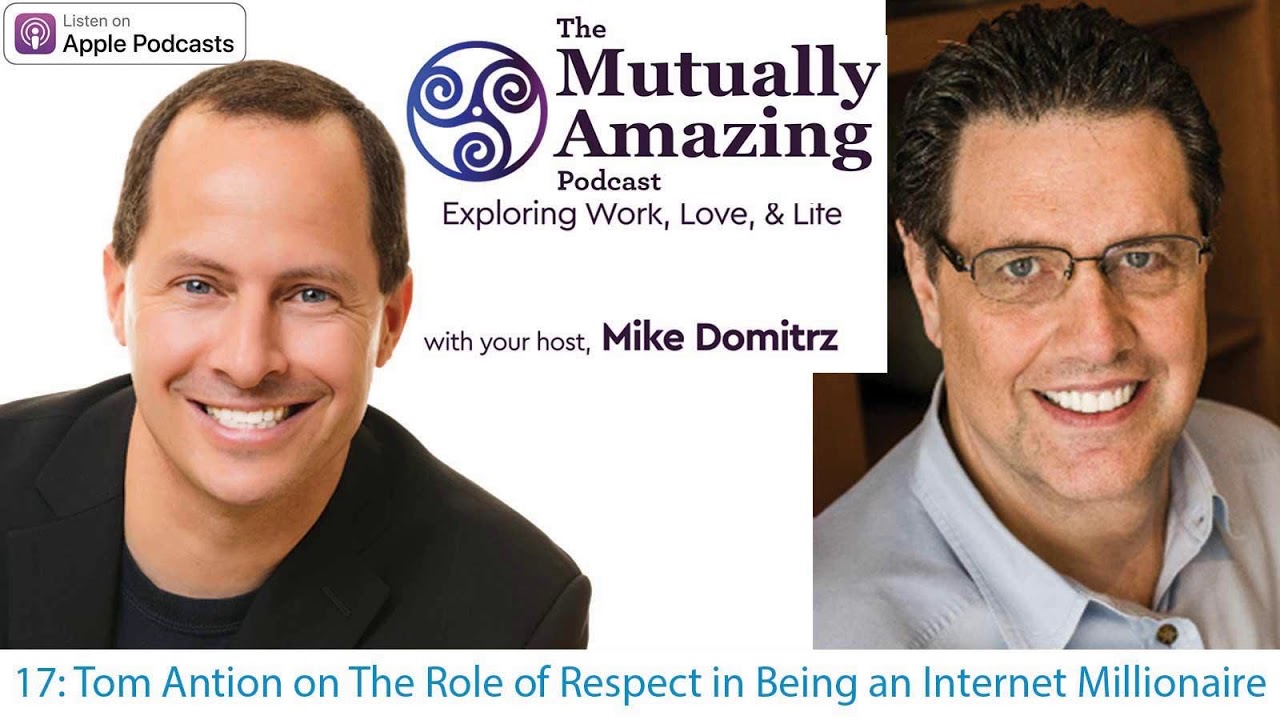
Tom Antion built a multimillion-dollar internet business on one principle: create quality products people want at reasonable prices and service them after the sale. He sells niche ebooks like wedding-toast guides, has a TV project called Scam Brigade to expose fraudsters, and credits his father's craftsmanship ethic and martial-arts training for teaching him that respect and excellence go together.
Chapters
Welcome to the Mutually Amazing Podcast. I'm your host, Mike Domitrz, with the Center for Respect. The episode you're about to listen to was recorded when this show used to be called the Respect Podcast. So, you might hear that mentioned during this episode. Well, let's get to the show. And welcome to this episode. I want to get right into it with our guest here, Tom Antion. I've known Tom for now almost 2 decades. He's an internet multimillionaire and lifelong entrepreneur who has built his business on treating people right. He's got a one-sentence respect-filled business plan he's lived by for 44 years. Tom, thank you so much for joining us.
Mike, it's been a long, too long, man.
It has been too long. So let's start there. What have you been up to in the last 16 years since we originally met? NSA, actually the very first time was an NSA Wisconsin event.
So even before that, the last 24 years, I got on the commercial internet when the commercial internet started around 1994, and I've been selling like crazy on the internet. No spamming, no porn, but all kinds of products and services. And part of what I wanted to talk to you about today was a topic called excellence. Try, you know, I didn't know anything about the internet. Nobody did back in 1994. And so when we started learning about it, it led me to a lot of other things and we can get into it later. But the topic of excellence is really ingrained in me by my dad is do everything you can to the greatest of your ability. And that's respect for yourself and it's projecting respect to other people around you.
So let's get right into that then, because when a lot of people think, oh, I made a lot of money on the internet, you were doing it in ways that were common sense, but going against the norm. So for all of our listeners to get an idea, uh, Tom, while people are trying to say, let's build beautiful, amazing websites, Uh-huh. Tom would say, no, no, no, I don't care if it's ugly. It could be the ugliest website in the world. If it gets people to my site and it helps them get what they need, that's what's important. So you built very content-rich, very keyword-loaded sites on things like, you had to once write, uh, this story I've never forgotten. You were giving a toast at a wedding. And you started looking up, hey, where do I find toast? And you thought, hey, people are constantly looking for this. And you sold an ebook on toast for weddings. And that did very, very well by just helping people find it and get what they needed.
$72,000 a year for that, uh, for 9 years straight, just selling electrons. I also had one, I don't know if you know about it, called Instant Eulogy. People were also desperate to, uh, at the last minute, they're distraught. And, uh, helped them, you know, that was $42,000 a year for 9 years straight, uh, helping people with eulogies. So, uh, it's all based around helping people. That's what we all do is help people. And there's a value to that.
Well, and I'm glad you brought that up because I think when a lot of times people think of internet sales, internet marketing, they have this negative stereotype that often has accompanied such industries as used car sales that, or that there's this ambulance chasing lawyer concept. That they're manipulating people to buy versus serving people, being present to what people need and providing that to them, which is exactly what the eulogy situation was, exactly what the best man speech was. Uh, it was saying, hey, here's a need that somebody's not filling.
Well, yeah. And I will say that there is a respect involved in manipulating people. Think about that. That's, again, I'm always gonna go the other direction, right? I know. And in fact, you talked about scams. I started a— there's a TV show in development in Hollywood called Scam Brigade. It's me going after bad people. And the industry is fraught with it. So if I know that I'm going to take care of you as a customer and keep you from being robbed by other people, I want to get you to buy that, my stuff, because not only do I believe that it's going to help you, I will. I know that I'm going to keep you away from getting robbed by unscrupulous people. So there's a respect in there from my point of view. You know, I call it manipulation, but I'm manipulating you for your own good. That's, that's— Yeah.
So let's discuss that, Tom. Are you manipulating or are you helping people find what they need? Like, why do you, why are you comfortable with the word? Or some people would argue, why are you comfortable with the word manipulation?
I'm comfortable because when you come from a, position goodness, where you know you're in the other person's field. You've got a fiduciary relationship to take care of that person. I don't care what you call it really. I just know that if you go with me, I'm going to take care of you. I'm going to make sure you get great value. This is my one-sentence business plan I was telling you about. I lived this way since I was 10 years old. If every business on earth would live by this one sentence instead of spending $100,000 to develop a mission statement. You know, this one sentence will do it. I create quality products that somebody actually wants at a reasonable price, and I service them after the sale. Every piece of that is respect for the customer, but it can make you a lot of money. There's no, no sin in that as long as you're giving that great value, showing respect. not fleecing the people because they don't know any better, which is very common nowadays. So I don't really care what you call it, but I want you to, and anybody out there, not just me, if you really believe, like you, the work you do with the DATE Project and all that stuff, you know that you're gonna keep people from getting out and getting in trouble, right? You've lived that for most of the time I ever knew you, right? Right.
Right.
So you better darn well get people to go through your program to keep them. I mean, yours has bigger ramifications than mine does. Mine, you might, you know, have trouble making your car payment if you don't do it, but you, there could be, you know, lifelong ramifications or not have a life if they don't do what you say. So if you manipulate somebody to get somebody to listen to you, I'm cool with it. Totally cool with it.
So I love this language. I think it's very fascinating. Would somebody say there's a difference in influence and manipulation? In other words, manipulation is getting you to do something.
It has a negative connotation.
It does, right? It has a very negative connotation that you're getting somebody to do something they wouldn't do. But as I say that, I recognize that's not negative. Like to get somebody to do something they don't, they don't, wouldn't normally do is not negative. It could be incredibly powerful.
The people that you teach, if, if you can manipulate them not to get drunk and pass out behind a dumpster so that they're vulnerable, I'm okay with that. You do that all day long and I'll help you.
So maybe the difference here is that somebody's listening and thinking, wait, wait, wait, you're describing education versus manipulation. Manipulation has a sense that it's only about what the seller wants, not about what's good for the buyer, maybe, right? That, that if we're educating and that inspires people to take action they would not normally take, That's different than manipulation, which means it's all about me getting you to do what I want you to do. Would there be— maybe that's the difference there?
It's just semantics to me. As long as I'm coming from a good place and I can help you be in a better place, you could call it whatever you want. I don't really care.
Well, and I love that about you, Tom. You've always had that approach of, I'm not worried what people say about me. I'm not worried what people care about me, uh, in that if I know I'm doing the right thing, That's what matters in the end. Uh, and, and you describe that in your one-sentence mission statement that you've always had. Uh, and I— you mentioned there briefly that there's this documentary that you're working on. Uh, there actually— I think there's 2 elements here, right? There's a show that you're working on about busting, uh, scams, and I know of one that you worked on busting years ago. Then there's also a documentary about your life.
Yeah, that, that, that is something where, uh, you remember Dottie Walters?
Yes.
Dottie Walters got me started in speaking in 1991. I, I, bizarre story about how I got hooked up with her, but I ended up being her right coast son because I would help her every time she would do her Speak and Grow Rich seminars on the East Coast. I would just go for free and help just to, to be involved and learn. And I ended up speaking at her memorial service in California. when she passed, and a producer-director saw me and was introduced to me, and it was, hello, how are you? And it was a solemn occasion. That was the last I thought of it. And then a couple years later, she had been following me, and she approached me. She has done 38 documentaries, and she approached me about doing one. And I thought, man, I thought you had to be dead to have a documentary done about you. They must be lowering their standards or something. I don't know. But So she said, I'd like to do a documentary about the American entrepreneur. And from what I've seen, you're the man. And I said, wow, what an honor. And so, uh, it's been 3 or 4 years in the making and it's going to premiere probably in the fall. The, um, the trailer is out now. It's beautiful at facebook.com. Well, maybe you can put it in the show notes if somebody wants to watch it.
Yeah, we'll put it in the show notes.
Absolutely. The trailer. So it's, uh, it's me and it's a celebration of the American entrepreneur, the American spirit. And I just happened to be the figurehead, but there's just, you know, you and there's thousands of people out there could be the, could be the subject of this. But it was a great honor, uh, to be featured in that.
That's very cool. Now the show you're working on, Busting Scams, how would— if somebody said, wait a second, you just said that if I'm getting you to do something I want you to do, you call manipulation you want, what's the difference in that and the scam?
Well, the, the difference in that is that the person that is the scammer is manipulating you for the purpose of robbing you in some fashion. And that is a whole different— I mean, that is diametrically opposed to what I am talking about with respecting people.
Right.
So that is the whole thing, is taking advantage of people. And I mean, I think we have worked the figures up, 120,000 people, elderly people last year lost their homes from the Jamaican lottery scam. They thought they, you know, were taken advantage of. They thought they were winning a lottery. They have to send the tax money in advance and boom, there's no lottery. And, uh, they couldn't make their, their house payment. And, and a lot of younger people, the reason I'm having a little trouble getting the show sold is because it's not in the demographic. You know, the elderly people are not in the demographic that TV likes, but I tried to explain to them. Look, the young people are going to lose their inheritance if they don't teach and pay attention to their elders being taken with scams. So they, they kind of got that, but it's— they told me for sure, don't quit your day job. You know, it's Hollywood.
Right. Right. Right. 'Cause they, they're selling to a certain audience.
Yeah.
And we talked about this just a moment ago that you believe in excellence and everything you do, whether it's a documentary or TV show. How do you feel that excellence and respect do go hand in hand? Like in my heart, I think, well, of course they go hand in hand because Excellence requires you to respect yourself and your mission and what you're doing.
Well, excellence, uh, it also has hidden benefits. For instance, when I got started in speaking, 1991, I had come out of an entertain— crazy entertainment company. I've had a lot of fun businesses in my life. And a lot of people said, hey, you're better than a lot of people that have been charging $4,000 and $5,000. And I said, well, I don't know anything about hotel. I was doing, At parties, you know, birthday parties and stuff. I said, I better study and learn how to be a speaker in hotel rooms and in corporations and be politically correct and all that stuff. So I started studying like crazy. In my library in here, I probably have 200 books on public speaking, every tape that was ever made, everything from NSA. I have got all of it. And so I started doing it just to make myself better And so that I could really compete in the speaking world. And where excellence comes in, and this is what my dad taught me, he said, when you're excellent, people will notice. And so I got, again, I'm not trying to blow my horn, but I got so good, people started begging me to teach them how to be good as a good speaker. And that led me to write the Wake 'Em Up speaking book, the Wake 'Em Up Video Professional Speaking System, Amazing Public Speaking. It took me a whole different route. So fast forward to 1994 when the commercial internet came along and I said, oh, are you kidding me? It's hard enough to sell my stuff across the street, let alone around the world from my desktop. I'm gonna figure this out. So I started studying like crazy, didn't make a nickel for the first 2 years, got good at it, got some good training in '96. 4 years later, I was a multimillionaire and people were begging me to teach them this stuff. Again, trying to be excellent for me and respect me and what I can do for the world showed other people that, hey, this guy is good. So it led me into this internet training path. I never planned on being Mr. Internet Guru ever. I just wanted to sell my stuff around the world. So all of this is trying to be excellent for yourself, shows such a massive respect for yourself and for the medium that you're learning. Other people get inspired by that. And so I believe that's a form of respect for them.
Well, I think there's also a respect in there that you were gonna learn everything you could to be successful. You, and then you sold people how to do that because you did it. You weren't selling people how to do something you weren't doing right. Because for instance, in the speaking industry, there can be people who are barely speaking, charging people a lot of money on how to be a professional speaker. And that's not common, but it happens. And people need to be aware of that.
Like, whoa, whoa, whoa.
You need to be watching who you're learning from there. That might not be the best resource where you were saying, no, I'm going to ace this myself and then teach others how I aced it.
Without even thoughts of teaching people. Right. I want to do it extremely well because my dad, I remember my dad, I'm 10 years old. He came from Syria back in the early 1900s. He, he put the first electric light bulb in Carnegie, Pennsylvania.
Wow.
He had his own electrical contracting company at 13 years old in Carnegie, Pennsylvania. And I remember watching him one day, he was wiring a box and I said, Dad, why don't you just cut the wires across on an angle, save some wire? He looked at me like, I'll smack you. He said, you crazy? I'm going to make it perfectly lined up so that Somebody looks at this job, they'll know a professional did it. Boy, do I— I'm getting goose pimples thinking about it. I remember it vividly. And he said, and also, if somebody has to work on this later, it'll be easy for them to work on. So don't you ever do something that's not great. Don't— you know, we're all blue— we were blue collar, you know, total blue collar. And, uh, but I'll never forget that. And that's the way I've lived my whole, whole life.
I love that. So thank you for sharing that. How do you think it is, or what's a way to make sure you're living with respect in that everyday life? That's a great way in work. Make sure everything I do is with excellence.
To me is that, uh, along the topic of respect, you will never see me at a restaurant being all snooty with my black Amex card and giving the waiter or waitress some kind of, you know, treating them like they're dirt. You will never see that. In fact, if you were sitting there with me and doing it, I will leave and hell with you because you are not the person I want to be around. That person is doing good work and doing whatever their life is and trying to take care of me and give me respect. There is no way I am going to lord over them. So that is just an everyday example of treat everybody with respect. There is another one. There is a student I have that I was speaking at a big event Nobody would talk to this guy. He was dressed like some kind of halfway hippie, halfway Indian, feathers hanging off. He had no teeth or something, I don't know. And nobody would talk to him. And I'm just standing back there and he started asking me questions and I'm happy to talk to him. He ended up being one of my best customers. He's a bestselling author on some offbeat topic and nobody would talk to him because he looked funny. You know, so, so that's not the way to treat people. I mean, uh, I'm very fortunate. You're fortunate. Everybody deserves respect. You know what? Even people that— rotten people deserve respect. I, I remember I've been a lifelong, uh, self-defense and martial arts practitioner, and I remember studying with an Aikido guy back way, way years ago. And this is one of these guys that had to go to Japan for 2 years and to hold a bow. And he had to pull the bow for 2 years before they'd let him have an arrow. All right, that's serious stuff. And he's teaching me this thing called an S-lock one time, and then it's like you could really put a hurt on somebody. And he says, Tom, you hold it like this and then you bow to the person. Show respect to your enemy. Of course, they're screaming bloody murder. And that stuck with me too. Even your enemies, Uh, you can respect them. You can't let them take advantage of you, but you have to respect them.
Yeah, we talk about this in the US military in that the Geneva—
Were you in the military?
Yeah, well, no, I didn't serve in the military. I work with the military. When I'm working with the military, the Geneva Convention clearly states that if you run across the enemy and they're in dire need of help and you are safely able to help them, it's your responsibility to help them because all human beings are to be treated with dignity and respect. And a big reason for that is so that prisoners of war, if ours are captured, they are treated with dignity and respect, which means we have to treat others with dignity and respect. So whenever somebody comes to me and goes, well, not all people deserve dignity and respect, actually, yeah, they all do. The moment you think all don't means you think you're above certain people. That's not living from a place of respect. That's living from a place of arrogance. There's a difference.
Yeah.
And you've talked about in the past when somebody pushes your limits of respect, What do you mean by that? What do you mean by when somebody pushes your limits of respect?
When you come from a place of power and respect for others, you can recognize very easily when somebody doesn't have that attitude. And so without— and it all comes from probably my self-defense and martial arts study in that, well, there's a guy, I can't think of his name right now, but he has a program called You're Dead and You Don't Even Know It. And somebody's getting in his face and he's thinking of the 100 different ways he could just tear this guy to pieces. And I have the same kind of skills, not as good as this guy, but— And so when you have that kind of feeling that I could do this to you, but there's something in your system that doesn't deserve it, something happened to you to make you like this, and as long as you don't cross a line I'm going to treat you with respect and treat you with— I don't want to say disdain. I don't know the word for it, but I'm going to feel sorry for you rather than get all up and say, let's go, buddy. You know, that's, that's what weak people do. So coming from that power, you know, you could say they didn't reserve it or they didn't deserve it at that moment for what they were doing. But as long as they don't cross the line and hurt somebody that's innocent or cross the line to cause me harm, There's no reason for me to escalate it. I'm going to de-escalate it and I'll walk away. If people are saying, oh, you big sissy, well, I saved that guy's life pretty much. So I'll live with that.
Yeah. It's describing really leading with compassion and empathy over bullying or domination, right? Because you have the ability to dominate in that moment, but you decide, wait, there's got to be a reason this person's coming from this place. Something has triggered this behavior somewhere. And, and, and that's so important cuz I'll run into people as we're traveling this world doing this work and who'll say, well, you know, you can't, you just can't do that for everyone. And you have to think, because this one person I met, they're so bad. And you think, yeah, but how'd you get there?
I mean, I had, uh, good parents. I had the, you know, a, a shirt on my back, food. And, you know, some of these people, I mean, I did some fundraisers for these, uh, I did a fundraiser where I raised a whole load of money for bunch of homeless kids. Homeless is considered you have a different place to live or no place to live every 30 days. I didn't have that. So when those kids grow up, there's going to be some scars and it's going to come out in certain ways. And so I just have to think, man, I had it good. As long as they don't hurt me or hurt somebody innocent, I gotta say, wonder, you know, how they got there, what happened to them to make that happen.
Well, yeah. And I think that's so brilliant to recognize I had it so good.
Mm-hmm.
And I think what happens is when you're in a position of— and that's the reference to privilege— where those kids didn't get control over that, we also didn't get control. Those of us who feel we were raised in a stable home with wonderful, loving parents, we didn't get to choose that. That's what we were born into. They didn't get to choose their situation. And we're gonna have different negatives out of our loving home. There's gonna be negatives that we're gonna miss out. We're not gonna see Things that others, somebody would've saw coming from a different home. Uh, there's gonna be pluses and minuses to that. And to understand, well, I made it. Okay. Well, yeah, but you made it under very different circumstances than that person made it. So, I think that's so brilliant, brother, you brought that up. For you, when you, when you hear the word respect, what does it mean?
It's ingrained so much in me in that, uh, I'm not gonna, uh, dominate the conversation. I mean, just like, I like to, I'm a pretty simple guy, bring things down to just the, like I said, I came from the sticks and, and a handshake meant something. So if I'm at a party, even though I'm Mr. Big Shot Speaker and I'm known everywhere, I'm not going to stand there and talk about myself. I want to know about you. I want to bring the best, show respect to you by bringing out you, what you've been doing, and honestly not looking over your shoulder to who's more important than you. That's, that's a simple everyday I like to bring the everyday things, how you can show respect. And that would be a show of respect is ask the other person what they've been doing. And you could learn something, you know, from doing that. So to me, it's more of the everyday little things. Back in the old days, there was a movie called The Poseidon Adventure. They have a remake lately, but the original was Gene Hackman and Shelley Winters on this ship that was kind of like the Titanic.
I remember it.
All right. Well, Gene Hackman, I was, I was young, much younger than— I don't remember what year it was, but He was on stage, or excuse me, on deck and doing a sermon. He said, you take the little piece of God in you and do good for people. That was like a sledgehammer to my head. I am thinking, you cannot go too far wrong with that attitude in life. From that moment on, that has been in my mind, that is my religion, that is my spiritual guide, is take the little piece of God in you, Do good for people. I don't go to church every Sunday, I'll admit that. You'd have to get up maybe a lightning rod if I got near it, but take the little piece of God in you. So that's respect for doing good things. If you have the attitude, I'm gonna try to do good for you before I do good for me, that's another thing my dad taught me, give before you get. So all of these little things are everyday things that I live and I'm attracted to people that live like that because it shows respect. All the time, not just when it's convenient.
Is there a time in your life you can remember where you failed to give yourself respect and the lesson you, you got out of that experience?
Yeah, I think it was, um, you know, I went to college on a football scholarship to West By— you gotta say By God— West By God Virginia University. And, uh, at that time, I mean, all the time, uh, from the time it's midget football till, you know, everybody could kill you at that level, that, That level of athleticism. So I'm working out like crazy. And then when I got out of that, it was like, oh my God, I never want to see a weight room again. I mean, it's 15 straight years of that, 2-a-day exercise, you know, all that stuff. And so I let my weight— I went up to 360 pounds or something. So I don't think I was paying much respect to myself there. And I struggled with that a lot over the years. I had some trouble with— my mother was— my dad was great. My mother, not so much. But I got a handle on it now only by finding a certain kind of diet. I'm on a ketogenic diet, which is extremely low carbs, high fat, which is opposite. Again, look at me, opposite of everything else all the time. But it's the only thing that's worked. So I dropped about 100 pounds. Good handle on that now, but that was a long period of really not respecting the— luckily I got good genes from my dad and a strong foundation of working on working out for 15 years like a maniac. So I'd say that was— that's my biggest obvious one.
Well, and I noticed the difference right away when— for those who are not— who are listening, Tom and I can see each other because we always do these shows also on YouTube, so you can watch that. And as soon as I saw you, I noticed, wow. I said in my mind, I'm like, it looks like Tom's lost a lot of weight. So, but that, but what I think is beautiful about that is it was a choice you made to respect yourself.
Yeah. It took a long time to, to, to do it. And that's the thing about things, folks. All these choices aren't always easy. I mean, it might be time when your steak is cold and you want to give that waiter or waitress some guff, but you got to hold back and you got to say, you got to have self- your own self-respect to say, no, I'm not going to make a fool of myself and embarrass that person over a steak that I probably ate too much already. So the delayed gratification, you know, our friend that put us together recently, Caroline de Passada, you knew her dad, right?
Absolutely.
Yeah. He's the one that made that famous, that marshmallow study about delayed gratification. And for those that don't know, it's, they showed these little kids some marshmallows and said, hey, we'll give you one. If you don't eat it in 15 minutes, we will give you 2. And then they— some of the— most of the kids ate it and some did not. And they followed them over a period of years. All the ones that had the delayed gratification were successful and everything, and the other ones were having problems. So I think it is the same thing with respect. You know, in this case, I had to fight a long time to get that one piece of my life that was not working right to respect myself. Uh, had I given up or quit too soon, where would I be? I'd probably be in death row from a heart attack or something, or diabetes, or who knows. So, so sometimes it takes longer to realize the respect that you want to give yourself or others.
Well, and I appreciate that because I think when people hear these conversations, they think, oh, he's got it all. Oh yeah, right. That's the mistake, that because of this level of success, that— and they've learned, and they have these messages they live by of respect. They've got it all. What they don't realize is no matter where we're coming from, there's some area we could be better at that we don't give the same kind of focus, respect of that we do other areas. And so it's constantly looking at our whole picture and saying, where is that happening now for me? Because it's happening somewhere, right? That there's so many balls in the air.
And you can always get knocked in the face. In 1988, I was living in a vacant house on a Mattress. I don't want to say like a country music song, my dog got run over, my truck got stolen. No, but I had a nightclub for 6 years and the drinking age went from 18 to 21 in a college town. I was going to be a millionaire before I was 30, wiped out, lost $400,000 and, uh, was playing racquetball, tore my Achilles tendon and a partner I had had not paid the health insurance. So living in a vacant house on a mattress, watching a black and white TV. And a lot of your viewers will never, don't even know what that is. And so I got knocked in the face really good, but that's when your true colors come through. When things don't go so well, what do you do? Do you get back up? Do you fight or do you give up? And so I had enough respect then. And I got, oh, I got all kinds of bizarre stories. There was a, I was watching Candid Camera on TV. And you know Juliette Funt?
I remember, yes.
She's from NSA. Well, her dad was Alan Funt from Candid Camera. And I was— when I was laying there living off credit cards, busted up and had nowhere to go, I was watching Candid Camera on this black and white TV. And that's when I got the idea for the entertainment company called Prank Masters that I moved to DC, and that got worldwide publicity and got me into the speaking business. And then I ran into Juliet. I'm getting goose pimples again. Ran into Juliet at NSA and I thought, oh my God, I'd never be able to thank her dad. So I mentored her for a while just to, uh, to pay back, uh, for that idea, that little spark when, uh, that somebody else gave me because I was able to keep my eyes open in the face of adversity. And that's when your true colors show through. And that's sometimes the hardest part.
I love it. And you have 2 books that you really recommend. One's Influence: The Psychology of Persuasion by Robert Cialdini, and then—
It's pronounced Cialdini.
Oh, I've always pronounced that wrong then. So I appreciate that. Yeah. And the other book's Lost Consciousness by Alan Burris.
Yeah. So the influence of psychology persuasion is what I was— we began this conversation with about manipulation and persuasion, you know, kind of going hand in hand. One's negative connotation, one isn't. But, but that is— I've read that book 7 times because that is a way you can really get your products and services out there and get people to buy them. But again, because you know you're going to take care of them and help them. The other one is completely opposite the other end. You better not be faint at heart if you read it. It's a book about a friend of mine, and it's a book about a sniper from the Army who decided to go after pedophiles. So it's a Whole different thing. But again, it was, it was that pedophile, who knows where he came from, but there came a point when you had to draw the line and couldn't let him hurt children anymore. So even though you have to have some respect, some people cross that line and have to be stopped. So it's a completely different end of the spectrum.
Yeah, and to stop someone from doing harm is not failing to respect them.
Right.
In fact, you would argue the opposite.
You're respecting everybody else that—
And them by saying, you can't do this. This is not acceptable. Out of respect, I'm going to take action now. Yeah. And so, I want to thank you, Tom. This has been— we've gone all over, which I love, and explored different areas. So, thank you very much, Tom, for joining us.
My pleasure.
We'd love to hear your questions, your thoughts, and your ideas. And the best place to leave those with us is on our Facebook page. At facebook.com/MutuallyAmazingPodcast. Of course, you can always contact us on our website at mutuallyamazingpodcast.com. Remember to subscribe to this show so you automatically get it every week. And if you could take one moment to leave a review, that really helps other people find the show, which we are greatly appreciative of. So thank you so much for joining us. May you make today and every day a life full of mutual amazingness. Mutually amazing relationships.








