#19 - Management vs Leadership
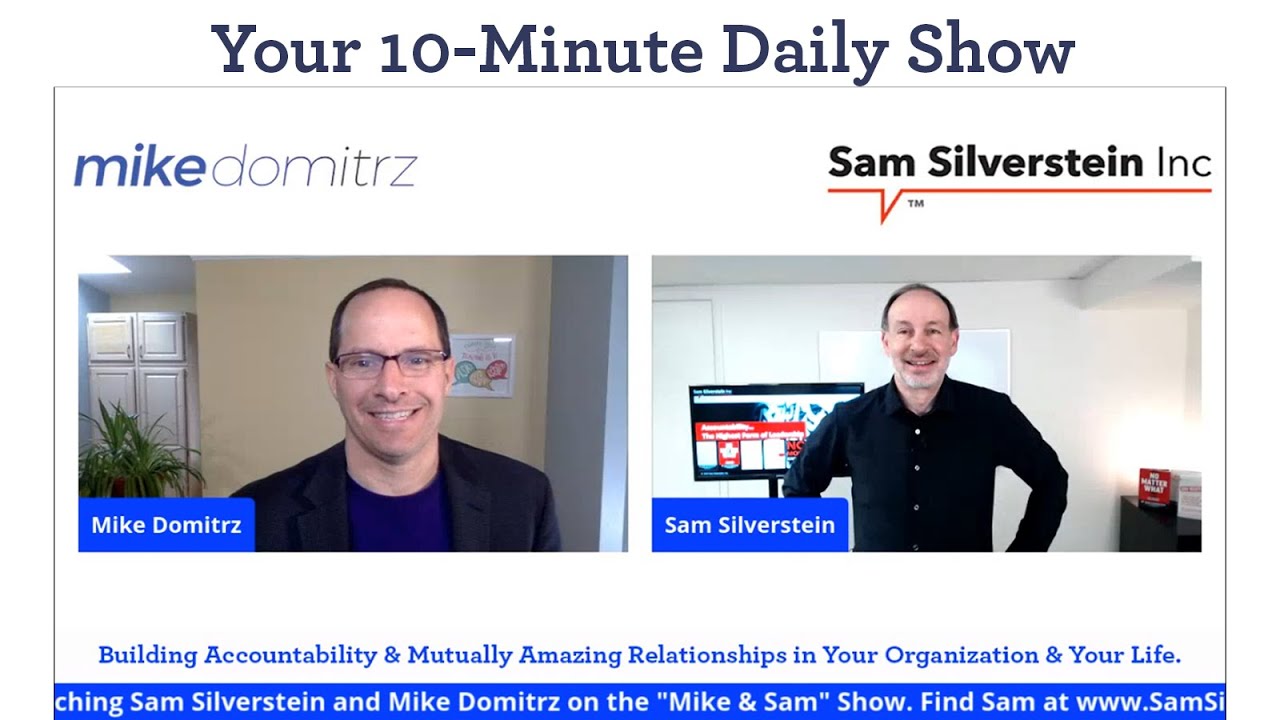
Mike Domitrz and Sam Silverstein separate management from leadership: management handles resources and systems, leadership develops people. They argue that calling someone a "store manager" instead of a "leader" shapes how they lead, and most people would rather be led than managed.
Chapters
Hello, Sam! How are you doing today?
I'm great, Mike.
How are you? I am fantastic. And today, we are going to talk about the difference in leadership versus management.
I love that.
Sam, I want to start with you right away because when I brought it up, you're like, let's do this.
Yeah, go ahead.
Yeah, people use the words interchangeably, but they're different. They're different. So, to you, what does management mean versus leadership, Sam?
Yeah, a lot of times you'll hear, well, we have middle management. That's a real popular phrase. And our managers and this type. And it drives me nuts because I truly believe that you manage things but you lead people. That people are led. That if you're a leader at a different level of the organization, you're still a leader. You're a leader of people. Nobody wants to be managed. People want to be led because when you're leading someone, you're leading them to their potential, to their greatest effort, to their best. possible work. You manage the computers, you manage IT, you manage your inventory, you manage your financial resources, you manage the property. That's how I see it.
I love that, Sam. So in your world, by that philosophy, would any company have management or managers, or would it all be what level of leadership you're at?
I see it as what level of leadership. Now, a lot of times you'll, you'll hear expressions Like in fast food, for instance, they'll say, well, we have a store manager. Well, I'd like to just say you have a store leader. You have a unit leader. Use the word leader. If we start using the word leader, then it's going to send a message. It's going to send a message. It's going to elevate the expectation that we have of those people. And so, I think it's critical that we get away from using the term management and we really strive to incorporate the term leadership.
Yeah, I'm going to show you a good example of this, Sam. I've been fortunate to work with people in the industry of project management. So these are people that are project managers. Now, interestingly, they will tell you they absolutely are doing what you're describing. They're managing a project. Here's the difference. So they will tell you that often people in that industry, project management, feel they have no or little influence on the people that they have to work with in the project because they're not actually given authority to lead. So these people are all coming from different perspectives and they're trying to manage the project and the chaos of the people without authority to have over those people necessarily, because there's a lack of being given leadership authority. And so it's a great example of the difference in management and leadership there.
Right. You could take, let's say you took 5 people that are at the same level in an organization but from different vertical sections. So, maybe you took the Vice President of Sales, Vice President of Marketing, Vice President of Finance, Vice President of Production, and Vice President of Security, whatever. And they're all at the same level. They don't have cross-authority. But they are brought together with a task of doing something. There is a project that they need to accomplish together. They're all leaders in their own divisions. But even in working together, when they come together in a project management situation, They can still utilize, they can still use leadership characteristics. Leadership characteristics are always putting other people first, helping them succeed. Leadership is serving others, not others serving you. And so if we come together in a project scenario and I'm trying to serve you, I'm trying to help you succeed, and you're trying to serve me and you're trying to help me succeed, it creates an environment that's a real positive, thriving environment. And in a project, if someone is the leader of that project, maybe one of us is is put in charge of being the leader of that project. Well, it is project management, but it's leading people.
Yeah. And that's why I think that's such a valuable conversation. And when you have this conversation with people about leadership or management, I think there's a simple question we can ask everybody listening or watching right now. Would you rather be led or managed? Right? It's a simple question because almost no one wants to be managed. Manage sounds like control. That's— we want to manage you. We want to make sure you don't go too far, that you're going far enough. Where a leader brings out the best in you. A great leader brings out the best in you. So, how do you want to be led? Even if I'm a leader, I want to be led. Look, if I'm the VP, I want a CEO who's an amazing leader, right? I want to be led no matter what level I'm at.
And great leadership is attractive. If people move towards great leaders. They want to be around the great leaders. They want to learn from them. They know that their opportunity to excel is much better if they're with a great leader. And a great leader is one— there's several we can— that's a whole, Mike, that's a conversation for another day.
I think we should. That's an upcoming episode for sure. What is a great leader?
We don't have enough time in 10 minutes. But a great leader is always going to put their people first, is always going to care about their people. going to ensure the success of their people. And so, yes, I want to be with a great leader because I have a better chance to succeed in my career, in this organization, in my life. Everything is enhanced when you're with great leadership. And so, that's what, like you said, nobody wants to be managed. Well, if no one wants to be managed, then I don't want to be a manager. And the only thing that I want to lead people, but I will manage resources. I will manage things. And that's a different story.
Yeah, right. Tamara's got a great example. I definitely want a leader, right? And that's— you want a leader if you're the CEO. You want leaders with you helping build. If you're at whatever the lowest level of leadership is, you want every— you want every leader above you to be a leader because a leader will make the red tape go away. Management is famous for the phrase red tape and bureaucracy. When you think of management, people think of those words because typically, there's been a lack of leadership. And so, it's about systems and processes that you manage versus leadership.
Tamara, I really appreciate that comment. And I know that up there in the Panhandle of Texas where you're located, that you have great examples of both. There are some amazing leaders in your community and there's some people that try to manage people. And being able to see the difference and then associate with those people that are great leaders is critical because great leaders don't stymie the people around them. And nobody wants to be stymied. We want the opportunity to grow. We want the opportunity to be our best. And great leaders inherently develop great leaders. And so, great managers don't develop great managers.
Well, and that's just it. You just used the word stymied. And I think when people think of management, they think there's a high risk of being stymied. Like if I'm going to be managed, somebody is going to contain me. Right? And that's the difference in the word management and lead. Lead, I let you go to your greatest, I let you explore and go there. Right? I let you be your best self. Whereas management is to contain and make sure we follow the system, the process, the path.
Exactly.
And so, if you're starting to say, oh no, what do I need to do to follow procedure? You need to stop and go, wait a second. Am I letting people lead? Or now, if that's not a high risk, obviously, if there's liability or whatever, you need to follow a procedure. But If you're getting caught in procedure versus leading, you want to stop and go, wait, I'm becoming a manager. I want to be a leader.
Right. And Jane nailed it. And Jane, I appreciate that. A great leader wants everyone to succeed. That's really what it's about. Hey, you want to manage? Go manage natural resources. Go manage the water at the lake, the water level. Manage the forest system. Manage erosion. Manage all that stuff and be great at it. But guess what? You're going to do it with a team of people and you're going to lead those people. That's what it's all about. Unfortunately, a lot of people don't see the difference. And Mike, as we started out talking about the difference between manager and leader, I think it's critical that we get rid of the manager name title when we talk about positions of authority within an organization. You're a leader. You're a store leader. You're a unit leader. You're a product leader. Whatever it is where you have a team of people, You want to be a great leader.
Yeah. And that's why I asked you right off the bat, should there be management in titles? And I agree with you, not in a title of position over people. That's not what we manage. So I love that you clarified that for all of everybody watching right now. And speaking of leading, we got to lead the way and honor what we said we always do, and that's make sure we wrap this up and, and keep it nice so that everybody gets that 10 minutes every day. We also want to make sure you can find us. So you can find us on youtube.com/samsilverstein or slash Center for Respect. You can also find us on iTunes at Mike and Sam. Now we have a little time left because Tamara said something, Tamara said something really important here, that the conversation is so important that you're so right that people are not grounded in the difference between management and leadership. And so I think there's a good way for us to wrap up, Sam, which is there are people who are going to argue this is semantics. And when you tell me this is semantics, It tells me you're not willing to lead. You're coming up with excuses to not change titles that can influence how people view themselves.
Right. It's about power. You're not leading.
Right. And so, a leader would say semantics matter because semantics influence people's view of themselves and others.
Exactly. Hey, thanks for a great conversation, Mike. I want to thank Jan, Tamara, and others for, for, for the points that you shared and participation. That's what makes it robust. Be sure and like us, share us. Um, subscribe, click the bell on YouTube so that you get notification when we go live, and we'll see you next time.
And thank you, Sam. Have a good one, everyone.








