19: Stacey Hanke: Do you have influence? How much?
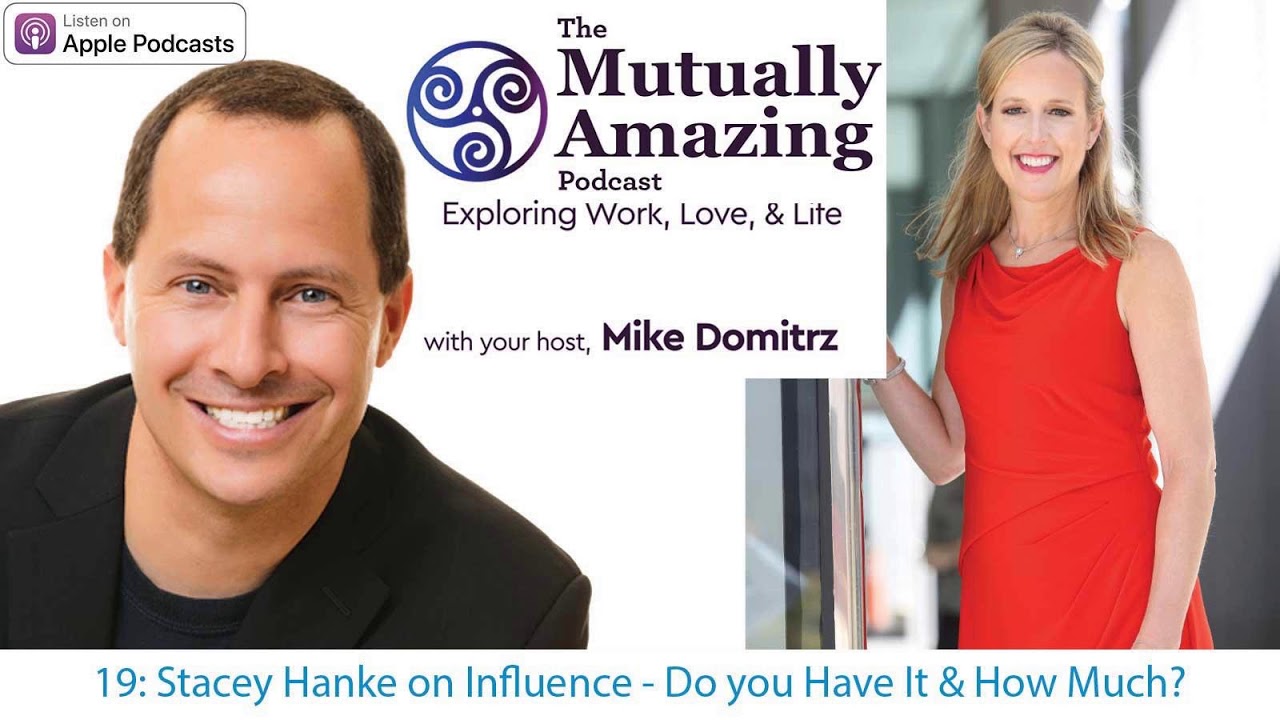
Leadership coach Stacey Hanke defines influence as clear messaging delivered authentically, not titles or charisma. She emphasizes consistency in how you show up every day, practical habits like eye contact and phone-free attention, and how fear and gossip erode trust. Her book is Influence Redefined: Be the Leader You Were Meant to Be – Monday to Monday.
Chapters
Welcome to the Mutually Amazing Podcast. I'm your host, Mike Domitrz, with the Center for Respect. The episode you're about to listen to was recorded when this show used to be called the Respect Podcast. So, you might hear that mentioned during this episode. Well, let's get to the show. And welcome to this episode. We have a friend of mine, a very close friend, a really special, amazing person with a With just a brilliant mind and a cool energy source around her all the time. Stacy Hunky is the author of the book Influence Redefined: Be the Leader You Were Meant to Be Monday to Monday, which such a brilliant statement, by the way. I love the Monday to Monday because most people think Monday to Friday. Her team works with directors up to the C-suite for companies including FedEx, General Mills, AbbVie, Nationwide, and Kohl's. Stacy, thank you so much for joining us.
Welcome. Thank you for that introduction. I don't know how I can top that.
Well, let's dive into that introduction for a second. Some people listening are going, what's the C-suite? So, will you explain what you mean by when you're working with the C-suite?
Yeah. So, it's anyone from the CEO and their executive team.
Okay. So, the highest level of the organization. That's where you're working with people. And you deal a lot in influence. That's your expertise. That is your subject matter. How does influence and respect— how do they— do they have a role together? And if so, what's that role?
I was thinking about this before you and I hopped on this call because I think there's so many to me, so many layers. So, I'm going to just make it super simple to start and then we can see how far we want to dive into it. When I look at influence, influence means to me is someone who really cares, puts in the work, the discipline to make sure that their messages are clear. To make sure how when they interact with someone, no matter if that's over the phone or in person, they truly are designing a message that is important to what that listener's experience level is and knowledge level is with their topic. That's the messaging side. The other side of influence to me, and this is— I'm going to get to where this respect ties to it— is someone who really thinks through how does everyone experience me, and that's all delivery. Do I come across as I truly care that That I care about what is important to them, that I can build trust with them. And when those two are not consistent and they start to collide, I think we start really not thinking about respecting people's time, respecting people's choices. I always say to our participants, even if you host a meeting, whatever that meeting looks like, that doesn't mean people have to listen to you. I think you have to do the work to respect that, A, they showed up, And B, they cared enough to be there in your presence. You've got to respect their time. And that's where I see there's a lot of correlation with your topic and my topic on influence.
Yeah. And I think it's a struggle for people because influence is also— authenticity is really important to it, right?
Yeah. Because I think the authenticity ties to the delivery piece that you don't just turn on your personality. your energy level, that you're suddenly different than what you are day in and day out. That to me is where the authenticity comes into play.
And that's respecting your, your true expression, right?
Yeah.
Your true self is the most authentic expression you can give to the world. If you're not giving that, you're holding back, you're not respecting your brilliance, you're not respecting your voice, you're not respecting what you have to give to the world.
Yeah. And so you're taking it from a different angle where really it is first about your own respect And then taking it to who you're trying to convince, who you're trying to influence, who you're trying to build trust, connect, and engage. I think there's the other piece to this, and this ties to the consistency. I've seen it many times with my clients where I'll see them as a leader, them interacting with their team, and it seems that they're really putting in a lot of thought and care to that group. And then I'll overhear them in another conversation with someone who might be higher up than they are or the same level as they are, and suddenly the conversation is different. than what they just told their peers.
Do you think that happens because of fear? Do you think I, I talk to people differently out of fear? In other words, I talk to the same horizontal level in, in an organization and below as me, cuz I don't have fear at that level. But I, or, or, or maybe only below, right? In, in the hierarchy. But somebody at my level or above, I fear their judgment cuz of how that can impact me getting back higher up that ladder. So I'm not truly authentic myself out of a fear. Is that possible there?
Yeah. And then I think it ties exactly what you were just starting to say. Then you start disrespecting your authenticity, which to me is the same thing as disrespecting your consistency, that people are guessing who shows up from conversation to conversation. And, and to me, that, that does, that ties all to respect. I mean, you and I both know, we, we ask, we always work with our participants asking them, how do you want to come across every day of the week, no matter who it is? What are some adjectives that come to mind? And believe it or not, as they're throwing out credibility, confidence, knowledge, authenticity, and I'm waiting for trust, I'm waiting for it, waiting for it, and maybe one person will throw it out, and if they don't, I give it to them, and I always turn to them and say, every one of you should write that down. Because let's face it, if people like you, they'll listen. That has no influence around it. When people start trusting you, they start respecting you. And that to me is where influence comes into play.
That's really powerful. And I've fallen guilty of it because I, I think, oh, I don't wanna say the wrong thing. Right? And so I'm very aware of language because in my line of work, the wrong word can actually do harm. Yeah. To survivors and to others. But what you can make the mistake of doing then is thinking, I need to censor all my language versus I just need to be me. I, I know it, I know that this over here could do harm. I'm not gonna say that. So stop censoring everything I'm saying. And I think a lot of us in society do that. We censor ourselves because we're afraid the true us won't be accepted. And in doing that, we lose trust. It's, it, to me, it's amazing. There are people that we will disagree with vehemently, their values, but millions will follow them because they're consistent. They know what they're getting with that person. Politically, this is so true, right? There are people that follow certain politicians. Because they're so consistent, they can trust them even if, even if they don't agree with a lot of what that person— but I can trust them. I can trust that person. Uh, and so I think what you're saying is so true. And we, we all forget about one, the consistency. And those people are willing to say what needs to be said in their mind. I'm not saying it's the right thing to say at all, but what they believe needs to be said, they say it and they're consistent about that.
Mm-hmm. And this is the part, if anyone right now is watching this and they're thinking, oh, come on, it's common sense, I know that. Isn't that what is in life the most difficult? It's the common sense that's not the common practice. And to me, when— what really wanted me to get on this podcast with you is when you think about respect, it's a word that's been around forever. But as we live in this world of noise and there's tons of messages coming to our plate, we're all— I think we all fall into that fear of saying the right thing, doing the right thing, that suddenly we've lost That the 101, the basic 101 that I'm guessing most of our parents have taught us, and that's just be true to yourself, respect others no matter who it is, and make sure that— to me, true to yourself means you're consistent. No one is ever guessing who shows up. And the minute you start affecting that, people start doubting. But if you're consistent, you, you will eliminate all doubt in your listener's mind.
Yeah. And what I love this weekend, I was at an event where we were hearing some speakers And the person was talking about personal branding. And it was so interesting because what the expert said was that personal branding is personal self-expression. And what most people make the mistake of thinking is personal branding is this brand I have to create that sells versus understanding that personal branding is actually the ultimate example of personal self-expression that you fully express and that you are you. So I know what I'm gonna get with you. I know your brand, then I'm gonna align With the you I that I know is always going to be true, and I want that. I want that. So yeah, you might lose some friends over here, or you might lose them, but you're going to gain the friends that align with you. And I think that's the fear that if that if we truly are self-expressive and consistent in that, we're going to lose some people. But you're going to gain like in the world of business, you're going to gain clients that are so in tune with you, you're going to be with each other forever.
It's so true. You're starting to— and I think this applies to our personal life and our professional life. I'm just going to throw out Facebook for a moment only because there was a conversation with one of my clients about it the other day and he was saying, he was like, I can't stand Facebook. I don't like being on it. He goes, because everyone's life is so great. Everyone is just having such a great day. He goes, are you kidding me? Who would ever put on Facebook, I'm just not feeling well today? And we all have it, right? So that's one example of we now live in this culture where I said earlier, there's a lot of noise and we're always trying to fit in with that next group, with that next crowd. And is it— does it tie in with we're afraid of what to say or are we losing that authenticity? We're sitting back, we're trying to watch everyone because now we can see people more often through social media. Get back to the basics. Get back to— I reflect on my— you know, I love country music a lot, and there's a Tim McGraw song that is Humble and Kind. And it's— if you listen to the lyrics, they're so simple, but we just have forgotten it. And a lot of those lyrics tie to respect the people that are around you. I come in from an angle. Respect their time every time they come to listen to you. Make it the best 10, 5, 20 minutes. That they always feel like you don't waste their time, you always give them an action step because that's the purpose of the conversation, and there's always some value. There's always some value proposition that's tied to it. If you could do those 3 things, I bet people look at your name when it appears on their Outlook calendar in the morning a little differently, meaning, okay, I don't even have to bring my technical gadget. Mike will make all use of time that is my value. And he'll be done in 20 minutes as he promised.
And I love that cuz that's all about respecting their time. And before we were talking about making sure we're being ourselves in that moment of respecting their time, that we're truly saying what needs to be said. And that reminded me of a quote I heard this weekend. It was from Jason Goldberg. He said, authenticity is what is left over when you stop trying to manage impressions. Isn't that powerful? Which is what you were just talking about. We're all over social media trying to manage impressions. Which means we're not ourselves.
We're not. And we're just, we're losing that. We always use the line with our clients, the ones that are, we have a lot of clients that are virtual. I'm sure our listeners understand that. And I had a conversation this morning with a client and she said, we just were, we've relied too much on it that we're starting to get lazy when we really could have a live webcam conversation and we're not. And I said to her, maybe it's something as simple as telling your Folks, your team, to hang up the email and pick up the phone. I know it seems like such an ancient concept. Or turn on your webcam. That to me is another way for them to see your authenticity, another way to respect their time because you're just putting in that extra effort versus anyone else out there that sends a quick text and in the bottom of the text it says, excuse my typos.
I just had somebody do this the other day to me and it was awesome. I don't know the person. I didn't know the person. They friended me through Facebook because they're a podcaster and I'm a podcaster. And in the Facebook messaging, he sent an audio message. Hey Mike, just listened to your show. Love your show. I love blah, blah, blah. And I'm like, wow, this is cool. I don't— I'm hearing this person's voice. It took no more energy, but so much more personal than his written word, which I would not have felt that passion, that energy. It was just incredible. So I think sometimes we get caught up in, well, those other things take more energy. No, they don't. That's the myth. It's actually quicker to talk than to type.
Oh, it's so much quicker. I was just told on Friday you can do that through Twitter too, because a client of mine received a tweet that was an audio retreat or tweet. I'm like, brilliant.
Yeah. What, what do you think are actions that people choose, strategies people choose that jeopardize their ability to be, to be seen as respectful? Or as trustworthy.
That jeopardize it. First, I, I go back to the technical gadget, you know, your phone. How many times it'd be as if we were on this podcast, but I just have to quick check email.
Mike, for anybody who's listening, she's literally checking her email on her phone as we're talking.
Right? It, there's just, there's so much distraction when I travel. I spend a lot of time with my laptop in a restaurant cuz I love the energy around me and it is a research project every time. Because you just look up and half the people are down in their technical gadgets. You can tell it's a pet peeve of mine. And I see it with leaders that will do it in their meetings and I always tell them, how you behave is how people respond. If you do it to your teams, they're going to do it to you too in a meeting. It's fair game. I think that's a big piece is we're really losing the ability to look people dead in the eye when we're having a conversation. We don't do it anymore. And it's free. It's free to build trust just by looking people dead in the eye. We're so caught up in all the distractions around us. We don't, we don't, we're not paying attention. We don't focus on what's happening. And our mind is always wandering, which I think someone can tell when your mind's wandering too. You're just, you're not quite there.
Yeah. When I ask audiences, what does it feel like to be respected? They say words like seen, valued. So if you are on your phone or I'm on my phone while you're talking to me, there's no way you feel seen because I, you can't even see my eyes.
Yeah.
And I remember when I would coach kids, youth in middle school, and we would say, the way we know you're listening is when your eye— we can see your eyes. That's how we know you're listening, right? That tells us you're— you're— we're being seen and you're seeing us and we're seeing you. And it's so powerful. And you think many of us as parents in corporate America, we can all fall guilty. So I don't want somebody listening going, well, geez, do you never do that? Yeah, we do that. But the thing is, can we catch ourselves and say, I want to reduce that dramatically, that behavior. And when I catch it, I want to acknowledge it for the error it is. So if I am doing it, go, you know what, I was just on my phone while you were talking. That wasn't okay, and I want to apologize for that. You are what matters, right? Because now I acknowledge it. Now if I keep doing it, it's not going to mean anything. But if I acknowledge that and don't repeat that behavior, that's powerful.
Now you hit something very key there, because I like the fact that you said you and I. I do it. I get caught doing it. Here's the difference though, I know when I do it. And to me, that's part of this authenticity and having that consistency. It's being aware, self-aware, that when you are doing something, body language, that's not consistent with trust, credibility, it's not consistent with your message. So that would be your first question, first answer to that question that you asked. I think the other piece is when you're in a conversation And everything that you say is so incongruent with the conversation at hand because you can tell that person is completely drifting and not listening to what you're saying. And it's Q&A. Q&A would be a good example of that. When we jump in during— perhaps it's during a meeting, someone asks you a question, you're already formulating your answer, and then you go on and on. You talk about what you think they should hear rather than what is really important to To their need and their expectation.
And along that same path of being inconsistent in what we say, I know I certainly have fallen prey to this. And I think when you have an analytical mind, and I don't even think that, I think that's an excuse we make. I think as human beings, we have, we like to talk negative. I don't know the psychology of why. I don't know if that's to make ourselves feel better at times, but we can be negative. And when we have a caring, respectful, image, and that's who we are, but then we don't speak that way around certain people. When we're around that one person, there's a lot of negative energy and we go there. We go to the gossip, we go to all of that.
Yes.
We lose all trust, don't we? We lose all influence. So how do you help somebody, all of us, from getting caught into that? And is there a place where people go, but I need somewhere to have that expression? How do I have— what do I do with that, that feeling like I want to be able to evaluate what I just saw? and talk about that, and there was negative to it. Why can't I do that without harm to this, breaking this trust?
I think there's a piece of that you can go there. I would always be careful. This is just a personal recommendation, take it for what it's worth. I would always explain why I feel that way and where it's coming from. I go back to, since I focus on body language, I go back to it's It sounds a lot different than when I'm talking to someone negative and the body language supports that, meaning I'm all negative with my facial expressions, the tone of my voice, my gestures, versus I can tell you something that's negative but do it in a way that softens it. I'm not saying soften it jeopardizes your authenticity. Again, you've got to make sure that every time you're in those conversations that might get caught up in the gossip or the negativity, get rid of the core to the gossip And focus on, well, why are you saying what you're saying? Why does your opinion stand the way it is? And make sure that if you think there's any comp— uh, confusion what you're saying, I would always explain, here's why I'm coming at this subject from this angle.
Yeah, I love that because that's reframing. I'm reading a book right now called Designing Your Life, which is all about how we reframe things, whether we choose to reframe or not. And that can build trust. That, that can actually do the opposite of hurting, cuz you're not gossiping if you reframe, right? If I go, I was at this thing and Dave did this. I couldn't believe Dave did that. Okay, that's gossip, right? That's just pure negative. There's nothing else coming out of that. It's me venting, right? But if the world knows I talk that way about Dave, then they can wonder, are you going to talk that way about me? Therefore, I don't feel safe around you. I don't trust you. You've lost influence by what you've described. That would be a loss of influence.
Yes. And you'd lose respect for it. And it's easy to get caught up in that. I get what you're saying.
And I could have reframed it. Could have reframed it and said, I'm really curious why Dave made that choice. I'd be curious to ask Dave why he made that choice at that moment, because that was a little bit different than what I expect Dave to do at that moment. There's really no— there's no gossip to that. That's a, that's a wanting to learn, wanting to be curious. And it also means I'm being compassionate to Dave because we all make mistakes. So people have the right to gossip about me because there's mistakes. What if they were curious instead of gossiping? And, and I know I have fallen guilty to this.
Exactly. We all, we all have. As long as we learn from it. I always say it's— we're going to continue to make mistakes and fail and, and hurt people. It's knowing when you did it and don't do it again. I think that, that's not what I'm talking about when it's consistency, by the way.
Right, right, right.
Learn the mistake and, and do it. I love the way you reframed it. You know what I think? That to me, the example you just gave, if someone said, well, how would I define a good communicator versus someone who's influential? What you did, that's an influential communicator. That they take a moment, they may be listening to as the gossip is happening, they really sit back and listen to what's going on, and in their mind they're taking the time to really give that response of, how will my words land on this person's ears and how will they translate it long after this interaction is over?
Yeah, it's taking responsibility for the impact of your words, not just the words.
Exactly.
There was a, there was a quote on Facebook this year that said, I'm only responsible for my words, not how you hear them, which I thought, no, that's, that's a horrendous lack of responsibility because that implies words have no power and I can just say them and I can say, yes, I said them, but your reaction is the problem, not my words that are the problem, which is really, really messed up. It's callous. I mean, is, is there's no other way to put that at that moment. Uh, and it was just a quote that was out there, but people were sharing it like, oh, isn't this funny? And I'm like, there are a lot of people who operate that way actually.
I, I agree with that. Or it is also, it's going to the next level where just because I communicated a message, you understand it, you'll act on it. This is another part of respect. It's your responsibility to work as hard as you need to work to make sure that your message is right for the listener. Now, when I say right, It's adaptable to what they already know about your topic, their knowledge level, and it's starting to meet their level of understanding so that they can act on your recommendation. I always tell individuals that I work with, you've got to do the work. You've got to do the work to get people to listen to you, to answer you, to respond to you, and act on your recommendation. And it kind of ties to that quote. You just make the assumption that if I throw something out there, people respect that that I'm having the conversation with them and they'll act on it. Not anymore. We live in too, too many messages are coming at us 24/7. It's harder now than ever to stand out from that noise.
And Stacy, you send out newsletters via email that give people great content, great information. And I love it because there's 2 sides of this conversation. There is the, you're not as influential as you think you are. And you work with some of the biggest brands in the country, some of the biggest, you know, people in very powerful positions that, that, Dictate the lives of thousands, tens of thousands of people out there, and they're not as influential as they think they are. And then we have people who are authors and speakers, and you're going, you're not as influential as you think you are. And then, but on the flip side, you don't want them thinking, then I have no value, that I'm not influential. So how does somebody who's listening to that going, yeah, if I put something out to the world, not a whole lot of people are going to act on it, you know, the majority of the world's not going to act on it, I'm not influential, therefore why try? So, can you explain that so that people don't get caught up in the, I don't have the influence others have, so why, why would I bother?
Yeah. So, it definitely is a catchy phrase and, you know, that's all part of it because we want people to hear us. Here's my point behind that, and I'll compare it to like an athlete, an actress, anyone that practices constant, that no one ever— an athlete, for example. Do you have a favorite? Is there anyone that you—
I don't have a favorite. I have, I have ones that I, I love their achievements. I've learned that we gotta be careful of, Knowing that that doesn't mean their personal life's in order, but their achievements. Michael Phelps' achievements in the pool, I was a swimmer, are unbelievable.
You can only imagine because he's so unbelievable with his achievements. He wasn't born with those skills. I mean, and he gets that no matter how good and all those medals that he has already earned, he still practices. It doesn't stop. And what I have found throughout the years before I started really pushing that phrase, you're not as influential as— you may not be as influential as you think you are. I'd be working with these leaders and they would come off with these comments of, I communicate all the time, I'm good. I worked hard to get to this position, therefore I'm influential. My title determines the level of influence I have. And once we started to do a lot of work with that C-suite, we realized just because you feel good, just because you've got this experience doesn't mean You are all being— you are influential all the time. And we use those sports analogies a lot where we talk about you're influential if you are consistent with your body language, your messaging, if you are constantly getting feedback. And I'm not saying good, nice job, but you're getting feedback and you're always having that deliberate practice like Phelps does. You're on that track to be influential.
I'm not.
Solid, influential. But I get that. I also do the work that I'm constantly working towards that. So it's not that— I think there's definitely people that are more influential than others, but my— the ones that are, they're, they're aware of it. They're constantly getting feedback. They're practicing these skills.
And your book brilliantly teaches how to do that. You teach people how to seek the feedback, how to become aware of where their weaknesses are, because there could just— it could be one thing they're doing. That's killing their ability for people to hear them, and they're totally unaware, but they're willing to seek that out. They're willing to ask questions.
That's it. I mean, I, I get coached. I have several coaches. Just when I get comfortable in my communication and the way that I interact with individuals, my coaches rip me apart, and I realize, all right, I have— I now I caught this habit. Where did I pick up this? I've got this to work on now. And to me, that's someone who's influential, that understands This is a lifelong learning, and that's someone that truly respects how they show up every day. Not only impacts them as a person and their values and their ethics, it also impacts everyone around them in their personal life and their professional life.
Well, when you were speaking in, you know, personal and professional, what do you think is the greatest lesson you've had dealing with respect in your own life?
How much time do you have? You've heard me talk about my parents before. And I grew up on a farm and my parents are 78. My dad retired several years ago, literally for 6 days. And on the 7th day, he was back up and doing his thing. He still is. That's where I learned my respect. I remember my dad telling my sisters and I, he always said, if you show up on time and you follow through, you will be the top 1%. Now, that's my dad's statistic. He gets that from nowhere but up here. That's just his own thing. And I remember as a little girl thinking, Mike, oh, that's easy. Like, that's all I have to do? Like, he kept ingraining that. And I watched my dad— I guess the third thing, he would always say, be kind to everyone around you. It doesn't matter their culture. It doesn't matter what they do for a living. And my dad modeled that. My dad models all of that to a T. He still does. And that's where I learned this whole idea of respect, that from little on, I've always been told it doesn't matter who that person is. Respect them as it's someone that you want to be their best friend or you admire. And it just, it comes, that's pretty basic.
I love it. And you, Monday to Monday, that is your slogan, the Monday to Monday, which is all— what I love about it is, you know, anybody listening right now should get one word consistently, consistent, right? Right? That's the word that you have been very consistent about throughout this discussion. And Monday to Monday bleeds it, right? There's no days off in being yourself, truly yourself. You should always want it, whether you're at work or at home, you should want to be that person.
Just want to make sure that the best of you shows up as much as humanly possible.
Yeah.
And we, some people will say, come on, Monday to Monday, you never take a day off. But, well, it's not like taking a day off. Are there times I just lay back and I relax? Of course. But I also, I think if you'd ask any of our clients, if you'd ask any of my friends, you get a pretty similar response from people. And it goes back to where we started this conversation. In my world, that's how I define respect.
Yeah. And what I appreciate about that is I think that if I ran into my friends who know me well, they know I love to dance. They absolutely— people who know me know I love to dance.
I remember that's how I kind of first met you.
That's right.
at some event and you were totally— had your dance shoes on, and I'm like, he's got it down.
Well, thank you. And there are times where my clients have known it, which, which I'm cool with. And people are like, why would you post that? Why would you? Because that's who I am. Like, why would I not post that? That— what's inappropriate about that? There's nothing. But they think, well, that doesn't— that's not your topic, or that's not— but it's who I am. And what I've learned more is the more I share that The more my clients can trust me because it's not just always talking to us about the topic, right? That this is the same Mike. I've traveled with Mike and I've seen him dance in this public square in a city in Greece. You know, one of my clients saw that happen because we were all out together and these kids were street dancing and I jumped in. And why not, right? That's who we are. And I think that's where people make the mistake when they hear Monday to Monday. They think work. I have to work on this Monday to Monday versus being Are you just being your best per— every day you wake up, I wanna be my best self, whether I'm working or not. I wanna be, have my best day. If it's an off day especially, right? Why wouldn't you want it to be amazing and allow yourself to be your truest self?
Yeah. Yeah. I was, this is on a personal side, I was at a restaurant. This was a couple months ago and it was 2 parents. I'm guessing they were parents, meaning married couple, and they had 3 little kids, little kids. And the kids were not exactly well-behaved at the table. And the minute that the mother got up to go to the restroom, the kids were angels. It was like turning the faucet, Mike, on and off. The minute she came back, it was an absolute circus. And I'm like, okay, what's that tell— what's the consistency there? What's happening? I've got stories of I had one, this was a while ago, this is in the book, where I was speaking at a conference and the CEO is up on stage presenting, kicking off the conference for the week. It was a sales conference. So, it's a big deal. They're pulling their sales professionals out of the field for a full week. That's a big deal. And the CFO, she's sitting next to me and she's on her phone the entire time that he's up there talking about how critical it is that we focus on our development. I'm thinking, everyone sees her because the house lights were on. It gets better. She goes up on stage, CEO comes off, the CFO, who was just on her phone, is talking about how critical it is. We pulled you out of the field all week. It's so critical to focus on your development this week. We ask that you shut off your phones. There's just that moment of, I'm like, okay, she obviously isn't doing it on purpose. I don't think she got it that her behavior is on display. We're all on display. I do find as you climb that corporate ladder, the camera is always on. People are watching leadership because they want to try to figure out how do you do it? Because you truly are a representation of not only that team, but I think your company culture as a whole.
Well, and that's what I love about our work, that when you're a speaker and you're on that stage, everybody's watching you. And when you're off that stage, everybody's watching you. Everybody in— and people go, well, that's the burden of being sort of in that public— and I don't mean celebrity public life, but where people watch you, uh, publicly. Uh, that's the burden of it. And I think, well, it shouldn't be a burden if you are who you are. There should be no even thought going into what I'm doing offstage. If that— if I am who I am onstage, then why, when I walk off, is it a burden to be who I am? The only way it would be a burden is if I wasn't authentically consistent on that stage. Because then I have to put a show on when I'm offstage.
I've gotten it before. I bet you can relate, Mike, where you're at the conference or at the event and then you're at the airport and you run into participants.
Oh yeah.
I've had participants where I'm just— my head's down, I'm working on my laptop or whatever in the terminal. I had someone once come up to me and they kind of sat and they kind of looked at me and they're like, oh my God, you look the same. Yeah, I mean, it's just— it's interesting. Or how many times do you get when you show up at an event and you haven't met the planner or your buyer in person, just over the phone, I've heard a lot of people say, you look like the person on your website. I'm like, that's good. I guess that's a compliment. Yes. But it's little things like that that still scream respect.
Yeah. I had a person today, or yet today, this weekend when I was at event, I was, I'm off stage. I had spoke actually a day or two before. So this is the last day of the event and people were, someone was talking to me. And when they were talking to me, we were into this deep conversation. And then someone else talking to me, we were in this deep conversation. And I walked out and then a participant did not know I was behind her when she was talking to my wife Karen and said, he'll never get outta there. He'll never get outta there cuz of how deeply he's talking to everybody. And I was literally 6 inches from her. She did not know. And Karen pointed at her like, he's on your shoulder. And, but what I thought was interesting was that she was surprised. That I was having deep conversations with people because in her mind, speakers don't have time for that, right? Speakers get off the stage and they don't, they don't make time for us. They leave. So if he is gonna have these deep conversations, you're gonna be here all day because people would— it was just, it was as interesting the way she thought it out. And she even made a comment that verified that, you know? And so you're like, how sad that there's a reputation there That either somebody who's been in the public eye in any way, whether it be from a stage or performance, that they're not going to care about the people in the room. And so if they do, it's very striking, which is sad because shouldn't that be the norm? That's why you came in the room in the first place.
Yeah.
Well, I want to thank you. You've been—you've been gave us so much brilliance today. There's three books you recommend in addition to your own. I'm going to have the links to all those real leadership talk. Like TED and Mastering the Complex Sale. I'm gonna have those links on our website for anybody who wants to check those books out, because I love to share the books that the people I have on are reading. I think that's always powerful.
Of course. Thank you so much. You're doing amazing work. Keep doing it and influencing everyone around you.
Well, thank you, Stacy. For everyone listening, we'd love to have you join us on Facebook. We have a discussion group. We'd love to hear your questions, your thoughts, and your ideas. And the best place to leave those with us is on our Facebook page at facebook.com/MutuallyAmazingPodcast. Of course, you can always contact us on our website at mutuallyamazingpodcast.com. Remember to subscribe to this show so you automatically get it every week. And if you could take one moment to leave a review, that really helps other people find the show, which we are greatly appreciative of. So thank you so much for Thank you for joining us. May you make today and every day a life full of mutually amazing relationships.








