20: Darcy Luoma reveals to Mike Domitrz how living "Thoughtfully Fit" can make the difference
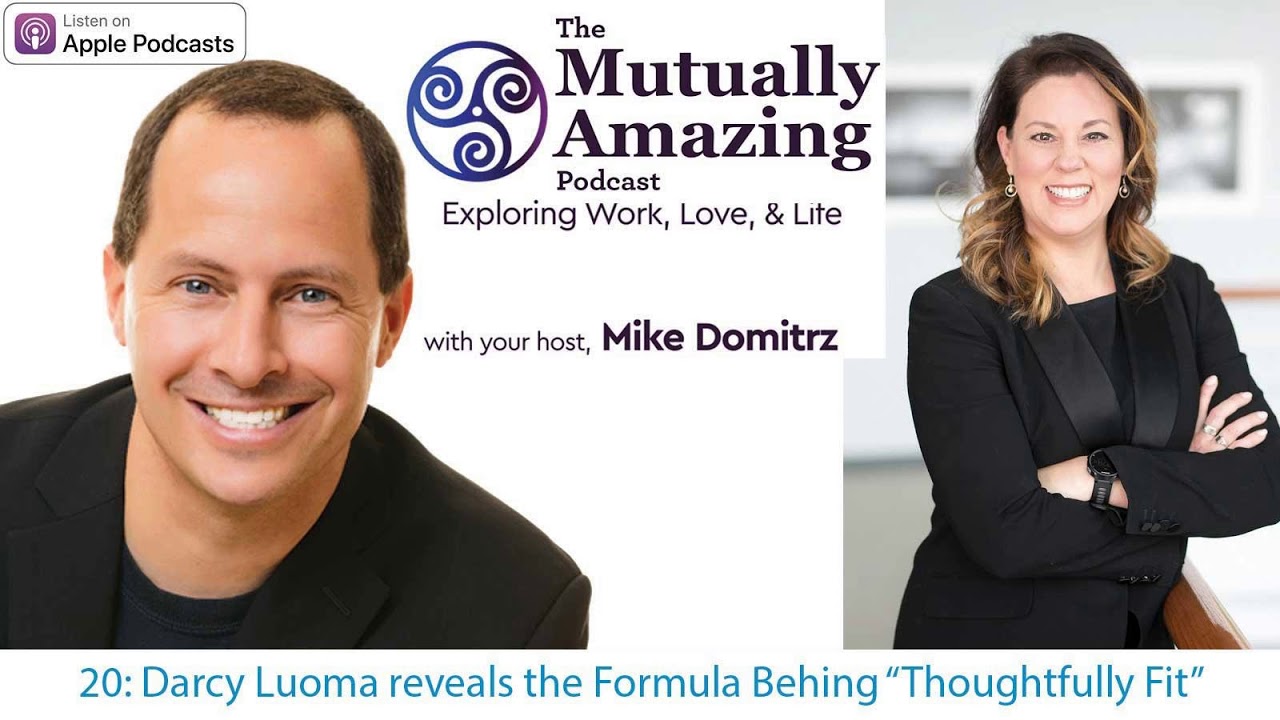
In this episode of the Mutually Amazing Podcast, host Mike Domitrz interviews master‑certified coach Darcy Luoma about her Thoughtfully Fit leadership and self‑coaching model. Darcy shares her personal journey—from a 12‑year tenure as director of Senator Herb Kohl’s Madison office, through a career pivot into coaching, and the sudden personal crisis of a marriage dissolution that forced her to live the model she was developing. She explains Thoughtfully Fit as a six‑element framework (three internal: Stillness, Strength, Endurance; three external: Flexibility, Balance, Agility) built around a core practice of Pause → Think → Ask → Act. The conversation explores how thoughtful questioning (open‑ended, “what”/“how” questions) cultivates self‑awareness, how respect underpins both internal self‑care and external interactions, and how the model can be applied in personal, relational, and professional contexts. Darcy recommends three books—Brené Brown’s Rising Strong, Gary Keller’s The One Thing, and The Art of Powerful Questions—and points listeners to her website (darcyluoma.com) and weekly social‑media “Thoughtfully Fit Thursdays” and “Wednesday Workout” for ongoing practice.
Chapters
Welcome to the Mutually Amazing Podcast. I'm your host, Mike Domitrz, with the Center for Respect. The episode you're about to listen to was recorded when this show used to be called the Respect Podcast. So, you might hear that mentioned during this episode. Well, let's get to the show. This week, I am super excited to have on a friend of mine, Darcy Loma, who's a master certified coach, dynamic facilitator, and professional speaker. She's with us today to discuss her model, Thoughtfully Fit, and I just love that name, to help you be more thoughtful in every aspect of your life. Darcy, thank you so much for joining us.
Hey Mike, it's so good to be with you. Thanks for the invitation.
Oh, absolutely. Now, Darcy, could you give everybody a little background on your personal story? Because you have an amazing journey. And so, you could start with what you were doing in your life before a certain shock hit you that sort of put everything in a new perspective.
Yeah. So, I was working for U.S. Senator Herb Kohl as the director of his Madison office for 12 years. And when he announced he was not going to be seeking reelection, he was going to be retiring, I hired a coach to help me figure out what was next and it totally changed the trajectory of my career from being in politics and nonprofit education sector to launching my full-time business doing coaching and speaking and consulting. And so I launched that in January of 2013 and was really excited to jump into that. And yet it was also pretty scary because I was the sole breadwinner for a family of 4. My husband at the time stayed home full-time with our daughters and took care of everything On the home front. And, you know, we've had some real adversity in the last couple of years in my life that I've had to put this whole model, Thoughtfully Fit, to the test to be able to overcome some real obstacles that were thrown my way. Business, luckily, was flourishing. But on the personal front, my marriage was falling apart. And I was really blindsided by that and caught off guard. by some of the things that my husband was doing. And it required me to really try to figure out how to keep moving forward, given that everything I thought I knew was being questioned. My husband had a double life that I didn't realize. And all of a sudden, I found myself as a single parent needing to learn how to run a household. In ways that I had never needed to do before. I mean, the simplest things, learning how to run my washing machine and what kind of gas the snowblower took and all these things, because I went from having a full-time stay-at-home dad to being a full-time single parent with 100% custody.
And through this, you had already set up the Thoughtfully Fit profile right before this happened. You were like launching the model, you were, you were writing it, you were setting it all up. And then this happens and suddenly you have to live thoughtfully fit. Now, did it happen that quickly, like for you? And we're gonna get into what thoughtfully fit is in a little bit for all of our listeners, but did you immediately go, I need to live now what I worked, or did that become part of the process?
Yes to both. Yeah. I mean, you're right on. So I'd been researching and developing this model for a couple of years and this Saturday in March, my colleague and I sat down and, and Really, it all came together. We had flip charts all over and Post-its and we're like, yes, this is it. And then, it was 4 days later that my life blew up. And so, I didn't realize it at the time just how valuable and essential being thoughtfully fit would be. I didn't realize that I was now thrown into the biggest pilot project, pilot testing of this model. But in reality, it's what helped me to get through the adversity and the dissolution of my marriage and my life as I knew it by putting these principles to test that I had been researching and developed, developing for so long. All of a sudden now I got to live it. And it was critical in helping me get through to the other side where I am now, you know, really finding the new normal. And luckily in a place that I feel like You know, business is thriving and flourishing. But that was not really the case for much of that period when I was going through those tough days and weeks and months.
Let's dive into it. What is Thoughtfully Fit?
So, Thoughtfully Fit is a leadership model. And in a nutshell, I took— I've been coaching and consulting and doing organization development with organizations and teams and leaders for decades. And I started to notice that there were some themes that came up over and over and over again and what gets in the way. of really having a life you love, of having success, having fulfillment, and inner peace. And I started to look at what were the themes. And we found that there were 6 themes that get in the way of— and obstacles of what get in the way of people really living the life they want and having the fulfillment that they want. And 3 of those themes are internal and 3 are external. Now, if you look up the definition of thoughtful, In the dictionary, there's 2 definitions, interestingly. There's the internal definition, which is really being mindful and intentional. So, you can even think about that, Mike. If you get an email asking if you want to be on a new committee and before responding, you really pause to be thoughtful, like, huh, do I have space for this? Is this aligned with what I want? Is this going to bring me closer to the work-life balance I'm looking for, my passion?
Yeah.
And then responding thoughtfully, intentionally.
I want to just pause on that one because I think that's really powerful. I think it can sometimes be even more deliberately obvious that we don't even catch the need to pause. For instance, we had an email come in recently where somebody said, hey, and we get this in my line of work, hey, you're doing this program and I heard you're going to be talking to my son or my daughter, and are you going to say A, B, C, and D? Because we're hoping you're going to say X, Y, and Z. And here's why, blah, blah, blah. And your gut's like, oh, I— there's no way I'm saying X, Y, and Z. Are they— do they not understand the whole topic? Like, you're fired up and you want to email back like, that is not what we do. And then you take a breath and you're like, that's not going to accomplish anything here at all, at all. So let's just take a breath and email back that, hey, we appreciate you reaching out. Here's what we do in the time we have with those students, and we look forward to talking with the students. You don't need to respond to everything, right? That's taking a moment to be thoughtful. And that's something we can all do. We can all want to fire back sometimes because somebody triggers us or offends us. And is that the same thing as what you're referring to, just taking that moment to pause?
It is. And your example is fabulous, Mike, because you— that example really encompasses both the internal and the external. So, internally, you're pausing to think about, how do I want to respond to this? Externally, you're doing it in a way that the message can be received, not getting defensive, not firing back. And that is the second definition, being thoughtful. It's being considerate of the other person, right? So, your example where instead of saying, well, of course, we're not going to say that, or that's not the training, you just said, hey, thanks for your email. We appreciate that. And here's actually what we do cover. Very thoughtful. So, that's what the Thoughtfully Fit is about— how to be thoughtful in every action, interaction, and reaction, whether it's with yourself, pausing to think about how you want to show up and then acting from that place, or with others.
Well, and I love that you also mentioned that it's to pause on decisions, not just reactions, right? Whether we respond versus react. But do I want this energy in my life? Do I want this responsibility in my life? Like you gave an example of, do you want to join this committee or do I want to get involved with this activity? And I think sometimes that's even especially hard when our friends are involved and they're asking us, right? Like, hey, do you want to be on this team with me? And you like being with your friends, but You're— you don't have the capacity right now, the energy capacity to do that. And sometimes we say yes because we don't want to disappoint our friends and we love being with our friends, but we're going to regret that yes if we don't take a moment to pause and say, do I have the mental and energy capacity right now for that in my life?
Well, you're right on. And what you said is key because if you're not thoughtful in how you respond, it creates regrets, it creates resentments, it creates conflict. And so it's all about slowing down and Thoughtfully Fit is a play and a metaphor on being physically fit. And in order to be physically fit, you need to train and practice. You can't just wake up tomorrow and decide, I'm going to be fit. I'm going to run a marathon today. You have to really practice. And in the same way, if you want to be thoughtful in all your interactions, it does take intention. It takes practice. It takes training so that you don't have regrets and resentments.
Yeah. And you talk about that if we were training physically, you know, and you're an athlete, you, you train for triathlons and you have to really work on your core no matter what. Just about all athletes want to have a strong core. And you talk about this in your work. And so when it comes to the core of Thoughtfully Fit, how can somebody build up their mental core?
Physically fit, you got a strong core, everything's easier, you're less likely to get injured. With Thoughtfully Fit, the core is to pause, Think and act and repeat. So, when you were talking earlier about the pause, many of us don't pause and think. We just act. So, we get that invitation. Can you be on this committee? Thursday night is the first meeting. You look at your calendar. Your calendar is open. You reply yes. You put it on your calendar. And all of a sudden, Thursday night comes and you're, you know, it's 5 o'clock. You're excited to go home because you're exhausted. You had a long week. And all of a sudden, you know, calendar pops up that you've got to go to this committee and you're like, oh. Dang it, why did I do that? Well, likely because you didn't slow down to pause and really think before acting. You— and so when you build your thoughtfully fit core, you don't just act or react. You pause. Give yourself some time to think. And the think always involves asking questions, asking thoughtful questions of yourself. Is this where I want to be spending my time? What do I really want? And then also thoughtful questions of others. If it's, if it's in a relationship with someone else, instead of just pounding and jumping in and responding or reacting or giving advice or fixing, uh, you know, what, what, what is it? I'm sensing that there's some frustration here. What, what are you frustrated about? Or what do you want from this relationship? And then you act from that place with the new awareness you have from pausing and thinking and asking those thoughtful questions. That's the core.
Yeah. And what I love about what you're sharing here is you're a coach. You are very open about you're trying to help other people coach themselves. And some people go, well, why would a coach do that? Because they want the business. They want people to hire them as a coach. But what you're really trying to create here is a self-guided ability to help ourselves coach ourselves. Is that correct?
That's absolutely right. And, and how it happened, the spark many years ago, I ran into a client at the grocery store and she said, oh my gosh, Darcy, I have to thank you. I was going to call you a couple months ago because I was stuck. Now, she was a former client. We weren't currently coaching. She said, I was going to call you because I was stuck and I just didn't know what to do. And then I paused and I thought, wait a minute, what would Darcy do? She would ask me some questions. She would ask me, what do I really want? And what's getting in the way of that? What are the obstacles? And how can I overcome those obstacles? And she said, I coached myself and I want to say thank you because you gave me the capacity To coach myself. And that's where it dawned on me that there are skills, there's an ability for people to be more thoughtful in their lives by slowing down, building their core to pause, think, ask yourself those questions, and then act from that place of new awareness.
How do you get better at asking the right questions or being more— creating more possibilities in your questions? Because I can imagine some people will fall into the trap of asking the same question all the time, and that's going to become a limiting thought process.
Yes. I don't know if you want some really concrete tips and asking questions. I do whole trainings on how to ask thoughtful questions. I'll give you and your listeners some really concrete tips. Open-ended questions are more powerful than closed-ended. So, instead of a yes/no question like, should I go to this meeting or not? It's black and white, yes or no. You ask open-ended questions that start with what or how. So, what would be the value of my going? What would be the cost? How might I benefit this cause without ruining my work-life balance? You know, and so asking open-ended questions, what or how questions can create more awareness. And it's always then when you have more awareness, you have access to different actions. So, instead of firing off, yes, I'll be there Thursday night, you say, You know, I love this organization, this nonprofit. I can't serve on the board or the fundraising committee right now, but I would love to write a check. And I've got a friend who actually expressed interest in doing more volunteer work. I'd love to connect you with them if you're interested. So you can still get to the core essence of what you want out of that interaction, that situation, to make an impact with an organization you love without having to jeopardize your time, your work-life balance, or, or, you know, make a reactive decision in the moment.
I think this is so important because I know people that will talk about being on boards, you know, nonprofits or trying to help, and the amount of anal detail that's involved drives them nuts. And I say, well then why don't you give it another way? You know, for instance, if, if that drives you nuts and you don't enjoy it, then why not find a way to give to your organization in a way that you enjoy sharing your gifts and your skills that you're meant to share in this world? So, that might mean you don't serve on a board, but maybe you speak at their chapters. Maybe you teach them how to make their other volunteers more productive at what they do. Maybe you teach a skill set. That could be more valuable than ever being on the board.
Well, yes. And not only can it be more valuable, it also— if it's honoring the way in which you want to be of service and give, you're going to have more passion and more energy instead of building up more resentment. Where every month, oh God, I got to go to this meeting or I have to do, you know, and then the way you're showing up, even if you think you're self-managing, chances are if you're feeling resentful for having said yes to something in a form that doesn't bring you joy and passion, it's probably having a negative impact in that energy in that room versus finding the way to serve that brings you joy. And so, it can be that win-win. And that takes a level of degree of thoughtfulness to identify and then courage to be able to say, here's how I would love to serve and contribute to this mission and this organization.
Love it. And you mentioned there's 6 elements here.
Yep. Stillness. I hear all the time from people who say, oh, I don't have time to think. I just, I just want more space. So that's the first obstacle that gets in the way. Next one is strength. Strength is all about being able to consciously choose how you want to show up in every situation instead of being on default or in autopilot mode.
Let's pause on each one just because I want to really get our listeners thinking about where they have stillness in their life. Because I know people that say, I have stillness, like I won't do work, but then they're on social media. Real stillness means there's— I'm not putting anything in my brain. I'm allowing the brain to be still and be almost an empty void. Of course, thoughts come in. That's normal. But is that— that's what you're referring to, right? A true stillness?
Absolutely. It's like quieting the mind. And not filling it with social media, with Netflix, with— and stillness can come in different forms to quiet the mind. Some people like to go for a walk in nature. Some people like to cut vegetables. There's different— doesn't mean that you have to be sitting still, but your mind, giving yourself the ability to have a quiet mind to be able to process, reflect, think.
And I really challenge all our listeners right now because I used to struggle with this. And we all do on certain days, given moments, but I used to think 20 minutes or 15 minutes of stillness or— start with 2, start with 3. I used to set my phone next to me and the timer and put it to 20 minutes and just sit there and whatever thoughts come, come and go, you just let them go. But it's amazing if you say, I'm going to challenge myself to 20 minutes or 10 minutes, you'll do it. You'll find a way to do it. So, just— it's almost like— Hey, I can do this. I'm going to challenge myself to have this stillness, because once you do it, you realize, all right, I am capable of this, because some people just don't think they're capable of it.
Well, yeah, and I don't know, Mike, I'm curious. Have you found then when you create that more stillness that your productivity and efficiency actually goes up?
Oh, without a doubt, because what happens in that stillness is while you're trying to quiet the mind, the mind is going through thoughts to allow it to be quiet. It's clearing the thoughts that are on top of it right now. So, that thought pops into your head and you have that thought there for a second and then you let it move on. But maybe in moving on, a solution popped up at that time, even though that's not why you're being still. So, when you come out of the stillness, you feel like, okay, I know what I need to do, even though that wasn't why I was doing it. I was just trying to create stillness. I find that you can have really profound results in that stillness and the rest of your day.
You're right on. And I think, for me, I also struggled with this and I still do. I mean, I struggle with all of these. My fear was that I was going to be less productive, and the exact opposite happened. I became more productive when I took time to quiet my mind, more thoughtful.
I love the quote that if somebody says to you, I don't have 20 minutes, I'm so busy, I don't have 20 minutes, that that means you need to take 40. I love that it should be double. If I don't have an hour to meditate, well, that means you need to take 2, or something's wrong. Something's not wrong, but something's out of balance because I don't want it to be a guilt or a shame thing. So, number 2 was strength.
Number 2. And the first 3 are the internal. So, these are in how to be thoughtful with yourself. Strength is about choosing consciously how you want to show up in every situation. And it takes strength to be able to have the courage to self-manage, to leave that argument behind as you walk in the door, you know, to your family instead of being like, ugh. To be able to have the courage and the strength to say no, a thoughtful no, to honor yourself. So, strength is a tough one if that muscle is not well developed. And I say that because the more you do it, the easier it gets, just like with the physical fitness. The more— the stronger you get, the easier it gets.
Well, and I think strength is at the heart of why I wanted this on the show, right? Because we're the Respect Podcast, and strength is the one area where people fail to respect themselves. When we believe in something or have a boundary and we don't stand for that, when we have the opportunity— I'm not talking about somebody forces onto you. I'm saying when we have a free and open opportunity to make a choice and we don't exercise our choice to respect our boundaries, we're failing to stand strong for ourselves.
Yes.
And so I think strength is so important because it's about standing for what we believe in, including ourselves.
Absolutely. And that's powerful when you can have the strength to stand for what you believe in and to choose consciously how you want to show up in any situation. It has a positive impact.
Yes. All right. So then, we're at number 3.
Yep. Number 3 for the internal is endurance. And this is all about being able to overcome obstacles. It's about embracing a growth mindset to be able to deal with adversity, whatever life throws at you, to have the endurance to know that I can make it through this.
Absolutely. Number 4?
This is where we get into the external. So, 4, 5, and 6 are external, dealing with other people. First one is flexibility. This is all about stretching for acceptance of others just as they are. And it's a stretch for many of us to say, gosh, I don't like how they're showing up, and try to change someone or not want them to be the way they are. Flexibility is saying, That's who they are. That's how they are. Can you just accept that that is who that person is? And if I, I mean, if I could figure out how to change another person, I'd make a bazillion dollars because when I go to these workshops, people say, oh, this is so good. Okay. Now, how, how, how can I get my, my boss or my spouse or my brother to do this? Well, you can't. You just have to accept them for who they are. That's hard and it requires flexibility.
Or choose to not have those individuals in your life. Like if there's harm in that, if there's harm in that relationship, you don't have to accept it, but you can just say goodbye to the relationship.
Absolutely. And that's where you would set a boundary and make a choice.
Yeah. So important.
Yep. So, so say no to the relationship or that when you could step into the 5th one, which is balance. So balance is about achieving alignment in your relationships. So, it may— and that's like looking for the win-win. It's about balancing what you want and need with what I want and need. So, before you say goodbye to a relationship because you can't stretch to accept someone, you may step into balance and say, hey, here's what I need in the relationship that I'm not getting. What do you need? And how might we achieve better alignment and create a win-win in this relationship by looking for and trying to find balance?
What I love about this is when I'm working with an organization, They think this is relationship talk, as in like marriage, and they don't realize, no, this is colleague talk. Like, hey, here's what I need to thrive in this role with our organization, working with you. What do you need when you and I work together to thrive in this relationship? All of these components can work in an intimate relationship, loving, sexual intimate, can also work in the workplace when they're approached respectfully and appropriately.
Absolutely. And it shows up in both places, the need for these skills.
Yes.
Yeah. If you have somebody, your colleague, who's a creative, innovative, big-picture thinker and you're an analyst, you like details, facts, and figures, and the two of you have to work together, there could be some misalignment, some frustration, some conflict. And that's a perfect opportunity to step into balance and say, hey, what you bring to the table is really valuable. And it can be frustrating for me because I need some more facts and figures. How can we best work together to honor your style and mine? And if you do that, we'll get a better outcome.
Love it. And number 6.
Agility. And agility is all about being able to respond effectively when you're blindsided instead of reacting. So, somebody comes at you. They pick up the phone and they're screaming at you. They're upset. They come into your office. Being able to have agility to say, okay, I'm going to respond. And think about the dodgeball. The dodgeball is being thrown at you instead of like, Just, you know, getting hit or dodging, you say, okay, I wonder if I want to slow this down and catch the ball and then, and then respond. Do I want to throw it back? Do I want to call a timeout? Do I want to call a truce? How do I want to respond in this moment when I'm feeling really blindsided?
Love it. Thank you, Darcy, for sharing all 6 of those. You know, we're on the Respect Podcast, and so where does respect play and integrate into the whole model of Thoughtfully Fit?
As I was reflecting on the model and your podcast, and I love listening to your guests, I love the New Respect Podcast, Mike. It's fabulous.
Well, thank you.
You know, respect, I think, integrates in both the internal and external. Having respect for yourself to be able to say, this is a boundary that I want to set, or I want to create more stillness, and being able to respect yourself enough to make those conscious choices. And then certainly respect with others is all about being thoughtful. It's all about being considerate with another person. So I think respect shows up everywhere in this.
And where did respect— where did you first learn about respect in your own life?
The first thing that comes to mind is when I was young, from my grandma, when I inadvertently didn't know I had— I mean, I won't go into the full story, but I had made a mistake and I didn't go back and make it right. And she called me and she called me on it. And I had disrespected her and she had the courage to tell me, which I thought was incredible because I could have gone on without knowing it. And she said, when you can respect another person, and she said, and this is a display of respect that I have for you and the relationship with you that I'm going to share with you that I felt disrespected. Holy cow, did I feel like crap. And what a gift she gave me to teach me. And that's the first thing that comes to mind. That's a fabulous question, Mike.
Oh, I appreciate that. What have been, for you, you have your daughters.
Yes.
And so what do you think is key as a parent instilling respect in their children?
You know, I think having the ability to self-reflect, being able to, I mean, going back to the pause and to think in the moment, what's needed in this situation to be as respectful as possible, both respectful to myself, my boundaries, my wishes, my desires, And how can I be respectful to the other person, whatever the situation might be? And then acting from that place. So, I think awareness is key and always look, putting it through the lens of what's the most respectful way to honor my needs and the other person's needs to move forward with courage and compassion.
That's beautiful. You recommend 3 books. One of them is by an author that I absolutely love and we've spoke about on the show before, and that's Rising Strong by Brené Brown. And you said really any of Brené's books you love.
Yes.
What about Brené's books for you does it, does it really trigger in a positive, wonderful way?
Well, one of the things I love about Brené is she has found this beautiful combination of telling personal vulnerable stories and grounding them in research. And so, it makes it come alive because the story is so real and so vulnerable. But then, she comes back and says, and here's the research behind it and here's the application to your life.
It's awesome that way. The second book is The One Thing by Gary Keller. What about that book?
Yeah, that was just— really came into my life at a time when I was starting to get— have too many yeses and too many things on my plate and my business was growing. And I read The One Thing and it was like laser focus. So what is the one thing that I want to be focusing on right now? And I come back regularly to asking myself when I feel overwhelmed. Okay, what's the one thing? And that book was so powerful in its simplicity. That one, and then another one that I read around the same time was Essentialism.
Love that book. And so, I'm going to add that to your list of books here in our show notes, Essentialism. And you had one more, you had The Art of Powerful Questions. Now, I can only imagine that's because it's all about asking ourselves the right questions or being open to possibilities of questions. Is that the reason that book?
It is. And because questions is the place where you can access new awareness, right? Being curious, whether it's with yourself or being curious with another person. And so, how do you ask powerful questions? It's very different about than asking a question like, well, what time of day was it? And what were you wearing? And what did he say? Those are not powerful questions. Those are not thoughtful questions. It's about really trying to get to the essence and the heart and to create new awareness.
Darcy, if somebody wanted to participate, be able to dive into the Thoughtfully Fit model, is there a way they— somewhere they can go and really learn this and live it and dive into it?
Yes, lots of ways. Lots of free ways as well. My website, darcyloema.com.
Which we'll have in the show notes because your spelling is a little unique. You, like me, have some last name nobody can spell right.
Yes, that's right.
So, for our listeners, if you don't see the show notes, it's Darcy, which it sounds like Darcy, Loma's L-U-O-M-A.
And Darcy, D-A-R-C-Y, with a Y. And so, we've got on there a whole section on Thoughtfully Fit. We've got a blog. Every week, we put an article up that talks about how to be thoughtful in your life, whether it's dealing with emotional intelligence or conflict or tough conversations. We also have Thoughtfully Fit Thursdays on Facebook. I go live every week where I'm talking about something that has come up with clients. whether they're individual clients or teams or organizations that I'm working with where I'm sharing more. And then, we also have Wednesday Workout, which is a 2 or 3-minute every week video that comes out on all my social media platforms, LinkedIn and Instagram and Facebook, that gives you a focus for the week. If you want to be more thoughtfully fit, what's your workout for this week?
That's awesome. So, our listeners, you got all those ways to really dive into this. It's such a great system. Darcy, the work you're doing is so wonderful, and what I love about having you on the show is you're a friend, and, and I know that your soul comes from such a wonderful space. So thank you so much for joining us.
Thanks so much, Mike. It's really a pleasure to be here. I love what you're putting out in the world.
We'd love to hear your questions, your thoughts, and your ideas, and the best place to leave those with us is on our Facebook page at facebook.com/MutuallyAmazingPodcast. Of course, you can always contact us on On our website at mutuallyamazingpodcast.com. Remember to subscribe to the show so you automatically get it every week. And if you could take one moment to leave a review, that really helps other people find the show, which we are greatly appreciative of. So thank you so much for joining us. May you make today and every day a life full of mutually amazing relationships.








