#20 - Mindfulness. Are you?
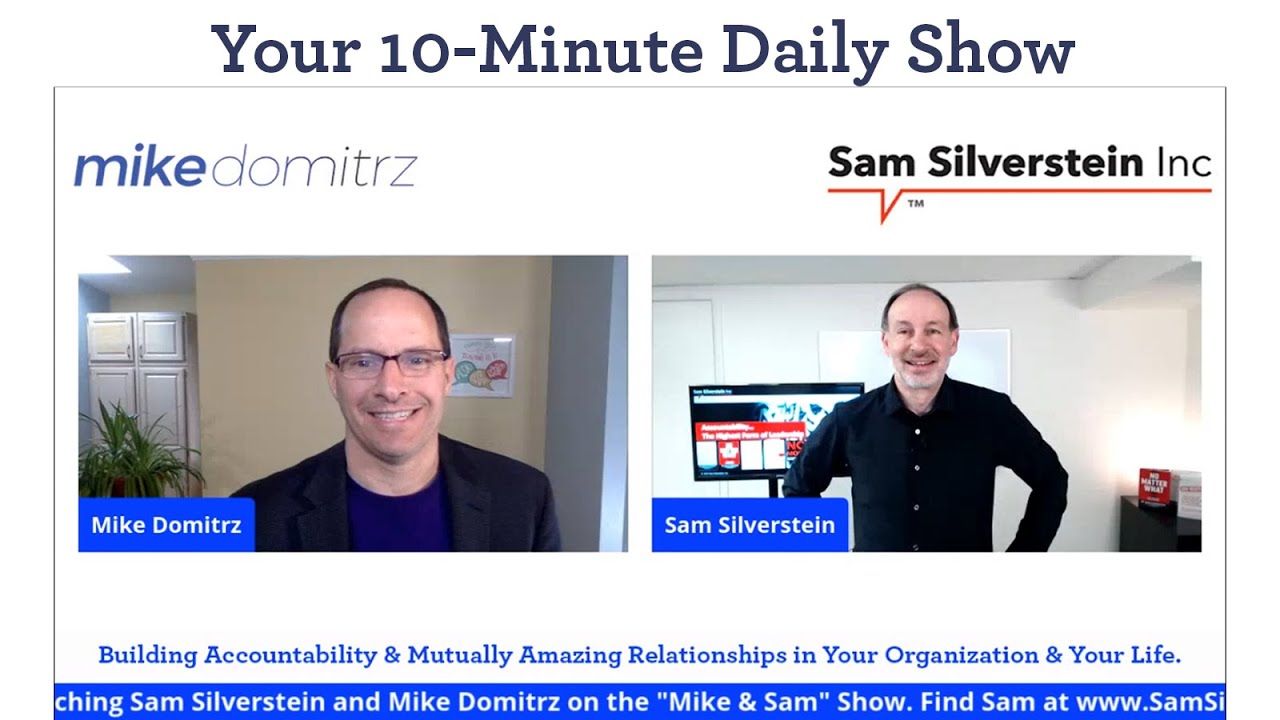
Mike Domitrz and Sam Silverstein discuss mindfulness as recognizing choice points, those moments when you can pause and breathe before reacting. They explain how this practice prevents microaggressions, improves workplace and parenting relationships, and requires self-compassion when you mess up.
Chapters
Hello and welcome to Mike and Sam. All right, so we're gonna get going here today. Uh, we're gonna talk today about— What'd you do?
You drink your crazy juice today, Mike?
Well, I drink my crazy juice every day, Sam. You know what I didn't do, Sam, today? I was not mindful there. I almost went right into the show. Sam, how you doing today?
Hey, I'm great. And I appreciate you asking. How are you?
I am, as you see, full of energy, ready to rock and roll. So many exciting things going on. I need to be very careful to be mindful of my energy, what I'm doing, so I'm not overwhelming the whole system here.
You know, that's, that's, that's an interesting topic, Mike. I think we should talk about mindfulness today. What do you think?
I think that I love your mindfulness of us needing to talk about mindfulness. So yes, let's dive into it.
Frame it up. How do you see this?
Well, you know, I used to do a, I used to do a podcast about mindfulness. So for me, Mindfulness shows up everywhere. I think a lot of times when people think of mindfulness, they think of woo-hoo kind of concept, and they don't think it applies to them because that's not their personality, that's not where they get their energy from. But that's a real misunderstanding of mindfulness. That, that has a role for some, but mindfulness is about being mindful of our world, the people around us, how we project ourselves, how we feel the world. And in the workplace, That's really, really essential that you get that. Because if you don't understand how you're impacting others or they're impacting you, you're going to have a real struggle with really being able to connect with others and/or take care of yourself so you can get where you need to go.
Yeah. In my work that I've done, and we both worked in mindfulness extensively, and all the training that I've had and the courses that I've taught, One of the things that I like to focus on is, is this, this what I call a choice point. And it's this point in time where we literally, we have a choice. How are we going to act? How are we going to respond? Which characteristic inside of us is going to flow out? And one of the best examples is you're driving down the road and you're in a hurry to go someplace and the person in front of you is going 10 miles below the speed limit. Or someone cuts you off. And so, what do we do? How are we responding? Are you— does your hand go up? Are you just talking right in your car as if they could hear you? Is there anger? Is there frustration? Or are you stepping back and going, wow, you know, that person's in a rush, cut me off. Maybe someone's sick. Maybe they're going to the hospital. I don't know their whole story. And so, depending on how you look at that, it's going to be how you respond. But the idea is there is a choice point that we need to notice and that we have a choice on how to respond. And if we rush through that choice point, many times we may respond in a way that we're not happy with when we look back on it.
Yeah. Well, you just described what's key to mindfulness. Mindfulness is not just a belief, it is a practice. You have to practice it and you have to catch yourself because nobody is perfect.
Exactly.
Nobody's perfect. Even the leading mindfulness experts, the real, the truly, the people who get it are the first to say, no, I'm not always. That's why I work on mindfulness so I can get better and better. And so, you know what? Maybe the one day I did react too quickly. The difference is when I'm mindful, I go, I don't want to do that again. So, I want to create a trigger within my mind that when this occurs again, I want to take a breath. It's just that simple.
Right.
I want to take a breath and reevaluate the choice I'm about to take next. That breath can make a world, world— this is true of parenting. This is true of workplace environment. I mean, how often are people in the workplace saying, I can't believe so-and-so did that, or I can't believe so-and-so failed to do that. And it's all about, I can't believe versus, well, what would it take you to believe why that happened? That's mindfulness, not what you can't believe. What can you believe?
Exactly. And, and, you know, we, we, you mentioned we're not perfect and that's exactly—
I mean, you're pretty close, Sam.
I said you were pretty close before. Um, in our minds, maybe we are, but we know we're not. But here's the thing.
We can just bring Renee or Sam, Renee or Sam. We could bring Renee or Karen on here and all discussion would be over perfection.
They'll let you know we're not perfect, right? Here's the thing. We are going to slip up. And this is really key. The key is not to beat ourselves up when we do mess up. Don't fall into that trap. Just recognize what happened, fix the situation and move forward. We have to be kind and gentle to ourselves. If we cannot be kind to ourselves, we'll never learn how to be kind to other people around us. And the other thing is, is that we cannot use mindfulness and our desire to really pay attention to how we're reacting in situations to manipulate other people or to expect them to respond a certain way. This is about us. This is about us being the best we can be. It's about us trying to pull out the best characteristics that we can in ourselves and live them consistently.
Yes. You know, you talked about we're not perfect. And one of my morning affirmations says, I'm fallible. And that is what it is. And it isn't what it isn't. It's perfect exactly as it is. That's part of being mindful. I make mistakes. Danielle's comment here is really important and brilliant. Because one of the defenses you will hear when you do my line of work, culture of respect in the workplace, is, well, they took it that way. And you and I have talked about this before on the show. They took it that way. What you're telling me is you don't care to be mindful of their world, of how they're experiencing your words, of how they're— and it allows microaggressions, which is what Danielle's talking about. Somebody says, well, I didn't mean it that way. That's still a microaggression. You did harm. You said words or actions that did harm. And had you been more mindful, you could have made a different choice in that moment. Absolutely.
And we have a responsibility when, when we open our mouths to say things that, that, that, that are proper, that are right, that are truthful, that are kind, that are not hurtful, that are helpful. And if, if, if we hide behind, well, they took it the wrong way, well, we have a, a responsibility in that message. If they took it the wrong way, there's a good chance we put it out there And allowed them to take it the wrong way because we weren't as clear as we could be, because our intentions weren't from our heart, weren't necessarily where they needed to be. It's one thing to say we are trying to be kind. It's another thing to really be kind in the way that we communicate.
Yeah. And you bring up something really important there. Somebody could listen to that and go, well, wait, no, I, from my heart, did say what I meant. The problem is you forgot how their heart could be impacted by your heart. So, you might've been in the right place. You and I have done this to each other. We've done it to other Sams where we get really blunt sometimes 'cause we wanna cut to the chase. And we could've said it in a more loving way to the other person. And it could've been more effective, but people will hear that and go, but it was effective.
How many times do I have to apologize for that, Mike? How many times do I have to apologize for that?
But people will go, but I learned, but they learned the lesson they needed to learn. Well, they could've learned it a different way. They could have learned in a more loving way.
So, mindfulness is critical with literally every interaction that we have throughout the day. It's going to impact every decision that we make. It's almost like, you know, in baseball, they talk about when that batter is hitting, like he has a hitting streak for 30 games and he's just doing unbelievable. They say it's as if the game is slowing down for him. And I think that's what it is in life for us. We need to slow things down a little bit so that we are actually in control. We are ahead of the game and we understand what we're thinking and how we're reacting. And when we take the time to do that, we're bringing mindfulness into our daily habits. We're gonna be communicating with people more effectively. We're gonna get a better result and we're gonna build more meaningful relationships. Which means there's going to be greater respect and greater accountability.
Absolutely. What an awesome way to wrap it up because that just sums it up right there. We want to make sure anybody listening or watching right now, you know, you can always watch us live. That's on youtube.com/SamSilverstein, youtube.com/CenterForRespect. Click on the bell there because the bell makes you get an automatic notification that we're live.
Be sure and subscribe for both of us as well.
Yeah, we'd love that because we're both doing lots of other videos and other work that you could also get, not just the podcast. I don't think a lot of people realize that sometimes. So we want you to be able to get that. And then of course on iTunes, look up Mike and Sam. Please subscribe on iTunes and leave a review. It makes a huge, huge difference. We love to read them too. We appreciate that because we appreciate you.
And thanks, Dan, for the comments today. We appreciate that. Everyone have a great weekend.








