21: Teri Yuan discusses Gender, Identity, & False Equivalencies
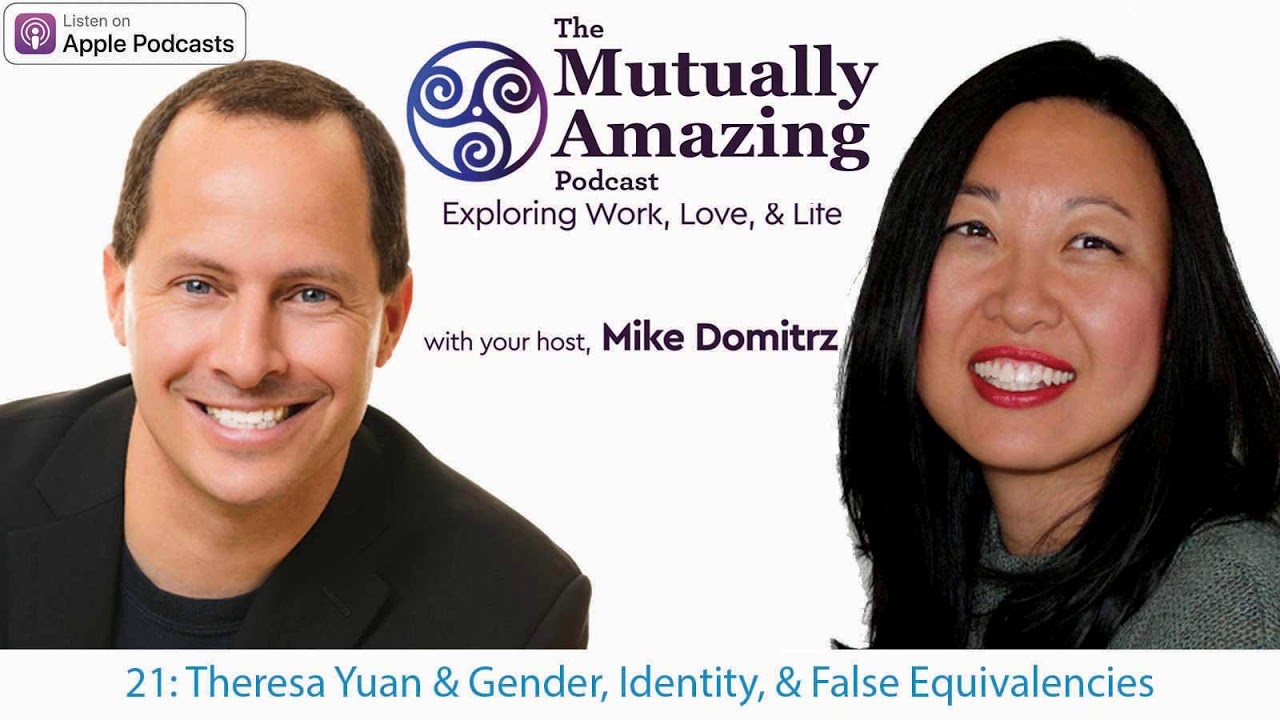
In this episode of the Mutually Amazing (formerly Respect) Podcast, host Mike Domitrz interviews Terri Yuan, host of the Engendered podcast, to explore how respect, civility, and equality intersect with gender identity and political polarization. Terri defines equality as universal access to rights and opportunities regardless of gender, race, class, or ability, and describes respect as treating others with kindness and compassion. She argues that societal messages create hierarchies of who ‘deserves’ respect, leading to oppression. The conversation delves into the misconception that gender is binary, explaining that gender, like race, exists on a continuum and that biological markers such as genitalia or reproductive capacity are insufficient to determine gender identity. They discuss how masculine norms are socially imposed on boys, causing stigma, mental‑health risks, and unhealthy coping mechanisms. Terri highlights the importance of inclusive language, especially pronouns like they/them, as a way to honor complex identities beyond the male/female binary. The dialogue also addresses false equivalencies—comparing self‑defensive violence to the initiator’s aggression, and political examples where those who create problems receive credit for minimal fixes. Throughout, both hosts stress the need for a shared definition of respect and civility to bridge polarized political divides. The episode concludes with Terri recommending three books—bell hooks’ Feminist Theory: From Margin to Center, Tom Digby’s Love and War, and Eric Liu’s You’re More Powerful Than You Think—and invites listeners to engage via the podcast’s Facebook page and website.
Chapters
Welcome to the Mutually Amazing Podcast. I'm your host, Mike Domitrz, with the Center for Respect. The episode you're about to listen to was recorded when this show used to be called the Respect Podcast. So, you might hear that mentioned during this episode. Well, let's get to the show. Welcome to this week's episode of the Respect Podcast. I want to get right into it so you can meet our guest and get into this conversation. Our guest this week is Terri UN, Teresa UN. Do you prefer Terri or Teresa?
Terri.
Terri. I noticed that when we were communicating back and forth, it was Terri. So, but yes, Terri UN is the host of the Engendered podcast, a weekly show that explores the systems, practices, and policies that enable gender-based violence and oppression and the solutions to end it, and uses gender as a lens to better understand power and oppression and its impact in the private realm so as to better recognize and confront it in the public sphere. So, Terri, thank you so much for joining us.
Thank you for having me.
Oh, our pleasure. What do you think is the place respect has in our current political environment, and how does civility play a role in this?
I think one of the underlying causes of oppression and abuse of power is the fact that there is no common definition of what respect and civility and the role of both of those should be in civil society. There's no recognition of the humanity of other people, and there's no common definition of what equality and freedom means.
So that's a great point. So how do you define equality and freedom?
Equality is where everybody has access Regardless of your gender, race, class, physical ability, etc., to all of the rights and privileges and opportunities that should be afforded to all human beings. And then respect, I think, is recognizing and treating other people with understanding, kindness, and compassion, and seeing them as whole human beings.
I love it. And do you think that part of the conflict that occurs out there is that in your definition of equality that you said that all people deserve? Do you think that's where the conflict occurs, that some people think, no, not all people, we don't deserve this treatment, like you earn respect? Now, I don't believe that statement. I talk about it a lot in the show, talk about when I'm working with corporations and organizations. You don't make somebody earn respect. That, that is a level of arrogance. to think you have to earn my ability to treat you with respect. But so how do you explain that to people when they say, well, nobody deserves anything except the basic right to be alive and breathe?
I think that it's innate in us to actually treat each other with respect when we're young, when we're babies. Babies have been known in experiments to really show compassion to other living animals, to living beings, whether it's animals or other people that have been hurt. And so I think what happens is over time society, you know, sends us messages that create a hierarchy of who deserves more respect or less respect or no respect. And those messages then become ingrained in us and reinforced. And even if we may not innately believe it, We might not have started out believing it. Over time, we are rewarded for reinforcing those messages based on who we are.
Can you give us an example, Terri, of where that happens in society?
So, I think in my most recent podcast, for example, I talk about the construction of gender. I think it's a myth for people to think that feminism is only for women and that it's not for men. And people don't recognize that Feminism is about equality of all genders, right? And men think that feminism is something that's a threat to their place in society. But the issue is because when we're young, we're taught that being a boy means being strong and being powerful and exerting our strength potentially through violence, through— domination. Those are aspects of our being that may not be natural, and yet we are going to be rewarded or punished for not being able to adhere to those norms. And so people, you know, boys, young boys who might be not interested in sports or not watch, you know, whatever, the NFL, might be interested in music, or, you know, the stereotypes of being interested in drama or creative arts. Those are stigmas that we create for young boys for not really expressing themselves and exploring their creativity and their passions in a different way than what and how society deems is worthy. And so what happens is over time, those boys potentially could be targets of bullying. They could not be encouraged by their parents. or, you know, other members of society to really explore those innate aspects of who they are and what they're interested in. And then as they start repressing those aspects of themselves, it creates an imbalance that may lead to potential health risk. You know, they might seek coping mechanisms that are unhealthy, that might lead to addiction, or maybe, you know, exerting their— their frustration in an unhealthy way in their relationships. And so that's an example where equality and feminism actually benefits all of us, you know, women as well as men. And if we can see that and how the system of male supremacy is actually there to control all of us, then I think that's something that can actually garner more desire and the ability to learn how to communicate with each other respectfully.
Yeah, there was a video recently of, if I remember, it was 4 or 5 people. Most were actors or performers in Hollywood. One was not, Tony Porter. And they're around a dinner table having a conversation, and it was released around the world and it went viral. So people could look it up. I don't remember the exact name of it, but Tony Porter's in it if they want to look that up. And it's, it's men talking about all different aspects of sexual violence, of society, and how we treat respect. But they also talk about the pressures they felt as men growing up that speak 100% to what you're saying right there, that this masculinity I was supposed to be, whether it fit me or not, and how dangerous that can be. And so you do the Engendered podcast, you're the host of that, you facilitate that conversation. When it comes to gender specifically, what do you think is the biggest misunderstanding that's out there?
The biggest misunderstanding is that identity in general, of all aspects, is a binary, that gender is a binary, and that it has to be either/or. You're either male or female, and there are traits that are specific to being— the same trait can exist in both genders, and it could be perceived in different ways, usually positively. You know, like being assertive can be positive for men, and if you're assertive as a woman, then you could be seen as dominating, you know, as a supervisor, as a manager. And so there's a value laid in dichotomy, binary, that cuts it in 2, and it's really a continuum. So I think that's the biggest myth, that gender is a continuum, race is a continuum.
So I want to pause there because a lot of people push back on this part of the conversation, which is, how is it a continuum if— and I'm not asking this myself, I'm saying this is what we have as the pushback from— you know, you hear what I'm about to say.
Sure.
If somebody is born biologically with a penis and this person over here is born biologically with a vagina, how is there a continuum? The penis is the male, the vagina is the female, is what we often hear as pushback.
Well, first of all, biology itself, or how it's expressed and its possibilities, aren't necessarily, you know, binary as well. So for example, the question of just genitalia. You know, lots of babies are born without the full expressed genitalia that we attribute to being a boy or a girl, or the hormonal corresponding, you know, hormones. And as you grow older, for example, as a woman, if you were to get a hysterectomy, you know, taking away your reproductive, you know, organs, does that make you no longer a woman? I mean, obviously culturally, society actually deems that's the case, you know, and attaches certain value to women who can no longer, you know, bear children. But what if you were like, you were born that way, you know, from the beginning? Does that make you less of a woman? Because it's not the vagina or the, you know, that, that's not the reproductive organ. It's, it's really everything else, the uterus and the fallopian tubes, etc., right?
Let's say somebody makes that argument then. Okay. If the body has the reproductive possibilities, that's a female. If the body does not have the reproductive capabilities, that's a male. Let's say somebody makes that argument. Now, what's the discussion?
People don't necessarily identify with their reproductive capabilities. You know, there could be women who don't want to have children. Does that make them less of a woman? You know, because— does that make them not a woman because they choose not to express the full potential of their reproductive organs. And similarly, a man may have the desire to give birth, but that doesn't mean that he can and doesn't make him a woman. And so biology is also different from sexual desire and your identity. So one can identify male or female, right, and be born in a different body, which is what transgender is. But then you can also have different sexual desires. So regardless of whether you're male or female embodied, you may have an attraction to male or female traits or, you know, people. And so there's, you know, so many layers of gender identity that I think the, you know, the whole thing is a continuum. And even if people who are biologically expressed very much one or the other, it doesn't mean that they have fully those traits that we have identified as belonging to those genders.
I think what you just said there is so brilliant in that why do we think that genitalia is the marker, or why do we think that reproductive parts are the mar— you know, actual biological body parts are the marker? Why— what if the marker is the brain? And this is where people do get confused and they go, Well, wait, if you're born with this body, but your brain's saying this, then you need to convert to your body. As if the brain's not as important. Like they choose the judgment of which is happening here. The chemical, what they'll say imbalance, right? The chemical imbalance versus the just a different chemistry than they have. But so they say the body, the physical being must be what you convert to, which is interesting to go, well, what about the heart, the soul, and the brain? We have to ignore all those. And make them something they don't fit in is what you're saying, correct?
Exactly, yeah. And ultimately, it does have to do with the brain. And so if our brain is, you know, the organ that controls all of these things and the expression of all of them, our brain is not gendered. And so what does it really matter, you know? And I think the main issue is not trying to reinforce these sort of myths of identity and gender, but to really go beyond it and to come to a place of acceptance. And back to, you know, your show, respect, that people can choose to express themselves and define themselves any way they like, you know. And it's not just gender, it's with race or whatever, you know, national identity, citizenship, you know, etc. So that's obviously one of the common—
Issues.
Challenges that we have in our day politically, right?
Right, absolutely. And when it comes to gender, some people who may be listening going, are you implying there's more than 2 genders, is a question. And I've had that in audiences when I say, hey, inclusive means all genders, and people go, whoa, whoa, whoa, all? You mean there's more than 2? So can you explain that? Are there more than 2? Are they defined? Or because there's a spectrum, when we say all, we're leaving the possibility open?
I'm not an expert on being able to sort of— I'm not an LGBTQIA expert. So I also want to say that, you know, beyond male and female, there's also intersex and, you know, obviously asexual. And so how you express your gender, it's the performance of it, basically. It could be the physical performance in terms of how you dress. It could be gestures. It could be the things that you like, you know, in your sort of day-to-day activities that you enjoy doing and how those are associated to particular genders. But ultimately, you know, the combination of those 3 things really determines what your gender identity is. And that's why so many people, even who are, you know, heterosexual, they might now consider, you know, using the they/them pronoun because They're tired of being pushed into this box and trying to fit in.
So let's go there, because for some people listening, they'll go, what did you just say? The they/them pronoun? Now, for those of us who work in the field, if you work on college campuses, you're aware of what we're discussing right now, or you may be aware of what we're discussing, which is when somebody meets someone, they may say, by what pronoun do you go by? Or, I go by this pronoun. And that way people sit there, go, you get the stereotypical, Is it a he or she? Which is a horrible statement because it's an it, right? Versus are they— do they identify as he or she or they? They might identify as they. And people say, well, why is this? It allows somebody to be respected in the way they see themselves, in the way that they know themselves to be true of. So this is not uncommon that somebody says, well, how do you identify? So for my case, it would be a he/him because that's how I identify. Somebody else could be a her, could be a they, could be all different possibilities, but it's just saying, how do I see myself? It allows people to be treated right from the start within their identity. Is that correct?
it was basically Mr. or Mrs. You could only be those 2, or Miss, I guess. So you had Mrs. or Miss, and you were either married or unmarried, and there was nothing in between. And I think—
And yet, and yet Mr. was always consistent. And that was the argument that, hey, how come the person identifies as a male can always be treated the same with Mr., but the woman has to be identified by marriage or not? Right.
Right. And then, and then based on whether you're a Miss or a Mrs., then it actually helps people calibrate their treatment of you, right? Which, why should that be the case? It should be uniform regardless of your marital status. And similarly, and then so similarly with they/them, I think what it represents to me is the plurality of identity. You don't want to be boxed into, again, a she or he. And for me especially, you know, as someone with, you know, who's Asian American, who's a woman, who has all these other identities that I'm not going to share with you, you know, right now, but— those other identities aren't necessarily visible. And being able to be called they or them elevates those other identities in a way that, you know, one word in gender would not.
Do you think we're moving to the place, or do you think it would be more ideal if we moved to the place where we're removing gender from the conversation?
Well, I mean, I think the goal of equality itself is eventually to make it irrelevant, you know, what you're fighting for once you get there, right? I definitely don't think we're there at all. We're at the beginning stages of opening up the conversation. And I think we can both recognize from the national climate and how polarized we are that it's gonna be a struggle. But I think one of the benefits of having, you know, your podcast and this conversation is hopefully to bring other people regardless of their, political affiliations, where they grew up, and all the elements that make up their identity, that they can come and see that there are different ideas and opportunities for personal growth. And recognizing why people feel certain words are offensive or not, or more offensive or less offensive, and the historical implications of it is something that can really open up dialogue for getting to know each other and hopefully being more compassionate and understanding.
Yeah, I think it's a really important discussion for people to have. If somebody's listening right now, and let's say you're pushing back going, whoa, whoa, whoa, you're going against genetics. And actually what we're saying is we're incorporating more genetics. We're taking the genetics of the brain, the chemistry, everything, not just the pure physical genetics that people tend to refer to. But if somebody's pushing back right now, I just want to ask you to pause and think, why do you need them in the box? Why do you need each of us to fit into a drawer? Because I know that history will tell you, because I can then know where my world is. This is what I learned my world is, and you're saying my world is different, and we don't like change. So let me just put people back in the box. But what value is there in putting people in a box? What value is there in straight categorization of people? It actually places some value higher than others when we do that. It's just a matter of fact. The moment you categorize, that means certain categories are different than others. therefore, we tend to treat differently. So, I just throw that out to someone listening right now going, if you're struggling with this, just think, why does it matter to you that Jordan identifies this way or that Chris identifies this way? And yes, I'm being intentional about the names I chose because people then want to go, which are you talking about? That's the point. Why does that matter? If Chris or Jordan are brilliant, if Chris or Jordan bring value to this world, Why do you need to know what category they have to fit in in this one area? That's sort of what we're saying here, correct?
Yeah, I mean, I think, you know, it's too long for a discussion for us to get into now, but I think historically, you know, our country was built on basically a colonialist mentality that hasn't really been addressed, you know, and so all of the historical repercussions of whitewashing and erasing that part of our historical identity, you know, has in some ways both rendered it invisible to all of us, you know, whether it's, you know, whatever, you know, race or gender we are, we are unaware of our full history. And yet at the same time, because it's rendered us invisible, we've also had no place to have a discussion for it. And so What it's done is it's created a system where people are trying to connect with one another based on superficial identity constructs rather than on more deep meaningful values. And the reason people try to put other people in a box is because they crave connection, they crave community, they wanna find their tribe. And they think that their tribe is based on These things of, oh, we like to— I'm going to use the sports analogy again, right? We like to watch the Super Bowl together and have a tailgate or whatever, but that's just an activity. Why do you like that activity? You like it because there's community. There's— over time, you've built a set of rituals that people engage in, so it's predictive. You know that every— I don't know this football so well, but— You know, every year there's a football season that you can rely on, that you could always be able to connect with other people and see. Similarly, people go to church. But if we can like look at all of these cultural institutions and see them as just that, you know, they're just cultural institutions, and peel away the onion to get to who we are as core people, then we don't need to have those sort of artifices to connect with one another. We can connect with one another on a deeper level. I care about getting to know you because you and I share the value of treating people with respect and with equality, and that matters to me more than what else— what you do on your weekend or after work, right? And there's a commonality there.
Yeah, and that's what I always find intriguing. Every now and then I'll meet someone who says, Mike, hey, one of your best friends is so polar opposite you politically. I don't get that. And I think that's because they're only seeing the political aspect, not all the other aspects I see in that person and that that person brings to this world. And that's true on so many levels, whether it be gender, sexual orientation, racial, cultural, that when we actually drop the, I identify this way, and walk out as in, I always have to be seeing, be connecting with my same identity, I don't have the chance to learn about other people. I don't have the chance to connect on the multiple layers that we are as human beings. And so, the more that we're able to drop the, as you said, the institutions, the cultural institutions, and just be able to connect on a sincere one-on-one level, like, hey, what drives you? What inspires you? What angers you? And be able to have those conversations where real connection happens. It's so powerful.
Yeah. How do you want to see the world?
Yeah. And identifying that way. Right? Like identifying yourself as a loving person. Well, see, 'cause if you say, well, I'm a loving person, but those people don't belong, that doesn't sound loving. So—
Exactly.
Are you identifying yourself as a loving person? Because do your actions then back that up? Now, that doesn't mean that I'm not gonna be loving to those people who say they don't, that they aren't loving, 'cause I believe I'm a loving person. I have to be loving to all people. I'm just gonna be aware of what energy I let into my life, what I intentionally spend time with energy-wise.
Yeah, and I think one of the challenges that we have today that, you know, obviously the 2016 election has really exposed is that people are more willing to remain in their tribe and remain in their community even at the expense of what the values of those communities espouse, you know, or purportedly espouse. And to me, that's very disappointing because there's so much more, you know, that they're missing out on. And it's kind of like holding on so dearly. You know, there's also research, and I'm sure you've seen these articles recently around how— I don't know if it was just white Americans, but I think it was white Americans who really seek community and sort of defending their white privilege. You know, they're more willing to accept authoritarian rule. And they're more willing to give up democratic principles and benefits in their society. And that could mean access to facts and access to true values of kindness and empathy and compassion and treating people with equality, even though all their lives they have been engaging in, at least in rhetoric, in promoting those values. But now they're willing to give it up because their white privilege is at risk. So that's, I think, something that we need to really talk about.
Personally, I don't know that specific research. That's interesting because you do see it on all— and we do see it on all sides. We see grouping occurring on all sides that say, lockdown over here. I'm gonna go this way and you're over there. And now we're against each other. And neither makes sense because neither are about love, respect. It's all about my way or the highway, which is dangerous when extremes do that. And so, and I don't, I do not want to imply in any way that one side here is less culpable for their actions than they are. So that's really important. But I think it's important for all of us to step back and go, where am I potentially lacking living with respect by this choice I'm making? I think that's an important question.
Well, Mike, I do want to address that point because I think that too often, and one of my complaints about the media, mainstream media, is that they're constantly putting forth a false equivalence.
Right.
And I do feel that in some ways that analogy may be so because when someone is doing something, this happens within gender-based violence, that community, the violence against women community. When someone does something wrong, if someone is abusive to their partner and their partner is acting in self-defense and happens to use violence in self-defense as a response, they are not equally culpable. You know, so when you are resisting and trying to defend yourself, that is not the same as the person who actually initiated it and what the intention of that person was. And in the eyes of the law, they both may be treated equally because they both engaged in based on statutes of assault, they may be actually treated the same way. And so I think similarly, when people are trying to sort of erase or minimize our democratic ideals of freedom and equality and the value of fact and all of our First Amendment rights, Um, and, and others are responding in defense of those, which are the founding principles of our country, they are not the same thing.
No, I'm so glad you brought this up because that's what I was trying to reference. You did it much better than I did, which is that false equivalency discussion, which is— it's— yeah, that's what we have to be careful of, not doing that. And, and I think it's so important. Uh, I think we need to be able to have both conversations, to be able to say there's problems on both sides Politically right now in grouping and how people are behaving in groups at times, especially extreme sides. But at the same time, that also means I should say, and at the same time, that does not mean that's okay to use false equivalencies. And that's why I think it's brilliant, the example you gave, that defense from the person in power is different than the person in power causing, starting the harm in the first place. There is a huge difference there.
Yeah. And I think also what happens is, I mean, you see these in memes on Twitter all the time with regard to responses to the administration. The best example that I give is someone causes a problem, let's just say the migrant crisis, and then they try to minimally address it but not really fix it. And then all of a sudden they get credit for it. So it's basically like giving an arsonist credit for trying to put out the fire but not successfully. put out the fire that they started. So why are we giving that person credit for something that they actually created but then never fixed?
Right.
And so that's kind of the situation that happens again and again that I see. And I think it's important to be able to distinguish the person who's trying to put it out because they didn't start it and they're trying to put it out and save that house versus the person who's trying to put it out because They realize that people are upset at them for starting that fire. And, you know, they, they want to, um, get in everybody's good graces again.
That's brilliant. Thank you so much for sharing that. You have 3 books you recommend. One's Feminist Theory: From Margin to Center by bell hooks. Another one is Love and War by Tom Digby. And the last one's You're More Powerful Than You Think by Eric Liu. We're going to have all of those links for our listeners and viewers to be able to find at respectpodcast.com. We'll also have that obviously in the show notes if you're listening on iTunes. We'll have that available for everybody. Terri, I want to thank you so much for sharing your insights and your brilliance today.
Thank you so much, Mike, for having me.
Absolutely. We'd love to hear your questions, your thoughts, and your ideas. And the best place to leave those with us is on our Facebook page at facebook.com/MutuallyAmazingPodcast. Of course, you can always contact us on our website.
at mutuallyamazingpodcast.com.
Remember to subscribe to the show so you automatically get it every week. And if you could take one moment to leave a review, that really helps other people find the show, which we are greatly appreciative of. So thank you so much for joining us. May you make today and every day a life full of mutually amazing relationships.








