#22 - Integrity in the Workspace
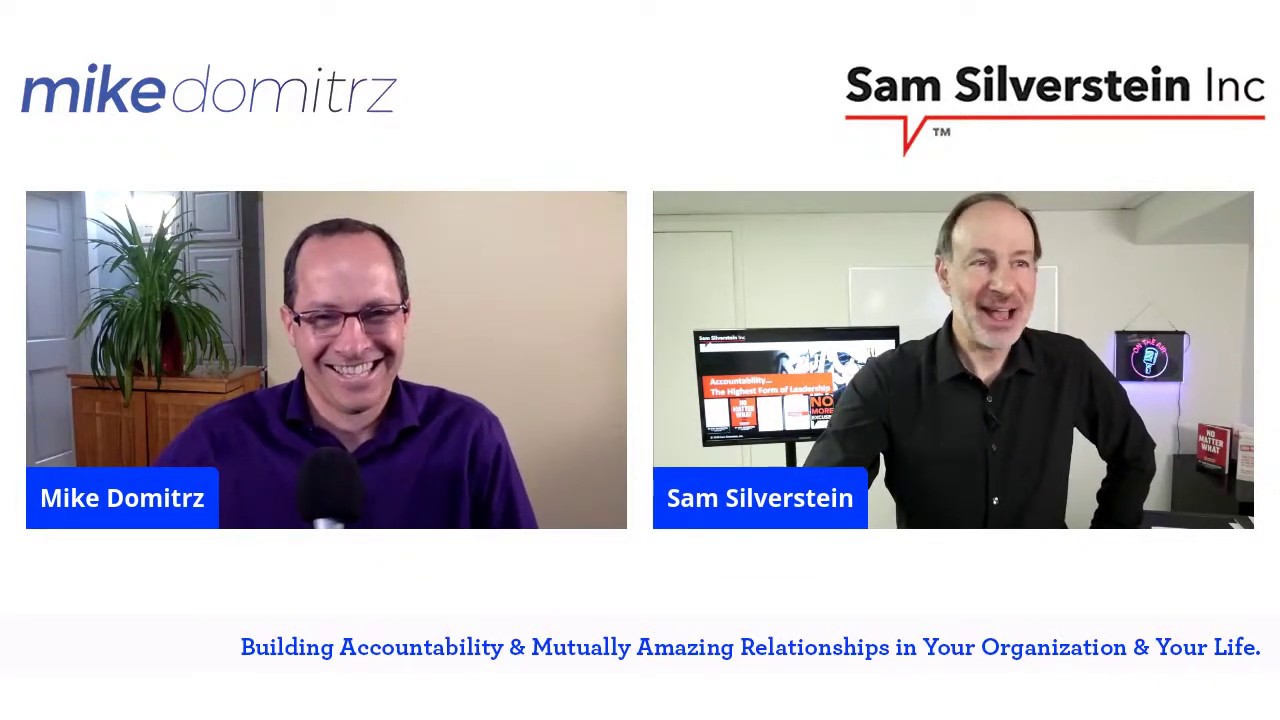
Mike Domitrz and Sam Silverstein discuss integrity as the top business challenge, defining it as alignment between values and actions. Organizations with integrity attract better employees and customers, while the absence of it carries severe consequences, as illustrated by Barbara's work protecting military personnel.
Chapters
Alrighty, here we are on another episode of Mike and Sam. And Sam, I know you're revved up and ready to have this conversation today. You, you really got you sparked up. So I know we're talking about integrity. I want you to take it from here.
Oh, you, you're, you're stealing my thunder before I even start. Now why would you do that? That's not nice.
Stealing your thunder? I just said integrity.
Well, I hadn't gotten there yet. I was searching around this morning and looking at articles on major challenges that businesses face today. And because there are challenges, there's always challenges. And most of these articles were written before all the coronavirus issues and challenges associated with that. And I think that the challenges that existed before still exist today. And this article in Forbes, The 8 Great Challenges Every Business Faces. And they talk about things in here like Marketing and customer loyalty, increased selection and competition, cash borrowing, and resource management. All issues that businesses face. But at the very top of the list, number one, the item was integrity. And so, that's really why I wanted to talk about that. I think that all these things in business, all the physical part about business that we have to do. You have to sell something. You have to make something. You have to deliver a product or service. All that stuff has to be done. But I find that the organizations that really master integrity set themselves aside from the competition. What do you think, Mike?
Well, let's start with what is integrity? How do you define it, Sam?
Well, you know, there's integrity is alignment for me. When you say this is what, these are your values and your actions actually align with your values, then you're living with integrity. A lot of people say, one thing, but then do another. And so values to me are all about people. They're not about things. And when you're making decisions that are about people in the best interest of people, and you do that consistently, whether it's in your best interest or not, then I think you're living a life of integrity.
Yeah, it's interesting. I was just looking it up. In fact, I think the screen went blank there for a second. I didn't know, realize that, but I went to look it up to just have it in front of me, which I had it ready, but it, You might have saw that screen switch, and it said to be whole and undivided. I thought, hmm, very interesting, which goes in line with what we just talked about, those values, right? If you're, if you are in alignment, you're whole, right? You're not, you're not broken up.
Exactly, exactly. And so the, the real question becomes then, is seeking that wholeness, what, what is it that that we need to be whole. And it's not just a set of values, but it's a set of values that connect to people that are always— it's about serving people in the best interest of people. And when we live that sort of lifestyle, when we build that into every decision that we make, not just in our life but in our organizations, we're going to attract a different kind of worker. We're going to attract a different type of customer. We're going to Attract a different type of sustainability. And, um, and, and that's powerful.
Yeah. I love one. Hi to Barbara. She was saying hi to us before. And Tina agrees about to be whole. Right. And Barbara, what Barbara does is work in a field of protecting people and supporting people who others treat it with disrespect, others degrade it, and does that work. It's such important work for our US military. And that's all about a lack of integrity when that happens. And by the way, that can be in the workplace that Barbara's working with. And so, lack of integrity can lead to such degradation. And I think that's the thing people don't realize. They're like, well, this word integrity is thrown around. What's the big deal? Because when you don't have it, the consequences can be horrific.
Right. And saying that you make decisions based on integrity doesn't mean you have integrity. Using the word does not mean That it is who you are. And that's really critical. And people see through this stuff. One of the things that I notice is a lot of business leaders, they feel like that they can make decisions that they think are in the best interest of the business, i.e., bottom line. And that if it is in the best interest of the bottom line, then it's okay to make those decisions. And I totally disagree with that. And I also totally disagree that those types of decisions are in the best interest of the bottom line because I think the long-term bottom line performance is going to be supported by decisions that connect to integrity.
Yeah. You know, Tina here is saying it's to believe you have worth. That's when you know you're being treated with integrity also. Because, right, when you don't feel valued, you don't feel they have integrity towards you. Denise is saying to be able to be consistent when things get hard. Now, I think this is really important what Denise is bringing up because a lot of people can act with integrity when all is good. But when pressure's on the line, Suddenly, morality is changing.
And yeah, and then what kind of decisions are you making when it's in someone else's best interest? What sort of decisions are you making? And I think that's the critical aspect. But this goes towards relationship. And what happens is when leadership is making decisions based on integrity, they're building stronger relationships with their people. When you build stronger relationships with your people, then they're there for you. They'll fight through thick and thin. They're not gonna leave for a nickel, a dime, a dollar. When you build better relationships with your customers, they'll stay with you thick or thin.
Yeah, Denise has got it right, which is how we act right now. You know, Barbara's agreeing with Denise too. Right now it is, how are you treating people right now in this time? There are people having very different views. There are people like, this is the time to sell, to opportunity, people are versus, How can I serve? That doesn't mean you can't sell, but are you doing it in a way that's serving, right? Are you being present for people? I know both you and I, Sam, have created a lot of things in these last 2 months really focused on what can we give people now that can be of support to them now? How can we help now? While still being able to look ahead at the future. But it's about serving.
And so, that's what it comes down to. And that's really where I wanted to go. I wanted to try and create an awareness that That integrity is something that sounds great but it's not easy. And for some people, it is easy because they know what they believe and they stick to it. And for others, they're wishy-washy. And so, when you have the right foundation and when you're making decisions based on integrity, well, then you sleep better and you feel better. And if you feel better, you're able to move quicker and be more effective. And it, the physical and the emotional, the mental, it all gets intertwined. But this is a key attribute, in my opinion, of great leaders. It's a key attribute of great organizations that build it into their culture. And it's a key attribute and is important in society.
Yeah. And to have that integrity, you do have to know your values. You know, Tina's stating a value here. Tina says, I have one rule. I respect you. respect me. And as, and as long as that's consistent, right? Where there'd be a lack of integrity is if somebody does respect Tina and she, she or he does not respect back, right?
Exactly.
So that makes a huge, huge difference, uh, in, in either side of the equation. And that's the hard part to do when you're upset with somebody, when somebody has triggered you. Do you still have that moment where you take a pause and say, wait, I'm a person of integrity. I need to respond this way. Yeah.
And I think you hit on something that's critical, Mike, and that is, this is irrespective of how the other person, the other individual, the other people, whatever, how they act. It doesn't— if they're not acting with integrity, that does not give us the right to not act with integrity. We have to stick to what it is that we say we believe. Stay consistent in our actions, make decisions based in integrity, and let the chips fall where they may as far as other people.
Love it. What a great way to summarize today. And I want to thank— what a great group we had today, right? Denise, Tina, Barbara. So many great conversations.
And we want to see you back here tomorrow.
Yeah, tomorrow, by the way, same time, 12:30. You might notice we did it a little bit at a time today. We've realized that 12:30 allows you to be during your lunch hour. You might have a chance to take a break and join the show easier. So we're going to do 12:30. And to be a point of integrity here, 12:30 also helps because Sam and I have something we do at 1 o'clock now. And so this allows us to be able to continue the show. So being perfectly transparent there, we want a win-win for everybody. So 12:30 tomorrow, exactly where you're watching us now, watch us tomorrow. Remember, you can find us on iTunes, uh, just look up Mike and Sam, and of course youtube.com/centerforrespect. youtube.com/samsilverstein. Push the button, the bell, and that will tell you—
Like, share, do it all. We love it.
Yep, we do. Until tomorrow, have a great one.
Take care.








