27: Dave Gerber Tells Us How to Have RESPECT Lead You in Times of Conflict
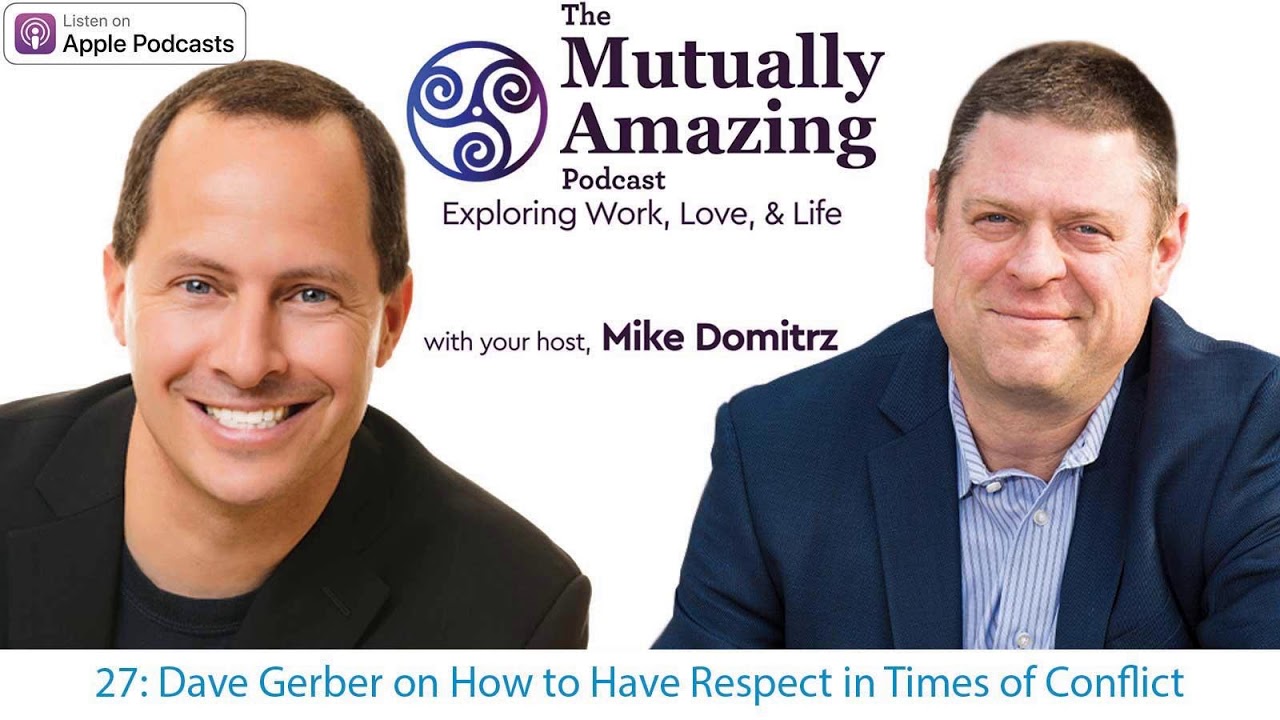
In this episode of the Mutually Amazing Podcast, host Mike Domitrz interviews conflict‑management expert Dave Gerber. Gerber introduces his diverse background—black‑belt Krav Maga instructor, Reiki master, sociologist, educator, and business owner—to illustrate how physical self‑defense, energy healing, and lifelong learning inform his approach to conflict. He explains that respect is the foundation of trust and that a breakdown in respect erodes trust, fueling conflict. Gerber outlines Christopher Moore’s five sources of conflict—data, interests/expectations, relationships, structural, and values—and shows how misidentifying the source hampers resolution. He provides concrete workplace examples for each source and stresses the importance of “conflict fluency,” a shared language for diagnosing issues. Values alignment, especially during hiring, is highlighted as critical because values are deeply ingrained, while behaviors can be negotiated. Gerber critiques the modern tendency to conflate venting with communication, noting social‑media oversharing erodes accountability. To counteract this, he offers practical tools: the WAIT (Why Am I Talking?) pause, a multigenerational conflict‑planning model, and meeting design tactics that balance introvert and extrovert participation. He discusses underlying needs as the “fuel tank” of conflict, positioning respect as a primary need. Throughout, Gerber shares personal stories of adversity—bullying, divorce, health challenges, and loss—to illustrate resilience and the necessity of self‑motivation. The conversation concludes with book recommendations that foster personal growth and a listener question about leading with respect toward provocative interlocutors.
Chapters
Welcome to the Mutually Amazing Podcast. I'm your host, Mike Domitrz, with the Center for Respect. The episode you're about to listen to was recorded when this show used to be called the Respect Podcast. So, you might hear that mentioned during this episode. Well, let's get to the show. Yes, welcome to this week's episode where we are going to hear from Dave Gerber, conflict management expert, healer, progressive thinker. His education is extensive. His leadership coaching and training experience is proven at the highest levels, and he is also a certified black belt instructor and a certified Reiki master. So we're going to welcome Dave Gerber. Thanks, Dave, for joining us.
Thanks for having me. It's great to be here. I'm excited to be on your show.
Oh, we're happy to have you here. I just have to ask right off the bat, Black belt instructor. What martial art form?
Krav Maga.
And what is Krav Maga?
So Krav Maga is sort of the quote-unquote Israeli martial art. Most movies you see, action movies now, they use it because it's the easiest and fastest to learn. It does take a while to master. I'm still on my pursuit of that, but essentially it's the best of several different martial arts combined along with Bear hug defenses, choke defenses, and then weapons of all different kinds. So, it's a self-defense system which is hyper-aggressive to defend yourself and go home alive.
Well, and I love this as our opening. I didn't plan on it this way because your work is in conflict and dealing with conflict management, which obviously martial arts has a lot to do with. And, a lot of people don't understand that. I did do martial arts in the past, my kids did it, and it is about conflict management. It is not about fighting. It's not about hurting someone else. It's about being the most efficient, effective way to get out of a bad situation, at least in the forms that I learned. Is that true with what you teach also?
Absolutely. I mean, if we have to use physical violence, then everything else is already broken down, starting from making good decisions about where you go, when you go, with whom you go, all those types of things. So, your point is well taken for sure. My goal was to do the deep dive into the subject of conflict. Studying sociology and conflict for the last 25 years. I've had my business for about 15, and I decided that I wanted to sort of look at how my hobby could be brought into the subject of conflict. And then my other hobby sort of turned, which is Reiki, which is the healing side. So it's kind of this triangle approach towards life and towards my work.
And Reiki is so unique, and I know about it, but a lot of people may not. Can you explain what Reiki is?
Yeah. I mean, it's Japanese energy healing and the best way to think about it is that it's like meditation with purpose for someone else. It's not like massage. I don't touch the person. So, you have to believe in energy. If you believe in energy, then you believe that some people have the ability to be a conduit for healing. And so, that's what I do and it's a part of my philosophy on leadership, which is that If it's lonely at the top, we have to learn how to self-heal. That's sort of the third piece of this, which is the ability to self-heal and also, in this case, to be able to help heal others.
I love that. And I love that it's for both, right? It's for myself and for others, which is powerful. Let's dive right into this because what you do with companies, you do deal with the connection of conflict, conflict management. What do you feel is the connection between conflict and respect? You often talk about sources of conflict. What is that? What are the connections? And how does that play into how respect plays a role in all of it?
What we found is that respect is directly linked to trust. So, a lot of times, we see both of those words kind of as cliché or overused, but fundamentally, a high-trust workplace is going to be more successful in all different ways. So, if you look at some of the components of how trust breaks down, respect is is one of them. So, without it and the way you speak to one another, you're not going to have respect. It's going to be impossible and then you're not going to be able to trust. And those are deep issues. Once they get down the path for some time, they get ingrained and they're very difficult to solve. So, that's what I would say about the connection between respect and trust, which obviously are components of conflict.
What are some common ways, Dave, that companies or individuals Some examples of where people don't realize their language is breaking that respect and it's not based in respect and it's thus breaking the trust.
Where all conflict sort of breaks down into 5 different categories according to a guy named Christopher Moore. And when anybody can understand whether it's a personal conflict or a business conflict, can sort of take 2 steps back and identify what the real source of conflict is, They can then better come to a conclusion. So respect and trust would be a part of one of those 5. So we'll get to that in a second. So the first is data. So people have conflicts over data or information like I have it or you didn't give it to me or it was wrong or we disagree on it, which actually if it's not solved at a data level, it moves down and gets more difficult to solve. We have lots— the second one is interests and expectations. That's where a lot of conflicts lie. It's not really about the third one, relationships. Oftentimes it's about data or interests that don't get addressed and then they turn into relationship conflicts. But trust, respect, those would fall into the relationship side as well as they might fall into the expectation side. So I have an expectation that you're going to show me respect that looks like X and your definition looks like Y. So that's one place. The 4th one is structural. That's often very frustrating for people because conflicts that are structural are often out of their control. They're process-related. They didn't make the rules. You and I didn't agree or disagree Or create, I should say, where we're getting our health insurance from. So, how can we have a conflict about it? And the 5th one is values. So, that's where the conflict lies oftentimes with people, particularly as we see in society right now. We have a lot of value-based conflicts which are very difficult to solve.
And so, can we take just one of those? Let's say, what would be an example in a workplace setting where the structural leads to a breakdown?
Roles and responsibilities would be the first thing that would jump to mind with me about where conflicts might lie. It might— if I simplify it really, it might be like, well, that's our work, and another team says, well, no, that's our work, and they get into conflict interpersonally about the work. But if you pull out the manual or the org chart and you see where the— what the workflow is and who's supposed to do it, you know, then the conflict should technically should kind of go away. Now, I never like to use the word should when it comes to conflict situations. But that's an example there. Another example of, let's say, a data conflict might be, you know, every Friday before you have to leave work, you have to get a signature from someone. And every time you go to their office at that time, they're never there. So you constantly build up this frustration, which one day comes out into an interpersonal argument. And what looks like a relationship conflict is really actually a data conflict. It was like, if you sign the information, We're done. You could even argue it was an interest expectation, like I had an expectation you'd sign it at 4 PM on Friday and your expectation was to sign it at 3 PM. But the big thing about this is when you understand that there are 5 and only 5, it helps to bring language to the discussion, which then helps us to get to solutions because we can talk about it. Because even if you and I disagree on the source, we can have the language to talk about it. So, I talk about that as conflict fluency.
And you said it was a Christopher Moore?
Yeah, Christopher Moore.
All right, awesome. So, what would be an example? Because several of the ones you gave, you said people mistakenly think they're relationship, but they're actually data or interest or structure or values. So, what are relationship examples?
It's a good question because depending on where you sit, it often will depend on how you interpret it, right? So, I might interpret something you say as a relationship jab. And you might actually be delivering an expectation that's maybe in a little louder voice than normal. That can be the confusion, but it's important to remember how often data and interest-based conflicts, the first 2 sources, how they manifest into a relationship conflict. Most relationship conflicts don't just like— it's like you don't see somebody like, I don't like you. You know, I mean, it's not really that way. Something happens. There has to be a set of events. I might have an expectation that you get to work at 8:15 and you show up at 8:05 and I'm bothered. And now this starts to spin into something relationship-oriented. So I do find, as part of my answer to your question, that relationships often become this dumping ground for either unaddressed conflicts that are easier to solve. Or because I just don't know how to solve it, so I just call it, it must be interpersonal.
So that becomes the question, what would be a relationship one? If so many of them are mistakenly thought of as relationship, what would be an actual relationship conflict?
Well, I mean, maybe a relationship conflict could be something that manifested over the course of trying to solve other types of conflicts. And then, it became like, well, I just can't deal with this person. Like, I've done this and we've had this discussion and we've tried to fix that and we've addressed our expectations and seems like I've done everything and this person is still negative or this person is still always disagreeing with everything I say. I think that's what the relationship conflicts, they happen after you've tried oftentimes. Now, clearly, if you go by the 80/20 rule, 10% of people you might have at your house, 10% you don't want to see ever, and 80% and fall in between. So, I think it's really about how we manage this stuff.
Awesome. And so, what are the best recognizers? It sounds like you might have just given us some insight to the main one, which is when I'm having conflict, look at the 5 and go, assume it's not 3, assume it's not relationships. What are the other 4? Could it be? Because those are allowing me to either separate myself from it and know, okay, it's the data, Or the expectation, where relationship, it makes it personal, right? Where the other 4 you can separate. Would that be true?
You can't. I see what you're saying. And I, yes, I mean, and first the critical thing is to try and isolate and determine what the primary source is because it gets less and less effective as a tool if you say, oh, well, it's a little of that and it's a little of that. So, you know, you're on the right track with trying to identify it as one. I would say the other issue is with respect to values. So, values is where stuff gets real personal, right? Structural is definitely not. Data is not. Expectations become. But values are usually pretty ingrained. People, you know, I can ask you to change your values and you're going to look at me and say, well, you can ask me, but I'm not going to change them. The best thing to do when it comes to talking about values, whether it's in the workplace in particular or wherever, is to talk about behaviors because values usually are Like the gas tank for behaviors. And behaviors are the things that you can talk about when it comes to conflict. There's no point in really spending, grinding your wheels on trying to come to agreement on values. But behaviors for what's acceptable in this context, in this culture, in this workplace, in this family, those types of things we can talk about.
So you bring up a great point that values are really ingrained. Would you say that means that it becomes crucial when you bring somebody aboard your team that values align because you aren't changing those?
Yeah. I think it's really crucial. I think that the first thing that teams have to do is really get clear about what their values really are and not just the ones that are on the poster, but the ones that get reinforced through behaviors when times are good and when times are bad. So, to be able to get clear on that and then, yes, to be able— I mean, the analogy I use is like, If you're going to be a landlord, it's a lot easier to find a good renter before you bring a renter in and try and get rid of them. It doesn't work. Plus, the costs are 150% to 400% of someone's salary to replace them. So, I think having a framework for how to build high-performance teams and using clear collaborative set of values as a part of the foundation of that, I think that's critical. Yeah.
And how does respect play into all of this?
Well, you know, I think that one of the things that we see in the workplace, one of the things we see in society right now is sort of the breakdown in what I would call sort of civility. Everyone has to not assume that some level of moral outrage allows us to behave in a certain way that is not becoming of a realistic approach, a chance at getting to a solution. So I think respect is also Really important when it comes down to, one, and these are some things that society has to do right now, particularly American culture. One, we have to sit down. I think we've lost our right to talk about content and we need to be talking about process. And we need to be talking about how are we going to have these healthy conversations, what do they look like regardless of what the topic that we're talking about. I think respect is a part of that. If we can't have respectful dialogue to design how we're going to have Good conversations, it will never happen. Okay, that is the first thing. So, we have to focus on that. We have to focus on process. We also have to look at, and greater society has to make some choices about this, but, you know, is this subject of order? And order and respect do go hand in hand in some ways. So, we cannot just have ends justify the means. We have to have a process of how we are going to communicate. We have to— Follow some semblance of order so that we're moving in the right direction. And I think those are some of the fundamental things that have to be thought of as people wanna move towards high performance.
Do you think that part of the problem is that people mistake venting as communication? And what I mean by that is right now there are a lot of people that feel they're not being heard. They feel that they're being harmed by what's happening in society, whatever viewpoint they're coming from. And so they have a genuine need to vent. And they're venting. But when they're venting, they think they're educating, they're communicating, they're impacting. And those are 2 very different places to choose to communicate. If I'm venting, it's usually a release for my own emotional needs. And odds are it's not going to help you. Typically, it's not going to move the needle either, unless you're already in the exact same place as me. But if you're not, it might even do harm. To where the needle is for our relationship on the balancing beam there. It could do harm. Do you think that's one thing that people have to be able to recognize, be able to step back and go, wait, am I venting right now or am I trying to influence? Because if I'm trying to influence, venting could be the worst thing I do in this moment.
Yeah. I mean, I think social media brought about a wave of society of oversharing. I think that people always have had a desire to be heard. And unfortunately, in most aspects of people's lives, they don't get that space, whether it's from their spouse or their family or their kids or their boss or their colleagues. Everybody's constantly trying to fight to be heard. And so, that feeling was given an outlet, a fire-and-forget outlet, one where people can say whatever they want because someone's not knocking at their door with violence or a threat of violence based upon what's said. So, we've created this oversharing society. Where, to your point, now when there are no bookends on accountability, people can say whatever they want to say. So, yes, then that moves into my opinion being stated as fact. And there's that old expression that everybody's entitled to their own opinions, but you're not entitled to your own facts. Well, unfortunately, we have such misinformation that's happening that it's very difficult for people to actually base their opinions on reality because reality is shifting and moving and it's hard to determine what that actually is.
Do you think that creates a conflict specifically in the workplace? Because if I'm on social media and I can vent and everything can be valued by how, who likes, who doesn't like, and then I come to the workplace and I want to do the same, is that appropriate? Or where is it appropriate? Where is it not to vent? How do you balance that in the workplace setting?
I think that's like the $64,000 question. Like, how do we find some balance? When we have a society outside of work of oversharing, of entitlement, everyone gets a trophy, you have to love me no matter what I do or say, and this is sort of, you know, we're lacking some order and process and things. And then, we want to go into work and depending on that workplace will really depend on how you're going to behave, what your job is, where you fall in the organizational chart, how much power you have. You know, all of these things are going to influence self and others, and I think that's where things are starting to get tricky. And the problem is, is that there are no boundaries, and worse yet, people don't have the skills, and it's not their fault, but they don't have the skills to talk this out. And that's what I mean when I say we talk about process. So, one of the things that I do with companies is I help them learn a multigenerational conflict planning model. So, it's a model that I put together that can be used to talk about difficult subjects and it helps people plan for both sides. And whether that's a performance planning assessment or whether it's a discussion about how social media is impacting the workplace, we have to have some non-personality-driven tools that can assist us in a society where it wasn't given to us in any of our K through 12 education or by our parents or teachers because it wasn't in any of their lesson books. And so, we have to get conflict skills and we can't assume that because we're a successful communicator that that means we're And so, is there an example that you could give us that people could use in their workplace?
If someone's listening right now, what's a question that maybe I could ask myself in that moment to help recognize what's happening right here, to identify what the component is that's taking place that's causing this?
I'll give you the acronym WAIT. Why am I talking? It's a funny one, but it's really like the version of like, Like chomping down on your tongue and not saying anything when you want to say something. Because are you talking to— when you hear something that you want to respond to, are you trying to defend, defy, problem-solve, react, respond? In that moment, the key is to sort of slow down and wait and use silence to gather more details so that you can make a better response. So kind of like that 2 steps back we talked about before, it allows us to sort of slow down. We used to talk about that shock-jock delay. When the radio station would pause for 5 seconds in case somebody swore. So, those are some of the things, like, that's a really good tool that everybody can use right away to slow down.
Oh my gosh, that's beautiful. And look, I'm somebody that innately likes to talk. It's how I'm wired. So, when I can catch myself in a meeting where everybody's contributing going, wait, do I need to say this? It makes a huge difference because otherwise, when you're wired to talk, you just talk. And it's not that you're trying to talk over, be the center or whatever. You're wired to think by talking out loud. But if you could acknowledge that to yourself and going, why am I about to say this? Is this necessary right now? Has this already been said by somebody else? Do I— in other words, maybe they need reinforcement, but maybe it doesn't. We're already on that page. We don't need to repeat this. I would imagine that could be very powerful.
Well, I think it's an interesting point. And one of the things I talk about with companies is like looking at some of the inherent differences between introverts and extroverts and how to be able to actually better prepare for meetings by using that data. So, like if I know that I've got a bunch of extroverts that are going to be at this meeting, I know that if I don't do something, if I don't give the extroverts a heads up and a way to sort of hash this out ahead of time, they're going to dominate the conversation because the introverts are going to be thinking. So, maybe as a part of my— I send an agenda out early and I give a question. So now, the question is to everybody so nobody feels like they didn't get the question. It gives the introverts time to think, which is what they want, and it gives the extroverts time to think out loud or talk to themselves or talk to their colleagues so that when they come to the meeting, the communication can be more effective. And I think that's what we're trying to do.
That's powerful. Would there also be the reverse? Why am I not talking?
I think one of the things, if we circle back, we talk about respect and trust and who's sitting on the golden egg because They've been wronged or conflict hasn't been addressed and they don't want to share. I think that's one thing. I think also the leader has to be good at facilitating and bringing people in who aren't normally talking. And that can be done as— and that's another advantage of sending out an agenda ahead of time because it allows people to prepare. So nobody can hide behind, I don't know, or, I haven't thought about it. The other thing is to facilitate using small mini-groups within the group because you can have people not have to own ideas, but they can share ideas and get going. So I think it's a matter of being creative as a leader in terms of how you facilitate to get the best out of people. Sometimes that just happens in a regular meeting, but the definition of meetings is where the minutes are kept and the hours are lost, right? So we have to be more effective beforehand. Otherwise, we just find we need more and more meetings. Which burns people up and then more opportunity for conflict.
Right, exactly. And you and your work talk about underlying needs in conflict management. How do— what is the connection between underlying needs and respect? And what does that mean? If somebody's listening going, well, what do you mean by underlying needs? I could assume it means a lot of different things.
So, when we talk about underlying needs, this goes back particularly to the conflict management stuff that I do training with is getting people to understand that Underlying needs are really like the fuel tank for why people are stuck. So, we talk about predetermined outcomes. Like, so people will come into a meeting, take a standard employee-supervisor meeting, and one says— supervisor says, I'm going to give a reprimand at the end of this meeting. And the employee walks in and says, well, I don't care what happens, but by the end of this meeting, I'm not going to get a reprimand. So, they could go back and forth, you know, yes, no, yes, no forever, and they're not going to get anywhere. But when we look at the underlying needs that are driving the person to have the position or the predetermined outcome, it's a lot easier to sort of find overlap and discussion starters for moving through the conflict. So in most cases, respect is one of many but highly prioritized underlying needs for people when they come into a conflict situation.
And knowing that, What is, for you personally, when you hear the word respect, what does it mean to you and what do you think it means to most people and what you've seen in the work you're doing? How do they interpret, how do they define the word respect?
Well, we, you remember the golden rule used to be treat other people the way you want to be treated.
Yeah. I've always actually taught audiences that's a horrible rule because there's so many people that don't treat themselves well.
Well, and then not only that, you know, the platinum rule says treat other people the way they would want to be treated. Do unto others the way they would want you to do unto them, which means Effectively, we all have different currency and we all have different needs. If teams are going to go well, relationships, families, we have to find out what those underlying needs are of those individuals and meet them where they want to be met. So, that's critical.
Yeah, I absolutely agree. When I'm working with companies, I'll say, we talk about creating a culture of respect throughout the organization. And they'll say, well, I'm afraid I won't be able to have fun at work. I won't be fulfilled at work. If I have to worry about what I say. And I say, you don't have to worry about you, what you say when you lead with respect. But the key is you have to know what matters to the people around you. If, if you want to be, have an incredible, fulfilling workplace, imagine if everybody who worked around you knew what mattered to you and talked about that with you and asked about that with you versus trying to crack a joke that can suddenly become inappropriate when you could have said something meaningful to me if you actually knew me better. And that would have been way more powerful.
Well, that's huge. And I think that's a good responsibility of leadership to encourage the relationship development that goes on on these teams. We can't get to high performance if we don't understand one another. And that's why we talk about it takes 18 months to grow a high-performance team. You don't build it, you grow it. And you do that by some of these conversations that happen at the beginning that are seemingly meaningless or for some are slowing down the process. But it's— we have to have a strong foundation and we've got to get to know each other better so we understand what our boundaries are and our limits are. It's like— it'd be kind of like getting pulled over for speeding and there hasn't been a speed limit sign for like 30 miles. It's like, how do I know how fast I'm supposed to go?
Right. What road got you here? What was your path that got you to where you are?
I guess I'll tell you it was a seriously winding road. It started off with the acknowledgment at some point that conflict always seemed to find me so that maybe I should sort of monetize it or move into that business and try and help people address their conflicts, not only through my experience but through research and best, you know, proven skill sets and techniques in the industry. And I just had a lot of winding experiences. I mean, everything from, like many, being bullied when I was younger to— I have a BA in sociology and gender studies, master's in education. I went on to teach high school. I left high school to go start a business so that I could say that I tried. I did that 15 years ago this past month. We celebrated. And on that journey, I had a lot of things happen. Family, divorce, child, more conflict stuff that you get experience in like many people do, and Krav Maga, and trying to figure out how to continuously just give back and find ways to give back my learnings. And all the while, sort of being a lifelong learner and going back to school all the time and building certificates and working with people and building relationships. And I've been fortunate to speak to over 10,000 to 12,000 people and work with them in different— capacities. And I love that is how can I help people level up faster? And that's what I like to do.
You mentioned that there were a lot of conflicts on the way, conflict experiences for yourself along the journey. What was the most difficult one?
I've had a lot of very powerful experiences from divorce to getting Graves' disease when I was 35 and working through thyroid issues all the way through getting a black belt in The struggle to do that as well as my mom passed away a year ago, so the struggle of that. So, there's been a lot of challenges and I think a lot of people have them and it's a matter of, I guess, how you try and just bounce back from them.
And what was— take one of those, one of those that you thought was very difficult. What did you learn was a key for bouncing back into where you were before?
I think actually with all of them, the thing that I've learned is that No one's going to do it for you. Everybody's busy. Everybody has their own dreams. Everybody has their own life. You have to find the motivation. You have to dig deep. You have to remember the successes that you've had in your life. You have to find the people, the right people around you to help you when you're not operating at your full potential. I think it's faith, faith in yourself. I think that's what I've learned is just keep going. We learned that in martial arts community and it's knock down 7, get up 8.
Absolutely. And your website's DaveGerber.com. That's G-E-R-B-E-R.com, DaveGerber.com. And you have several, lots of books yourself. And then there's 2 that you also recommend that you didn't read. And as you know, we always like to explore that here on this show. There's 2 you recommend, which is Celestine Prophecy by James Redfield and The Alchemist by Paulo Coelho, which I personally am a big fan. I know that book very well. Why those 2 books?
Well, in the Western Hemisphere, we don't really talk about the spiritual side. And I think one of the things that I've learned is you got to find yourself. I think many of us are still in that process, but finding happiness, finding gratitude, finding the fundamental pillars of life before trying to find everything else. I think both of those books are written in a way that any reader, adult reader, regardless of whether they read all the time or they just want to pick up a book, they can really help people level up in their life faster and find what's really truly important to them. They're books that you can always revisit because there's so much stuff going on that at any point in your life to also find motivation because they're really both about a journey.
Well, I want to thank you, Dave, for sharing so much brilliance here on this episode and really some insightful conversations on conflict. Thank you.
Thank you very much. It was a great conversation. I appreciate it.
This week's listener's question is, Mike, how do I lead with respect with somebody who's just saying things that really bother me, that are triggering me? This is a great question because leading with respect means we also treat those that we disagree with With dignity and respect. We can't just say those I'm like-minded with, I'm going to treat with dignity and respect. Now, treating you with dignity and respect does not mean I have to agree with anything you say. That doesn't mean that at all. Ways that I can try to find common ground so I can see the dignity and respect of you, a fellow human being, is to recognize, hey, this is a person in front of me with personal feelings and beliefs, and they strongly believe what they're saying, even though I disagree with it. They believe it. They're probably not just saying this to infuriate me, to upset me, to hurt me. That's probably not what's happening. So, in this situation, I want to lead with, all right, they genuinely believe this. I wonder why. Curious why. So, explore the why. Say, well, that's interesting. Why do you believe that? Or, well, I have never thought of it that way, or I don't believe that. So, why do you? It's okay to express your own. Ask why they do. Be in a place of discovery. Let me also be clear that it's important that you're also in a safe space for this to occur. I am not advising if somebody's harming you in that moment to try to discover and understand where they're coming from. That is a completely different discussion. I want you to always be in a place of safety and support. I think that's super important. So when you are in a safe place to have a conversation with someone with differing views, opinions, thoughts, When you're in that safe space, come from a place of discovery, of a why, of, hmm, that's curious, and learning. That's the key. We'd love to hear your questions, your thoughts, and your ideas. And the best place to leave those with us is on our Facebook page at facebook.com/MutuallyAmazingPodcast. Of course, you can always contact us on our website at mutuallyamazingpodcast.com. Remember to subscribe to this show so you automatically get it every week. And if you could take one moment to leave a review, that really helps other people find the show, which we are greatly appreciative of. So thank you so much for joining us. May you make today and every day a life full of mutually amazing relationships.








