33: Gair Maxwell & Respect as a Core Value in Business
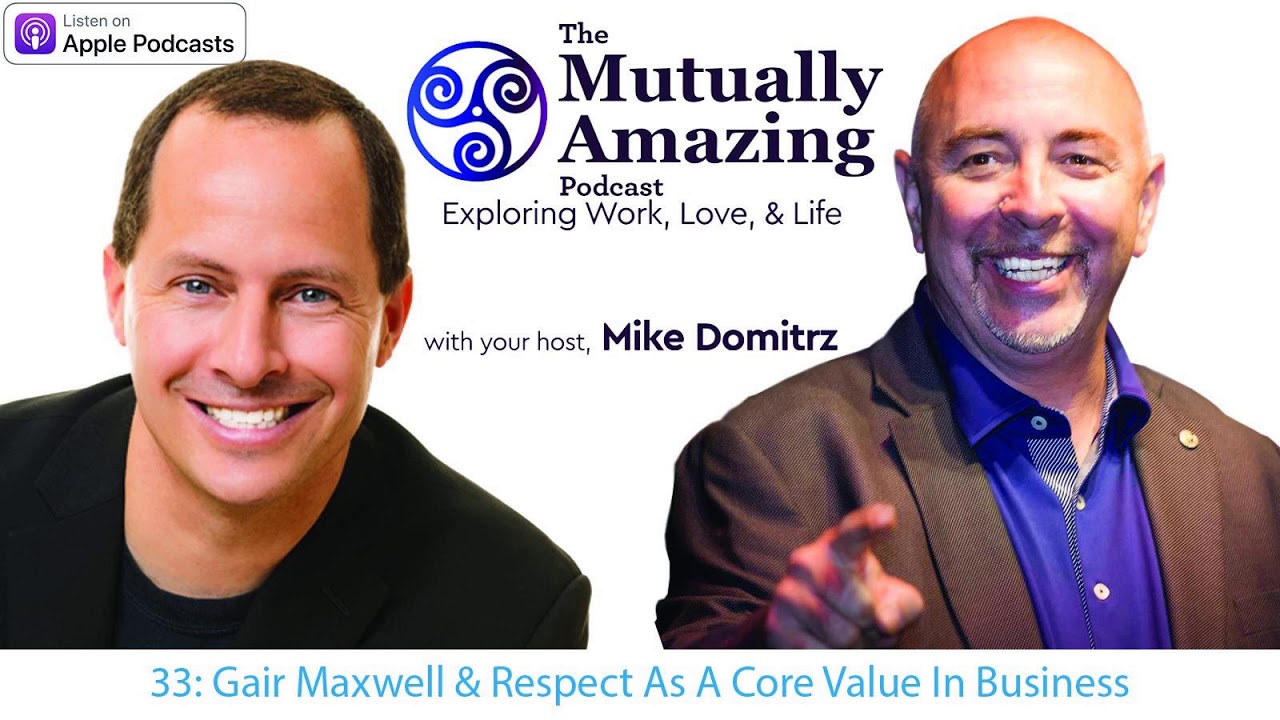
Brand strategist Gair Maxwell argues that successful companies build on authentic core values, not hollow mission statements. He contrasts Enron's fake values with Zappos' genuine ones, and explains how respect becomes real through hiring, firing, and daily actions, not just words.
Chapters
Welcome to the Mutually Amazing Podcast. I'm your host, Mike Domitrz, with the Center for Respect. The episode you're about to listen to was recorded when this show used to be called the Respect Podcast. So, you might hear that mentioned during this episode. Well, let's get to the show. And this week, we have with us Gare Maxwell. And to give you a little bit of background on Gare, he's a frequently flying author, speaker, and brand strategist. His His original market-tested ideas have inspired some companies to achieve 15-20 times growth while demonstrating a creative category of one, including working with some of the world's best brands and names. He has shared the stage with icons such as Richard Branson, Gene Simmons, and named Speaker of the Year by TEC Canada, the country's largest CEO organization. So, thank you, Ger, for joining me.
Oh, it's my pleasure. I've been looking forward to this For quite some time now, Mike, because I think it's just wonderful the work that you're doing.
Well, I appreciate that, Gary. Thank you. And you're going to bring a unique perspective today because we're going to be talking about how respect and integrity plays a role in marketing and how somebody builds a brand. And building a brand, I think some people could listen and hear that and think, hey, Mike, I am— I don't work for myself. I work for another company, or I'm a single person, or there are people listening that are going, no, I am an author or speaker. But building a brand is also about building your own self. It's not just, it doesn't have to be company-related. People can think, how does this apply to me as we're listening to this? I am going to start though on that corporate side because I do work with corporations and organizations. So, let's go there. How does respect play a role in companies and organizations building their brand?
Well, and this is why I was so intrigued because I think the greatest brands in the world are all built on a foundation of respect. But let's back up for a second. Brand, in my estimation, is still the most misunderstood, misapplied word in the entire business vocabulary. And I can say that, Mike, because I don't come at this subject with any sort of quote-unquote official marketing background. I was a broadcast journalist for the better part of 20 years. I was a reporter. I covered things like murder trials and city council meetings and political rallies and school board meetings. And so I still think my lens of the world is still skewed very much towards that of a reporter who, you know, just digging for the truth and trying to find out, well, what's real, what's, what's not being said, and all these things. And so let's, let's just take one item off the table in a hurry. The best brands in the world did not achieve that status or recognition because of their logo. I just want to make that clear. This conversation has really nothing to do with logos or visual identity or anything graphic design or any of that. What it has to do though, and this is where it connects back to respect, best brands in the world are built on one word and it's values. From the foundation of values, I see it as like the iceberg. And so, it wouldn't matter whether it's a corporate brand, a community brand, a personal brand for one's career. Values are really what's below the surface of the iceberg. And that's where any brand really gets its strength and its horsepower from.
Can you give us some examples where people failed in that category or maybe not failed, But their values did not match up with what the consumer, the customer, the world wanted.
I can do that in one word: Enron.
That's a great word example. And for everyone listening, there are some that may not remember Enron just due to age. Some people are younger, may not remember that. Can you explain?
Enron is famous for their language that was on their corporate website. Quote. We treat others as we would like to be treated ourselves. We do not tolerate abusive or disrespectful treatment. Ruthlessness, callousness, and arrogance don't belong here. Then there's more BS about integrity and then communication and then the values of excellence. And you see, I think we've entered into a world where people can see through all this mission statement language crap. And it's so disrespectful. I mean, this is hypocrisy and just plastering, you know, these, these, you know, boilerplate mission statement bromides. How does that respect anyone in any audience? How does that respect anyone inside the company who knows the truth and be the outside world?
And, and I agree 100%. Go backwards a little bit. Can you share with— because we have people of all ages listening, so for some people, our younger audience, Why was that BS? I mean, you and I know why the Enron mission statement was BS, but what did they do that proved that to be BS?
Oh, because you just Google the word Enron, E-N-R-O-N, and you'll see it's one of corporate America's most infamous stories about corporate greed and the kind of chicanery and financial shenanigans that just Not only toppled a company, it does much more than that. You're playing with people's lives. A lot of livelihoods and careers, Mike, really got torpedoed because— and people went to jail and rightfully so.
And we saw this recently with the financial industry where fake accounts were being created.
Exactly.
Just to incentivize. And then, you know, that in their core values, they had all the things we're talking about. It's somehow connected to their core values, but it didn't live to be true. I talk about this with organizations. And they'll say to me, well, you know, you say we build a culture of respect. That's what I do in cultures, in organizations and institutions and corporations. And they'll say, well, what does that mean? And I say, well, I can look very quickly if you actually care about respect. I can look at your core values and see if the word even shows up. And it's amazing how many people don't even have it. And they'll be like, well, no, it's, you know, we believe in respect for everyone. You don't even list it as a core value. Nowhere is the word there. And then, if you do list it and I walk your organization and ask people, what are your core values? And they can't name them, then it's useless that it's listed there because you don't actually have core values. You have a list of core values but you don't live those core values. And that's what you're referring to.
Exactly. And I think the poster child for core values would be a company like Zappos, for example. I know some people who were involved in that exercise. And they spent nearly a year developing those core values. And they've got 10 of them and thousands of employees who work at that call center. They all know those core values inside out. So, to your point, Mike, you don't allow cut-and-paste marketing BS to use that to supersede the truth.
Yes. Well, and core values are something That you not throw out as an ideal. They're a way of living. You hire by them, you fire by them, you thrive by them. And respect, if it's at the core value, should be there. Like, if you're interviewing somebody and go, mm, little sign of disrespect there, but everything else looks great. If a core value is respect, they don't get hired. Because you can't say it's a core value and then hire against it. If somebody acts in the company, you go, oh, but they have all these wonderful things, but yeah, they're not respectful. Well, then you can't say it's a core value because you just proved it's not at the core. When it's not there, you will like— in fact, you allow disrespect to stay at the core, which means now we're going to let disrespect fertilize because now it's in the heart of us. And clearly, it's not at our core. And you should be able to fire by respect if it's a core value, because when it's not there, this is not exercise of core value. We're not saying you're a bad person or not a good person. But you violated a core value that we exist on here.
And I think to bring what values really represent in 2018, I always picture values, Mike, as— I'm a big military history buff, and I picture values as Mount Suribachi on the island of Iwo Jima in April of 1945 when the Marine Corps was, was taking that island in the Pacific campaign, and they planted the flag on Mount Suribachi. You know that famous photo?
Absolutely.
Yeah. And I think 2018 showed us very conclusively the best description of what that really looks like. And that was Nike with their decision to embrace what Colin Kaepernick's doing because that spoke to Nike's values.
Yes. And what's interesting is because we're bringing this up, people go, oh, you're supporting that value or not supporting that value. Your point is, no, Nike's showing what they supported in that moment. And you could disagree with it, but it told you their core value. And if you go, I can't believe they did that. Well, if that is their core value, if that represents their core value, then if they didn't do it, they would have just been playing to you. If it is their core value and they actually did it against what most people wanted, that's a true exercise of core value. I do this not for popularity. But because it's what we stand for.
And more importantly, what we stand against. The best brands in the world, Mike, in my research, and I work with a lot of, you know, I've helped develop a lot of small to medium-sized brands. It's not just what you stand for. Everyone's for the same things. You know, I'm sorry, it's communication and excellence and customer-centric. Everyone's for the same, you know, unicorn and rainbows and sunshine and lollipop things. No, real values. What are you going to be against? Where are you going to draw the line in the sand? And anyone who has studied the history of Nike, like, I'll never forget, I was there in Portland, Oregon. Well, just outside Portland in Beaverton at the world headquarters back in February. And when you walk in there, it's pretty unmistakable about what they're all about and how they've always embraced the rebels, going back to way before Michael Jordan. Phil Knight was a rebel. You can read it. And the people who are upset over the Kaepernick thing, most of them never read Shoe Dog, where Phil Knight basically pours out his life story. And back before Michael Jordan, there was a rebel named Steve Prefontaine. And Nike was built culturally and from a values perspective on being the kind of company and the kind of organization that just wasn't going to do what everyone else was going to do. That's one of their values. And that's how they have respect for themselves. And those who don't like it, well, obviously, they can get their shoes elsewhere. But the, you know, the tale of the tape is last time I checked, I think the brand value of Nike stood at about $32 billion. And to put that into context for everybody listening, that's 3 times more than Under Armour and Reebok and Adidas combined. And so to me, the Kaepernick story, you know, to me politically as a Canadian, I don't weigh in one way or another. And with respect, as a Canadian, I'm not going to weigh in on anything that has to do with what's going on in America in terms of the politics. Is that fair?
Absolutely.
Yeah, because it's not my country. Right? But I can say from a brand perspective and a values perspective, you know, the Kaepernick thing was just another example of how Nike clearly demonstrates that they're not just another shoe or t-shirt company. They've actually got some sandpaper and some grit, and they're willing to plant the flag on the mountain and die with their boots on. So be it.
Now, when people go to respect, that was an interesting case because some people pushed back with, but that's a lack of respect of the analogies they were using, the examples they were using, that what are you willing to die for? And people thought that's— for people who have literally died for this country, have died for causes, the examples they were using were not of that. And so they felt it was disrespectful with that slogan, which is an interesting discussion because you say, oh yeah, I stand for respecting these values I believe in, what I don't believe in, But was there a contradiction there of respect?
Because it's so politicized, Mike, and because it's so— as the Canadian, all we can do is be the good neighbors while America deals whatever it's dealing with. Does that make sense?
Oh, sure. And well, here's the thing. There's a boundary where that ends, right? In other words, if you saw a country, whether it be America or anybody else, doing harm, we would all speak out about that. Not all, but a lot of us would speak out about that because whether it's my country or not, Degradation or lack of value of other human beings, we know is not acceptable anywhere in the world, even though we know it exists a lot of places in the world. What I love about what you focused on there was if people had been reading— the people that were angry, that were Nike owners, that were angry when this happened, if they'd been paying attention to what Nike stood for before, they would have never bought anything of Nike based on the way they're talking.
Exactly. You just summed it up. Very, very well, Mike, because what Nike has done with Kaepernick, and I know it's so explosive, but it's a great example for this discussion on this podcast, right? Because you can just picture it in your mind's eye. But what Nike did was just demonstrate, you know, once again, like they've always done for, you know, what, 3 or 4 decades now. This is not new to them. And Because differentiation is such a crucial component of any brand strategy, it really separated themselves from a values perspective from their major competitors.
So, what are some other examples of how you feel respect shows up in these discussions in corporate world?
Right now, and I think our— there's a guy who's done a great job on TED Talks named Simon Sinek, and he wrote a book called Start With Why.
Great book.
Right. And so, without even you and I comparing notes, you and I can both probably agree Simon really nailed it in terms of why it's so important to discover who you are and why you do it beyond the products and services you sell, right? That's basically it. Anyone can go out there and sell products and services. Anyone can go out there And pitch and, and try and do quick trips to the magic keyword store, or let's go visit the SEO House of Mirrors and try and manipulate and game that which is ungamable. Anyone can do that.
Now I'm going to pause just for listeners. We're talking about SEO, that's search engine optimization, and that's how people will try to put hidden words in their site or known words in their site just to get people to their site, even though they really are not ethical necessarily. Or even use those words in their work. They're doing it purely— they'll use the word sex even though they don't sell anything sexual on their website just to get people to their website.
Right, right. So, so there's all kinds of like digital Jedi mind tricks that can be played. What I liked about Simon Sinek's work is it zeroed in on the essence of how brands are built, which is like, why do you do what you do and who are you beyond the products and services you sell? And I am very privileged, Mike. I get to speak to the world's largest CEO peer advisory group. So, throughout North America, different tours of Europe. And so, consequently, I've dealt with thousands of CEOs and senior execs. When you ask them the question, well, who are you guys beyond what you sell, whether it's Tires or insurance or, you know, plumbing services. Like, who are you beyond that? I don't think it would surprise you to know that's a real struggle for, for a lot of people to figure that out.
And so how do you help them fully come to that, not being a marketing slogan, but truly respecting both themselves and their customers? Because when you create a campaign To try to get people to pay attention to you, and it's focused on that, that's not respecting your customer. Respecting your customer is creating a mission statement, a campaign that truly represents what you do that helps people find you for what you do.
Well, and it might not surprise you if I do this, but the best way I can explain it is in the form of a story. And because this is a real-life story, uh, that happened, um, Back in 2002. It's the genesis of my work in terms of bringing the real essence of the company to light. You know, you got to look at it as brands are like personalities, and every company, if it dares to find it, can find their personality. So in this case, it was 2002. I met this guy, Mike. He's in the worst business category in the world. When I met him, he was doing about $1.5 million a year in annual business. He employed maybe 5 people. In 2006, we changed the story. What you got to know about this guy, he's very soft-spoken. He's very kind. He's a bit of a mix between Santa Claus and Walt Disney. Very generous but quiet, humble. And in 2006, we changed the story. And he became, you know, basically what happened is he started to live in his own emotional truth, and he became what we now refer to as Canada's huggable car dealer. Now, that's the last thing you would expect in the used car business. True?
Right.
Right. But to know Jim and Donna Gilbert is to know these are the kinds of people, Mike, long before I showed up, They were writing handwritten, handmade birthday notes to their customers when they had no money. They're just good people. You show up there today or anyone searches them online, you'll see hundreds of teddy bears, you'll see the merry-go-round, you'll see the nature trail so that you can go walk your dog, you'll see the mascots. Like I said, I always tell people, if Walt Disney himself imagined a used car lot. This is what it looks like in New Brunswick, Canada.
Yeah, we had somebody— and this is ironic— we had somebody in a recent episode dive into this, their specific business. So, in Canada, I mean, you're the second person from Canada bring this up on our show.
Wow!
Yeah.
Yeah. And so, by standing in his own emotional truth called the Hoggable Car Dealer and totally embracing it, what happened was The values. What are the values? It's caring, kindness, comfort, respect, family. That's what the whole thing is built on. The teddy bears and the logos, that's all just— those are just the symbols of what those values are. And so, Jim has long been an advocate of sharing good stories without the pitch. In other words, they're not always driving You know, the marketing down your throat with the better quality, better selection, better service, better value porridge that everyone else is doing. But you're not gonna find it on every street corner.
Absolutely. Where did you first learn, for you personally, the importance of respect in business?
I think for me it came from when I migrated from broadcast— that's a great question, no one's ever asked me that one before. When I migrated from and made the switch from broadcast media as a broadcast journalist into the world of business, and that was, uh, in, uh, you know, the fall of 1999, I realized, like, in broadcasting, Mike, you were just a guy in a bubble. You were in a booth, a radio booth, a TV studio. But when you're in business, you're on the front lines. And when you're on the front lines of business— and I think anyone listening to this will understand it— your word is all you got. Your word and your reputation is sacred. That's all you got. You can't hide. And that's what I love about the internet today and shows like this one, is that there is no place to hide. People can see through hypocrisy like in lightning speed. You know, they say people's attention spans are shrinking. I think it's the other way. I think their BS meters are growing. So they're tuning out that which is not relevant pretty quick. And so I would say it came from That's why I'm very grateful for the whole discipline of entrepreneurship and everything it does because you only get to build long-term business relationships and build a meaningful business and a career. You can't do it without the essential ingredients of trust and respect.
When was an early time in your life where you learned this lesson the hard way about respect? Where's a time where you can look back and go, oh, That was the moment when I realized I can't act with disrespect. I need to lead with respect.
Wow, that's a great question. You probably know this yourself. There's no shortage of humbling experiences.
Correct.
You really got me thinking here. That's a sign of a good interviewer.
Well, thank you.
Here's the thing. None of us are perfect. And I can think of— actually, okay, you just gave it to me. There, it just came to me. Yeah, I took it too far with some former partners. I had a partnership a number of years ago and it fell apart like some partnerships do. And looking back, I should have— my motives were good, my intentions were good, but I should have been more upfront with what I felt was not working out. So, I made the decision, and it's mine alone, to keep my mouth shut because I didn't want to offend or hurt anyone's feelings. And probably that wasn't the right thing to do. I could just feel there's this gap widening that I'm going in a certain way and these guys aren't following and they're not keeping up. And I should have been more forthcoming.
I love that example. I appreciate you being vulnerable and sharing that. Here's why. A lot of times when people hear, I didn't say something, they think, Well, that's just you respecting them. You don't want to hurt their feelings. That's not respecting someone. Respecting someone is being honest. Now you can be honest in a caring way, being honest and blunt in a caring way so that all of our agendas are on the table. That's one of the most respectful things we can ever do with each other. So I appreciate you bringing that up because I think it's an example that a lot of us fall into. I'm going to keep my mouth shut to be respectful. And it's actually disrespectful to keep your mouth shut. Unless you're going to open your mouth and be mean or cruel, but that's different than just thinking my voice, sharing my voice is disrespectful. No, sharing your thoughts is not disrespectful. How you do it might be, but actually sharing it is actually the most respectful thing you can do for yourself.
Yeah. And like I say, if there's a do-over, it would have been, uh, I would have sided on the value of, uh, let me see, loyalty or honesty. I think I would have gone to honesty.
Well, and so, Garrett, what we do is we do something unique on our show. On our Facebook page, we have what's called the Respect Podcast Discussion Group on Facebook. And anybody can go there, Respect Podcast Discussion Group, and they can ask questions of upcoming guests. So, my question of the week is from one of our listeners, Lisa, who was on your website and noticed that you talked about the narratives that companies create with their branding. Now, you and I have already gone into this a little bit, so I think this question is awesome about how the company creates these narratives of respect. But then, the employees are not actually living those narratives. So, which is exactly what you and I already discussed. So, the question that Lisa had was, what are specific ways employers can turn narratives into respectful action in the workplace?
Well, and one of the best examples comes back to the one we talked about earlier, Mike. It's with the huggable car dealer. When you go out and you call yourself Canada's huggable car dealer, that automatically triggers a reaction internally. I can recall vividly when we launched that, that some people weren't on board, and those people had to go and build their dreams elsewhere. What it did, what the narrative does in that case, and anyone who really understands how deeply rooted these are, It kind of separates, uh, you know, who's, who really wants to be there and who doesn't, who's taking a, you know, who's just showing up to take a paycheck or a job.
Right. And would you say there's a difference in cleaning house and evaluating and providing opportunity for growth? In other words, if somebody first pushes back, 'cause I even said earlier, mistakenly, you got to clear them out. If they truly in their core value believe against your core values, if they're just pushing back though, and they don't fully understand, It could be they totally agree with the core value. They, they're misunderstanding it. They're hearing the media version of that core value versus what the company's meaning of that core value is. Would you agree with that? That can happen?
Oh, listen, listen, a lot, as you and I know, lots of things can get lost in translation. Okay. But fundamentally, I mean, when you decide, so for example, uh, Apple, have you been like, Apple's one of the greatest brands in the world, right? First trillion-dollar company.
Absolutely most well-known, one of the most well-known brands. There's no doubt.
Right. But what impresses me is when I go to the Genius Bar here in London, Ontario, Canada, and the guy behind the counter tells me he's a 3-year employee. Now, he doesn't know what I do for a living or a career or anything like that, but I'm just asking the questions. And when I hear in his voice that he's been working there for 3 years and I ask him, so what's The one thing that Apple's taught you more than anything? And without missing a beat, Mike, I'll never forget that guy saying, it's about paying attention to the little things. And if you research Jobs and Wozniak and their history and watch any of the movies or read the wonderful Walter Isaacson biography of Steve Jobs, you'll know.
Yeah.
Apple was fanatical about paying attention to little things. And yet, I heard a frontline employee just spit it back out to me no more than what, 3 or 4 months ago here in London, Ontario, like at the Genius Bar.
Yeah, it's brilliant. Now, speaking of paying attention to little things, for all of our listeners, there's a little thing that they can do to make a big difference. So, I'm going to ask them, just everyone listening right now, keep in mind that when you've Subscribe to the Respect Podcast with Mike Domitrz. You help our ratings go way up. That helps more people find us, help us spread respect around the world. It also, if you create a rating, a review there, it also soars us up in the rankings. That helps more people find us. You know our mission, you know our core values to help spread the message. We need that help and being able to ask for that is really, really important. So we're asking everybody to do that. Gary, you've been wonderful. What is And everybody listening, you can find Gare at garemaxwell.com. That's G-A-I-R, G-A-I-R, maxwell.com. You'll find Gare. What is a book that has had a major impact on you? And I have Start with Why already in our show notes from you. What would be a book that had a big impact?
The Alchemist by Paulo Coelho.
Yeah, yeah, yeah. Beautiful book.
The Alchemist by Paulo Coelho from a personal perspective. From a business perspective, it would be a toss-up between The E-Myth Revisited from Michael Gerber, but also the trilogy from the Wizard of Ads, Roy H. Williams out of Wizard Academy in Austin, Texas. I fell in love with Secret Formulas of the Wizard of Ads back in March of 2000, and that had a pretty profound impact on the way I see the world in business and in life.
Awesome. I so appreciate you taking the time to be with us, Gary. Thank you.
My pleasure. And really, Mike, thoroughly enjoyed being here and love the questions and really love your mission too. The world needs more of what this podcast is all about.
Thank you so much. Before I answer this week's Question of the Week, I'd love to ask you a question. Would you please subscribe to this podcast, The Respect Podcast with Mike Domitrz? By subscribing, you can make a huge impact. Now, you might be wondering, Mike, how does my subscribing to your podcast make a huge Well, here's how. For every person that subscribes, it raises the rankings of the show in the search engines. So for people who care about respect like yourself, when they're doing a search for podcasts, they're more likely to find this show, thus providing an awesome opportunity for us to spread more respect around this world. And all you do is hit subscribe under your podcast. Plus, the second benefit is by subscribing, you automatically get every episode Right into your phone or whatever device you are listening to the podcast on. It happens automatically. So subscribing also makes your life easier. Now let's get into this week's question of the week. Oh, and by the way, you can always ask your questions of the week by joining us on Facebook in our discussion group. It's called the Respect Podcast Discussion Group. Go there on Facebook and ask whatever questions you would like me to answer and/or address in this segment of the show. And then listen to each episode to find out when your question is included. This week's question is, what is your favorite book, Mike? Now, what I'm going to do is, you know, if you listen to the show that I love books and I love to ask often our guests their favorite books. We talk about their books frequently, not always, but frequently. So, what I'm going to try to do is share books every so often, maybe it's once a month, once every 2 months in our question of the week that have not been mentioned so far by guests that I've had on the show. So I'm gonna start this by a book that for me was really powerful. So simple, quick, easy to read, yet powerful, life-impacting. Life's Operating Manual by Tom Shayac. Shayac is spelled S-H-A-Y-A-C. Life's Operating Manual by Tom Shayac. Super powerful book. And I'm gonna try to share more of these as we go along this journey together on the podcast. We'd love to hear your questions, your thoughts, and your ideas. And the best place to leave those with us is on our Facebook page at facebook.com/MutuallyAmazingPodcast. Of course, you can always contact us on our website at mutuallyamazingpodcast.com. Remember to subscribe to this show so you automatically get it every week. And if you could take one moment to leave a review, that really helps other people find the show, which we are greatly appreciative of. So thank you so much for joining us. May you make today and every day a life Full of mutually amazing relationships.








