35: Matt Beaudreau & Respecting Each Child's Unique Ability
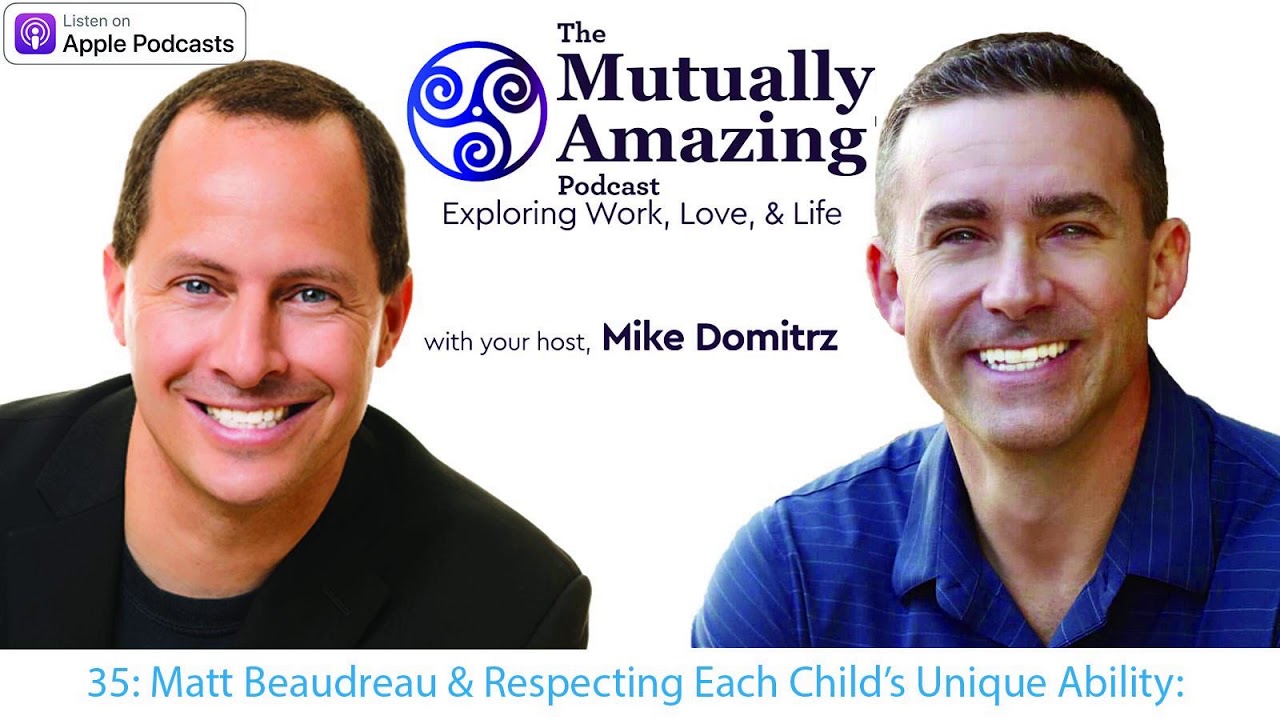
Matt Beaudreau, founder of Acton Academy Placer, argues that traditional schools standardize children and erode their confidence. His school replaces teachers with guides, frames learning as a hero's journey, and uses Socratic questioning and real-world projects instead of grades. He calls it Montessori 2.0 with technology and entrepreneurship built in.
Chapters
Welcome to the Mutually Amazing Podcast. I'm your host, Mike Domitrz, with the Center for Respect. The episode you're about to listen to was recorded when this show used to be called the Respect Podcast. So, you might hear that mentioned during this episode. Well, let's get to the show. And for this week's episode, I want to introduce right away Matt Boudreau, which is a keynote speaker, entrepreneur, having spoken to over a quarter million people worldwide on education, and generational-related topics. He's also the founder of Action Academy Placer, the fastest-growing K-12 program in California. Matt, thank you so much for joining us.
The pleasure is absolutely mine, my friend. Thank you for having me.
Absolutely. Well, let's dive right in here. So, you talk on generational ideas, you help in education. So, to get a little background, how did you get started working with youth?
Yeah, that's a great question. So, I went into education, was actually working at Stanford for quite a while and working with a lot of the college population there in kind of a corporate trainer capacity. And that really kind of fueled my passion for working with the younger generations. And so I went on from there and got my credentials. So I was a public school teacher. I was a public school administrator, a private school teacher, a private school administrator. And kind of throughout that time, I started doing a lot of speaking in education around kind of how we were dealing with our youth and some of the things that I'd like to see change. And things just absolutely took off from there.
Well, let's dive right into there. What are things you would love to see change?
My goodness, if we're talking school, everything, which is— and I'm a, I'm, you know, I'm a big believer in— and I want to say this up front too, I am the most pro-teacher and pro-school administrator person on the planet. I was one. I still have friends there. I absolutely love this. I never have a problem with the people. My problem is, is with the system. And I'm a big believer in creating the change that you want, which is exactly why I founded Acton Academy Placer here in Northern California. The biggest issue that I think I have in school is the concept of standardization. I think that is— I know you're big on respect and we like to talk respect and I think school as it's designed is really inherently disrespectful when we look at the concept of standardization. Everybody needs to learn the exact same thing at the exact same time and if you're not ready or interested in that, then labels start to get placed and we start to chip away at that self-confidence and that self-awareness. And I think that's a dangerous thing, especially moving into the society where, you know, information is ubiquitous at this point. And we need to help kids learn how to be in control of their lives.
Well, I love this. I was— there's a school very close to me. It's an old converted, like, one-room schoolhouse that is a school with a very unique approach. And I noticed that they don't use the title teachers. They use the title learning guides. Everybody in the school that teaches is a learning guide. What is the difference in somebody thinking of a teacher versus a learning guide?
Yeah, and that's a great, that's a great thing. And that's actually, so my, my employees, we don't, we're not teachers either. We do the same thing. We call ourselves guides. And so, um, it really is that concept of we're not gonna stand up and lecture you. We are going to come alongside you as much more of a mentor. Um, and that's really what it is. It's much more of a mentor to help, uh, each student kind of on that process of self- Yeah. We're big on what we call the hero's journey. We say every kid that comes into our school is on a hero's journey, and we're going to help them find a calling that is going to help change the world. We really believe that there is a unique genius that everybody has. Our job is to unlock that for each child and come alongside them as a mentor. We're not lecturing, saying, do this, do that. We're coming along and giving choices. We're kind of creating a gamified atmosphere where we're a game maker and we're We're inviting them on an adventure and there's a whole slew of things. Learning ends up being a byproduct of that kind of culture. We end up with kids that are truly self-aware and they're self-confident and they've got a lot of self-respect. I think that's a powerful combination.
Let's go back on a couple of those items. Let's talk about you're helping them on their hero's journey. For a lot of people who are listening, they might not even know the reference to hero's journey. Which for a lot of people in the speaking industry or in any kind of industry that's— there's storytelling involved.
Yeah. I mean, and I think the concept, you know, a lot of times is accredited to, uh, to Joseph Campbell and his work. And, you know, really in the most basic definition, it is that concept of every single person has something to offer the rest of the world. And that, you know, us as the guides, we're gonna be on the side of those individuals, both the parents and the kids, in helping bring about who are— what are your unique abilities that you are to go forward and provide value to the rest of the world. And in turn, that's going to provide value to your life.
So, how do you— so, let's pause there. How do you help a 2nd grader understand their purpose yet if they're not in that path?
Yeah, such a good question. And that's a great question. I mean, I've got a 2nd grader, so, you know, living with me at home. So, I've got 3 kids and our oldest is in 2nd grade. And so, of course, she goes to our school. And the concept here at this young age is you want to equip them to understand who they are and gain self-confidence. So when people ask me all the time, what's the curriculum for, for, you know, going on this hero's journey? I say self-awareness and self-confidence. That's it. Everything else is a trickle-down effect. So the self-awareness piece and the self-confidence piece come from getting them involved in real-world situations where they are setting goals for themselves.
Mm-hmm.
They're achieving those goals, and we do that with our academics. Then we also expose them to real-world projects where they are actually building— maybe they're building a business, maybe they're engineering the playground that we— and then they get to build the playground at our school. They do things like that. What we end up seeing is you get self-confidence from actually having done some things. They've achieved some things, but more importantly, In the process of all of this, the guides are looking at patterns. We're looking at patterns of behavior. So as we expose them to a number of different disciplines and a number of different projects, what you'll inherently see is kids will start to lean one direction or another. They'll take on these completely different— engineering a playground, putting on a theater quest where you're putting on a play, and starting a business are all vastly different. But you'll start to see patterns of behavior where they gravitate towards one thing or another. And you start to go, okay, well, look, you continuously gravitate here. This is what gets you excited. Even though all these disciplines are different, your patterns look the same. And you start to have those conversations. And that's where that self-awareness develops, i.e., the beginning of that hero's journey.
So when you hear somebody respond back with a comment like, yeah, but I mean, is this 2+ 2= 5?
Yeah.
How do you— I know that that happens for those who work—
Of course.
In what are considered alternative forms of education versus traditional. How do you respond to that?
Yeah, I think we're actually going back to the most simplistic form. I think your, your 2+ 2= 5 is really kind of more what that standardization has, has really sort of kind of started to lean towards. You know, the, the Common Core Standards and things like that I think have lent themselves more to that. We're really getting back to the very basic nature of who are you as an individual? The academics are academics. We're setting goals. We're teaching them to set goals, and we're telling them that, hey, here's the right answer, and the right answer is the right answer. How you get there is up to you. We don't need the, the, you know, the full-on explanation. So no, there's— we're very big into their personal responsibility and simplifying things as much as possible. There's no 2+ 2= 5. We're really looking for who are you as an individual and what's gonna, what's gonna create a happy life for you.
And so, for parents who are listening who think, my kid's in traditional school, they like being in traditional school setting, how do they apply this to their current educational setting or being a supportive parent and helping their child bring the best, their own hero's journey out of that child?
Yeah. You know, and traditional schooling, there's a lot of kids that do like it. And I'm a firm believer and there's, you know, about a third of kids that will play that game of traditional school and they'll like it and they'll do very well. You'll have about a third that'll play the game and just kind of say, eh, you know, whatever, I'm figuring it out. You might have a third that really struggle. For the kids that learn how to play that, maybe they like it, my big thing for the parents is still talk to them about what's next. Don't play the game for the sake of playing the game. Don't play the game for the sake of, well, everybody does school, and the next step is everybody does college. Because what happens is— and I hear this a lot from my corporate clients— we have a lot of kids who come out of college, and they've just played the academic game. They did well in school. They did well in college. Now, they're going into the workforce and the employers are going, oh my goodness, you don't have any idea how to provide value to what we're doing. You're not necessarily self-directed. You're looking for a rubric of exactly what to do and then you don't want to take the next step. There's no inherent risk-taking. There's no— a lot of these things they're not seeing anymore. So, that's what I would audit. If your child's really good in school, that's great, but don't make that the end-all be-all. Still audit. What do you want to do? How do you want to provide value? What's the next step we can take? And pursuing those things outside of the school environment.
What about for the parent whose child is struggling? They're not thriving, they're struggling, but maybe the kid doesn't want to leave traditional setting. Is there a way to bring both into this so that they can thrive? Are there techniques to thrive in traditional with this mindset of what you're describing of that hero's journey approach?
Yeah, I mean, it's a tough— you're battling a system. And I spoke to a great group called Project Lead the Way, and we had the administrator of the year and some of the teachers of the year, and we had this kind of small group setting. I did a keynote for about 3,000 people that were involved, and then did a keynote. And I had a question that was very similar from a superintendent. She was somewhere in the Midwest, and she said, so how do we do this? How do we bring this into a traditional setting when I'm very handcuffed as a leader in this setting of what I can and cannot do? And the reality— and I said to her, well, how do you change the Catholic Church? And that's not a knock on Catholics. I'm just saying that's a traditional system and that's not going to go anywhere. The school system is the same kind of thing. So bringing this— you're having to bring in the individuality at home. The system is not going to allow for that. So I'm a big proponent of homeschooling. If you do not have one of these in kind of an alternative environment near you, I think homeschooling is a great option if you can take it on And I help people around the world, you know, kind of figure out how to do that easily. But trying to fit this alternative approach into a standardized system is— it's not something that's going to take place. There's gonna be site-level leaders that might shake it up, but, you know, I'm not gonna— I can't say that it's gonna take place when it won't.
What are signs that a student would thrive better in A non-traditional setting. Like, I can think if you have enough kids, if you're a parent who has more than one child, and some that have one child learn this right away with their own, with that single child. But a lot of times when you have more than one child, you, you see one that thrives in traditional and you see one that struggles. And the struggling can really demolish the self-confidence, right, of the one who's struggling. And it's not that that child isn't brilliant, it's that they're brilliant in a different way than the system is showing. And I remember a principal in the traditional system who said, don't worry, this is referring, talking to me or me and my partner, my spouse, about, don't worry, this student's going to be great when he gets out there because he's such a hands-on learner and he has very great street smarts. And so don't worry about it. But that was such a thing you didn't hear in traditional education. It threw you off. Don't worry about whether they're, you know, at this point in their education, they're getting their grades there or there. We weren't used to that, you know, it throws you off. So, but it was wonderful to see somebody in traditional education go, hey, this, this is going to work out great. And then to watch that, that student in that case thrive exactly in that case when they got into what they loved and what they really do well and where they're meant to be. So what are things parents can look for To help them recognize, hey, my child might be the one, a traditional system, and they're trying to teach 'em all how to learn like a fish does. And this one is an amphibian. You know what I mean? Like, yeah, they are. They live, they breathe a different way.
Yeah. You know, and it's, and that's a, that's a great question. There's a, there's a lot to unpack there too. And that, you know, good for that administrator with the, he'll be great when he gets out there. I know many administrators feel the same way. They really do. I know many of them and I did as an administrator too. The problem is within that system and the way that, uh, you The way that your funding works and the way that everything has got to be geared towards taking these tests and getting butts in seats and having really just kind of the mass management of human behavior and the kids staying within these age ranges, so what Ken Robinson calls their date of manufacture, all those things are set up in a way that you're hoping the kid is not damaged when he gets out there.
Right.
Look, I played the game perfectly. I mean, I had the straight A's. I had straight A's all through college, and I came out going, I have no idea who I am or what I'm good at. What do I want to do? I had to overcome and figure out at that point. So we hope they're going to be great when they get out there, as long as their self-confidence hasn't been damaged to the point that they feel like they've got nothing to offer, right? Like that, I think that's the caveat. And so you're asking, so how do you kind of, you know, how do you know if your child's going to be good in this environment? I would argue I would argue that every child is going to be thriving in an environment that focuses on his or her passions, that sets him or her up with the ability to set goals, allows him or her to go at their own pace on an academic— from an academic standpoint, not competing with somebody else. I would argue that anybody is going— because I think that's how humans are designed. That's what we do as adults.
Yeah.
You know, we don't— I'm 39. I don't have a set of standards and academic standards that I've got to do at the age of 39. I don't have the ability to only speak to other 39-year-olds, right? Like, it doesn't play out like that in real life. The schooling system is— so I would say everybody would, would benefit from that. The real question is who's benefiting in that traditional program, and I think it's less than, than, than we realize.
You've designed this system now The Action Academy Placer, can you just— what is that?
Yeah, great question. So we are part of actually a network of entrepreneurs. So there are, gosh, I think about 120 of us worldwide. We're in 20-some-odd different countries. Um, and we truly are a network of entrepreneurs that are building what we think is, is a much better model. And so when I say network, it truly is a network where we're speaking to each other, um, virtually on a, on a daily basis. We get together physically. We meet physically in Texas once a year to talk about how we're running our schools and what kind of— anything that we design, any project we design, we throw it out to the network and vice versa. It's just this continuous feedback loop of how do we get better for these kids. So, the one basic tenet that we all agree on is that there's kind of 3 strong pillars we'll operate within, and that's getting back to Socratic thinking and having Socratic discussions with our kids so they learn how to think.
So, let's pause there. When you refer to Socratic thinking, if you want to explain, and I'm a big believer in it, but I'd love to have you explain that for our listeners.
Referring back to Socrates, right? So, Socratic— the Socratic method is essentially a form of questioning that's used to pursue thought in a lot of directions for a lot of purposes, used to explore complex ideas, to get to the truth of things, to open up issues, open up problems, uncover assumptions, analyze concepts. At the most basic form, it is your 3-year-old that goes, why? And you give an answer, but why? And you have to give another answer that's a little more simplified, but why? And they continue to dive deep in there. That's essentially what we are doing there. We held Socratic discussions every day with all of our kids. And our job as the guides is never to take a stand on any side. It's always to push back on why they believe what they believe. And it's to facilitate discussion and it's to raise the stakes. and get them to really think through why it is that they believe what they believe and how they would make specific decisions. It's putting them in that scenario. So, we actually don't even answer questions on our campus. We will answer questions with other questions. So, we are very deep into the Socratic method. So, that's, that's the one of the big pillars for us.
All right, awesome. And so, let's say a parent is hearing this and thinking, wow, where could I find an educational location like this?
So for the Actons in particular, if they go to Acton Academy, just actonacademy.org, we have a list on that site of all the various locations, and you can dive in there and click on the one specific that's close to you. So able to go there, and ours of course is Acton-Placer in Northern California. So, you know, again, that Socratic method is big, and then we all agree on a goal-driven education that's very individualized in terms of academics. So all of our students Our students are setting their own weekly goals for what they want to accomplish in an academic standpoint. Our guides meet one-on-one with each student every week and say, okay, so this week, what is it that you want to do? What are your goals in math? What are your goals in the book you're reading? What are your goals as far as what you're writing? What are your goals? So we're just working on helping them be accountable to those goals rather than saying you have to do this and have to do that. Then, of course, that third pillar for us is the real-world experience. They're continuously involved in projects that are Putting them out there in the real world, actually doing some things, which is where that self-confidence comes from.
So what is the difference in that environment and a Montessori?
You know what? We flow very well with Montessori. We kind of call ourselves a Montessori 2.0. We're kind of like Montessori on steroids where we will implement a lot of times more technology than a Montessori will. We understand we live in a technologically driven world, so we will allow students a little bit more We have a lot more leeway on the technology that we use both for gamification of some of the academics as well as using that as a tool for communication with others and with experts. It's really taken that Montessori concept and then putting in that entrepreneurial mindset with that. Yeah, it really is a natural flow. A lot of our kids come out of Montessori early education.
You're a big believer in talking about respect in the educational process.
Where do you think respect I remember my father saying respect is something that you earn and, you know, and I understand that sentiment. But for me, true respect is an inalienable human right, right? That can only be lost. And humans are worthy of respect, which means you honor their free will and their decisions as long as they don't impose on somebody else's ability to exercise theirs. And that doesn't mean you agree with them on everything, far from it, but it does mean you inherently respect, you know, and give them value as a human being. I think schooling doesn't respect kids because it imposes on them a standard of being the exact same as others and it takes away some of those inalienable rights. Just the fact that a high school senior may be 18 but has to raise his or her hand to say, hey, may I go to the bathroom right now because I already kind of know what you're talking about here, or I'm really not interested in what's being discussed here that the teacher isn't interested in discussing either. Then that teacher can say, no, you can't. because what I'm saying— those kind of situations are really kind of inherently kind of creating a false hierarchy. And, that's where a lot of our bullying and those kind of things come from is because we've got these hierarchical structures that are a false social construct our kids are trying to rebel against. We don't find any of that in our community because kids understand they're on kind of level playing ground. Their individual genius is being respected. And so, there's a collective code of conduct, but those standards don't go over into academics.
What about the person who says, yeah, but I mean, that's easy for you to say because you're not getting the same students those public schools are getting with the struggles, with learning disabilities, maybe coming from environments where there's no support for education. If somebody is in your school, there's a clear support for education. How do you respond to that?
Here is what I firmly believe, and this is, you know, when I taught in public schools, I taught in Title I schools, and I taught in schools that, you know, gang prevalence was, it was huge. And, and so I understand that population very, very, very well. They are right in the fact that that is one of the biggest downfalls right now, is that we've got organizations like mine that are private institutions and have to be funded privately. We've got to be funded by tuition. So inherently, there are some underserved kids who do not get that chance. That is a huge drawback. It's actually one of the things that we are focusing on. We'd like to build a second campus, whereas the profits from some of our first campuses can go towards scholarships for underserved youth to get those because I'm a firm believer that that population in that environment would actually potentially do better than a lot of the kids we serve here. There's a tendency— we're in a good socioeconomic area. My kids are phenomenal. It's fantastic families. Those kids are getting all kinds of support. support, and inherently for some of them, that actually creates a little bit of an apathy, right? Like, Mommy and Daddy are always going to be there. They're always going to be able to take care of me. It lets— sometimes can let almost an entitlement mentality creep in, whereas a lot of the underserved youth in less socioeconomically advantaged areas don't necessarily have that. If we could give them that same environment and empower them that way, I think they would do some amazing things because the truth of the matter is they're just as brilliant. They're just not getting that support at home. So we would actually give them the tools, that self-awareness, that self-confidence to pull themselves up from the bootstraps. I think you would see a revolution unlike anything you've ever known.
Well, and that's the neat thing. I'm fortunate in that I get to speak in alternative schools and I get to see that. The students are brilliant and yet so many people look and go, oh, that's just to get them through graduation, those alternative And no, they're thriving there. They're doing work totally unique, and it is in their unique ability. Uh, it's really powerful to see.
So powerful. So true. Yeah. I mean, it is, it is unbelievable. You know, I went from the Title I schools to the, you know, kind of a higher-end socioeconomic, and kids are kids. They're dealing with, you know, sometimes a lack of support and too much support from parents create the same issues. Um, you know, it's kind of that law of extremes. And so, you know, just because you're in a higher socioeconomic area, with more support, it's not necessarily a good thing. A lot of times it kind of equals out, and the kids themselves, when it boils down to it, are brilliant, brilliant people who respond very well to respect, love, and, you know, that, that self-confidence and self-respect driven kind of environment.
Yeah, absolutely. And Matt, you have a couple books you absolutely love. One is called The Underground History of American Education by John Taylor Gatto. Can you— what do you love about that My goodness gracious.
So anybody— you know, he's— John Taylor Gatto was a brilliant man who just passed away a couple months ago. He is somebody that I fully believe is going to be kind of this national, you know, treasure now after passing. And John was a public school teacher, was the New York State Teacher of the Year many years, was a phenomenal educator. But he first kind of got notoriety when he resigned and had start— he had started diving into why school is the way it is. So what, what was the That's the purpose of the system that we've designed that we continue to use and that's what that book really is, is a historical deep dive into how we created this environment. It was— it's one of the most eye-opening books I've ever read and for any educator, it's an absolute must, absolute must read because it really dives into the system that we've created and why.
That's awesome. Then you have a very unique pick for the other book that had a huge impact on you, not one people would think of in education. That's Fight Club.
Yeah, yes, yeah. Not one that many people think of. And when, you know, when I say that, people go, oh my gosh, what is this? That, that book, if you've had a chance to read it, you know, it's— yes, it uses, it uses violence, it uses that. It had— for me, it has nothing to do with that. What it has to do is everything about self-discovery. You know, there is a line in there where the main character is talking about letting everything that does not matter truly slide. And, I have absolutely taken that to heart. And, it's kind of cutting away the fat to get to the root of back to that hero's journey. Why am I here? Who am I? What are my deepest desires? How can I go back and be that person on a daily basis? And, I think in education, that's at the root of what we're really trying to do is I I wake up at night and I find myself deconstructing the mindset of some of the kids that I'm working with saying, why do you— I wonder why he made that decision. I wonder why. And I really want to get down to that root of who they are and help them just be their truest self. And I think that's what that book represents for me, and that's what I want to do for each one of my kids.
Well, I want to thank you, Matt. This has been an awesome conversation. For anyone listening, you can find Matt at mattbedraux.com. Now, like me, you have a nightmarish name to spell. And so we're going to provide that link to everybody in the show notes. So if you're listening on a podcast, just look at the show notes. All the links to Matt are there. The Acting Academy is there. Everything is there. All the social media, the book recommendations. Matt's working on a book. So all that information is going to be there for our listeners to be able to find. Matt, thank you so much.
Pleasure is mine. Thank you, Mike. Thank you for all the work you're doing, my friend. You do great stuff.
Well, I appreciate it. Thank you. And for our listeners, you know what's next. It is question of the week. Before I answer this week's question of the week, I'd love to ask you a question. Would you please subscribe to this podcast, The Respect Podcast with Mike Domitrz? By subscribing, you can make a huge impact. Now, you might be wondering, Mike, how does my subscribing to your podcast make a huge impact? Well, here's how. For every person that subscribes, it raises the rankings of the show in the search engines. So, for people who care about respect like yourself, when they're doing a search for podcasts, they're more likely to find this show. Thus providing an awesome opportunity for us to spread more respect around this world. And all you do is hit subscribe under your podcast. Plus, the second benefit is by subscribing, you automatically get every episode right into your phone or whatever device you are listening to the podcast on. It happens automatically. So subscribing also makes your life easier. Now let's get into this week's question of the week. Oh, and by the way, you can always ask your questions of the week by joining us on Facebook in our discussion group. It's called the Respect Group. Respect Podcast Discussion Group. Go there on Facebook and ask whatever questions you would like me to answer and/or address in this segment of the show, and then listen to each episode to find out when your question is included. This week's question of the week is, Mike, how do I protect my kids when it comes to their own personal sexual decision-making when they get to that age and/or those situations? And the answer is, you don't. You don't protect your kids because you're not going to be there with them in those moments. You're not able to protect And by understanding that helps you to pause, step back and go, okay, I can't protect them. What can I do? What you can do is empower them, educate them, give them so much knowledge and content that they're going to be able to make great choices for themselves and help their friends make better choices. Now, that doesn't mean fear, right? That's not scaring them. That's educating them, giving them the A to Z of the discussions. So you're going to talk about sex, you talk about all the wonderful gifts and positives can be. And everything it takes to get to that place for that to happen. And when those things don't happen, how it can be uncomfortable, awkward, painful, and honestly even criminal or horrendous or traumatic. But you give the A to the Z. You don't lead with fear only. You don't lead with the positive only. You educate them fully on the topic so they can make the best choices possible. People love learning what to do. They hate being told what not to do. Focus on the what to do so they have enough knowledge to make those right choices. We'd love to hear your questions, your thoughts, and your ideas. And the best place to leave those with us is on our Facebook page at facebook.com/MutuallyAmazingPodcast. Of course, you can always contact us on our website at mutuallyamazingpodcast.com. Remember to subscribe to the show so you automatically get it every week. And if you could take one moment to leave a review, that really helps other people find the show, which we are greatly appreciative of. So thank you so much for joining us. May you make today and every day a life full of mutually amazing relationships.








